concept
The Terracotta Army is one of the most impressive archaeological discoveries of the 20th century. It was found in 1974 near the city of Xi’an, in Shaanxi Province, China. The army consists of thousands of clay warriors, horses, and chariots, created over two thousand years ago to guard the first emperor of unified China, Qin Shi Huang, in the afterlife.
Even 45 years after the excavations, the terracotta army of the first Chinese emperor, Qin Shi Huang (259–210 BCE), keeps presenting puzzles one after another. It is still not entirely clear how thousands of terracotta soldiers were made, as not a single one resembles another. The kilns in which the figures were fired have yet to be found.
The longer I looked at the figures, the more I became interested in other questions: why was Emperor Qin Shi Huang buried with his army? How have the sculptures survived to this day? What was their purpose, and for whom were they intended? How can 1,000 unique faces unite to form the image of a single empire while retaining their individuality?
Terra Cotta Army
What is this?
These are statues of Chinese soldiers, horses, and chariots from the 3rd century BCE, guarding the eternal repose of the first emperor of unified China, Qin Shi Huang. The Terracotta Army is located in Shaanxi province near the city of Xi’an, which was once the heart of the Qin state.
Terracotta Army
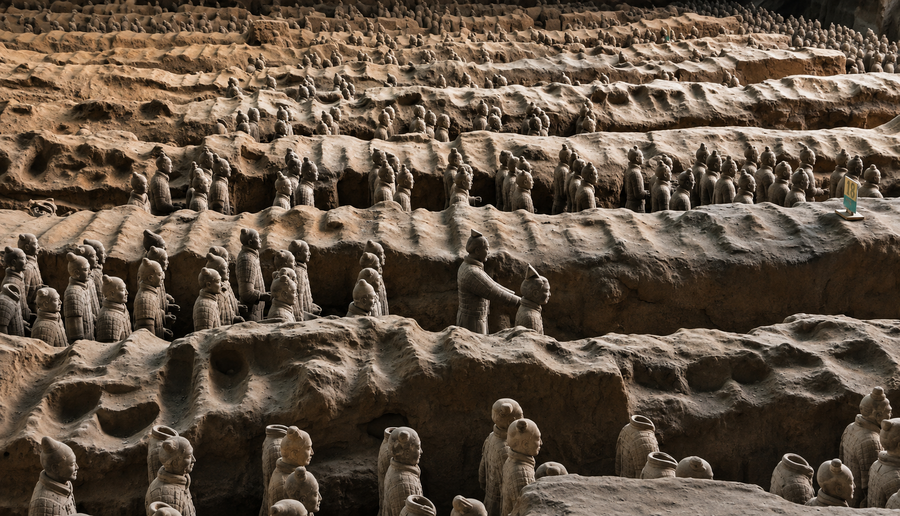
The Terracotta Army received its name from the material used to create its soldiers—terracotta, a type of ceramic that takes on reddish-brown and yellowish-brown hues after firing. The Terracotta Army comprises at least 8,000 soldier statues, 600 horses, and 100 chariots. The exact number of statues cannot be stated because excavations are ongoing. Every soldier was equipped with some form of weaponry. Furthermore, over 40,000 bronze arrowheads have been discovered at the site of the Terracotta Army.
How can 1000 unique individuals unite into the image of a single empire while preserving their individuality?
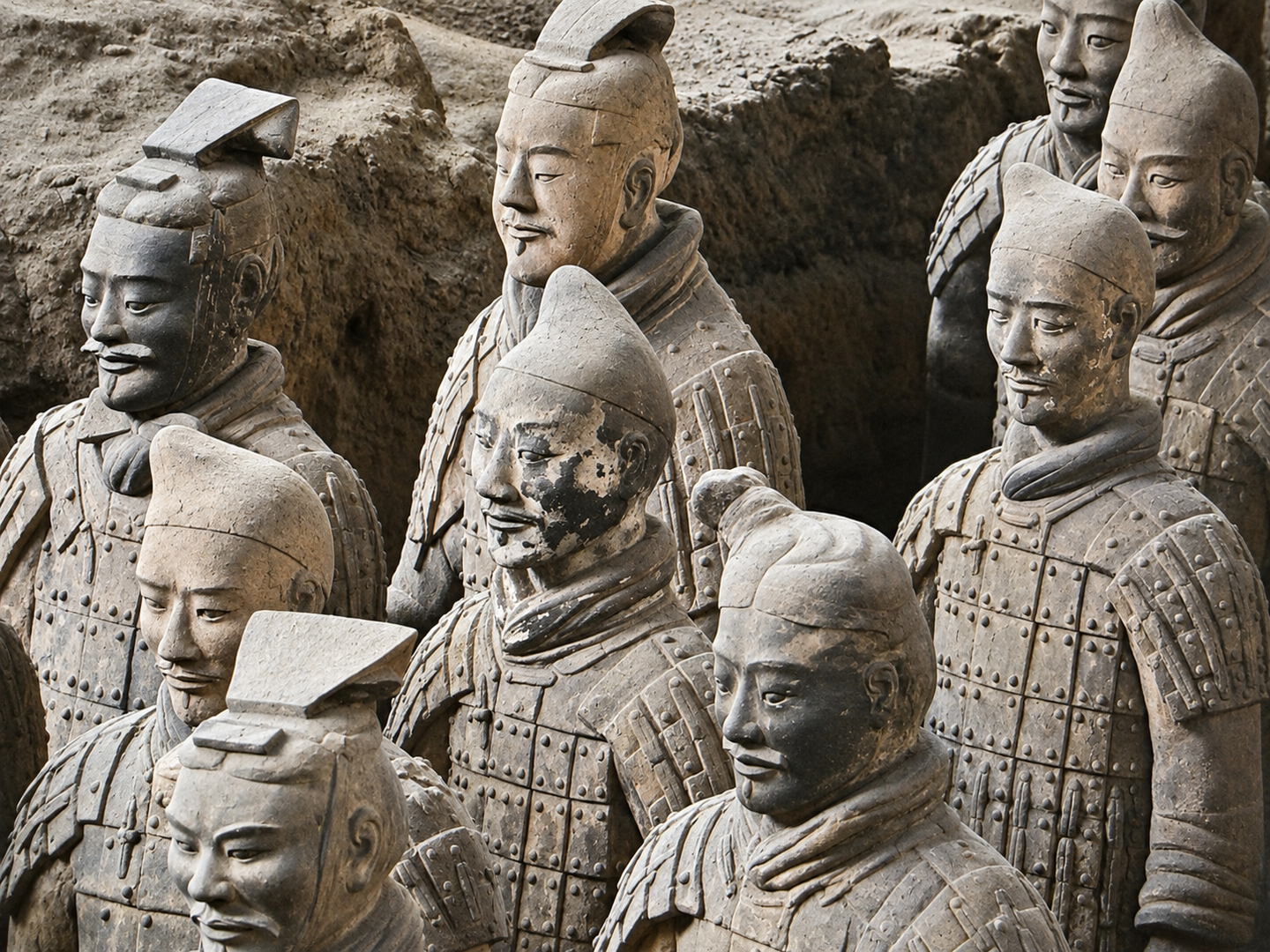
The Terracotta Army exemplifies the craftsmanship of 3rd-century Chinese artisans. Although all the soldiers in the army are based on eight typical models for torsos and heads, after each statue was created, care was taken to give every face unique features.
warrior figures
The statues differ in height, clothing, and hairstyle depending on the soldier’s rank. The height of common infantrymen was generally around 175 centimeters, while officers were taller—up to 2 meters. The troop deployment was also deliberate: light infantry and archers were positioned on the flanks, while heavy infantry and chariots were placed toward the rear.
Terracotta Army
Observing the sculptures, one can notice that the Chinese army of that era was multinational. Clearly distinguishable are the Chinese, Uyghurs, Tibetans, Mongols, and many others. The warriors' attire and hairstyles conform to the traditions of those times. The armor and clothing are rendered in great detail; a semblance of a sole protector is visible on the footwear, and the beards and mustaches are varied among everyone. It is believed that all the warriors were modeled after real people. At the time, they believed that after death, a soldier’s soul could inhabit a clay statue.
Terracotta Army
The terracotta army, in which each warrior was created in the likeness of a real person with their unique facial features and specific attire, was crafted by ordinary potters.
The Terracotta Army
Initially, the task before these masters was to produce building materials; however, they were forced to switch to creating sculptures because there was no separate class of professional sculptors in ancient China. The artisans left specific marks on the figures, which allowed inspectors to determine precisely who had committed a particular flaw. We can only guess what the punishments were—it is possible some workers were even buried alive. This conclusion is supported by burials discovered by archaeologists near the burial mound.
Terra Cotta Army
The warriors stand in three ranks, one behind the other. Their posture suggests that the soldiers are poised to charge into battle. The correct battle formation has been observed: infantry leads, followed by cavalry, and behind them are archers, officers, and commanders. In addition to the warriors, statues of officials, musicians, acrobats, animals, and birds were discovered during the excavation. Each statue possesses unique characteristics that remain discernible even 2,000 years after creation, despite the wear and tear caused by time.
Terracotta Army
Historical sources suggest that around 700,000 artisans were involved in producing the Terracotta Army. Recent research on the terracotta used for the statues has shown that it was manufactured in a single location. The material used in its creation was not raw clay, but rather a mixture produced centrally and then sent to various workshops, where the soldiers were crafted. While it is possible that each workshop used several different recipes, this hypothesis has not yet been confirmed.
To understand the meaning of the army, you must know its creator.
Qin Shi Huang ascended the throne of the Qin kingdom at the age of 13. After leading a series of brutal wars, he united the fragmented Chinese states into a single empire in 221 BCE, an unprecedented feat in history. He standardized writing, currency, units of length and weight, and constructed a network of roads and canals. It was during his reign that the construction of the Great Wall of China began.
Qin Shi Huang
The Emperor was obsessed with the idea of eternal life. Simultaneously, he began the grandiose construction of his afterlife residence—a mausoleum that was meant to be a replica of his empire. The terracotta army was only one part of this magnificent funerary complex. The warriors were called to serve the Emperor in the afterlife.
The Tomb of Emperor Qin Shi Huang: An Unexcavated Secret
The tomb of Qin Shi Huang, located beneath the burial mound, remains unexcavated. This is due to two primary reasons: Technical difficulties. Ancient chronicles (primarily Sima Qian’s Records of the Grand Historian) describe the tomb as being filled with traps (self-firing arrows), and the burial chamber is filled with mercury imitating the empire’s seas and rivers. Modern research has indeed confirmed the abnormally high concentration of mercury vapor in the soil above the tomb.