Concept
Approximately 40,000 years ago, anatomically modern humans, members of the species Homo sapiens sapiens—the Cro-Magnons—emerged in Europe. Concurrently, human cognitive abilities became more complex: people learned to think abstractly, began to connect cause and effect, and started building complex models of the world. This laid the groundwork for the emergence of symbolic imagery, one of which was dance, which manifested widely and multidimensionally in Paleolithic cave paintings.
«The eagle’s eye sees much farther than the human eye, but the human eye notices much more in things than the eagle’s eye, ” says Engels.
In prehistoric cave art, dance is one of the earliest forms of visual expression. It formed part of a ritual or magical act, deeply intertwined with mythology, beliefs, and primitive daily life. The dance depicted on the rock served a specific function: it was intended to conjure the powers of nature, celebrate hunting success or ensure future abundance, assist in initiation rituals, appease spirits, or organize the tribe. Furthermore, these images could function as «visual cues» for the Cro-Magnons—for example, helping them memorize and pass down knowledge regarding social norms, life stages, and mythological narratives. The body movements, gestures, and facial expressions in these scenes carried symbolic meaning. It is important to note that dance in cave art is viewed not only as an autonomously valuable illustration but also as a visual code. Therefore, the symbolic and allegorical nature of the captured poses, bodily motions, the composition of the image itself, and the inherent symbolism of primitive art play a crucial role in the perception, understanding, and analysis of this art.
The key question I pose to myself is: What is the specificity of depicting movement, rhythm, and collective character across different forms of dance in cave paintings?
The topic I chose for this visual study is truly relevant, as examining how dance was captured as a form of cultural practice in the Stone Age influences our understanding of how symbolic forms of communication actually originated and developed. Analyzing such images connects to many contemporary cultural practices. Nowadays, choreographers and creators frequently draw inspiration from primitive imagery, initiating a dialogue between the past and the present and illustrating the evolution of plastic language. I wanted to explore this topic because it genuinely feels rich for analysis, and moreover, the syncretic culture and ritualistic dances appear to be truly fascinating, mysterious, and captivating in my imagination. My research is structured into chapters that allow for the examination of various aspects of this topic from multiple perspectives. The first chapter identifies the types of dance and their characteristics in cave paintings. The second chapter analyzes the plasticity of movement and the anatomy of rhythm within the images. The third chapter is dedicated to the composition and meaning of collective dance. For this study, I selected the most vivid and unique works of art, limited to the Stone Age period but not restricted geographically, allowing for a comprehensive exploration of the subject.
«There are still many unknowns regarding one of the most ancient forms of human self-expression. What is it? Where is it? How old is it? And what was its purpose? The last question is framed in the past tense because, with very rare exceptions, cave painting as a form of human self-expression is no longer practiced. This means it is irreplaceable, ” says the Bradshaw Foundation.
Chapter 1. Diversity of Dance Forms
During the Stone Age, Cro-Magnon people developed a desire not just to act, but also to comprehend the world, record their experiences, and pass them down through generations. At this time, humans were developing abstract thought, which led people to not merely leave traces of their presence but also to try and convey images. They believed that drawings served specific purposes—for instance, influencing hunting success or possessing magical power. Over time, the focus in imagery shifted specifically to the human figure in motion: in daily life, combat, chase, or dance.
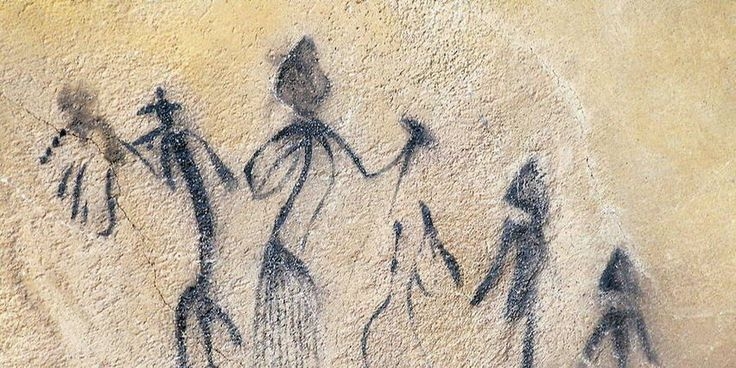
One of the oldest known images of dance in the «Three Brothers» cave, France. Upper Paleolithic; 15,000–11,000 BCE.
Drawing on the analysis of cave paintings, the following types of ancient dances can be distinguished: — Trance/Shamanic Dance (characteristic details: dancers with staffs, poses with bent hips, nasal bleeding) — Hunting Dance (characteristic details: imitation of animal behavior, weapons in hand, therianthropy) — Ritual Dance (characteristic details: objects in hand, bent limbs, figures oriented upward, painted body) — Collective/Group Dance (characteristic details: dancers arranged in a circle or a specific formation, a man in the center and women around him, clapping and singing) — Initiation Dance Ritual (characteristic details: figures are often depicted bent forward, specific and unnatural poses, mass participation) — Festive Dance (characteristic details: a circle of dancers and a musical backdrop, masks and painted bodies, specific poses, decorations) — Fertility Dance Cult Ritual (characteristic details: special attributes, such as digging sticks) — Recreational Dance (chaotic composition, mass participation, wide poses)
Various forms of dance depiction, and the classification of scenes and cultural practices in prehistoric cave paintings, are distinguished by a combination of characteristic features: figure poses, utilized attributes, symbolism, and ritual composition.
Kambge, Dragon Mountains, 1000 BCE. A shaman and a kudu antelope are clearly visible. The theme explores a trance state, spiritual power, and the animalistic nature within humans.
«The dance scene at Namahali is dynamic and appears to involve two distinct groups. The first consists of women leaning forward, which is likely related to the girls' initiation ceremonies,» explains Dr. Joshua Kumbani.
Why do images from our time still only show the initiation of young women?
«We are not sure why it is this way, but perhaps the men intentionally kept their initiations secret, ” notes Kumbani.
Dragon Mountains, South Africa. 3000–1000 BCE. A general scene of an initiation rite. A group of figures with leaning torsos—a typical motif in San painting. In the center of the group is a man, likely a chief or leader, surrounded by his subordinate tribe holding sticks and other attributes.
«Three Brothers» Cave, France. 15,000–11,000 BCE. This is one of the oldest known depictions of dance in cave painting, where it was not yet inextricably linked with magical rituals, therianthropy, or shamanism.
Söderberg. 6000–3000 BCE. Terrianthropes. This image clearly depicts the motifs of hunting, grappling, and conflict. The expression and rhythm are striking.
Dragon Mountains, South Africa. 3000–1000 BCE. Figure of a shaman in a trance. A solitary figure in a dynamic pose, likely adorned with pigments and various materials for a shamanic ritual.
Sierra de San Francisco Mountains, Mexico. Circa 1000 BCE. Hunting ritual dance. Figures of people armed in dynamic poses. The image is divided into two planes—animals, drawn with a red mineral mixture, are overlaid upon the black depiction of the people. This provides a visible contrast and symbolism through the color choice.
Taghert-Akakus, Libya. 6000–4000 BCE. The figures depicted have elongated limbs, which lends the composition a sense of lightness and dynamism; the forward lean of the torsos is generally considered part of an initiation rite. The dancers wear elaborate hairstyles, likely adorned with feathers, as well as ritual pendants and ornaments.
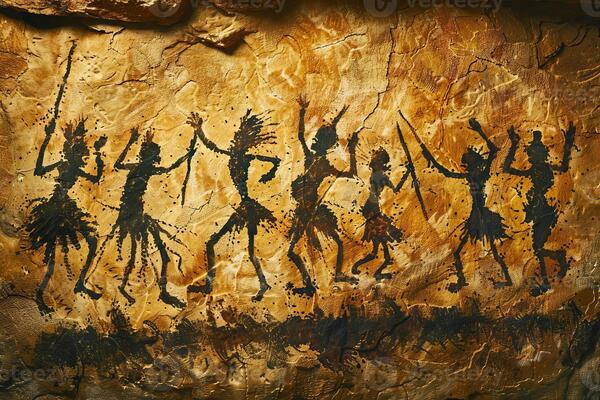
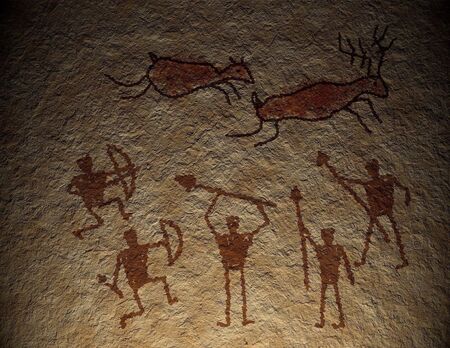
These images are modern, stylized recreations of authentic rock art monuments. Many researchers undertake the recreation of such works to preserve the images for future study. For instance,
the first photograph visualizes a hunting dance, as indicated by the attributes. Perhaps the people were celebrating a successful hunt.
The second photograph depicts a scene of a collective hunt. 10,000–6,000 BCE.
Conclusion: Thus, the analysis of rock art allows us to speak about the diversity of dance forms that existed in the lives of Stone Age humans. The images reflect not only different characteristics and purposes of the dance movements but also their connection to the daily, social, and spiritual life of primitive communities and tribes. Dance could serve as a means of collective interaction, expression of shared emotions, conducting rituals, and being part of hunting and other significant events. Despite the differences in the character and purpose of the dances and the various details of the rituals, they are united by the depiction of humans in motion, often in groups. This allows us to view dance not just as a physical action, but as one of the early forms of non-verbal communication through which humans expressed their views of the surrounding world and their attitude toward it. The main significance of this identified diversity is that cave paintings allow us to see dance as an important part of the multifaceted culture of prehistoric humans, reflecting the features of their worldview, social connections, and spiritual life.
Chapter 2. Movement Dynamics and the Anatomy of Rhythm
In prehistoric cave paintings, various techniques helped convey the plasticity of figures and the rhythm structure—techniques that ancient primitive artists intuitively devised. Among these were hyperbole and overlapping figures: it is not uncommon to see an animal depicted with a number of limbs exceeding the normal and natural amount by two or three times (for instance, a bison in the Chauvet Cave with eight legs). This triggered a perceptual mechanism where the sequence was understood as movement—the eye mentally connected discrete elements, completing the intermediate phases of the run.
Some of these techniques will be demonstrated using works featuring animals, as they manifest themselves more brightly and obviously in these representations.
Octopus bison in the Chauvet Cave in southern France. 28,000–30,000 BCE
Primitive artists often employed diagonal and horizontal lines to establish a dynamic direction of movement. Furthermore, figures were sometimes layered over one another, creating a more tense atmosphere in the work and a sense of a unified flow of energy invested in the image—in hunting scenes, even a feeling of pursuit.