Navigation
- Concept
- Main Body: 2.1. Polyphemus’s Embodiment and Anatomy 2.2. Polyphemus’s Eye 2.3. Polyphemus’s Space and Composition 2.4. Polyphemus’s Interaction with Other Characters
- Conclusion
- Bibliography
- Image Sources
1. Concept
In one of the most contemporary interpretations of ancient myths, Christopher Nolan’s film «Odyssey, ” the figure of the Cyclops Polyphemus is presented quite grotesquely and hyperbolically: his scale, physicality, interaction with the surrounding space, and his relationship with other characters are noticeably distorted. Undoubtedly, this visual choice is largely determined by the vast technical capabilities of modern cinema or the director’s subjective perspective.Nevertheless, I wanted to refer to works of ancient art that depict Polyphemus and compare the original version with later representations of the mythological hero. The study aims to determine how much the visual image of the Cyclops Polyphemus has changed.
Hypothesis: The depiction of Polyphemus has not undergone a substantial transformation; rather, his core characteristics remain intact, with differences between images being attributable only to the technical capabilities and stylistic features of different eras.
In this study, I plan to examine both works related to the Polyphemus and Odysseus narrative and pieces based on the stories of Polyphemus, Galatea, and Acis.
2.1 Embodiment and Anatomy of Polyphemus
In ancient art, Polyphemus’s anatomy often retains the human proportions typical of that era, meaning his physique does not significantly differ from other mythological heroes. One of the most noticeable differences is the character’s scale—he is depicted much larger than the other figures in the scene.
Polyphemus’s Blinding on a Clay Crater, Mid-7th Century BCE
In ancient art, the increasing size of Polyphemus serves as a primary method for visually emphasizing his physical superiority. Furthermore, his anatomy does not necessarily take on overtly monstrous features; the sense of the character’s otherness is largely created through the disproportion between his figure and the surrounding people.
Amphora from Eleusis (Proto-Attic Amphora), c. 650 BCE
The tendency to increase Polyphème’s size relative to other characters persists in later art. However, by the 20th century, this characteristic becomes even more pronounced, which may be related to the artistic trends of that period. Despite this, the original principle of depicting Polyphème as a being exceeding human size remains unchanged.
Nicolas Poussin’s pastoral painting, «Landscape with Polyphemus,» 1649.
Regarding embodiment. In Nolan’s modern film adaptation, it is presented with elements of grotesqueness and deformity, visually distancing him from the conventional image of a physically perfect and powerful hero.
A still from the film «Odeyssey, ” Christopher Nolan, 2026.
The ancient interpretation, in contrast, depicts a more idealized body: the skin shows no discernible flaws, and the musculature emphasizes the hero’s physical strength and power. His physicality is largely based on the classical sculptural canon. His belonging to a world of monsters is conveyed through the very image of the Cyclops and its physical hyperbolization.
Polyphemus’ Blinding, Reconstruction from the Villa of Tiberius in Sperlonga, 1st Century CE.
The depiction of Polyphemus’s hair deserves particular attention. In ancient works, the character is often portrayed with thick, abundant hair, which brings his appearance closer to the canonical representation of a human being. In contrast, however, modern adaptations frequently feature a bald Polyphemus, which enhances the grotesque quality of his appearance and visually emphasizes his difference from humanity.
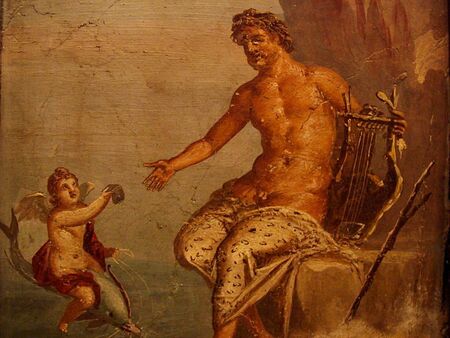
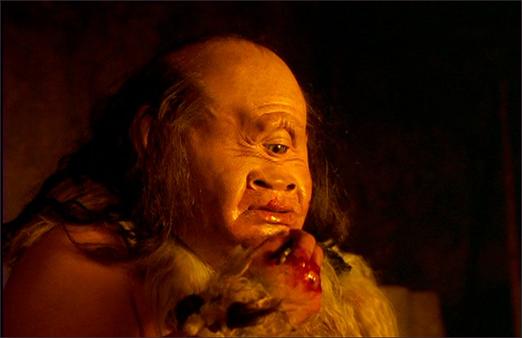
«Polyphemus receives a love letter from Galatea, ” 1st-century AD fresco from Pompeii / scene from the film „The Odyssey,“ Andrei Konchalovsky, 1997.
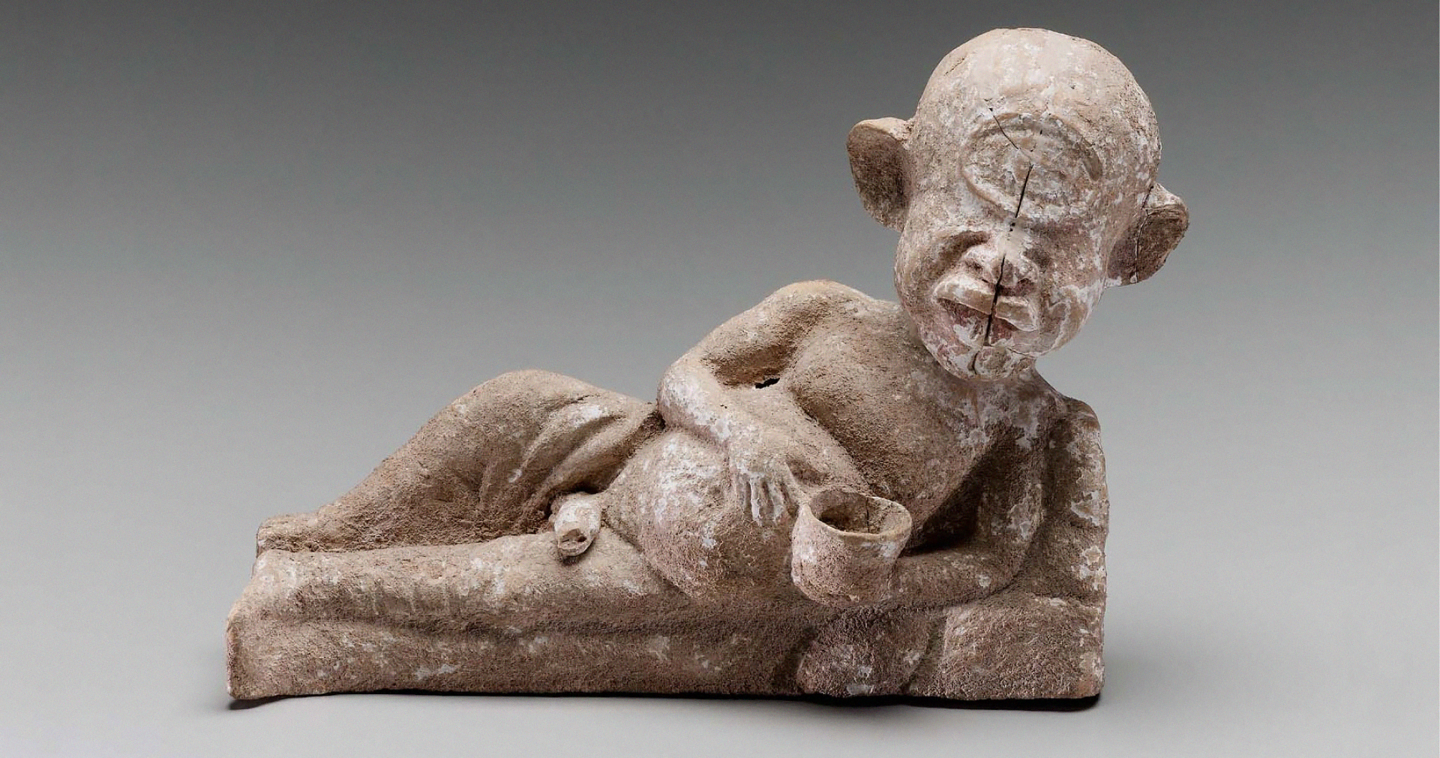
However, it is worth noting that the depiction of Polyphemus with hair was not the sole or universal portrayal; there are also works in which the mythological hero is represented without hair.
Greek terracotta figurine: Polyphemus reclines, holding a drinking bowl. Late 5th — early 4th century BCE.
Similar transformations are also visible in the portrayal of Polyphemus’s face. In ancient art, his features—aside from the characteristic cyclops trait (the eye)—often align with ideals of human beauty: balanced proportions, harmonious features, and expressive cheekbones. In later art, a trend toward the gradual distortion of these features emerges: artists increasingly employ hyperbolization and grotesquery, pushing the character’s appearance to a pronounced degree of ugliness.
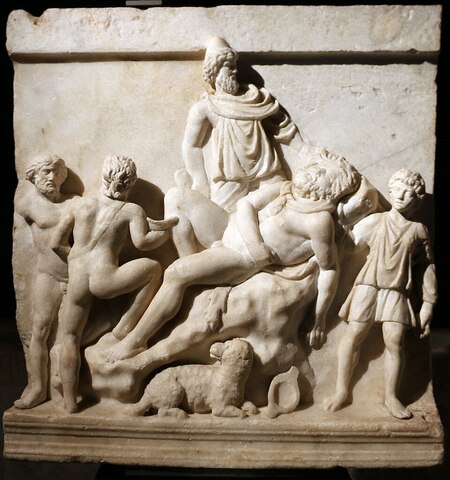
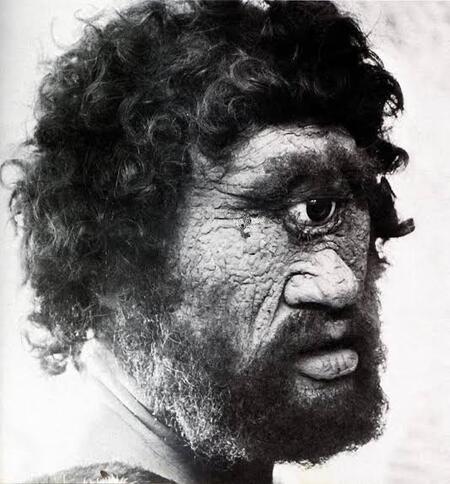
Polyphemus’s Blinding by Odysseus and His Men on a Roman Sarcophagus, 2nd Century CE / Photo from the filming of the movie «Odysseus’s Journeys, ” 1954.
2.2 Polyphemus’s Eye
Let us turn our attention to the most distinctive feature of Polyphemus’s appearance—his eye. In ancient art, the hero is often depicted without any explicit visual emphasis on this feature. In certain formats, Polyphemus is rendered quite flat and in profile, so the presence of a single eye is not immediately obvious solely from the depiction. The viewer can infer the hero’s cyclopean nature from the narrative of the scene and the very action of being blinded by the spear.
Blindness, Black-figure Laconia Cup, 565–560 BCE.
Nevertheless, Ancient art features depictions where Polyphemus’s cyclopean characteristic is quite pronounced: he is shown with a single eye situated in the center of his forehead, while retaining the conventional proportions and classical structure of a human face. In these works, the eye becomes one of the primary visual features distinguishing Polyphemus from the other human characters.
Fresco detail depicting Galatea and Polyphemus. From Boscorekaze. Late 1st century BCE.
Later art displays a trend toward heightened grotesqueness in the depiction of the eye, analogous to the changes in the representation of anatomy and corporeality in Polyphemus. This is particularly noticeable in 20th-century and later works: the eye assumes hypertrophied proportions, may take up a significant portion of the face, or is deliberately rendered distorted. Thus, the cyclopean feature, which initially served as a distinguishing characteristic of the character, gradually becomes one of the primary means of visually expressing his monstrosity.