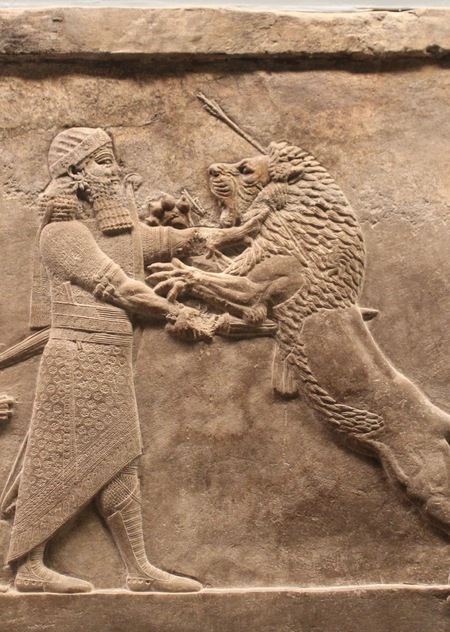
How does relief depict power?
In Ashurbanipal’s hunting reliefs, the movement is distributed among the king, the lions, and the attendants. In the struggle, the rearing lion sets a counter-direction, and in the scene of body transport, the movement shifts to the attendants. By comparing the poses, supports, and directions of gestures, we can trace how the relief transforms a clash into an image of royal victory.
Research Corpus
The focus of the research is gypsum reliefs from the palace of Ashurbanipal in Nineveh. The comparison begins with plate BM 124895, which depicts a servant leading a donkey toward a trap. Subsequently, two registers from the Louvre relief AO 19903 allow for a comparison between the king’s struggle with a lion and the transport of slain animals. These scenes provide three points of observation: preparation, confrontation, and its outcome.
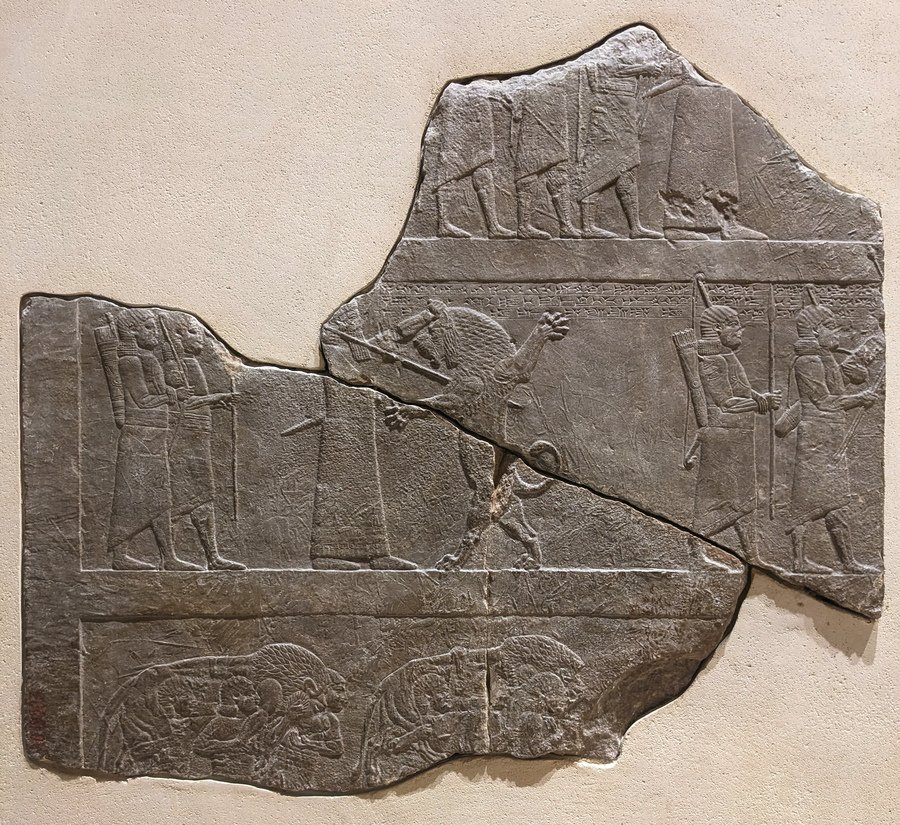
Full view AO 19903
Palace of Ashurbanipal, Nineveh, 7th century BCE. Louvre, AO 19903. Photo Shonagon, CC0 1.0.
Concept. Why the Hunt
The royal hunt provides an opportunity to examine how a political image is constructed through sculptural means. In stone, the action is static, yet the viewer perceives a sequence of efforts through the inclines of the figures, the placement of paws, and the gestures of the people. Our task is to understand which of these characteristics link the drama of the scene to the ruler’s image. To do this, we compare episodes from Ashurbanipal’s palace in Nineveh, distinguishing between the composition of individual scenes, the arrangement of registers, and the proximity of multiple scenes. The figures of the servants are important even in the preparatory episodes. Their gear, baggage, and placement help us understand why we are witnessing an organized action that begins before the king meets the lion.
Concept. How Comparison is Structured
The research progresses from the preparation for the confrontation to its outcome. The overall view shows the relative placement of the figures, while the close-up allows for an examination of the body’s supports, head tilt, and the direction of the gesture. Two fragments of AO 19903 are displayed at different scales. The comparison focuses on the direction and supports of the figures. In the middle register, the king and the raised lion participate in the confrontation. In the lower register, the positioning of the lions' bodies is determined by the actions of the attendants. The comparison on a single plaque allows for a connection between changes in posture and how the animal’s role changes within the depiction. The order in which the fragments are shown follows the research question. Reconstructing the viewer’s movement through the palace would require separately verifying the original arrangement of the plaques. In the images in other chapters, the overall view maintains the context of the detail and allows one to see how a single gesture is integrated into the rhythm of the entire scene.
Concept. Hypothesis and Sources
The hypothesis posits that the impression of royal power arises from the distribution of movement. The tsar’s gesture directs attention toward the clash, the lion’s pose creates a countervailing force, and the servants make the outcome of the hunt visible after the struggle. Verification requires examining whether the royal silhouette maintains stability during the most tense episode and which figures dictate the direction in the final scene. The preparatory episode is compared with British Museum card BM 124895; the two registers of the struggle and the transfer of bodies are compared with Louvre card AO 19903. Museum descriptions define the attribution and content of the scene. Observations regarding tilts, repetition, and intervals pertain to visual analysis. The overall composition preserves the context of each detail, and the caption indicates the source of the photograph. Through comparison, we will investigate how the transition from opposing motion to the rhythm of the servants explains the image of royal victory.
Concept. Boundaries of Inquiry
The selected reliefs date from the 7th century BCE and belong to sculpture. The comparison includes scenes related to Ashurbanipal. The chapter order is determined by three questions: how the relief sets up the confrontation, how the animal’s exertion is depicted, and how the role of the participants shifts in the scene of victory.
I. Before the Encounter
The preparation for the hunt becomes a self-contained scene. Motion here is distributed among people, animals, and equipment. Paul Collins links images of royal hunting in the palace of Ashurbanipal to the assertion of royal power [3, p. 30].
Visual Atlas. Preparation
The wide frame of the preparation allows one to read the scene as a movement of the group. A separate museum card, BM 124895, clarifies one of the episodes in this series: a servant leads a donkey with a trap.
Unknown Assyrian master. Preparation for a hunt. Circa 645–635 BCE. Northern Palace, Nineveh. Room R as described in the photograph. The British Museum. Photo by Zunkir, Wikimedia Commons, CC BY-SA 4.0.
Prep Group Rhythm
Framing the Preparatory Program. Photo by Zunkir, CC BY-SA 4.0.
Compositional Trap
The trap on BM 124895, positioned on the donkey’s back, suggests the participants' intentions [1]. Thanks to this detail, the movement of the servant and the animal is read as part of the hunt even before the lion appears.
People and Cargo
In the preparatory scene, the figures are bound by a common task. The depiction of the cargo allows one to see the work that precedes the regal gesture.
Human and Animal in the Preparatory Scene
The donkey is incorporated into the action via its load, while the handler controls its movement. The connection between the figures allows one to read the organization of the hunt without depicting the struggle itself.
The Object as an Indication of Action
The trap relates to a future event. A specific object transforms the image of a walking group into a scene of hunting preparation.
From Panorama to Individual Tile
The panorama shows the adjacency of figures. The individual tile card allows you to specify the action. These reading scales provide different information about a single ensemble.
Lion’s Release
The cage marks the boundary between preparation and action. Photo by Osama Shukir Muhammed Amin, CC BY-SA 4.0. Plate number not set.
II. Counter-Imagery
In the average register, the ruler AO 19903 strikes with a spear at a rearing lion. Archers are positioned on either side of them [2].
Lion’s Verticality
The beast’s ascent alters the scene’s composition: the elongated silhouette creates a counterpoint to the king’s gesture.
Spear Line
The spear connects two figures and highlights the point of their collision against the surrounding silhouettes.
Spear and Counter Pose
Middle Register AO 19903, photograph of Shonagon, CC0 1.0.
The Tsar in Action
In the middle register of AO 19903, the Tsar’s figure maintains a predominantly vertical axis. The spear is directed toward the rising lion, and the hand gesture links the figures. The positioning of the torso confirms the hypothesis of the Tsar’s stable form in this bas-relief.
III. After the Climax
In lowercase, AO 19903 depicts six servants carrying two dead lions [2]. The repetition of two groups establishes the rhythm of the scene.