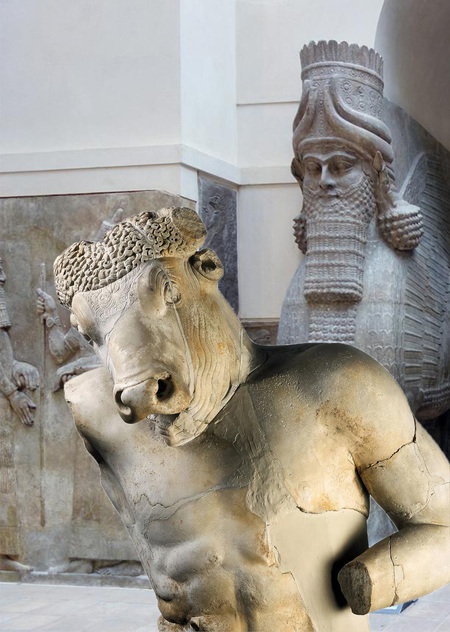
How does the depiction of the human-bull reflect the differences in the religious worldviews and cultural perceptions of the peoples of Mesopotamia and Ancient Greece?
Concept
Why in one culture a human-bull guards the palace entrance, while in another it becomes a creature that must be destroyed?The Shedu and the Minotaur share a common visual principle—the merging of human and animal traits into a single body. However, their cultural significance differs substantially.In Assyrian tradition, the Shedu are monumental mythological beings placed at the entrances of royal palaces. They served a protective function, demarcating the boundary between the outside world and the ruler’s domain.Attach Card In Greek mythology, the Minotaur is the descendant of a woman and a bull, trapped within the labyrinth. His story is intertwined with the disruption of natural order, human sacrifice, and the feat of Theseus. The focus of this research is not the similarity of the two hybrid bodies themselves, but the reasons why a similar visual principle took on different meanings.
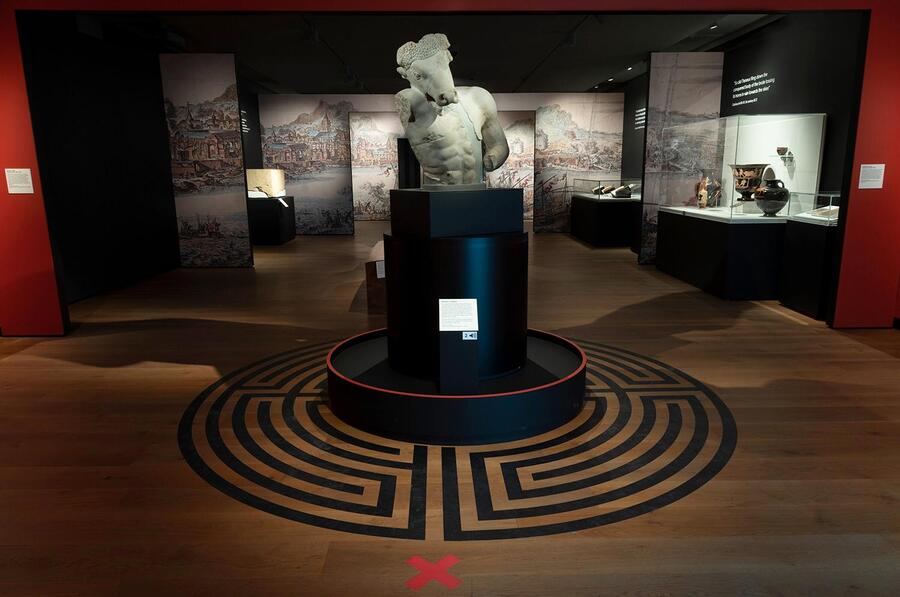
Entrance hall of the exhibition «Labyrinth: Knossos, Myth & Reality» at Ashmolean Museum in Oxford, UK, running from February 10 to July 30, 2023.
HYPOTHESIS
In Mesopotamian tradition, a hybrid creature could embody supernatural protection and power, whereas in Greek mythology, the Minotaur expressed the fear arising at the boundary between human and animal.
Historical Context
Assyria: Monumentality and Royal Power
Entrance area of the Assyrian palace in Nimrud. Reconstruction of the architectural setting for monumental guardian figures.
Bull-gods became widespread in the architecture of the Assyrian state. They are particularly famous for the monumental depictions from the Neo-Assyrian Empire, 9th–7th centuries BCE.
They were placed at the entrances to palaces and temples. Their presence symbolized the need to protect important spaces from malevolent forces.
The sculptures from the palace of Sargon II in Dur-Sharrukin (modern Khorsabad), who ruled from 721–705 BCE, are especially illustrative.
These figures simultaneously served religious and architectural functions: they guarded the entrance and supported the vault structures.
Crit and Ancient Greece: The Myth of the Minotaur
Knossos Palace in Crete. An archaeological complex connected to the setting of the Minotaur myth.
The myth of the Minotaur is linked to Crete and King Minos. According to ancient tradition, Minos received a bull from Poseidon, which he was supposed to sacrifice to the god. However, the animal was kept, after which Poseidon aroused Pasiphae’s passion for the bull.From this union, the Minotaur was born—a creature with a human body and the head of a bull.Minos commissioned Daedalus to build a labyrinth where the monster was imprisoned. Later, the Athenian hero Theseus traveled to Crete and killed the Minotaur.The myth became widely popular in ancient art. Its depictions can be found on vases, reliefs, coins, and mosaics.
The Human Body
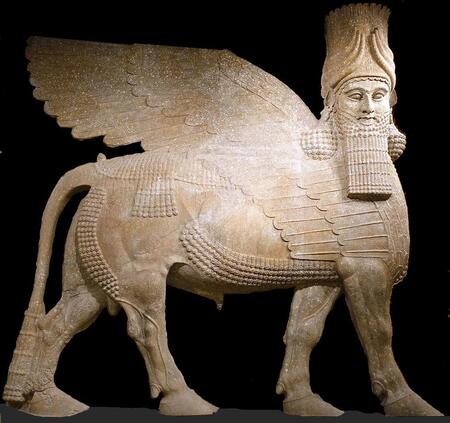
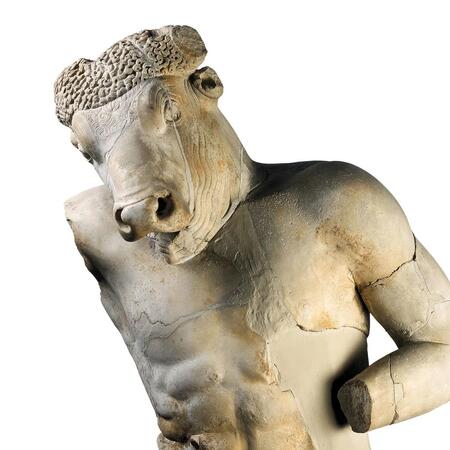
The Bull of Shedu, the Palace of the Assyrian King Sargon II in Dur-Sharrukin (modern Khorsabad, Iraq, c. 713–716 BCE), and the Minotaur Statue in Athens, 5th century BCE.
Two Principles of Merging Human and Animal
The visual design of the Shedu is based on the amalgamation of several creatures. The human form contributes the head and face; the bull provides the massive body, limbs, and hooves; and the bird supplies the wings.
The human head is typically depicted with a meticulously groomed beard and a towering, horned crown. The latter signifies the figure’s divine status.
The Minotaur’s composition is structured differently. Its body is human, but the head belongs entirely to the bull. While the human musculature and body proportions are maintained in the depictions, the animal head determines the character’s recognition.
The distinction lies in the distribution of traits: in the Shedu, a human face is attached to an animal body, whereas in the Minotaur, the human body is subordinated to the animal head.
A distinct detail of Assyrian sculptures is the five legs. When viewed from the front, the figure appears to be standing motionlessly, but when viewed from the side—it appears to be moving forward. This was intentionally incorporated by the sculptors to allow for the figure’s perception from various vantage points.
Function
Shedu — defense against external threats
Winged Bulls from the Palace of Sargon II in Hoshabad. Neo-Assyrian period, 8th century BCE.
The main function of the Shedu was to protect the palace grounds. These figures were placed on both sides of entrances and passages, where they were intended to prevent the entry of evil forces.Their function is confirmed not only by their placement at entrances but also by written sources. Assyrian texts mention the installation of Shedu figures as guardians of doorway openings.Shedu represented supernatural beings that combined the qualities of several animals and humans. In the interpretation of early researchers, the strength of a bull, the mobility of a bird, and human intellect created the image of a creature capable of guarding royal domains.Their presence also underscored the ruler’s status: the palace was under the protection of powerful beings connected to the divine realm.
Minotaur — a threat within the human world
Theseus and the Minotaur. A scene from Greek vase painting of the 6th century BCE.
In Greek mythology, the function of the Minotaur is opposite that of the Shedu. It does not guard human space; rather, it poses a threat to people itself. According to the myth, the Athenians were required to regularly send youths and girls to Crete to serve the Minotaur. This transformed it into a symbol of a threat existing within the political relationship between Athens and Crete. The killing of the Minotaur by Theseus concludes this narrative. The hero frees the Athenians from the obligation of offering human sacrifices. The National Archaeological Museum of Athens views the myth simultaneously as a story about the disruption of the natural order, human sacrifice, and the hero’s triumph over monstrous nature.
Architecture and Space
Shade: The Boundary of Protected Space
Reconstruction of the entrance to Sargon II’s palace at Dur-Sharrukin. Shedu bulls were placed on either side of the passageway.
The Shedu is directly connected to the architecture of the Assyrian palace.
They were situated at transition points from one space to another. The figures symbolized entrances while simultaneously serving as guardians and supporting architectural structures.
Their monumental scale was calibrated for the perception of a person approaching the palace. The entrance became a point of encounter with an image of supernatural power.
The Shedu were not separate from the architecture as independent works of art. Their placement and function were determined by the specific building.
This is a crucial feature of Assyrian art: sculpture became an integral part of the royal space’s architectural hierarchy.
Minotaur: The Labyrinth as a Space of Isolation
Image of the Minotaur and the labyrinth in the tradition of ancient mosaics.