Concept
Rationale for Topic Selection
The depiction of animals is one of the oldest and most enduring motifs in art history. The beast appears in the most ancient rock paintings, and for a long time, it was the animal, rather than humans, that remained the central subject of the imagery. The motif persists through antiquity, the Middle Ages, and the Modern Era. While the form of the motif remains recognizable across millennia, its meaning changes radically. It is this discrepancy between a stable form and a fluid meaning that prompted this research. I was particularly interested not in the history of the drawing itself—how or why people applied an image of an animal to a wall, a vessel, a page, or a pattern—but in what that image was intended to signify.
Principle of Material Selection for Visual Research
The study included 60 images of drawings and reliefs found on cave walls, tools, vessels, coins, wooden tablets, manuscript pages, tiles, dishes, and paneling. The main criterion was the presence of an image of an animal or a fantastical creature (or, in the later sections, an image that substitutes for them: a domestic scene or a floral pattern).
Only authentic artifacts with established attribution from the collections of major museums and libraries were selected (including The Metropolitan Museum of Art, the British Museum, the Louvre, the Archaeological Museum in Berlin, the National Etruscan Museum in Villa Giulia, the National Archaeological Museum of Athens, Trinity College Dublin, the British Library, the Bodleian Library, among others).
Images were sourced from open museum collections and Wikimedia Commons, with sources cited; for Paleolithic caves closed to the public, it is indicated if the photograph shows a museum or scientific replica (such as the Chauvet facsimile or an Altamira replica).
The selection of objects—from tools to paneling—demonstrates that the transformation of the image’s function is not dependent on the technology used. The animal loses its former power regardless of whether it was carved in stone, painted on clay, or struck in silver. This underscores the universality of the visual code.
Research Structuring Principles
The work is structured chronologically and comprises four sections, each corresponding to a specific «function» of the image:I. Paleolithic — the image as an animal spirit (10 images); II. Antiquity, Corinth — drawing as symbol and status, the image as a myth solidified in clay (26 images); III. Middle Ages — drawing as a symbol of faith, the image as allegory (12 images); IV. 17th Century — drawing as ornamentation, the image as decoration or daily life narrative (12 images).The Corinthian section is the most detailed: it begins by describing what Corinth was and how its vase painting originated, then presents a «bestiarium» of Corinthian creatures and mythological scenes. Within each section, the images are also arranged chronologically, allowing the viewer to trace how the image evolves sequentially—how an animal, once endowed with power, gradually transforms into a recurring element of the frieze.
Principle of Selecting and Analyzing Textual Sources
The sources are divided into three groups. The first group consists of ancient texts, which provide myths about the creatures depicted on the vases: Hesiod’s «Theogony, ” Homer’s „Odyssey, ” Apollodorus’s „Bibliotheca Mythologica, ” Pindar’s odes, Herodotus’s and Thucydides’ „Histories, ” and Pliny the Elder’s „Natural History.“ These are necessary to explain the narratives based on primary sources, rather than summaries.
The second group comprises foundational scholarly works: classic catalogs of Corinthian pottery by H. Payne and D. Emix, the studies of J. Boardman and R. Cook, domestic research by V. D. Blavatsky, G. I. Sokolov, A. D. Stolyar, and Z. A. Abramova, M. Pastore’s books on medieval symbolism, S. A. Maslikh’s work on Russian tiles, as well as E. Gombrich’s study on the psychology of ornament. The third group consists of scientific descriptions of the objects themselves found in museum catalogs (attribution, dating, subject matter). The dates in the captions are provided according to the records of the owning museums; where researchers disagree, this is noted. Interpretations (such as the „hunting magic“ of the Paleolithic) are presented as scientific hypotheses, not as established fact. The chronological principle, strictly tied to function, transforms the work from a mere catalog of images into a historical narrative.
The gradual progression within the sections (from early to later artifacts) allows the viewer and reader to physically trace how, for instance, the taut musculature of a Paleolithic bison (action) transitions through the conventional Corinthian panther (status) and the heraldic medieval lion (allegory) to arrive at the flat, stylized figure on the tile (decoration).
Key research question and hypothesis.
How and why has the function of the animal and fantastic creature image changed in artifacts—from the Paleolithic period to the 17th century?
When the core set of images (lion, horse, bird, hybrid creature) is preserved, their function progressively shifts from the magical to the symbolic, then to the allegorical, and finally to the decorative. In other words, the image gradually ceases to be an act (magic), becomes a message (myth, symbol, allegory), and ultimately transforms into ornamentation.
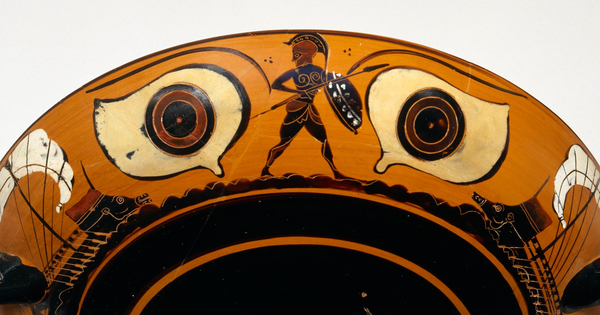
Each subsequent stage does not completely erase the previous one; rather, it «layers» onto it: the fantastic creature on a 17th-century Dutch tile still carries the memory of the Corinthian sphinx and the medieval syrinx, but it asserts nothing new and teaches nothing. Separately, I am examining the hypothesis that it was the Corinthian seriality (the repetition of animal friezes on thousands of vessels) that first demonstrated how an image loses meaning through multiple reproductions.
The hypothesis that new functions do not destroy old ones explains the persistence of the motif. A heraldic lion (a symbol of status) from the 17th century might be incorporated into a purely decorative cartouche (decoration), but it is still subconsciously read as a sign of nobility.
Paleolithic: Drawing as Magic
The image is the spirit of the animal. The earliest depictions are found deep within caves, in complete darkness untouched by daylight; they are often overlaid on one another, suggesting that the act of drawing itself was more significant than the finished «picture.» Scholars offer various explanations for their purpose: as hunting magic (A. Braille), as an organized system of signs (A. Leroi-Gourhan), or as remnants of shamanic rituals (J. Clottes and D. Lewis-Williams). The common thread in all versions is this: the animal here is not a decoration, but a power with which humans attempted to establish a connection. The same imagery is transferred to early tools—a spear-thrower, embellished with an animal, as if it were «charged» with its properties.
Unknown artist (Marlian culture). «Bull Hall»: tours, horses, and reindeer. Lascaux Cave (Dordogne, France). Circa 17,000 years ago. Mineral pigments.
The Lascaux Cave was discovered in 1940 and has been closed to visitors since 1963 to preserve the paintings. The animals are depicted large and in motion; many figures overlap one another. The paintings are located in areas untouched by daylight—they were created by firelight, meaning the viewer would «accidentally» not see them. This is the main argument for the image having a ritualistic, rather than merely decorative, function: the drawing was an action, not just a picture.
Unknown artist (Maldan culture). Horse with signs (the so-called «Chinese Horse»). Lascaux Cave, France. Circa 17,000 years ago.
Next to the horse, geometric signs are visible: branching lines (interpreted either as arrows or as plants) and a grid-like symbol above its back. This is a crucial point for the theme: even in the Paleolithic, the animal imagery connects with an abstract sign. If the signs are arrows, the image might have served as «magic hunting»; if not—we are witnessing the emergence of a visual code where the beast and the symbol exist side by side.
Unknown artist (Aurignacian culture). Horse panel, detail. Grotte Chauvet-Pont d’Arc (Ardèche, France), original dating to approximately 36,000 years ago. Charcoal. Photo of a facsimile copy (Caverne du Pont-d’Arc, discovered in 2015).
The Shove paintings predate the Lasco paintings by nearly twenty thousand years, yet they are equal in mastery. The artist utilized charcoal smudging and flint scratching to convey the volume of the head and the open mouth; according to researcher observations, the composition was thoughtfully designed as a whole. The horses are portrayed as a living, breathing force—precisely the «spirit» of the animal.
Unknown author (Aurignacian culture). Panel of lions: lions chasing bison. Chauvet-Pont-d’Arc Cave, France, original dating to approximately 36,000 years ago. Photo of a facsimile copy.
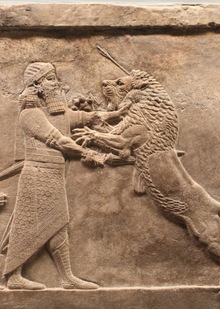
The cave lions are depicted without manes, looking intently forward toward the fleeing bison. Here, the predator represents the most powerful creature in the world of the hunter. It can be hypothesized—and this is merely a hypothesis—that humans portrayed the predator as a model of the strength they wished to emulate. Later, the lion would become one of the most enduring symbols throughout our entire chronology: we will encounter it in Corinth, in bestiaries, and on 17th-century English plates.
Unknown artist (Madrilenian culture). Ceiling with bison. Altamira Cave (Cantabria, Spain), original circa 18,500–14,000 years ago. Photo of a replica in the garden of the National Archaeological Museum, Madrid.
Maria, the daughter of amateur archaeologist Marcelino Sanz de Sautuola, discovered the Altamira paintings in 1879; for a long time, scientists did not believe they were ancient. The bison were painted onto the natural bulges of the ceiling: the artist did not impose the image onto the rock, but rather seemed to «discover» the animal within the rock’s relief and brought it out with paint. The image and the material are unified here—the beast seems to live inside the stone.
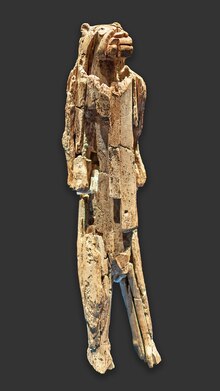

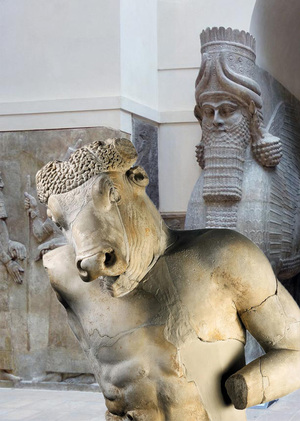
One of the oldest known figures and the first in our selection is a fantastic creature: a human body with a lion’s head. Its fragments were discovered in 1939 and later collected. Such a hybrid does not exist in nature, meaning it depicts something unseen—something imagined—like a spirit, deity, or a human in the guise of an animal. It follows that the «fantastic creature» that is the subject of this work was born as a sacred archetype, not merely as an ornament.
Unknown author (Aurignacian culture). Horse from the Vogelherd Cave. Circa 35,000 years ago. Mammoth ivory. Museum of the University of Tübingen (MUT), Germany.
A figurine only a few centimeters long. It has a curved neck and a tense posture: the master is conveying not the appearance, but the strength and bearing of the horse. The small size suggests the object was portable, but its exact purpose is unknown. What is important is that the depiction of the animal moves from a wall piece to a portable object—the image becomes a tangible thing that one can carry with them.
Unknown artist (Madelung culture). «Floating Reindeer.» Montastruck (Tarn and Garonne, France). Approx. 13,000 years ago. Mammoth tusk. British Museum, London.