Concept
For centuries, gold held a central place in Christian artistic tradition, serving as an integral element in mosaics, icons, and sacred decoration. Its function extended far beyond mere ornamentation, as it was firmly associated with key theological concepts: divine light, eternity, and sanctity. Gold’s ability to reflect light and create radiant surfaces became a powerful tool for artists to visualize the transcendent, otherworldly realm.
The role and application of gold in art have changed over time. In the early Christian and Byzantine periods, the gold background often functioned as an independent compositional element, replacing realistic depictions of space. This created an archetypal, timeless environment within which sacred events unfolded, thereby separating the depicted world from earthly reality.
In later eras, the use of gold became more emphatic and varied. Artists employed it to depict the halos of saints, elements of garments, and architectural details. Despite changes in technique, its deep symbolic connection to the sacred content remained constant, continuing to emphasize the significance of characters and events. The interaction between gold and other colors and materials generates complex visual effects. It can create either a sense of static solemnity or dynamism through the play of light on its surface. The perception of the image changes depending on the lighting and the viewing angle, which lends the work a special expressiveness. Thus, gold functions not merely as a decorative element, but as a complete medium of artistic expression.
The upcoming visual study will be built upon a comparative analysis of Christian artworks from various periods, with a particular focus on the Byzantine tradition. The analysis will concentrate on compositional solutions, techniques for utilizing gold surfaces, and their interaction with the figures. The theoretical foundation will be derived from art historical works concerning the history of Christian art and the symbolism of light, which will allow for the examination of the works within their cultural and religious context.
The main objective is to determine the artistic means by which gold becomes the visual embodiment of divine light, and why this particular material acquired such fundamental significance in religious painting. It is hypothesized that its unique expressiveness stems from the combination of symbolic meaning and physical properties: by reflecting actual light, gold creates an artistic representation of it, linking the material surface of the work to the concept of the divine and the eternal.
Chapter 1: Gold as a Medium
Mausoleum of Galla Placidia, Ravenna, Italy, 425–450 AD
Gold holds a special place in Christian art owing to its properties. It is malleable, resistant to corrosion, and possesses a characteristic luster. In early Christian and Byzantine mosaic, these qualities allowed gold to be transformed into an artistic medium.
Why gold?
This precious metal is easily worked: it can be rolled into thin sheets to create gold leaf. Unlike yellow paint, a gold surface shines and reflects incident light because its appearance always depends on the light and the angle from which it is viewed. Furthermore, gold is resistant to rusting, meaning it does not require constant reapplication.
Byzantine mosaic tessera, Metropolitan Museum of Art, New York, 6th century.
In Byzantine mosaics, gold was used not as massive elements made of solid metal, but as the finest foil, covered on both sides with glass. This allowed for the metal to be protected while preserving its reflective properties.
Byzantine mosaic medallion, Baptistery of San Giovanni in Monte, Naples, Italy, 362–408 AD
How is a tesseract structured?
- The bottom layer of glass—the element’s base.
- The thinnest layer of gold foil—the reflective layer.
- The top clear layer of glass—protecting the foil and enhancing the golden light.
This device allowed gold to be used in mosaics across large areas, creating patterns and various details without exposing the metallic layer to the environment.
Byzantine mosaic tessera, Metropolitan Museum of Art, New York, 6th–15th centuries.
Fragment of Byzantine gold mosaic, Ravenna, Italy, 6th century.
The tesserae were laid at an angle to one another, resulting in a surface that was not perfectly smooth. The varied direction of the glass elements created an uneven reflection of light, giving the mosaic a beautiful, shimmering effect when illuminated.
Interior of the Mausoleum of Gallus Placidia, Ravenna, Italy, 5th century, second quarter.
The Mausoleum of Galla Placidia is one of the earliest surviving examples of Christian mosaic art in Ravenna. Its interior is almost entirely covered in mosaic compositions. The distinctiveness of this monument lies in the contrast between the restrained brick architecture and the rich mosaic decoration of the mausoleum.
Mosaic vault of the Mausoleum of Galla Placidia, Ravenna, Italy, second quarter of the 5th century.
At the center of the vault is a golden cross, encircled by golden stars against a deep blue background. The metallic elements are interwoven into a complex color composition and do not exist as a separate part. Gold is distributed across the entire blue background, creating a noble combination of colors and shades.
Fragment of the mosaic from the vault of the Mausoleum of Gallus Placidia, Ravenna, Italy, second quarter, 5th century.
Upon closer inspection, the image reveals itself to be constructed from numerous glass elements—tesserae. The golden tesserae differ from the blue ones not only in color but also in their characteristic way of reflecting light.
«Good Shepherd.» Lunette mosaic of the Mausoleum of Gallus Placidius, Ravenna, Italy, second quarter of the 5th century.
In this mosaic, gold does not fill the entire space; instead, it is expressed in the halo, the cross, and the shepherd’s garments. Furthermore, the gold here is combined with the mosaic’s green, brown, and blue tones. Here, one can observe a different principle of material use. The gold becomes one element within a multicolored composition, rather than a mere accent.
Interior of the Basilica of San Vitale, Ravenna, Italy, 6th century.
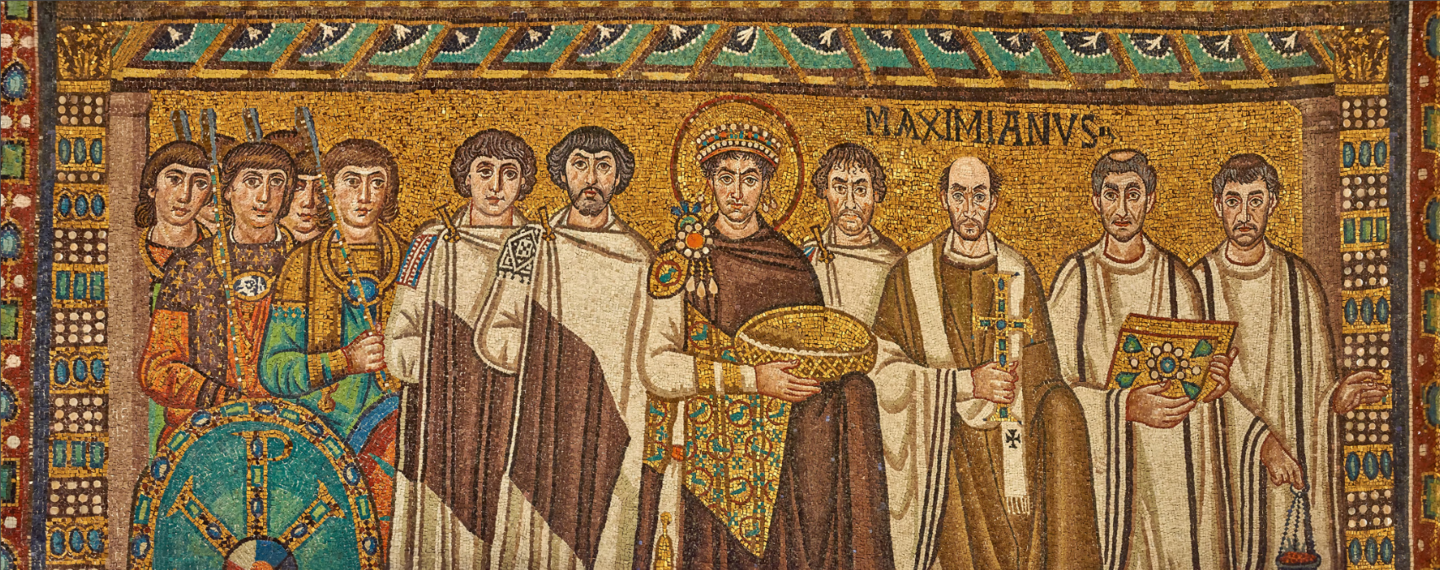
In the 6th century, mosaic gained widespread application in the monumental decoration of Christian churches. The Basilica of San Vitale demonstrates the large-scale use of mosaic on the surfaces of the church, where gold interacts with the architecture and compositions within the structure. Unlike the small mausoleum of Galla Placidia, here the mosaic occupies a significant space.
«Emperor Justinian with his entourage.» Mosaic of the apse of the Basilica of San Vitale, Ravenna, Italy, circa 547.