Rationale for Topic Selection
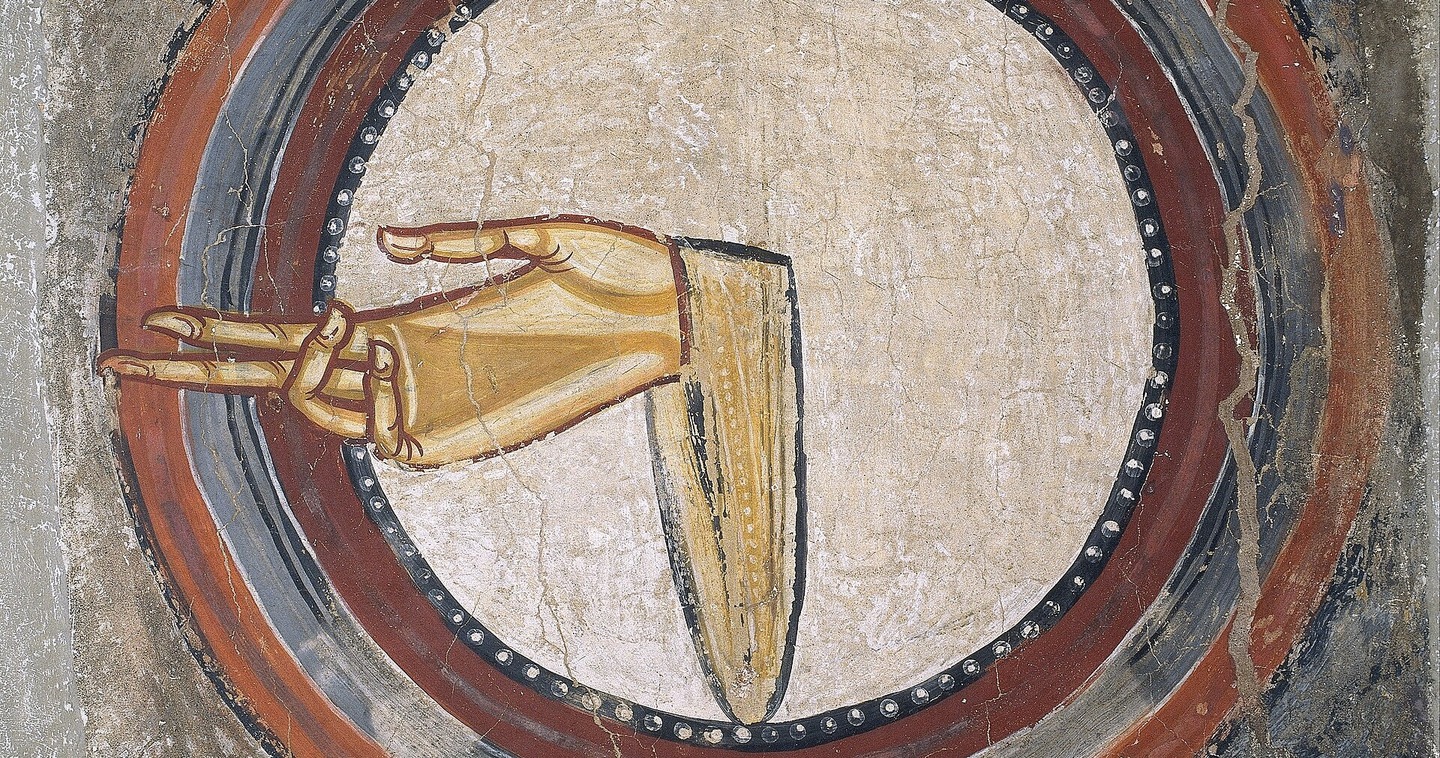
In medieval art, there is a character present in nearly every narrative of the Holy story—God the Father—yet for a long time, artists hesitated to depict Him fully. The Old Testament prohibition against depicting God, along with the Gospel formula, «No one has ever seen God» (John 1:18), presented artists with what seemed like an insurmountable challenge: how to depict the actions of the Unseen One?One of the most persistent answers to this question became the hand appearing from a cloud or from the edge of the image—the Dextera Domini, or «the Lord’s right hand.» This motif is usually perceived as a minor iconographic detail, but it is in this motif, I believe, that the medieval art most vividly reflects how it negotiated the very idea of the invisible God. Therefore, I focused on a single motif and traced its evolution over ten centuries—from the synagogues of the 3rd century to the mosaics of the 13th century.
Material Selection Principle
The study includes only works created before the 14th century in which the hand of God is depicted as an independent symbol, replacing the figure of the Father God. I selected artifacts from various techniques—fresco, mosaic, carved bone, illuminated manuscript, coin, jewelry, embroidery, and sculpture—and from different regions (Syria, Rome and Ravenna, Byzantine Empire, Carolingian and Ottonian Empires, Anglo-Saxon England, Spain) to demonstrate that the motif served as a common language across the entire Christian (and partially Jewish) world, rather than being a feature unique to a single school. A general view of each artifact is provided, along with a detail showing the hand where relevant.
The Principle of Rubrication
The research is structured both chronologically and functionally, analyzing the role the hand plays in the imagery. Section I traces the origins of the motif in Late Antique art. Section II examines the hand as a sign of divine manifestation in early Christian mosaics. Section III focuses on the hand crowning the emperor and sanctioning his authority. Section IV explores the hand in Romanesque and Middle Byzantine churches, where it becomes a symbol of God’s presence within space. Section V demonstrates how, in the 12th–13th centuries, the hand gradually gives way to the full figure of the Creator.
Principle of Selecting Textual Sources
The foundation consists of works on the origins of Christian iconography (A. Grabar), a report on the excavations of the synagogue in Dura-Europos (K. Krelling), summarizing studies on Byzantine (V.N. Lazarev) and Western European medieval painting (C.R. Dowdell), a study on the relationship between image and power (E. Kantorovich), and a paper on the theology of the icon (L.A. Uspensky).
Key Question
How did a medieval artist depict the invisible God’s action without violating the prohibition on His image?
Hypothesis
God’s hand was a visual compromise. It allowed for the depiction of the presence and will of the Father God without portraying His physical form. Throughout the 3rd to 13th centuries, the meaning of this symbol evolved: initially, it signified the Incarnation; subsequently, it became a mark of divine election of a ruler, and during the Romanesque period, it represented God Himself within the church space. Once the image of the Creator in the form of Christ-Logos became established in the 12th–13th centuries, the need for compromise disappeared, and the hand gradually gave way to the complete figure.
SECTIONS
I. Hand Instead of Face (3rd — Early 5th Century) II. Voice from the Cloud (6th — 9th Century) III. Right Hand Above the Throne (9th — 11th Century) IV. Sign in the Vault (11th — 12th Century) V. From Hand to Visage (12th — 13th Century) Conclusion Bibliography Image Sources
Part I. Hand Instead of Face
III — Early V Century
The motif of a hand reaching down from the sky predates Christian art. Its first stable examples appear in the 3rd-century synagogue frescoes, where the prohibition against depicting God was strictly observed. Even here, the hand serves the same function it would preserve for a thousand years: it shows that God is acting, but it does not depict God’s appearance. Around 400 years, the motif transitions into Christian art.
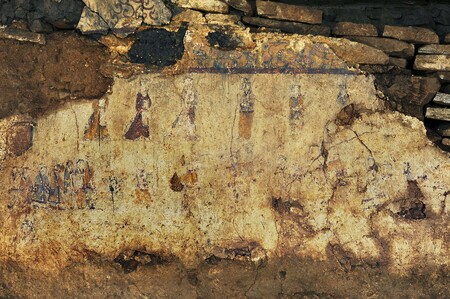
Fig. 1. Western wall of a synagogue in Dura-Europos during excavations. Syria, c. 244–256. Fresco. Now in the National Museum, Damascus.
The synagogue in the border fortress of Dura-Europos is a rare monument of Jewish monumental painting. God is never shown whole in the numerous biblical scenes; His presence is indicated by hands appearing from above. It is here that this motif first forms a stable system.
Fig. 2. Niche for Torah scrolls. Above the niche is the Sacrifice of Isaac. Synagogue in Dura-Europos, c. 244–256
In the scene of Isaac’s sacrifice, a hand is depicted above the altar, marking the place of the biblical «voice from heaven» that halted Abraham (Genesis 22:11–12). A word that cannot be drawn transforms into a gesture. This schema then transitions without change into Christian art.
Fig. 3. The Exodus and Crossing of the Red Sea (Fragment). Synagogue in Dura-Europos, c. 244–256. Fresco. National Museum, Damascus
Above Moses, who is parting the waters, are two immense hands. This is a literal visualization of the biblical formula stating that God brought the Israelites out of Egypt «with a strong hand and outstretched arm» (Deut 4:34). God’s power is conveyed through the scale of the hands, rather than through the figures themselves.
Fig. 4. Exodus and the crossing of the Red Sea, detail: the hand of God over the Israelite army. Synagogue in Dura-Europos, c. 244–256. Fresco. National Museum, Damascus
The hand emerges from the upper edge of the composition, as if from another space inaccessible to the viewer, and stretches over the marching crowd. The edge of the image becomes the boundary between the earthly and the celestial—this technique would be used all the way through the 13th century.
Fig. 5. Women at the Tomb and the Ascension of Christ («Raeder Plaque»). Rome or Milan, circa 400. Ivory. Bavarian National Museum, Munich
One of the earliest Christian depictions of the Ascension. Christ is not floating; rather, he is literally ascending a mountain slope, and God’s hand from the cloud takes hold of his wrist and pulls him into the heavens. The unseen Father «assists» the visible Son.
Fig. 6. «Ryder’s Panel,» detail: the hand of God takes Christ
The detail shows how embodied the gesture is here: it is not a symbolic sign, but an actual handshake. Later, in Carolingian manuscripts, this motif will be revived almost unchanged.
Interim Summary