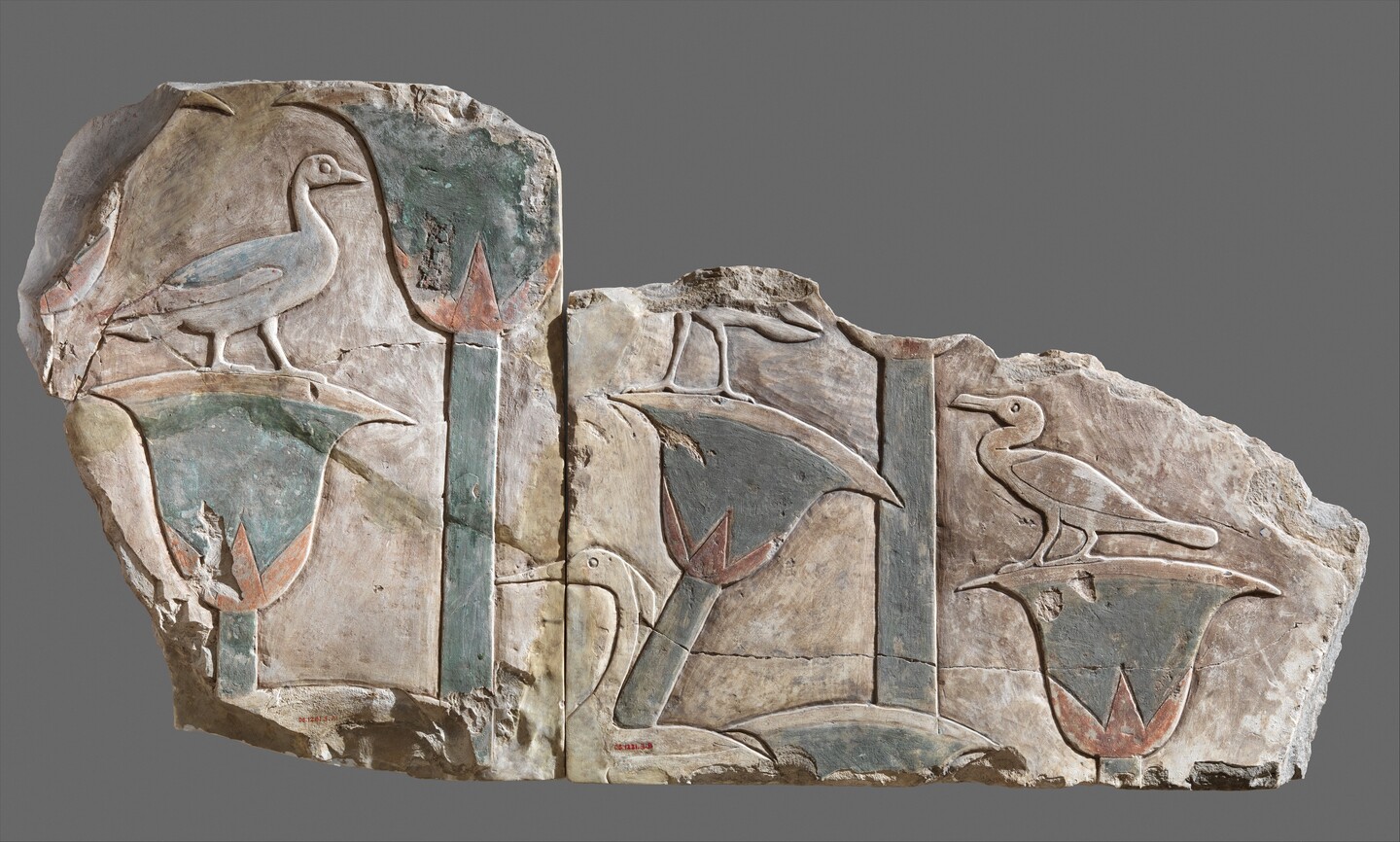
Животные в рельефах Египта
Как повтор и различия создают движение на камне
In ancient Egyptian relief, a herd might appear as a series of similar lines. However, if you look closely at the image, distinct steps, turning heads, empty spaces, and overlapping bodies become visible. I wanted to explore how a sense of movement is built from these simple variations. Comparing birds, fish, and large animals allows one to see not only what is repetitive but also where that repetition is disrupted. The topic choice is rooted in this idea: the same material can generate several ways to construct rhythm on the stone surface.
The main research question is: how does the repetition of silhouettes and deviations from them help depict animals and their movement in ancient Egyptian relief? I hypothesize that repetition provides direction and unity to the group, while slight changes in pose help distinguish the figures from one another. However, movement does not always arise from repetition. A solitary bird or a confrontation between two animals can generate tension through diagonals, body curvature, and the relationship to surrounding lines. These cases are necessary to test the boundary of the initial hypothesis.
I selected reliefs and individual preserved blocks from Egypt, spanning from the Old Kingdom through the Late Period. These are primarily stone images from tombs and temples, rather than applied art pieces. The selection includes depictions of herds, birds in papyrus, fish, and isolated animal figures. Some blocks are only partially preserved. While they can be compared based on visible forms, it is impossible to confidently reconstruct an entire lost wall or assert that every fragment was conceived as an independent panel.
For analysis, the direction of movement, the positioning of feet and heads, the overlap of contours, spacing, and image boundaries are important. I use the term «register» for a horizontal band of an image separated from adjacent bands. Registers help to stack multiple groups one above the other. This arrangement is not always meant to be understood as literal height in real space. Relief conveys depth and sequence figuratively, and this must be taken into account when making comparisons. [1, 2]
The five sections are organized by a visible characteristic rather than by a chronological history of all Egyptian dynasties. First, the movement of the herd is examined, followed by the individual animal and the person beside it. After that, birds, scenes of water, and the interactions of different creatures are compared. The final part explores how the remaining portion of the relief constrains our conclusions. While various images can be viewed side-by-side, differences in their function, context, and time do not automatically allow us to consider one a direct evolution of the other.
For the selection process, I utilized museum catalogs: they allow me to verify the title, material, approximate date, and provenance of the photographs. The texts from the Metropolitan Museum of Art and the Cleveland Museum help clarify the narrative and the condition of the blocks. [3, 4, 5] Dorothea Arnold’s book on animals in Egyptian art provides context for the depictions of birds and marsh vegetation. [1] Whitney Davis’s research helps in understanding the arrangement of registers. [2] These sources do not replace direct observation: the direction of the legs is visible in the photograph, but the animal’s spirit or the intention of the unknown artisan cannot be discerned from a contour alone.
ContentsHerd and Collective Movement Human Presence Birds Among the Lines Water and Counter-Movement What the Stone Retains Conclusion
Herd and Gait
In reliefs featuring animals, the horizontal surface often arranges individual figures into a sequence. We will compare extended rows and scenes where various creatures are depicted side-by-side.
Master not attributed. «Herd of Hufu.» Circa 2551–2528 BCE. Limestone. The Metropolitan Museum of Art, New York.
Long backs and horns repeat along the narrow stone. The figures are positioned closely, yet their outlines do not merge into a single mass; individual legs and heads retain their sense of movement.
Master is not set. «People Leading Wild Animals.» Circa 2311–2281 BCE. Limestone. Cleveland Museum of Art.
On the Cleveland relief, elongated bodies and large horns once again establish a horizontal rhythm. Comparison with the Hufoo herd reveals a difference: here the silhouettes are more distinctly separated, and people enter the sequence alongside the animals.
Master not set. «Man with Calf and Dog.» Old Kingdom, circa 2400 BCE. Limestone, traces of paint. Walters Art Museum, Baltimore.
Here, the rhythm is not constructed from a herd. A person is leaning toward a calf, and a dog is positioned nearby. The difference in scale and the placement of the bodies makes the group uneven. This is the first instance where the relationship between neighboring figures is more important than repetition.
Master unknown. «Goat.» Circa 2551–2528 BCE. Limestone. The Metropolitan Museum of Art, New York.
On the preserved section, we can distinguish the profile of an animal. Its body is oriented parallel to the stone, while the head and horns create a more complex silhouette. The isolated fragment does not allow us to determine what the entire original group looked like.
Repetition does not imply exact duplication. While the outlines in one group might align in direction, they can vary in the head’s turn or the degree of overlap. Therefore, it is important to compare not only the number of animals but also the distances between them.
The Person Beside You
Now, the focus shifts to smaller groups. Humans and animals can set a common rhythm through inclination, distance, and contrast in size.
Master not installed. «Man and Animal in the Reeds.» Circa 2600 BCE. Limestone, colored paste. State Museum of Egyptian Art, Munich.
Fragments from the tombs of Nefermaat and Itet preserve a figure alongside curved lines representing plants and animals. Here, movement is conveyed through the collision of lines, rather than through uniform stride. A significant portion of the scene is lost.
First image: Master not installed. «Scene with Cattle.» Circa 2323–2150 BCE. Limestone, paint. The Metropolitan Museum of Art, New York.
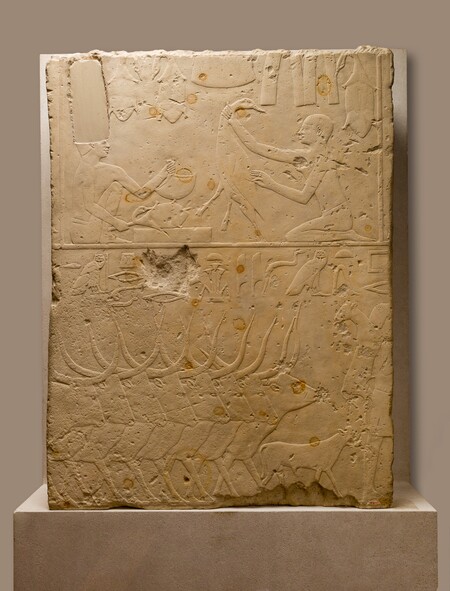
Мастер не установлен. «Птицы и стадо, переходящее воду». Около 1962–1952 годов до н. э. Известняк. Метрополитен-музей, Нью-Йорк.
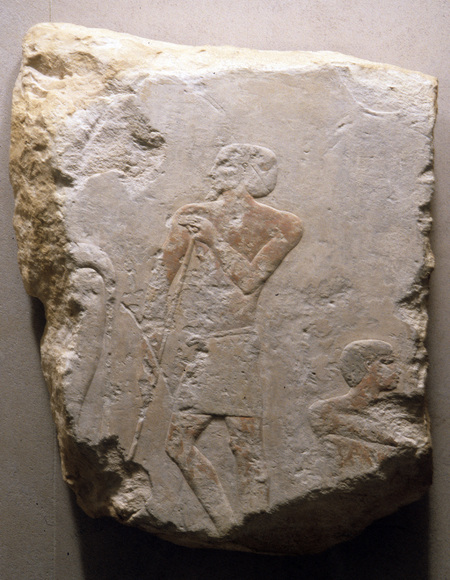
The surface is not entirely preserved: the human figure is more visible than the animal. This limitation is crucial for the research. From this remnant, one cannot confidently reconstruct the rhythm of the entire herd; one can only compare the preserved contour with more complete blocks.
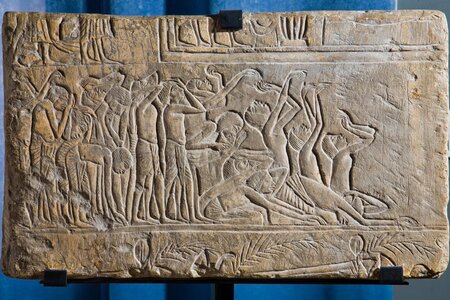
The block connects two horizontal registers. The upper register is related to poultry preparation, and the lower register is related to a school in the water. The boundary between the strips allows the simultaneous perception of actions while maintaining order within the dense surface. [3]
If only one fragment remains from a series, the rhythm of the whole cannot be proven using the conventional scheme. The damage to the stone becomes part of the contemporary perception and limits comparison with a fully preserved block.
Horizontal stripes help separate actions. However, this does not necessarily mean the animals were stacked one above the other in a real scene. It is a way to organize the surface, not a map of space.