Живопись и скульптура Древнего Египта: ключевые особенности древнеегипетского стиля
Правила древнеегипетского изобразительного искусства
Concept
Chapter 1. Abandoning Linear Perspective
Chapter 2. Composite View or Combination of Views from Different Angles (Paintings and Reliefs)
Chapter 3. Canon of Human Image Proportions
Chapter 4. The Rule of Figure Scale Variation Reflecting Social Hierarchy
Chapter 5. Method of Standards and Signs
Chapter 6. Color Symbolism
Conclusion
Sources
Concept
The influence of ancient Egyptian art is traceable in the modern Art Deco style, which borrows extensively from Egyptian geometric patterns, lotus motifs, and the use of gold and lapis lazuli colors. What is the secret to its appeal for so many contemporary people? Why do works of ancient Egyptian art differ so greatly from those of other cultures? In this project, I explore the fascinating world of ancient Egyptian painting and sculpture, the symbolism of the imagery, and, of course, the rules by which the artworks were created.
To truly appreciate Ancient Egyptian art, one must understand the principles guiding its creation and become familiar with the religious worldview of the ancient Egyptians.
Even in the Old Kingdom, a rigid monumental style developed within Egyptian art culture. This style relied on a system of strict artistic rules that remained unchanged for many centuries. The creativity of ancient Egyptians was inseparable from sacred rituals and beliefs: their works were not created for aesthetic enjoyment, but to fulfill ceremonial functions. The Egyptian pantheon included numerous deities whose roots stretched back to deep antiquity—to primitive animism and totemism. Because many gods possessed zoomorphic traits, animal imagery played a key role in local culture and often formed the basis for paintings and sculptures. Animals were revered as sacred beings, evidenced by the tombs of cats, dogs, bulls, and even crocodiles discovered by archaeologists. Nevertheless, the worship of the sun held a central place in the religious system and artistic iconography. In ancient Egyptian society, art was granted a special, sacred significance. Closely tied to religion, and particularly to burial traditions, it served as a guide to eternity and was viewed as a means of extending fleeting earthly existence into the afterlife.
Art held an unusually vital role in Ancient Egypt. Serving the needs of religion—and primarily funerary cults—art was perceived as a vessel of eternal life, a continuation of brief earthly existence.
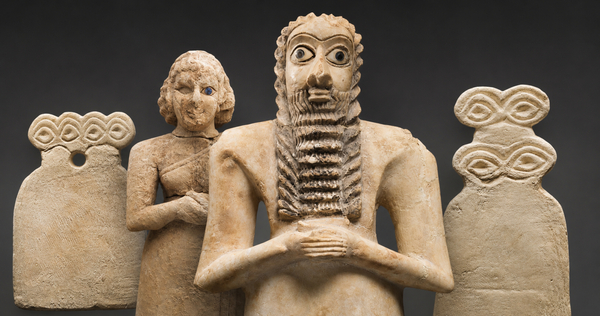
The foundation of the religious cult in Ancient Egypt was the belief that for the deceased’s happy afterlife, they needed to be equipped with everything they possessed on Earth, even their own body. The body of the deceased ruler was mummified, and the tomb, beyond immense treasures, was adorned with frescoes and reliefs narrating his earthly life; ushabti statues served as servants for the departed. According to the Ancient Egyptian beliefs, the deceased’s portrait statue, and sometimes more than one, was also placed in the tomb, and it had to be as accurate as possible so that the Ka—the vital life force, the human double while alive—could find him after death. Thus, it was precisely art that ensured the deceased’s post-mortem well-being.
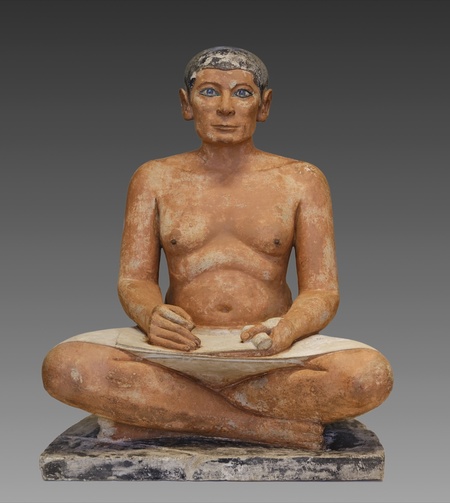
Seated Scribe (Louvre), Saqqara, 25th — 1st Dynasty, c. 2400 BCE.
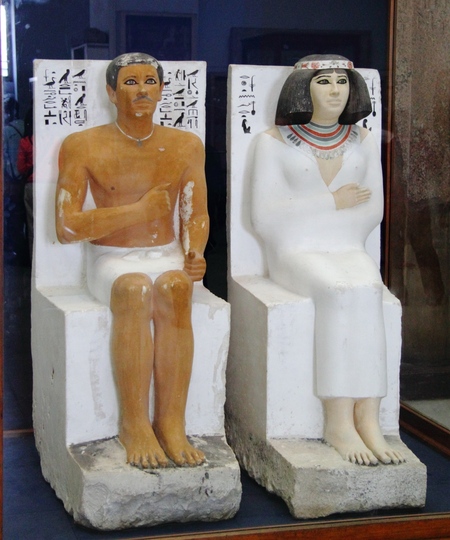
Statues of Prince Rahotep and Neferet. 27th century BCE. Old Kingdom. Cairo Museum.
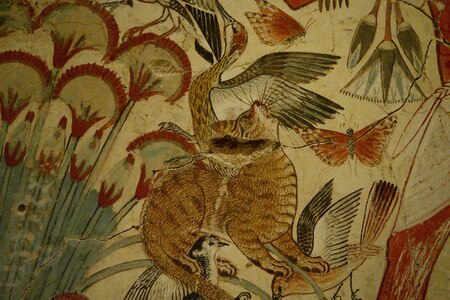
For three millennia, the artistic culture of the Nile Valley developed within stringent traditions. Formed at the dawn of civilization, this artistic code remained unwavering for centuries. While execution techniques and stylistic nuances evolved, the principles of depicting the human figure were not revised. At the same time, these restrictions did not apply to ordinary fauna—birds and animals without sacred status—which granted artists freedom of self-expression. The frescoes from the tomb of Khnumhotep I in Beni Hasan serve as a vivid example of this vitality and color richness. Overall, however, the ancient Egyptian system of conventions strictly regulated everything: from the selection of scenes to the proportions of the bodies, the color palette, the positioning of hands, and the stillness of the characters' poses.
Chapter 1. Abandoning Linear Perspective
Egyptian art developed a series of techniques that increased the informational density of an image. Emma Brunner-Traut [Lexikon, 1975; Brunner-Traut, 1990] developed a theory suggesting that the ancient Egyptians utilized not perspective, but aspect. The term «aspect» derives from the word «aspect.» Through this concept, E. Brunner-Traut wished to emphasize that the ancient Egyptian master sought to convey on the flat surface of the painting not a subjective perception, but the most objective and complete representation of the depicted event. The painting conveyed the main aspects of what was shown—details that allowed for a correct judgment of it. The aspectual approach required ancient artists to develop a range of conventional techniques that gave ancient Egyptian painting a profound uniqueness—techniques that were quite logical for gathering the necessary aspects and thus for achieving a complete representation of the subject.
Boris Viktorovich Raushenbach (Academician, Physicist, and Art Historian) studied the painting and relief of Ancient Egypt, believing that Egyptian artists did not use linear perspective from the New Age not due to «inability,» but because they were solving a different artistic and philosophical problem—conveying the essence of objects rather than a random optical view from a single point of view. Any object can be depicted as both an illustration and a technical drawing.
Professor Rauschenberg observed a similarity between an ancient Egyptian drawing and a technical blueprint. He termed this «artistic drafting.»
It turns out that ancient Egyptian artists and modern engineers were tackling the same challenges in visualizing the geometry of objective space on a flat surface. However, the methods used by the ancient Egyptians do not align with Renaissance perspective theory, which is why their illustrations appear strange and unfamiliar to us.
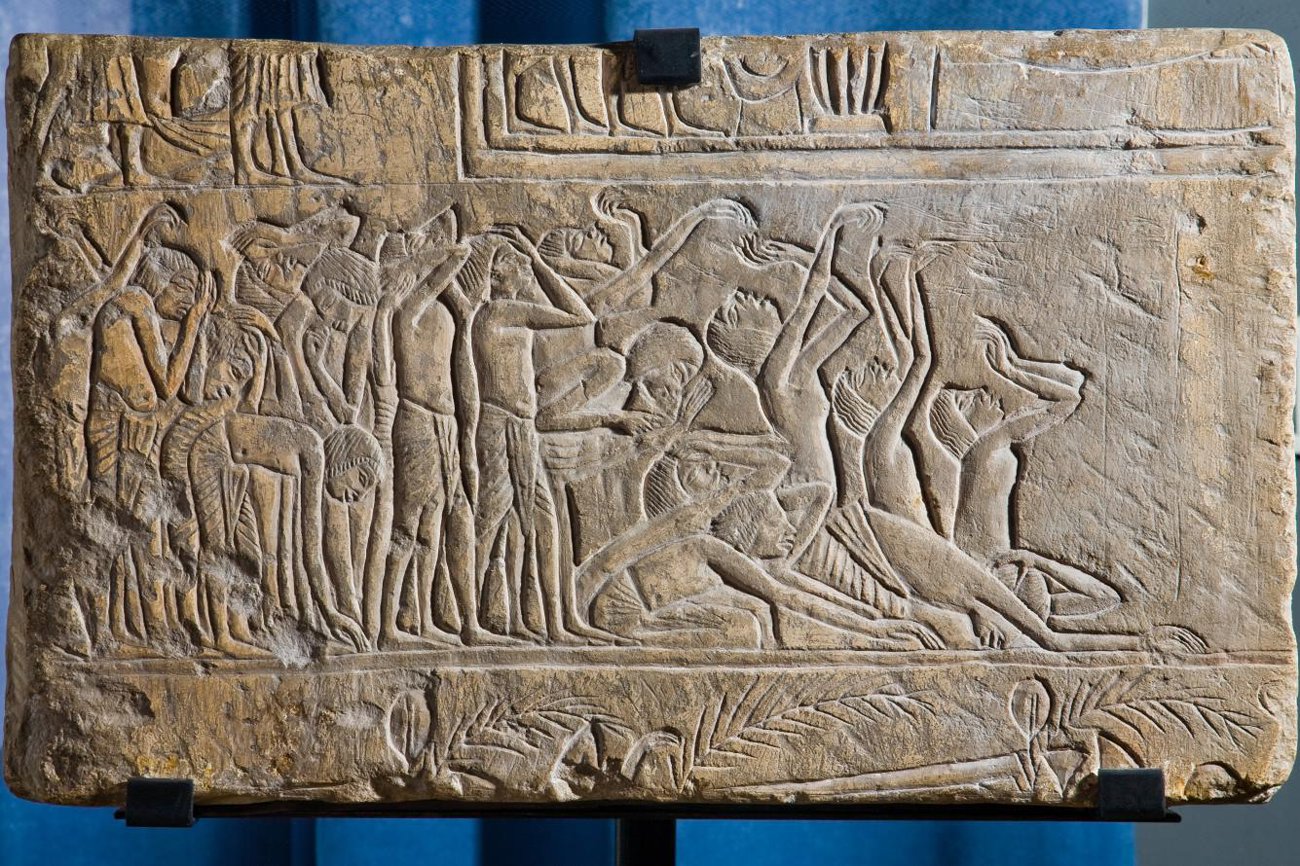
Wailers. Relief from the Saqqara Tomb in Memphis. 14th Century BCE. Pushkin State Museum of Fine Arts, Moscow.
Sixteen mourners are captured in the relief, lamenting the deceased. Through exceptionally artistic techniques—expressive gesturing of elegant, elongated arms, an emotive contour, and abrupt twists in the bodies—the ancient sculptor so vividly embodied the depth of their grief that the viewer feels as if they can hear the sobs of the mourners. Although the figures in the foreground and background are rendered at the same scale, the multi-tiered construction of the scene creates an impression of spatial depth. Compositionally, the image is divided into several focal points: on the right side, a prone figure forms a unified whole with two kneeling characters; next is a group of three figures in the middle ground, hands dramatically raised in despair; the composition is completed by a group of three mourners arranged in successive tiers, unified by a plastic rhythm established by the movement of their long, slender arms.
Chapter 2. Composite View or Combination of Views from Different Sides (Paintings and Reliefs)
The defining characteristic of Ancient Egyptian art is composite perspective. In frescoes and bas-reliefs, the human body is assembled from multiple projections: the head and legs are shown in profile, while the torso and gaze are directed toward the viewer. The ancient masters did this deliberately, adhering to religious conventions rather than due to a lack of anatomical knowledge. Because the image needed to remain cohesive for a successful transition into eternity, each body part was depicted from its most comprehensible angle. This rule was broken very rarely—primarily when creating depictions of servants, musicians, or other secondary figures.
Fresco from the tomb of Ramses I in the Valley of the Kings (Luxor)
On the most famous fresco in the burial chamber of the tomb of Ramses (early 13th century BCE), Pharaoh Ramses I is depicted standing between two great gods—Horus (on the left, with a falcon head) and Anubis (on the right, with a jackal head). The gods guide the ruler into the afterlife and symbolically bestow upon him life force and power. The figures are arranged in a single frieze plane against a vibrant gray-blue background, devoid of perspective, chiaroscuro, or spatial depth, which emphasizes their timeless, sacred status.
Fresco fragment from the tomb of Nebamun, circa 1325 BCE. British Museum.
The fragments of the banquet scene fresco from the Tomb of Nebamun offer a brilliant example of a pioneering approach and the high professionalism of an ancient master. While the high-ranking guests are presented here in strict, orderly rows, the figures of the servants and performing artists are rendered in a much more liberated manner. The elegantly kneeling female musicians are depicted unusually: the faces of two of them are turned almost frontally toward the viewer, which is highly atypical for the canons of that period. The relaxed and joyful atmosphere of the celebration is masterfully conveyed through the slight tilts of their heads and the swaying of thin braids in their elaborate hairstyles. The vitality and rhythm of the entire composition are set by the duet of young dancers—the artist rendered their expressive handclaps and swift leg movements with surprising sensitivity.
Chapter 3. The Canon of Human Proportions
In ancient Egypt, the canon of human proportions—a square grid of 18 units—applied to the standing figure and allowed for its reproduction at various sizes while maintaining anatomical proportionality. Two squares accounted for the face, measured from the hairline to the base of the neck; ten squares covered the area from the neck to the knees; and six squares spanned from the knees to the sole of the feet. A nineteenth square was also used for hair, but it was not counted with the other body parts. The foot measured one square in height and three and a half squares in length. The distance between the ends of the legs for a stationary figure equaled four and a half squares, whereas for a moving figure, it was ten and a half squares. The seated figure was based on a square grid of 14 units, with a fifteenth square included for hair.
Example of grid overlay on an image, «Book of the Dead, ” circa 1250 BCE.
The idealized figure was intended for those who mattered. Secondary characters, such as workers and prisoners, were drawn more freely.
Chapter 4. The Rule of Figure Scale Variation Reflecting Social Hierarchy
For ancient Egyptian artists, the scale of a character was the primary measure of their significance, establishing a clear hierarchy within any scene. According to the canon, key figures were depicted significantly larger than secondary figures: the pharaoh consistently dwarfed his subjects, and men were depicted larger than women. In addition to scale, status and gender were differentiated using color—male silhouettes were rendered in brown, while female figures were highlighted with pink or pale yellow pigment. Nevertheless, the artists did not overwhelm the ruler’s appearance with excessive luxury; despite his divine status, the pharaoh appeared reserved, and his greatness compared to his family and entourage was emphasized solely through the monumentality of the figure itself.
Temple of Tutmosis III relief from Karnak, circa 1450 BCE.