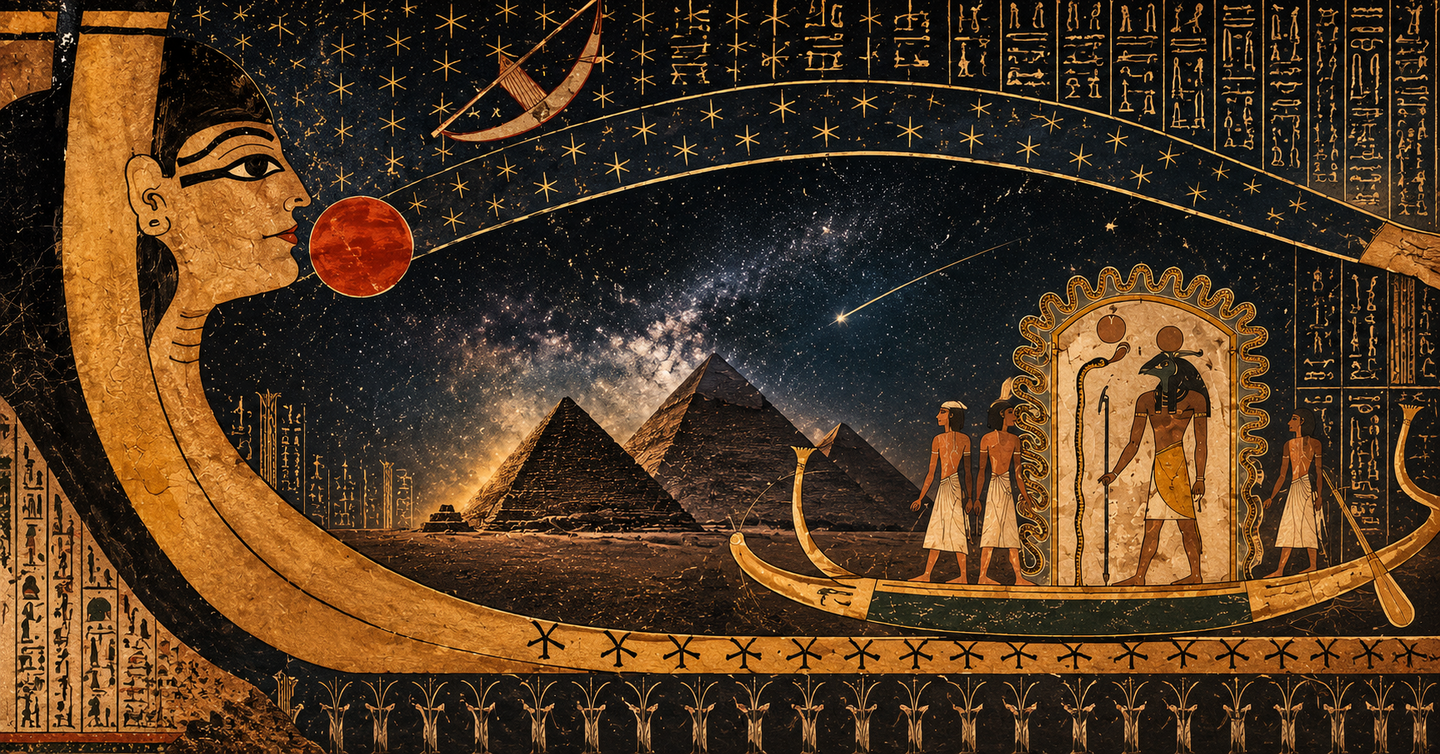
6th–11th centuries BCE. How did the sky become part of the structure, and why was it considered the zodiac?
Rationale for the Topic
The title of this work contains a word that the Egyptians of the New Kingdom (16th–11th centuries BCE) did not know: zodiac. The circle of twelve signs only appears in Egypt during the Greco-Roman period, on the ceilings of the temples at Dendera and Edfu. However, the search for a «zodiac» on Egyptian ceilings began in the 19th century: Hippolytus Rosellini used this term to refer to celestial images found in the tombs of Thebes, and the term became established. The error proved productive. It compels us to ask what the Egyptian sky truly was and how it was integrated into the architecture—what the Egyptians conceived of the sky and why it held such a significant place in architecture, being depicted not on the walls, but above the head. I chose this topic because it is precisely during the New Kingdom that the astronomical imagery first becomes part of the structure: from the ceiling of the burial chamber of Senmut, architect to Hatshepsut, to the vaults of the Ramesside tombs in the Valley of the Kings.
My hypothesis is that instead of the familiar circle of twelve zodiac signs, the Egyptians created a cohesive model of celestial space. The ceiling of the tomb was not merely an illustration of the starry sky, but a symbolic schema of the cosmos and the deceased’s afterlife journey. The arrangement of heavenly bodies, constellations, and solar and stellar deities followed a specific order, reflecting the Egyptians' conceptions of the cyclical nature of time, the movement of the sun, and the rebirth of the soul. In this way, the ceiling became a distinct boundary between the earthly and divine realms.
The selection includes only authentic images: photographs of monuments, 19th-century drawings by Lepsius and Rosenellini, and facsimiles from the Metropolitan Museum. Each image lists the author and license, and it is sourced from digitized museum and library collections. I selected objects where the sky is visible as part of the structure—ceilings, vaults, and colonnaded halls.
The chronological scope is strict: from the reign of Hatshepsut to the 20th Dynasty. Dendera and Esnat were excluded from the work as they are later monuments; they are only needed to explain the origin of the word «zodiac» in the title.
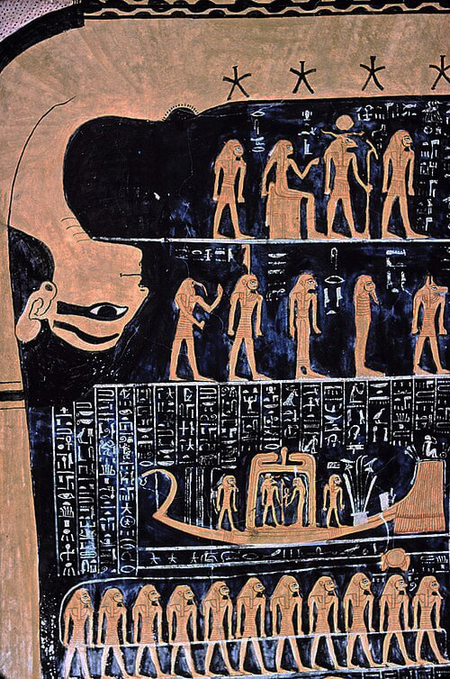
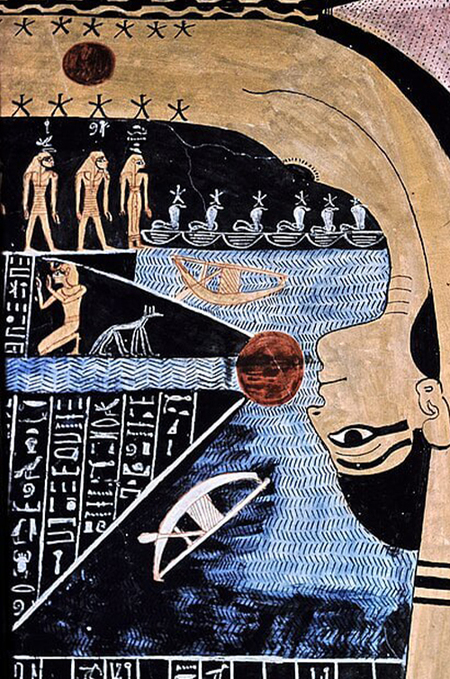
Nut, the Egyptian goddess of the sky, in the tomb of Ramses VI.
To determine the necessary materials for this research, I focused on finding authentic visual sources that trace the development of astronomical imagery in ancient Egyptian architecture.
The works of Karl Richard Lepsius and Hippolito Rosellini were particularly important to the study, as they allowed for a comparison between the original appearance of the monuments and how 19th-century European researchers perceived and interpreted them.
It is important to note that my work paid attention to the imagery of all celestial bodies, including the sun and other symbols. I viewed these celestial images not as standalone decoration, but as an integral part of the architectural structure, linked to the building’s space, function, and symbolism.
Topics:
Chapter 1. Origins of Celestial Architecture: Senmut and the Temple of Hatshepsut
Chapter 2. The Sky Above the Sarcophagus: Astronomical Vaults in Tombs
Chapter 3. The Sun’s Journey: Celestial Routes in Tomb Spaces
Chapter 4. The Egyptian «Zodiac»: Decans and Constellations in 19th-Century Studies
Chapter 5. The Sky Beyond Royal Tombs: From Nefertari to the Temples of Abu Simbel and Karnak
The work progresses from the origin to the canon and finally to the viewer. The first section is dedicated to Senmut and the Temple of Hatshepsut. The second showcases the tombs of Seti I, Ramesses V–VI, and Ramesses IX. The third follows the sun along the corridor walls. The fourth compiles 19th-century sketches where deacons and constellations were read as zodiac signs. The fifth expands the sky beyond the royal tombs—into the tombs of Nefertari and Senenmut, and the temples of Abu Simbel and Karnak. In each section, a general view precedes the detail.
Chapter 1. Origins of Celestial Architecture: Senmut and the Temple of Hatshepsut
Threshold of the 15th Century BCE. Architect Senmut leaves one of the earliest ceilings with astronomical content in his tomb. The Temple of Hatshepsut shows how the sky merges with worship and landscape.
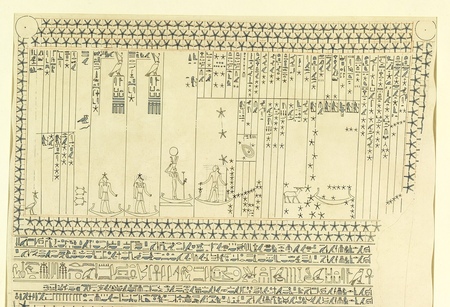
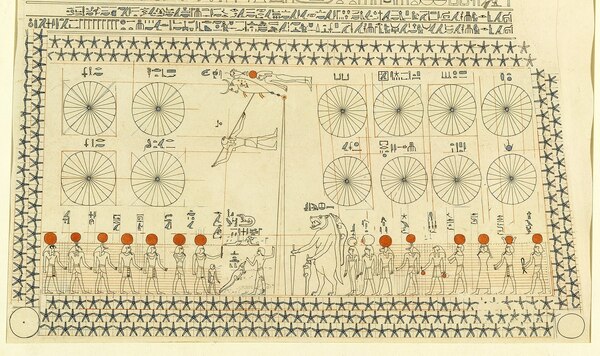
Astronomical ceiling of the Senmut tomb, original c. 1473–1458 BCE
The ceiling is divided into two fields: one displays near-polar constellations, and the other shows zodiacal and calendrical divisions. Even in this early version, the sky is arranged as a table rather than a drawing. The color facsimile allows one to visualize the ceiling in its entirety. The rows of figures are read like instrument rows—direction and order are more important than aesthetics. The diagram emphasizes the ceiling’s calendar grid. Here, a constellation is not a scattering of stars, but an entity with a name. For instance, Meschetiu, which is linked to Ursa Major, is depicted as a bull’s leg. Adjacent figures include animals and patron deities.
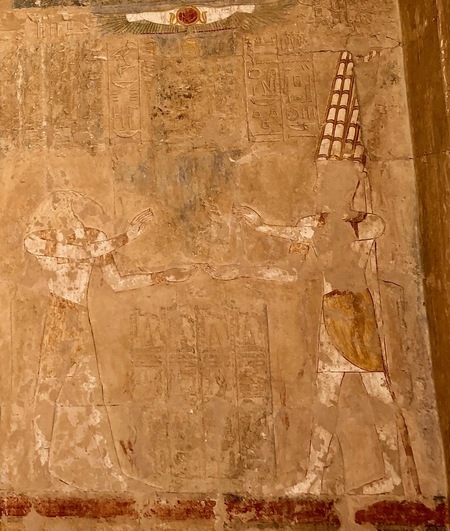
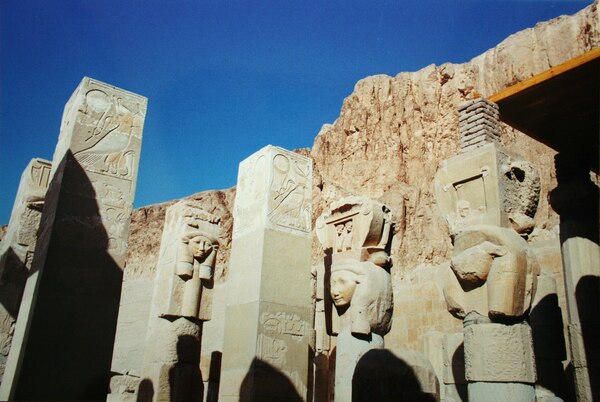
Chapels of Anubis and Hathor, Mortuary Temple of Hatshepsut, Deir el-Bahari. c. 1470 BCE
The Temple of Hatshepsut was built under Senmut’s direction and carved into the rock cirque. In such chapels, the sky serves as a backdrop to the scene, rather than an independent narrative element. Hathor holds the title «Mistress of the Heavens.» Therefore, her chapel is situated among the celestial spaces of the temple, even though it lacks stars on its walls.
Conclusion: At the beginning of the New Kingdom, the sky was dual. In the tombs, it functioned as a document—a constellation chart—while in the temples, it served as a patron, integrated into the structural elements. This is the original schema, which was further developed by the tombs of the 19th–20th dynasties.
Chapter 2. Sky Over the Sarcophagus: Astronomical Registers of Tombs
From Enki I to Ramses IX, the vaulted ceiling of the burial chamber becomes the body of Nut. Constellation figures, the sun disk, and columns of text are gathered onto a single curved surface.
Astronomical ceiling of the burial chamber of Tomb Seti I (KV17), fragment. c. 1290–1279 BCE.
The blue background and dark stellar figures transform the vault into a night sky above the sarcophagus. The figures are arranged in rows, like lines of text. Each is labeled and integrated into the line. Here, the sky is read, not merely observed.
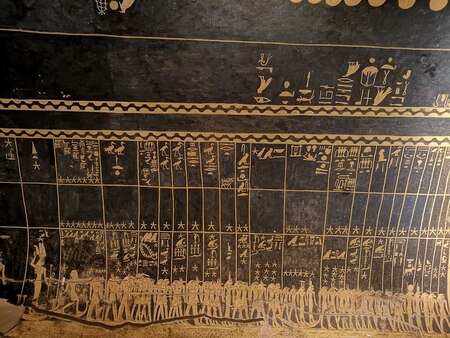
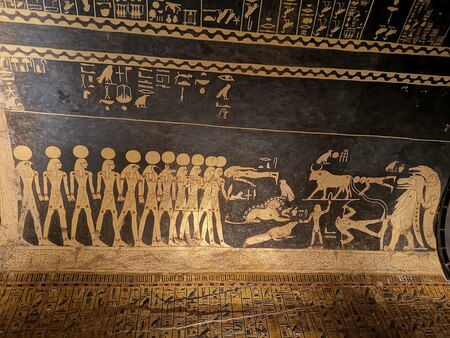
Astronomical ceiling of the burial chamber of Tomb Seti I (KV17), fragment. c. 1290–1279 BCE.
Full view of the vault. A strip of the starry sky runs along the room’s long axis, and the deceased lies directly beneath it. Another angle shows the curvature of the vault. The figures follow the bend of the stone, and the architecture transforms into a celestial dome.
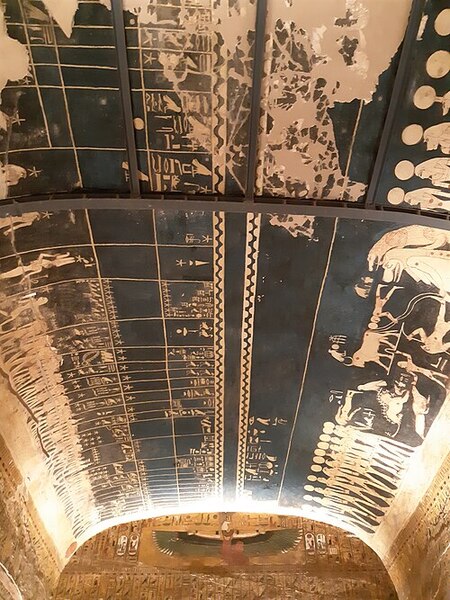
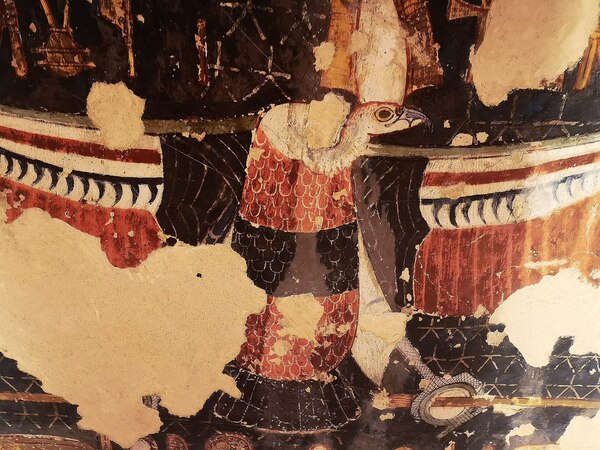
- Interior of Seti I’s tomb, Valley of the Kings. c. 1290–1279 BCE.
- Ceiling of Corridor B in Seti I’s tomb, featuring flying griffins. c. 1290–1279 BCE.
The vertical frame conveys the ratio of wall to vault. The entire interior shell is painted, not just the ceiling. In the corridors, griffins—the king’s protective birds—fill the sky. Here, the vault functions as a talisman, not a star map.
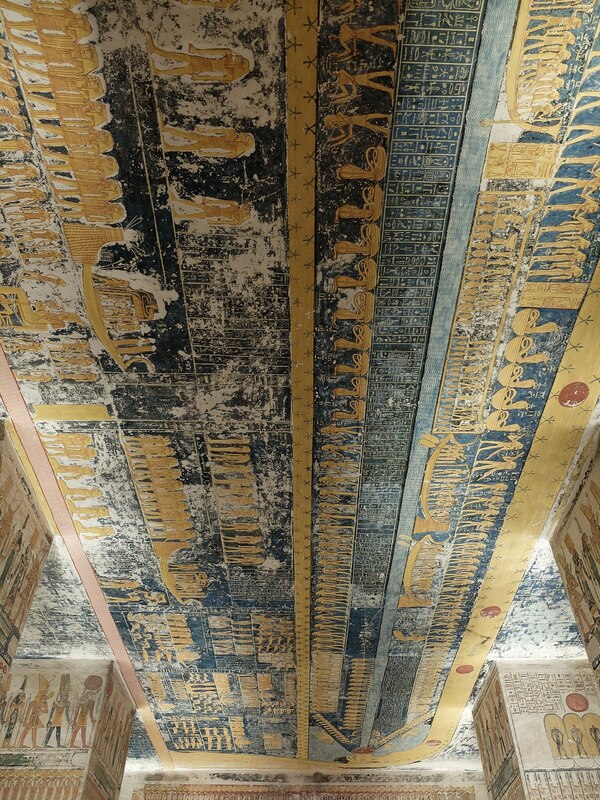
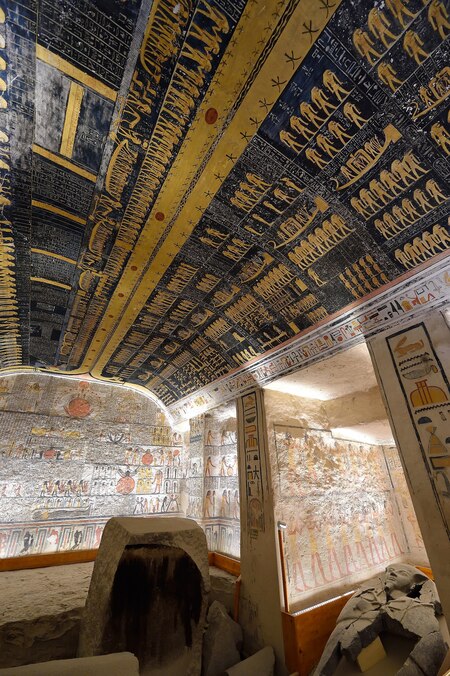
Burial chamber of the tomb of Ramesses V and VI. c. 1147–1137 BCE.
The frame depicts the camera as a vessel covered by the sky. The vault spans the space where the sarcophagus stood. Stretched across the vault is the figure of the sky goddess Nut. Her body runs along the entire chamber, and the deceased is situated within this body.
Nut on the ceiling of the burial chamber of the tombs of Ramses V and VI (KV9). c. 1147–1137 BCE.
The goddess Nut is arched over the earth. This pose sets the shape of the vault: architecture mirrors the body of the sky.