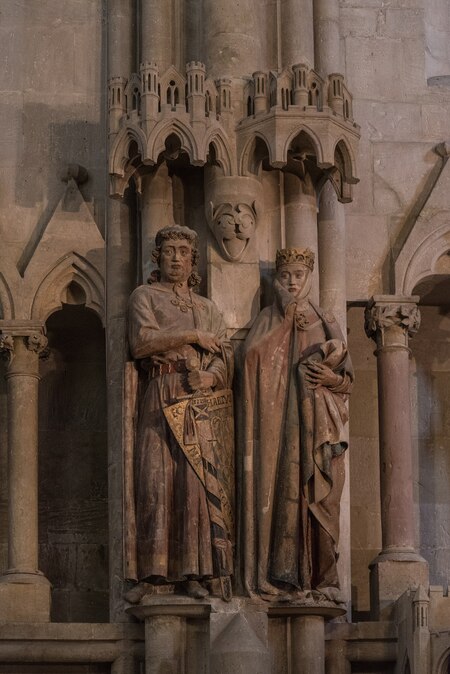
Concept
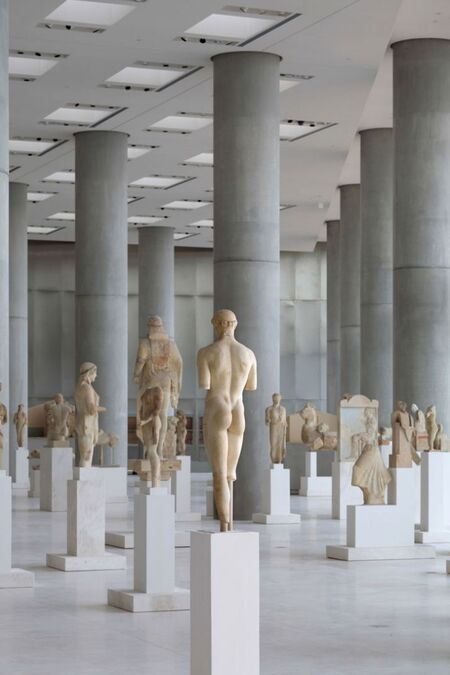
The Archaic smile is a conventional term describing the facial expression of 6th-century BCE Greek statues: the corners of the lips are raised, while the rest of the face remains motionless. It is found throughout the Greek world—from Attica to the islands and Asia Minor—on kouroi, korai, pediment figures, and friezes, and it disappears around 480 BCE with the advent of the Severe style.
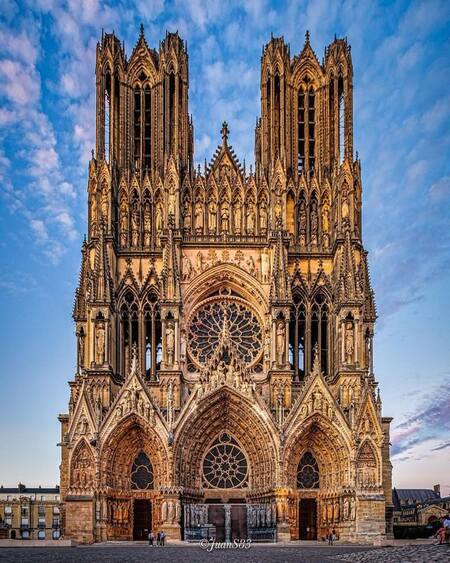
The Gothic smile—a facial expression appearing in French cathedral sculpture in the 1230s, notably in Reims, and spreading across the Holy Roman Empire within a few decades—is seen on angels, saved figures, donor statues, and even on negative characters by the end of the 13th century.Approximately eighteen centuries separate these two phenomena, and there is no direct lineage between them. Nevertheless, in both instances, the smile emerges at the same critical point in the development of sculpture: when the statue ceases to be part of a block or column and becomes a self-contained figure.This theme remains relevant because the smile today is the most conventional facial expression in imagery—from photography to advertising—and the contemporary viewer unconsciously interprets ancient smiles as indicators of mood or character. Comparing the two eras reveals that this interpretation is not always accurate; the same facial feature can serve different purposes in sculpture.Much has been written about the archaic and Gothic smile, but they are usually analyzed separately, each confined within its respective era. In this study, however, they are compared as visual solutions rather than as symbols: the subject of analysis is how the smile is rendered in stone and what function it holds within the figure.
The core research question
Does the smile on a stone figure in the Archaic style and the Gothic style achieve the same effect, and what visual means are employed in each case?
Hypothesis
In both traditions, the smile serves the same fundamental goal—to show that the stone is «alive.» However, they are structured in opposing ways. The archaic smile belongs to the form: it is a permanent characteristic of the face, identical across the young man, the maiden, the sphinx, and the dying warrior; it is independent of the narrative and addressed to no one. The Gothic smile belongs to the action: it arises alongside the turning of the head and body, is directed toward a neighboring figure or the viewer, and is distributed selectively, allowing one to distinguish an angel from a ruler saved from a curse.
Material Selection Principle
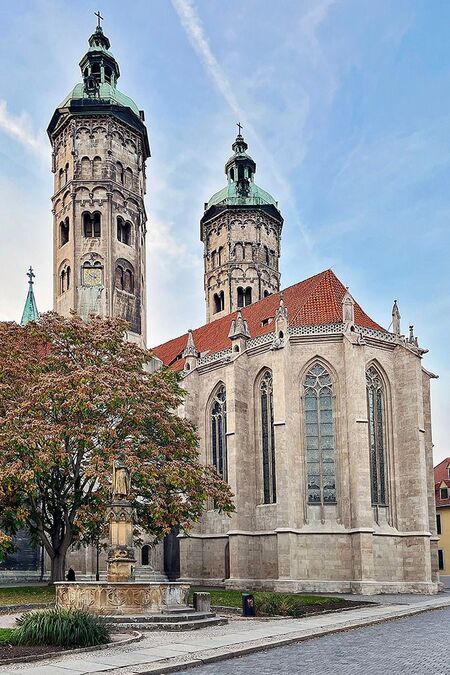
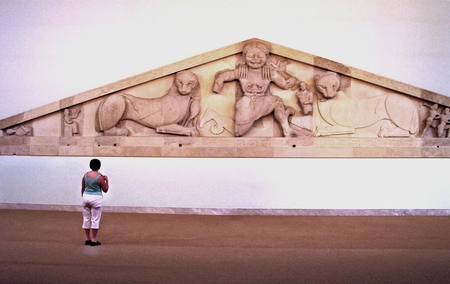
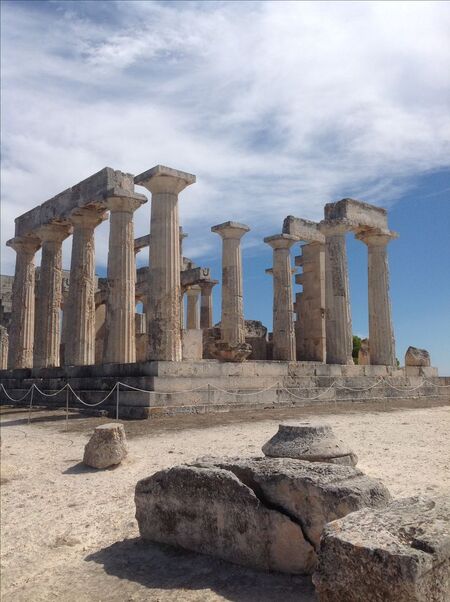
Only round sculpture and architectural plastic arts are considered: statues, pediments, friezes, portals, and interior figures. Vase painting, small-scale sculpture, ivory, and metalwork are excluded as they belong to decorative and applied arts. For the Archaic period, monuments dating approximately from 600 to 480 BCE were selected: the Kouroi and Korai of Attica, the Peloponnese, and the islands, the pediments of Corfu and Aegina, and the frieze from the Syfnos treasury. For the Gothic period—sculpture from the cathedrals of France and the Holy Roman Empire from approximately 1225 to 1300—these include Reims, Amiens, Bourges, Bamberg, Naumburg, Magdeburg, Strasbourg, and Regensburg. Each group also includes «liminal» pieces without a smile (the Kouros of Sounion, the Kritios Boy, statues from the Royal Portal of Chartres, the Bamberg Rider): these illustrate where the smile begins and where it ends.
Rubrication Principle
The research is structured as a comparison. The first two sections present the material of each era separately, in chronological order, to showcase the body of work itself. The third section addresses the general theme: the smile as an indicator of form vitality. The following three sections analyze the differences across three elements, moving from the smallest to the largest: the structure of the smiling face, the relationship between the smile and the body, and its addressee—the circle of people to whom the smile is intended. This sequence allows the analysis to progress from observing the form to concluding its meaning, without substituting analysis with a retelling of narratives.
The Principle of Selecting and Analyzing Textual Sources
Three groups of texts were utilized. The first comprised museum catalogs and descriptive guides for monuments, which were used to verify dating, material, and storage location. The second group included comprehensive works on archaic and Gothic sculpture (J. Bordman, G. Richter, R. Nir, V. Sauerlander, P. Williamson). The third consisted of specialized studies on facial expression and movement in the Gothic period (P. Binski, J. Jung). Facts and existing interpretations regarding the smile were drawn from these texts; the comparison between the two eras and the conclusions regarding the differences are based on the author’s own analysis of the images. Biographies of masters, mythological narratives, and theological interpretations are outside the scope of this study—the subject of inquiry is what is visible in the stone itself.
Section 1. Archaic Smile
Over the course of a century—from 600 to 500 BCE—the smile evolved from a barely suggested line into an obligatory feature on almost every face. A series is arranged chronologically, featuring both male and female figures, funerary and votive, to illustrate that the smile is independent of both gender and the statue’s purpose.
Kuros from Sunion. c. 600 BCE. Marble. National Archaeological Museum, Athens
Starting point. The face is assembled from individual signs (eyes, volute ears, a straight mouth slit) cut from planes of the block. There is no smile yet—the mouth is merely indicated.
Polymede Argos (attributed). Kleobis and Biton. c. 580 BCE. Marble. Archaeological Museum, Delphi
Two nearly identical figures with broad faces and heavy proportions. The corners of the mouth are slightly upturned, marking the first deviation from the straight line on a still face.
Moschophoros (Bear-carrying calf). Circa 570–560 BCE. Marble. Acropolis Museum, Athens
A human hand and a calf’s leg are crossed over the chest in a diagonal cross, and above this rigid knot is a smiling face. The smile functions as another element of the ornamental scheme.
Kuros from Thebes. Circa 560–550 BCE. Marble. Glyptotheca, Munich
One of the clearest examples of a mature formula: a narrow face, high cheekbones, and sharply upturned corners of the mouth. The smile mirrors the overall rhythm of the figure, which is built on curves and symmetry.
Rampen Rider. Circa 550 BCE. Marble. Head — Louvre, Paris; torso — Acropolis Museum, Athens
The head is slightly turned and tilted, which is rare for an archaic style. The smile, however, remains the same formula; the head’s rotation does not change it or direct it anywhere.
Skin in a Peplos. c. 530 BCE. Paros marble, traces of polychromy. Acropolis Museum, Athens (Inv. Acr. 679).
The most recognizable smiling face of the Archaic period. The simple, almost columnar body volume leaves the face as the sole place where form «moves.»
Kora in Peplos (face, fragment). Circa 530 BCE. Acropolis Museum, Athens
The smile softens: the lips become voluminous, and the transition to the cheeks is smooth. Traces of paint on the lips, eyes, and hair remind the viewer that they are looking at a painted face, not white marble.
Kuros from Anavyssos (Kroisos). Circa 530 BCE. Marble. National Archaeological Museum, Athens.