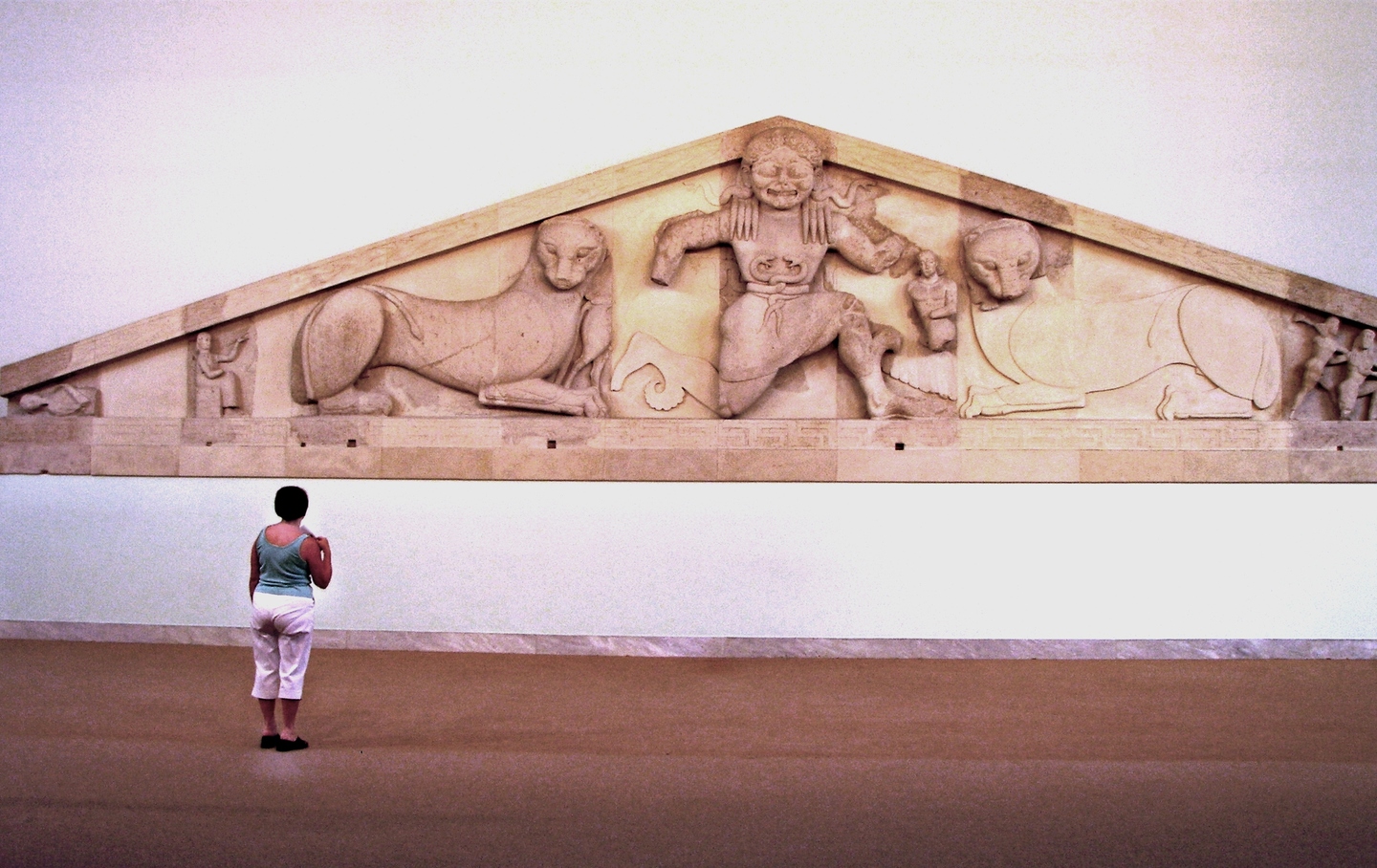
Evolution of Ancient Greek Sculpture: 12th–8th Century BCE — 4th Century BCE
Concept
For my visual research, I chose the theme «The Evolution of Ancient Greek Sculpture: from the 12th–8th century BCE to the 4th century BCE.» I was interested in the abundance of sculptures and the journey they undertook from the earliest pieces to the latest—what remained constant in them and what changed.
The first aspect of our research will be an exploration of how the image formed, changed, and developed in ancient Greek art. Special attention will be paid to the transition of art from early, more geometric and stylized forms to sculptures with developed anatomy, natural proportions, and complex modeling. I want to discover what distinctive features defined each historical period and how the methods of depicting and constructing sculptures evolved.
The second aspect of our research will examine the evolution of sculptural modeling. I aim to investigate how proportions, the conveyance of movement, and the interaction of individual figure parts changed. It is also important to trace the shift in sculptures from strictly frontal depictions and symmetry to more natural, complex poses.
The third aspect of our research will be an examination of how the concept of sculpture itself changed. Across different periods of ancient Greek art, the figure was interpreted in various ways—from generalized and stylized forms to harmonized, idealized, and individualized representations. I want to understand how anatomy, proportion, and posture conveyed the ideals of their time and the level of human perfection they were able to achieve.
The primary goal of this research is to trace the evolution of Ancient Greek sculpture from the 12th to the 4th century BCE. We aim to identify the fundamental changes, demonstrate how artistic techniques and principles of sculptural composition shifted over many centuries, and articulate what sculpture ought to look like.
The main focus is placed on comparing sculptures from different historical periods, which allows us to track the general evolution of how artists perceived sculpture.
Main Body:
1.1 Homeric Period—this is the period of Ancient Greece that followed the decline of the Mycenaean civilization. Its beginning is connected to large-scale transformations in the political, social, and cultural organization of the Aegean world at the end of the Bronze Age.
1.2 Following the decline of the Mycenaean palaces, the social structure changed. The foundation of social organization consisted of small communities linked by territorial and kinship ties. The development of public life occurred unevenly. Aristocracies, who possessed landholdings, wealth, and authority, began to occupy significant positions in society. Key markers of high social standing included lineage, military valor, and communal rituals. In turn, all of this is reflected in funerary complexes and artistic depictions of warriors, chariots, and horses.
1.3 Religious representations occupied a significant portion of social and cultural life. The most important forms involved the veneration of deities. One common form of offering consisted of small bronze and terracotta figurines of people and animals, which are found at sites of religious worship. Images of horses and warriors were particularly favored. By the end of the 8th century BCE, the importance of panhellenic sanctuaries strengthened. Offerings to the gods gradually took on diverse forms—ranging from small metal figurines to large bronze tripods decorated with images of people and animals.
1.4 One of the most significant cultural phenomena of the period under review is the development of epic poetry associated with the name Homer. The «Iliad» recounts the events of the Trojan War, while the «Odyssey» is dedicated to the journey of Odysseus. The images of heroes, gods, and mythological creatures subsequently become an important component of ancient Greek visual arts.
1.5 The most characteristic artistic phenomenon of the late Homeric period is the development of geometric art. The working of bronze and other materials advanced. This included the creation of jewelry, fibulae, weapons, and small figurines.
1.6 Sculpture from the Homeric period is primarily represented by small-scale plastic works. Unlike subsequent epochs, monumental stone sculpture had not yet developed significantly during this time. The surviving archaeological materials consist mainly of small objects made of bronze and terracotta. A characteristic feature of the sculpture is the geometrization of the human and animal figure. Forms are created based on the principles of symmetry and structural equilibrium. The individual characteristics of the depicted characters, as a rule, do not receive independent development. The use of geometric principles is particularly noticeable in bronze figurines of horses. Their bodies are constructed using cylindrical and planar volumes, and individual anatomical elements are emphasized by disproportionately large forms. Monumental art, however, was likely executed in wood and other perishable materials. Its existence is known mainly through later written records and isolated archaeological data. In contrast to the bronze figurines, such works have not survived in sufficient quantity.
1.7 Significant Works of Homeric Sculpture:
«Bronze Horse» circa 750–725 BCE. In this work, the animal’s anatomy is rendered through geometric forms. Particular attention is given to the powerful hind legs, elongated muzzle, curved mane, and pointed ears. Individual details are accentuated by disproportionately large volumes, which lends a heightened expressiveness to the animal’s most recognizable features. A characteristic feature of the composition is the positioning of the tail, which extends to the rectangular base, providing additional stability to the entire structure. The eyes are indicated by small protruding elements. The base is adorned with geometric perforations, characteristic of bronze figurines from the late 8th century BCE.
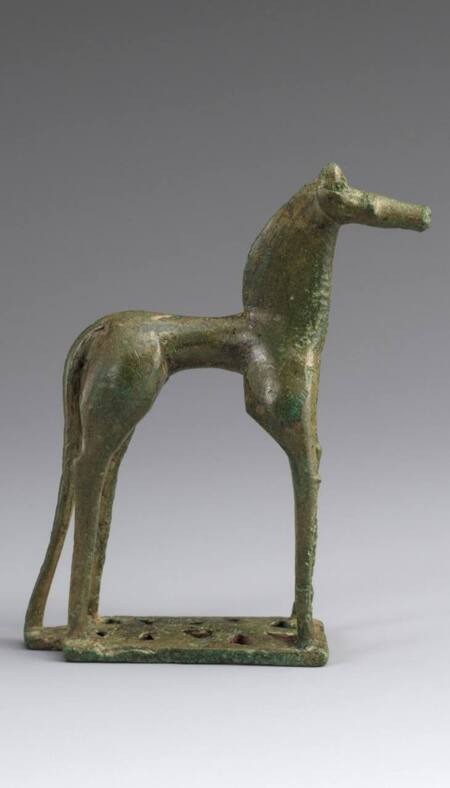
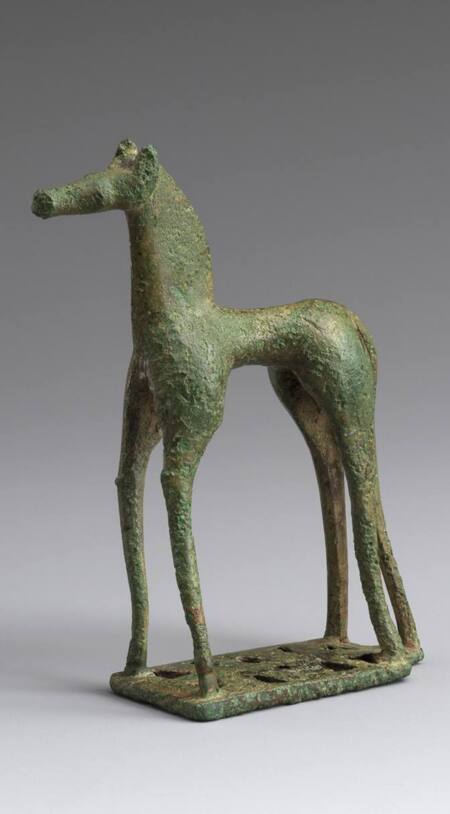
«Bronze Horse, ” circa 750–725 BCE
«Bronze Apollonian Triad.» Dresos, second half of the 8th century BCE. Unlike small cast bronze statuettes, the figures are crafted from individual bronze sheets, joined onto a wooden base, which has not survived. This technique allowed for the creation of larger and more volumetric cult figures. The sculptural group demonstrates a more advanced treatment of human volume compared to the small bronze figures from the early 8th century BCE. The forms become more massive and rounded, and the figures gain a more pronounced physicality. At the same time, the characteristic frontality and a relatively strict compositional organization are maintained. Thus, the group from Dresos represents an important stage in the development of Greek cult sculpture. It testifies to the expansion of sculptural technical capabilities and a gradual transition from small metal figurines to larger cult images of the human figure.