Concept
The human body has remained the primary subject of artistic representation and, simultaneously, a vital tool for understanding the world throughout the history of art. How an artist or sculptor «constructs» the figure—what proportions they employ, how they render musculature, or how they make fabric drape over the body—is a direct reflection of the worldview of the era.
The visual image of humankind is not static; it reacts sensitively to shifts in philosophical, religious, and cultural paradigms. Studying this evolution allows us to see how the very concept of the value of earthly life, humanity’s place in the universe, and the relationship between the physical and the spiritual have changed.
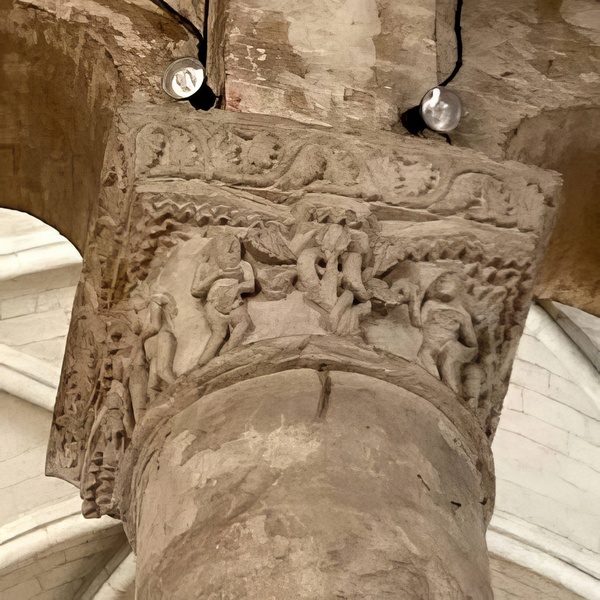
Topics
- Anatomy and Proportion
- Drapery and Costume
- Pose and Movement
- Face and Expression
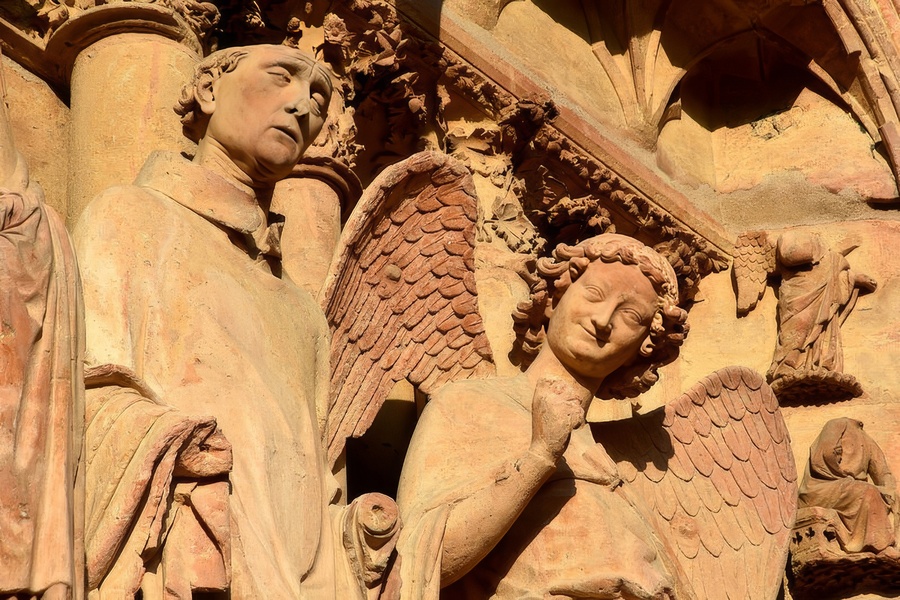
«Smiling Angel.» 13th century. West façade of Reims Cathedral, France.
Chapter 1. Anatomy and Proportion
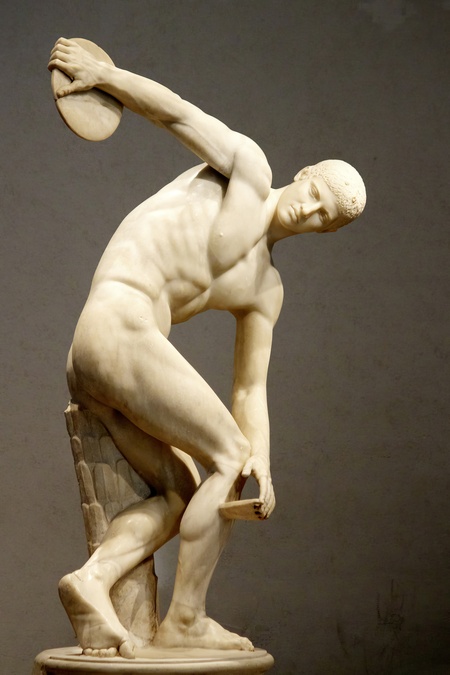
The foundation of ancient body depiction lies in rigorous mathematical precision. For the ancient Greek sculptor, the body was not merely a physical shell, but an ideal, harmoniously organized cosmos.
The canon serves as the primary tool here—a system of proportions where every part of the body is in precise numerical relation to the others. Visually, this manifests in the depiction of anatomically accurate musculature and natural weight distribution. By analyzing Polyclitus’s «Doryphoros,» we see how the sculptor structures the figure according to the principle of chiasmus: the tension in the right arm corresponds to the tension in the left leg, creating ideal balance. The marble under the master’s chisel transforms into living flesh—not only the major muscles but also the fine tendons are rendered. Light, falling upon the marble, creates natural chiaroscuro, emphasizing volume. This body lives in three-dimensional space; it possesses physical weight and heroic power.
«Doriforus.» V century BCE. National Archaeological Museum, Naples.
With the advent of Christianity, the perception of the corporeal form underwent a radical shift. In the Romanesque and Byzantine art periods, anatomical accuracy vanished, giving way to visual dematerialization.
The body ceases to be valuable in itself; it becomes merely a symbol, a sign pointing toward the divine. Visually, this manifests as a departure from correct proportions and volume. Looking at Romanesque column statues (for example, in Saint-Denis Basilica) or tympanum sculptures, we observe figures being elongated, becoming disproportionately narrow, or conversely, having overly large heads. Muscular anatomy is completely ignored: the bodies possess no physical weight; they seem to float in space or are rigidly subservient to the architectural lines of the church. Garment folds do not cling to the figure but conceal it, transforming the body into an abstract geometric silhouette. Light here does not sculpt volume; rather, it creates a flat, linear pattern.
Heads of statue columns. Abbey of Saint-Denis. c. 1140. Cluny Museum, Paris
Gislebertus. «Last Judgment.» Tympanum of the west portal of Saint-Lazare Church, Autun. c. 1130–1135. France.
A turning point in the depiction of the human body occurs during the Proto-Renaissance (13th–14th centuries), when Italian masters begin to rediscover the ancient principles of volumetric form in sculpting.
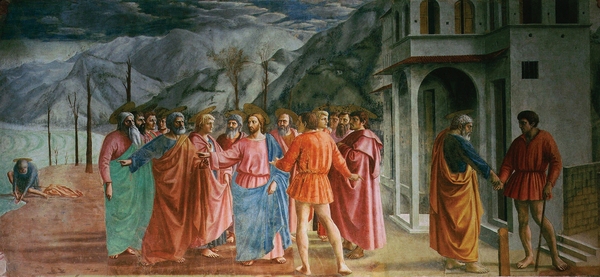
Giotto di Bondone is the primary innovator here. In his frescoes, figures regain a lost sense of weight. Giotto uses chiaroscuro to illustrate how clothing conforms to a real, volumetric body beneath it. The characters begin to occupy real space, their feet firmly planted on the ground. Masaccio takes the next step in the fresco «The Trinity»: he employs linear perspective to construct space, and his figures possess a colossal, almost sculptural weight. While the anatomy is not yet perfect by the classical canon, the body reacquires materiality, density, and realistic physical proportions—a development that lays the foundation for the future Renaissance.
Giotto di Bondone. «Lamentation of Christ.» c. 1304–1306. Fresco in the Scrovegni Chapel, Padua, Italy.
Thus, visual analysis reveals that while the ancient master constructed the body according to the laws of mathematics and anatomy, the medieval artist deliberately abandoned these rules to create a flat symbol. However, the return of chiaroscuro and the sense of weight during the Proto-Renaissance proves that the body is the key marker through which art moves from convention back toward reality.
Chapter 2. Draping and Clothing
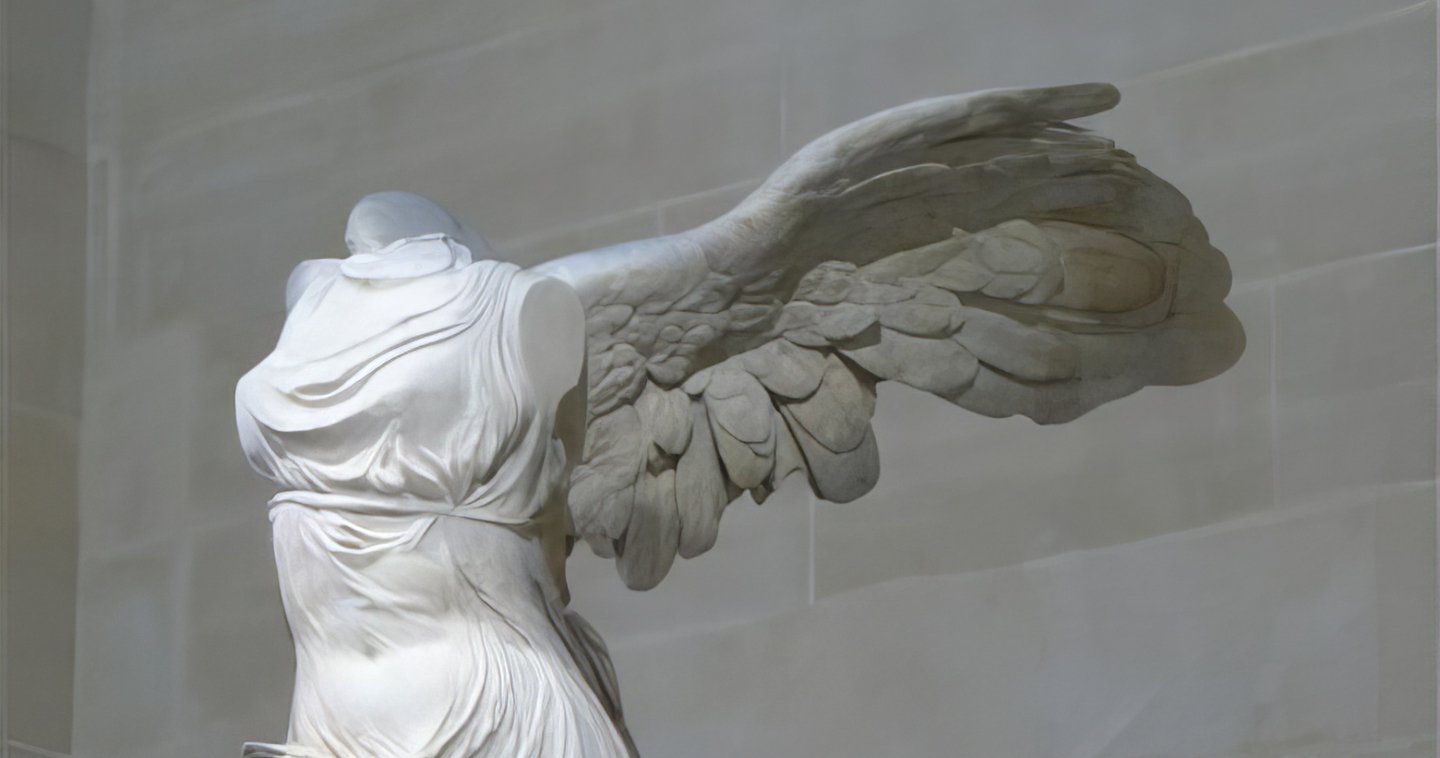
In ancient art, clothing never conceals the body; instead, it serves as an instrument for its glorification. The primary visual technique employed here is known as «wet drapery.»
Analyzing the sculptures of Nike of Samothrace or the friezes of the Parthenon, we observe how the fabric seems to adhere to the marble, replicating every line of the hip, chest, and knee. The folds here are not a separate element—they serve as an extension of the anatomy, emphasizing the natural movement of the muscles and the dynamism of the pose. The fabric drapes, forming a complex rhythmic pattern, yet it remains perpetually three-dimensional and tangible. Light, skimming across these deep folds, generates additional volume, compelling the viewer to physically sense the density and weight of the depicted figure.
Unknown sculptor. «Aphrodite of Knidos.» c. 190 BCE. Louvre, Paris.
With the advent of Christianity, the function of clothing in visual art changes radically: it transforms from a tool for glorifying the body into a tool for concealing it.
In Byzantine mosaics and Romanesque sculpture, we see a body completely enclosed within the heavy, rigid «cocoon» of ritual vestments. Drapery here loses connection with anatomy: the fabric does not cling to the figure but instead forms an autonomous linear pattern dictated by strict geometry and symmetry. The folds become flat, hard, and angular; they do not create deep shadows but merely outline the silhouette. In the Middle Ages, clothing ceases to be physical material and becomes a visual marker of social and spiritual status: the richness and color of the fabrics indicate not the beauty of the body, but the sacredness or hierarchical position of the character.
Unknown Master. «Empress Theodora with Her Entourage.» c. 546–548. Mosaic in the Church of San Vitale, Ravenna.
However, during the Gothic and Proto-Renaissance periods, drapery regained volume and dynamism, albeit for a different artistic purpose. In the sculptures of Claus Sluter, the fabric becomes expressive: it forms deep, fractured folds that create a dramatic interplay of light and shadow, intensifying the emotional tension of the figure. The next crucial step is taken by Giotto di Bondone. In his frescoes, clothing is no longer a flat symbol—it obeys the laws of gravity and interacts with the real body. Giotto uses drapery to convey the physical weight of the characters: the fabric falls heavily, outlining voluminous hips and knees, and in moments of movement—it billows, emphasizing dynamism.
Klaus Sluter. «Moses.» 1395–1406. Chartres-de-Champmol, Dijon.
Thus, the visual evolution of drapery clearly demonstrates the transition from the ancient cult of physicality through the medieval spiritualization to a gradual return of interest in the material world and the human physical form.