Сцена как каркас: композиционные приемы Иеронима Босха
Navigator
I. Concept II. Curtain: Flaps as Boundary III. Stage: Spatial Construction IV. Scenery and Risers V. Mises-en-scène: Rhythm and Plasticity VI. Spectator VII. Conclusion
The structure of the research mirrors the viewer’s journey in the theater. First, they see the closed curtain (Section II). Then, the stage opens before them (Section III). Next, they notice the platform where the action takes place (Section IV), examine the characters and objects (Section V), and finally realize that they, too, have become part of the events (Section VI). I chose this division because it allows for a progression from the general to the particular—from the triptych as a whole to an individual figure and gaze.
I. Concept
Hieronymus Bosch is most often viewed as a painter of riddles: researchers debate the meaning of individual creatures and objects, and discussions of his work often devolve into deciphering symbols. I am interested in a different question: not what his images signify, but how the space in which they are presented is constructed. If we set aside the search for hidden meanings, the sheer spectacle of Bosch’s paintings becomes evident. The action is staged, the participants are arranged to be clearly visible, and some of them frequently gaze directly at us.There is no direct evidence that the artist himself used this metaphor, so in my work, theater serves as an analytical approach to the painting, rather than a declaration of the master’s intent. The context of the era allows for this approach. In 15th-century Dutch towns, processions and living paintings were a common part of life, and artists were directly involved in them—staging living pictures for processions and designing sets for performances [1, p. 94]. In 's-Hertogenbosch, where Bosch lived his entire life, the Brotherhood of the Virgin Mary held an annual procession in honor of the Virgin Mary and paid the singers, musicians, and actors involved [18]. Bosch joined this Brotherhood in the latter half of the 1480s, and his father served as an artistic advisor [].
Key research question: How does Bosch transform an image into a scene, and a person before the painting into a spectator of a performance, through his pictorial means?
The hypothesis is that the resemblance to the scene in Bosch stems not from the plots, but from recurring compositional techniques. I have identified five such techniques:
— The wings of the triptych function like a curtain, separating the prologue from the main action. — The space of the open triptych is organized as a series of simultaneously visible settings, with paradise on one edge and hell on the other. — Architecture transforms into scenery and a stage. — Characters, like actors, are rhythmically placed, allowing for an examination of each one. — The viewer is incorporated into the painting, and the heroes’ gazes are directed beyond its boundaries.
The material focuses on the paintings and drawings of Bosch. The study includes works where theatrical compositional techniques are most evident: the triptychs «Garden of Earthly Delights, ” „The Raising of the Cross, ” „Adoration of the Magi, ” and „The Last Judgment, ” the panels „Man, ” „Death of a Merchant, ” and „Crowning with Thorns, ” as well as the drawings „Man–Tree“ and „The Hearing Forest and Seeing Field.“
Sources were selected across three areas: studies on Bosch himself (works by M. R. Maizuls and L. D. Raygorodsky), works on late medieval theater (articles by I. Klimova and G. Rannals), and scholarly museum catalogs and data from the Bosch Research and Conservation Project (BRCP), which were used to verify dating and attribution.
II. Curtain: Panes as Boundaries
The 15th-century Dutch altarpiece was a mobile structure: its wings could be opened and closed, and what a person saw depended on the day. Lynn Jacobs showed that contemporaries perceived the wings as doors—as a threshold between different times and spaces [14]. These doors were rarely opened. Michael Maizul writes that triptychs were only opened during Sunday masses or on major church holidays [3]. The opening of the wings was an anticipated event, akin to the raising of a curtain. Let’s examine how Bosch constructs the composition on the exterior of the wings.
Hieronymus Bosch. «The Garden of Earthly Delights» (outer panels). 1490–1500.
The closed, colorless, and deserted world on the shutters functions like a drawn curtain bearing an emblem: it promises a spectacle while simultaneously concealing it.
The composition of the external panels of «Garden of Earthly Delights» is built upon strict, almost blueprint-like geometry. Here, it is not the subject matter that dominates, but the form: a transparent sphere occupies nearly the entire field, creating a closed and static space. The vertical seam of the panels divides this sphere precisely in half, transforming the frame into an axis of symmetry. The small figure of God the Father is placed outside the sphere, in the upper left corner, creating a point of asymmetry that holds the viewer’s gaze.
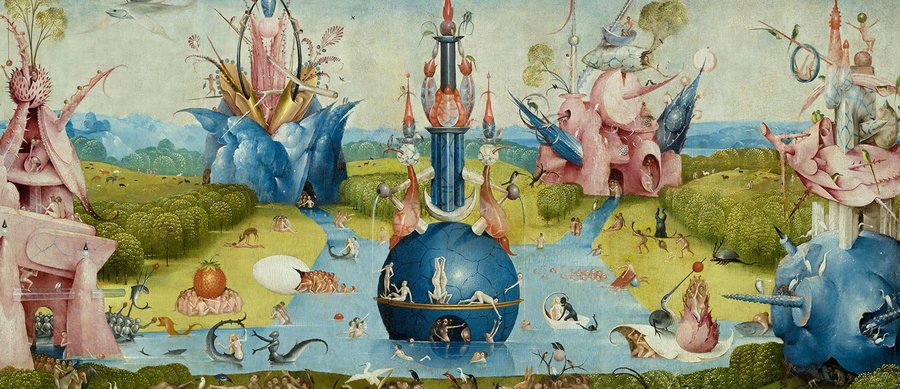
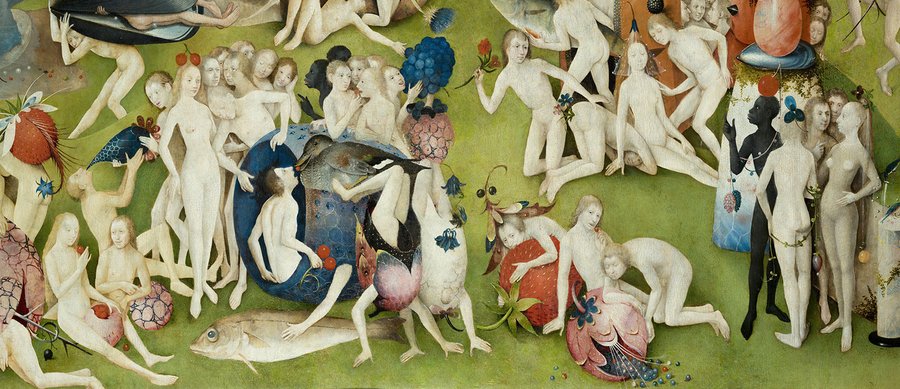
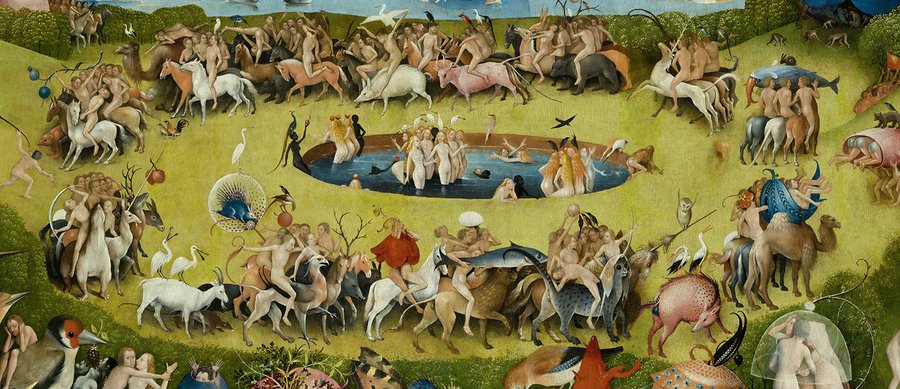
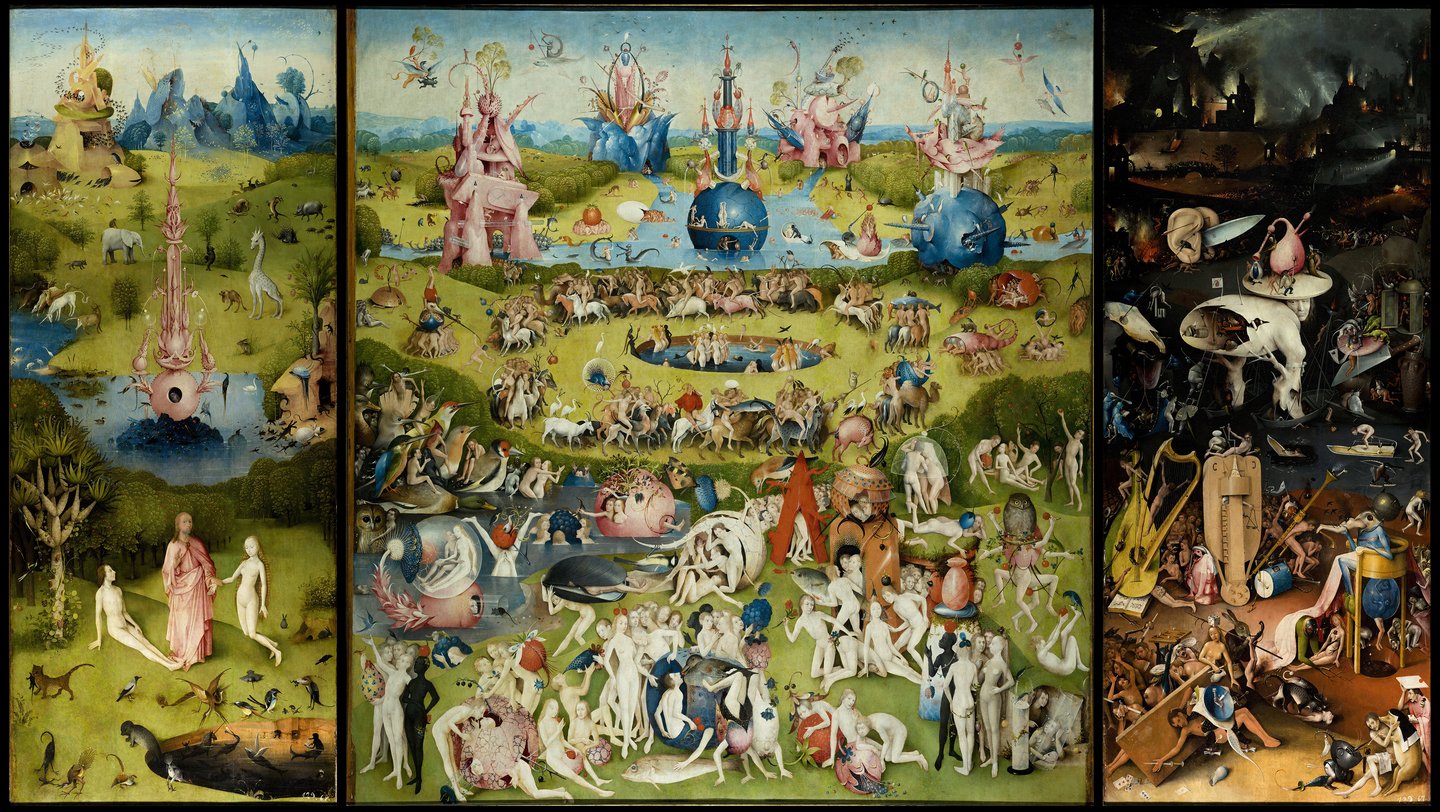
When the panels spread apart, this rigid geometry collapses. The sphere disappears, giving way to a three-part panorama saturated with color. The contrast is designed for immediacy: after the static gray sphere, the viewer is instantly confronted with hundreds of vibrant, dynamic forms. Maizels describes the structure of the triptych as a sequence of chapters—the outer surface of the wings constitutes the first, followed by three scenes visible when the triptych is opened [7]. The term «scenes» arises naturally here because the open triptych is perceived as a sequence of images within a single presentation.
Hieronymus Bosch. «The Haywain» (outer panels). 1512–1515.
The exterior panels of «The Hay Wagon» are painted in color, yet the compositional principle remains consistent: one figure on the outside and a crowd on the inside. A stooped traveler moves through both panels, walking from left to right and establishing a diagonal line of motion. The palette is built upon ochre and earthy brown tones, causing the traveler’s pale face to stand out as the lightest spot—the compositional focal point. Majuls notes a crucial technique: the figure is painted along the seam where the panels meet. When the triptych was opened, its figure was divided into two parts, presenting the viewer with a subsequent, more complex allegory—the hay wagon besieged by sinners [3]. The solitary protagonist of the prologue literally gives way (is cut along the vertical axis) to allow the viewer passage into the mass scene.
In the closed «Adoration of the Magi, ” the Mass of Saint Gregory is depicted. The composition here is strictly centered and symmetrical. The altar stands at the center, and a semi-figure of Christ rises from the sarcophagus above it. Curtains hang on either side of the altar, and witnesses to the miracle peer out from behind them. The join of the doors follows the axis of the altar and the figure of Christ; therefore, by opening the triptych, the viewer parts this very vision to see the Infant behind it.
In all three cases, the exterior of the shutters does not mirror the interior but rather prepares the viewer for it. The shutters separate the prologue from the action and establish its theme, while the moment of their opening becomes part of the artwork itself. This is the first technique that connects Bosch’s triptych with a stage setting.
III. Scenario: Spatial Composition
The mysteries of the Late Middle Ages unfolded on a simultaneous stage: all settings were pre-built and visible at once, and performers moved from one to the next. G. Rannalls clarifies how such structures were arranged on the elongated platform of the French mysteries: heaven and hell stood at opposite ends of the row [17, p. 89]. This scheme provides the key to how Bosch composes his open triptych.
The open «Carcosa» is organized using the same logic. The left panel is given to paradise, the right to hell; earthly life is placed between them, and the image is read from left to right as the story of sin—from the fall of the angels to the retribution in the netherworld [3]. These three sections are not isolated. Paradise and the central panel are «connected by a common horizon line, a single color of earth, and the landscape relief» [3]: green hills and a blue distance continue across the frame. The right panel, in contrast, is separated by color. The sky there is crimson, and instead of hills, an unfinished circular tower rises, being erected by demons. The action is directed in one direction. A massive yellow chariot rolls to the right, followed by the Pope and the Emperor on horseback; people from all classes crawl under and fall into the wheels, and the team consists of half-human, half-beast creatures who have already crossed the border into hell.