Изнутри
Между видимым и скрытым: архитектурные проёмы в живописи XV–XVII веков.
INDEX
- Concept
- Window
- Door
- Arch
- Illusion of Openings
- Conclusion
- Bibliography
CONCEPT
In painting, architecture has never been merely a background or decoration upon which action unfolds. Walls, windows, doors, and arches are capable of not only denoting the place and time of the events but also of shaping a specific space of interaction between the image and the viewer. They determine from where we look, what we can see, and which parts of the depicted world remain inaccessible to us.
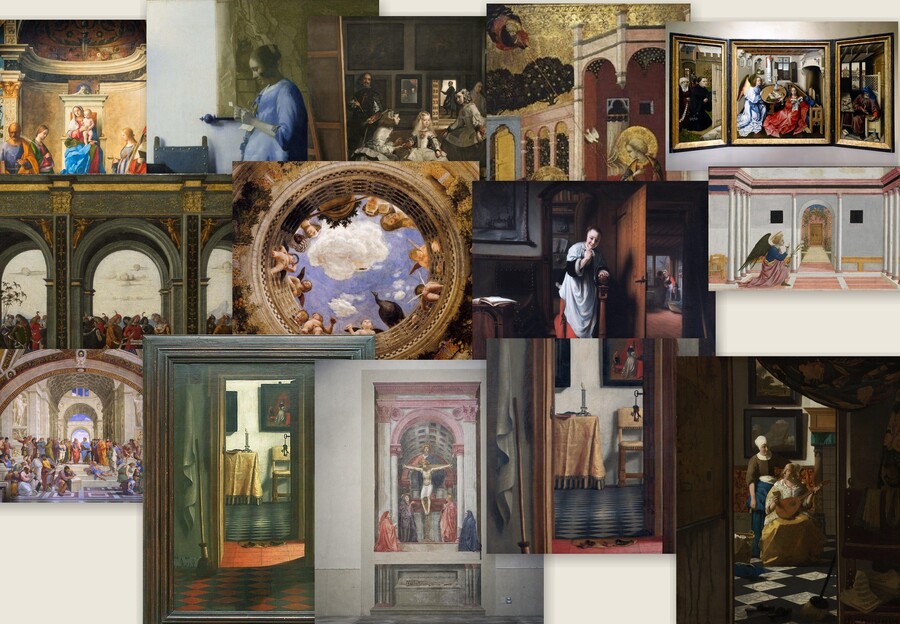
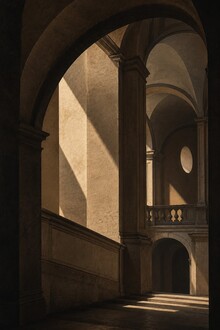
Image generated with artificial intelligence (ChatGPT)
Unlike a solid wall that completely separates spaces, an opening creates the possibility of a partial view. It allows one to glimpse into an adjacent room, see a fragment of a street, notice a silhouette deep within a space, or examine what is happening outside the main frame of the artwork. However, an open passage does not always mean complete accessibility; the viewer may only see part of the action, without the ability to know what lies beyond. Thus, the opening simultaneously reveals space while preserving its mystery.
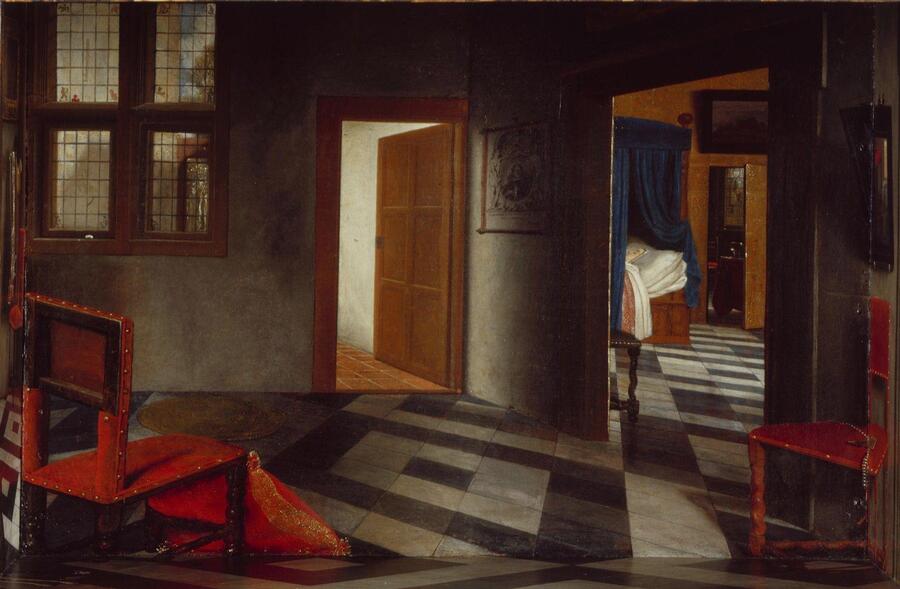
Windows, doors, and arches possess distinct visual and semantic functions. A window connects the interior with the outside world, establishing a sense of distance and allowing one to observe life from a safe vantage point. It can symbolize freedom, anticipation, solitude, or the striving for something unattainable. A door, conversely, suggests the possibility of movement and transition. It denotes the boundary between two spaces, separating the private from the public, the familiar from the unknown. A slightly ajar door creates intrigue: the viewer sees only a portion of the neighboring room and subconsciously tries to imagine what is hidden from their view. Arches, passages, and corridors shape spatial depth, direct attention, and create a sensation of gradual entry into the depicted world.
Image generated using artificial intelligence (ChatGPT)
A crucial element of the investigation becomes the position of the viewer themselves. When examining a painting, we do not always perceive what is happening from a neutral standpoint. Sometimes the composition makes us feel as if we are peering into someone else’s home, observing characters from an adjacent room, or watching an event from behind a wall. This evokes a sense of eavesdropping, accidental presence, or participation in an event to which we technically have no relation. Furthermore, the characters within the painting may also look out of windows, doorways, or beyond the frame, creating additional lines of sight.
Images were generated using artificial intelligence (Chat GPT)
Material Selection Principle
For this study, pictorial artworks dating from the 15th to the 17th century were selected. The primary criterion for selection was the presence of images of windows, doors, and arches in the paintings. Special attention was paid to their significance within the work, their interaction with the viewer, and their role in the composition. The following works were chosen for how vividly they reflect the project’s theme: «The Merodi Altar, ” „Portrait of the Arnolfini Couple, ” „Girl Reading a Letter by an Open Window, ” „The Last Supper, ” „Family Playing Cards with a Servant, ” „The Annunciation, ” „Menin, ” „Eavesdropper, ” „Love Letter, ” „Saint Jerome in His Cell, ” „The Story of Griselda, Part II: Exile, ” „The Trinity, ” „The School of Athens, ” „Oculus, ” and „San Zacchary’s Altar.“
Principles of Selecting and Analyzing Textual SourcesTextual materials were selected based on their relevance to the research topic and their degree of reliability. Art historical and scholarly articles, descriptions of works from museum catalogs, and other publications concerning the significance of architectural elements in painting were used as the foundation. During the study of these materials, special attention was paid to the compositional features of the works, the explanation of the concept, and the purpose of using windows, doors, and arches.
RESEARCH QUESTION
How do architectural openings influence the perception of space and the viewer’s interaction with imagery in 15th–17th-century painting?
HYPOTHESIS
Architectural openings in painting from the 15th to the 17th centuries serve not only decorative and compositional functions but also actively influence the perception of the image. Through windows, doors, and arches, artists construct spatial boundaries, guide the viewer’s gaze, reveal or conceal specific parts of the depicted world, forming a unique interaction between the painting and the observer.
WINDOW
Before the 18th century, the relationship artists had with the window gradually changed.
— Middle Ages: The window was often perceived as a source of divine light and a symbolic transition between the earthly and spiritual worlds.
— Renaissance: The window becomes a way to display space, architecture, and landscape. Artists begin using it to create depth.
— 17th Century: Especially in Dutch painting, the window transforms into a means of observing daily life. It becomes part of the painting’s psychological space.
Window as the boundary between the earthly and spiritual worlds
Robert Campin’s workshop — «The Mérode Altarpiece» (The Annunciation), c. 1427–1432
In the «Merodsk Altar, ” the window becomes a symbolic boundary between the earthly and spiritual realms. Natural light permeates through it, symbolizing the presence of God and the divine beginning. Simultaneously, the window connects the sacred event of the Annunciation with an ordinary domestic interior, illustrating how the spiritual intrudes upon everyday human life.
The Window as a Compositional Element
The Last Supper. Leonardo da Vinci. 1494–1498
In Leonardo da Vinci’s painting, «The Last Supper,» the windows serve as a crucial compositional element: they are positioned behind the figures of Christ and the apostles, creating a sense of spatial depth. The central window accentuates Christ’s figure, directing the viewer’s gaze toward him and reinforcing the painting’s compositional center.
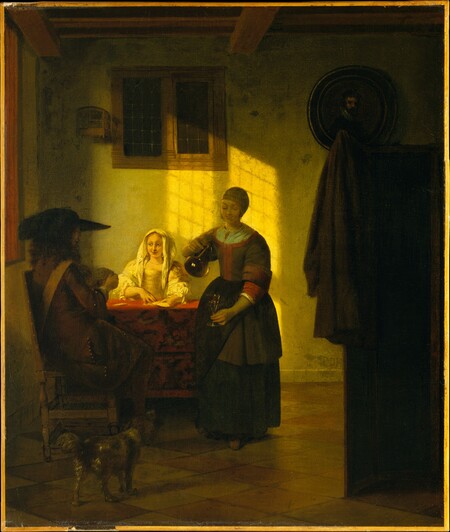
«A Family Couple Playing Cards with a Servant.» Pieter de Hooch. c. 1665–1675.
Although the window is not depicted directly here, its presence is felt through the lighting. This technique helps the artist organize the composition: the light draws attention to the main characters and their actions, creates a contrast between illuminated and shadowed areas, emphasizes the volume of objects, and suggests the depth of the space. The window becomes an invisible compositional element that directs the perception of the space.
The window as a connection between private life and the outer world
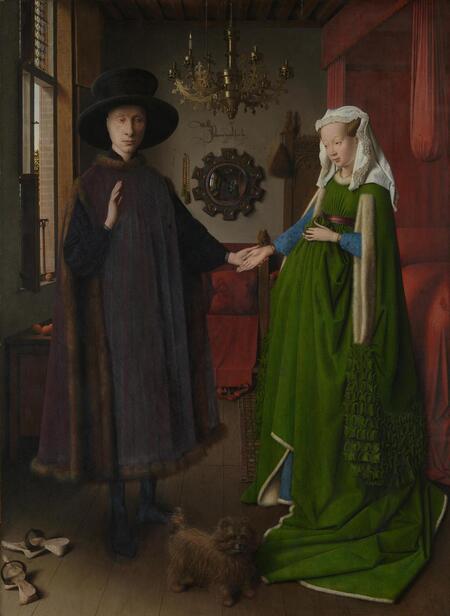
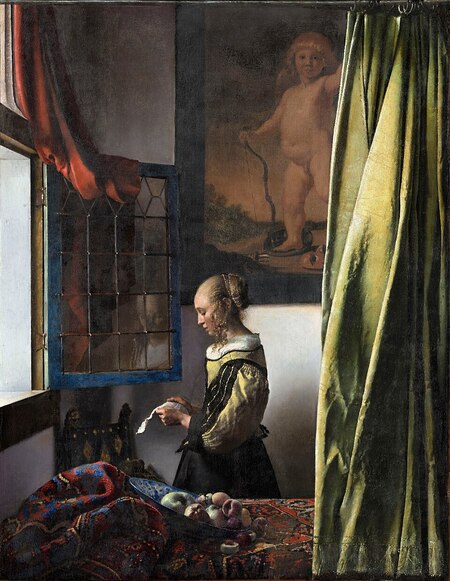
1. Jan van Eyck — «The Arnolfini Portrait, ” 1434. 2. Johannes Vermeer — „Girl Reading a Letter by an Open Window, ” circa 1657–1659.
In Jan van Eyck’s «Arnolfini Portrait, ” the window symbolizes the connection between the enclosed private space and the external world. Through it, daylight streams into the room, revealing the surrounding environment. It underscores the boundary between the couple’s private lives and external reality.In Jan Vermeer’s painting „Girl with a Letter by the Open Window, ” the window serves as the demarcation between the private and the external world. The girl resides in a secluded space, absorbed in reading a letter, and the open window visually links her to the surrounding reality. It symbolizes the possibility of the outside world infiltrating private life through light, air, and the letter itself, which carries news from beyond.
DOOR
A door establishes a relationship between what we see and what remains hidden. It creates several levels of pictorial perception:
1. An open door—it reveals an additional space, allowing a glimpse into an adjacent room, or showing what is happening beyond the main subject. 2. A closed door—it generates a feeling of inaccessibility, mystery, isolation, or prohibition. 3. A slightly ajar door—it builds intrigue: the viewer sees only part of the action and independently constructs the hidden scene.