Navigation
- Introduction. Research Concept.
- Flowers as Symbols in 15th-Century Painters’ Works.
- Roses as Symbols of Love and Beauty in the Works of Sandro Botticelli.
- The Lily as a Symbol of Spiritual Purity in the Works of Leonardo da Vinci and Jan van Eyck.
- Carnations as Symbols of Engagement and Marriage in the Paintings of Jan van Eyck, and as a Symbol of Compassion in the Works of Leonardo da Vinci.
- The Significance of Wildflowers in 15th-Century Painting.
- Conclusions.
- Bibliography.
- Image Source Citations.
Introduction
When we examine the works of great artists, we strive to understand the meaning the creators intended to convey through their pieces. Everything matters: color, shadow, composition, detail, and technique. This visual investigation is dedicated to studying colors as symbols in 15th-century visual arts. We are particularly interested in the hidden meanings of roses, lilies, daffodils, and other flowers, as well as the significance of the small details in their depiction.
The main idea is to explore the purpose for which artists depicted flowers in their paintings and the meaning they imbued them with. What symbolic meanings predominated in 15th-century paintings featuring flowers—religious significance, the conveyance of human emotion, or cultural and historical context?
Material selection for the visual study was based on two criteria: the painting had to date from the 15th century, and the painting had to depict flowers. The research question was as follows: What role did flowers play in 15th-century painting, and what significance or meaning did artists of that period attribute to them? Did the symbolic meaning of flowers depend on the painting’s composition and subject matter?
It is interesting to analyze which flowers appear most frequently in the works of 15th-century artists. Do all flowers carry symbolic meaning, or could they have been used merely for decorative purposes? The research attempts to group and analyze paintings based on specific types of flowers: for example, analyzing paintings depicting lilies and their symbolic significance separately from paintings depicting roses, and so on. Does the meaning of these flowers remain consistent across the paintings of different artists? For instance, is the lily always interpreted as a symbol of purity, and the rose as a symbol of love?
Research Hypothesis: In 15th-century paintings, artists depicted flowers to convey hidden meaning rather than for mere decorative embellishment. If flowers appear in a painting depicting a biblical scene, the flower becomes a religious symbol. If the painting illustrates a mythological subject, the flowers are imbued with philosophical symbolism. If the painting is secular in nature, the flowers convey widely accepted social meanings. It can be hypothesized that during this period, flowers were not represented for decorative purposes but were all laden with hidden meaning and significance.
This study examines the paintings of Jan van Eyck, Leonardo da Vinci, Sandro Botticelli, and other artists who placed particular emphasis on color. The research is presented in sections: the first general part explores the symbolism of colors in 15th-century painting, followed by a selection of paintings featuring roses, lilies, daffodils, and wildflowers, complete with descriptions of their meaning within each artwork.
In the conclusion, the research hypothesis is confirmed, and the principal symbolic meanings of colors in the works of 15th-century artists are described. To enhance the semantic impact of the paintings, 15th-century artists utilized floral symbolism to evoke an emotional response in the viewer.
Flowers as Symbols in 15th-Century Artists' Paintings
The symbolic meaning of colors in 15th-century paintings can be divided into three groups:
- Religious Meanings. For example: the lily (white) symbolizes the Virgin Mary, purity, and innocence. The white rose symbolizes purity, while the red rose symbolizes love. In Christian symbolism, the combination of white and red roses represents the union of all Christians.
- Secular Symbolism. The carnation symbolizes engagement and fidelity. Field flowers represent renewal, blossoming, and hope.
- Historical Context. Flowers symbolize the crest of a city or region and are connected to historical facts.
The study posits that paintings by 15th-century artists predominantly feature religiously significant color symbolism, as the primary subject matter in works from this period is Christian.
Roses as a Symbol of Love and Beauty in the Works of Sandro Botticelli
Sandro Botticelli. Spring. 1482.
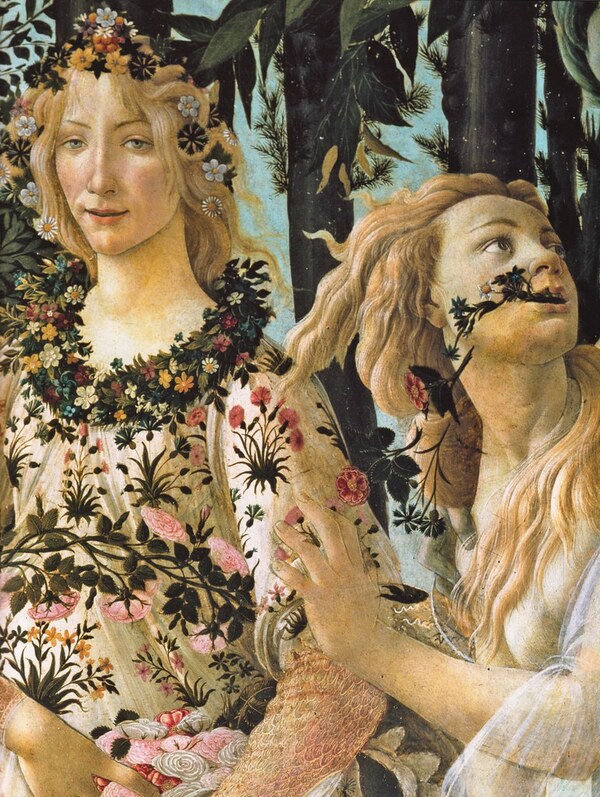
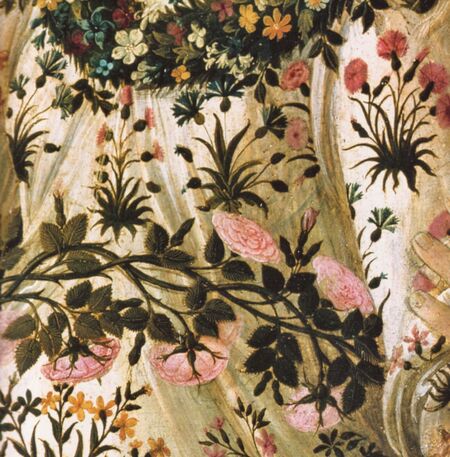
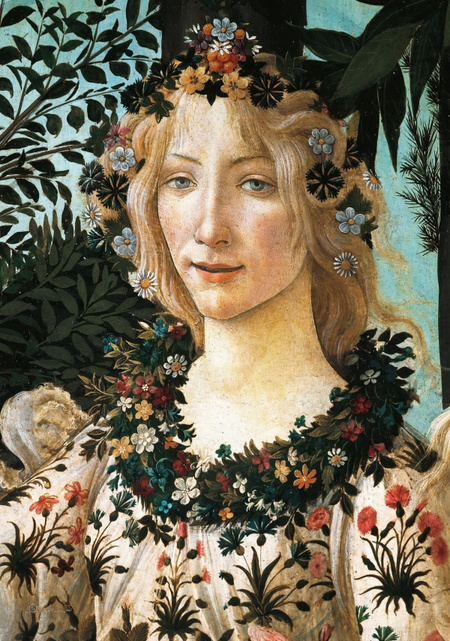
The goddess Flora showers roses from her hem, symbolizing purity (white roses) and love (red). According to one version, this painting was a wedding gift. The tradition of scattering roses before newlyweds continues to this day. Sandro Botticelli selects delicate shades of roses—from beige to soft pinks and muted reds. This combination of purity, tenderness, and love harmoniously comes together in the colors that play a special role in this painting.
Sandro Botticelli. The Birth of Venus. 1486.
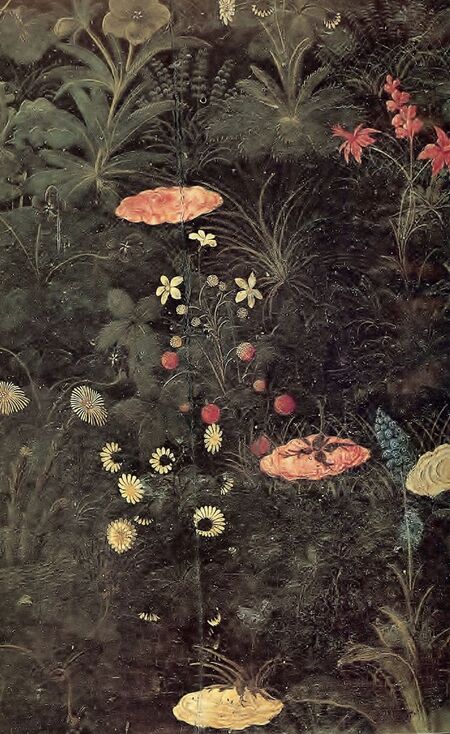
Botticelli imbues every flower in this painting with its own symbolism. Roses mark Aphrodite’s path—where her foot has trod. These are white and soft pink roses, the very shades Botticelli frequently employs in his works. The rose, an ancient flower of Venus, symbolizes love and suffering. In these two pieces, you can also find numerous wildflowers: violets on a cloak (a symbol of fertility), daisies on the shore (a symbol of purity and innocence), and cornflowers (fertility).
S. Botticelli. Madonna in the Pink Garden. 1470.
Behind Maria is a rose garden—a symbol of her purity and innocence. Since the rose bushes are presented as a garden, many art critics interpret the symbol as the heavenly Garden of Eden.
The examples in these paintings show that S. Botticelli uses the rose as a mythological and religious symbol. The roses accompany the imagery of the goddess Flora and become a symbol of the purity of the Virgin Mary.
Lily as a Symbol of Spiritual Purity in the Works of Leonardo da Vinci and Jan van Eyck
Jan van Eyck. The Annunciation. 1434.
The white lily in Jan van Eyck’s «Annunciation» composition symbolizes Mary’s purity. The three petals of the lily are often read as a symbol of the Holy Trinity—the unity of the Father, the Son, and the Holy Spirit. Furthermore, the lily also suggests future suffering: the plant’s leaves resemble thorns, which served as a reminder that the news of Christ’s birth foreshadows both His crucifixion and the sorrows of the Mother of God.
Jan van Eyck. Ghent Altarpiece. Annunciation Scene. 1390.
Archangel Gabriel presents the Virgin Mary with a white lily—a symbol of purity and innocence. Some suggest that the artist originally depicted an olive branch instead of the lily—a symbol of good tidings. Ultimately, the artist settled on the lily.
Leonardo da Vinci. The Annunciation. 1476.
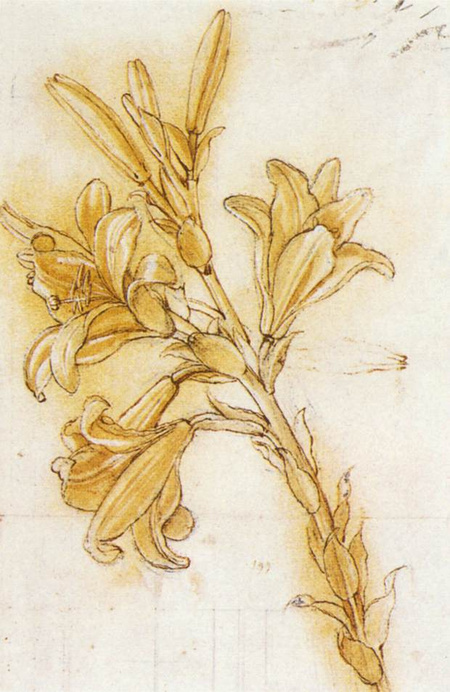
Leonardo approached this symbol with great care, and individual sketches of the lily, which the young artist rendered with particular precision and attention to detail, have been preserved. For Leonardo, the lily was a steadfast symbol of the purity and innocence of the Virgin Mary.
In Leonardo da Vinci, the lily is a symbol of the Annunciation. In Jan van Eyck, the lily functions as an overarching motif within a biblical narrative. The symbolic meanings of the lily as an artistic representation converge.
Carnation as a symbol of engagement and marriage in the paintings of Jan van Eyck, and as a symbol of compassion in Leonardo da Vinci.