Concept
The question of what means to use to depict history has always fascinated artists and has been crucial to painting and visual communication.
In narratives and books, depicting a story is much simpler using prepositions and auxiliary words; in painting, it is significantly more complex. Narrative in paintings can be conveyed through composition. In painting, details are crucial for the plot—such as the distance between figures, the direction of a gesture, or a repeating element of clothing—all of which reconstruct a sequence of actions and help reveal the scene’s content.
It is interesting that all moments of a history can be viewed simultaneously, yet the viewer’s gaze might first register the consequences of the work, only to uncover its initial cause later. Studying such phenomena helps us understand how an artist engages the viewer’s attention, because this dictates the overall perception of the piece and the understanding of its meaning.
«The core principle of narrative in medieval art lies in presenting not just one, but several events or actions on the same plane. The viewer, alongside the main character, seems to move from one stage of the events to another, much like the spectator of a so-called simultaneity scene.» [1]
This topic immediately captured my interest, prompting my research to focus on 15th-century Italian painting, where artists conveyed the passage of time through the reappearance of characters within a single composition. I was struck by how, at first glance, it appears that the actions of multiple figures are occurring simultaneously; yet, upon closer inspection, you realize that two figures represent the same person. This observation entirely shifts the perception of the entire work. The meaning of the scene fundamentally changes—the space between objects begins to be perceived as a span of time between two actions. This led me to wonder what techniques were employed to recreate the narrative and how to decipher the flow of the story just by looking at the image.
The research will be based on frescoes and painted panels by 15th-century Italian masters. A crucial element is the recurrence of a character within a single composition. In this work, I am relying on art historical studies, books, and scientific articles about 15th-century Italian painting.
The structuring will be determined by several themes that collectively unveil the research problem. The first part will address the details that allow the viewer to identify the character across various episodes. The second part will examine how the specific placement of figures, architecture, and landscape help track the plot and the hero’s journey. The third part reveals how the varying scales of figures, gestures, and contrast guide the viewer’s attention and emphasize a particular event. The conclusion will summarize the understanding of the scene upon a first glance versus a thorough examination, as the viewer reconstructs the entire narrative.
The central research question is: how did 15th-century Italian artists enable the viewer to reconstruct the sequence of events within a single composition? I believe that the depiction of the central figure helps the viewer connect several figures to the fate of a single character, linking everything into one narrative thread. The viewer reconstructs the order based on the interaction between the figures and the surrounding space. The discrepancy between the painting’s focal point—which guides the viewer’s gaze—and the unfolding action helps to interpret the story. For instance, the viewer first notices the central action, and only then the consequences or the preceding circumstances.
Chapter 1. Details Affecting Character Recognition
«We know clearly that sight is one of the fastest actions that exist; at one point, it perceives infinitely many forms, yet it immediately understands only one object.» [2]
A viewer looking at a painting might wonder how to distinguish one person across different periods if the same character is depicted. It might seem that identification could be made by clothing or the character’s pose. However, this can change throughout the narrative. This chapter will examine the details that affect a character’s recognizability upon reappearance, as well as the gestures and actions that influence the story’s progression.
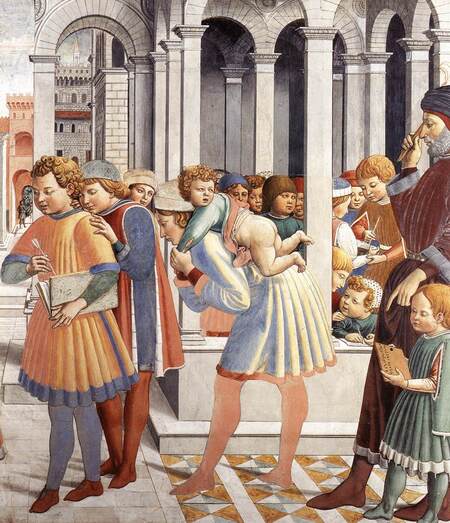
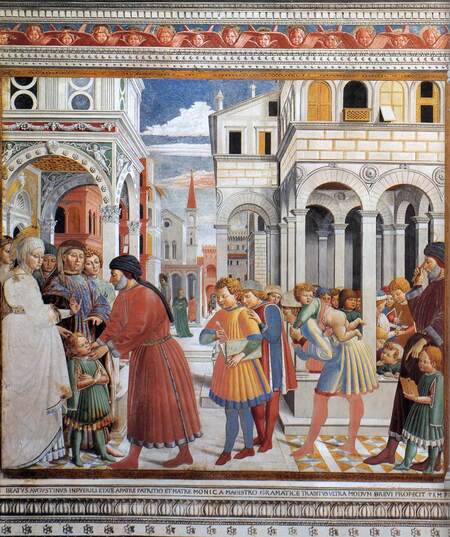
Benozzo Gozzoli. «School in Tagaste»
On the left side of this fresco, you can see a young Augustine standing next to his mother. On the right, we notice a boy in the same green attire, holding a writing tablet. «Gozzoli combines the successive method of narrative with a unity of place and a new conception of space—a single vanishing point, a singular light source, and unity of scale.» [1] By using a single shade of clothing for the central figure, one can recognize the same person, and the writing tablet helps convey that some time has passed. The narrative sequence is as follows: first, we see the boy who has just arrived at school; over time, he studies there and completes an assignment.
If Gozzoli requires merely matching two adjacent figures, Botticelli’s heroes must be sought throughout the entire fresco.
Sandro Botticelli, «Scenes from the Life of Moses»
On the right side, Moses raises his weapon over the Egyptian, while nearby, by the well, he draws water for the sheep. On the left, he leads the people. In each scene, Moses is depicted differently, but his yellow robes allow him to be recognized even where he is bent over and his face is barely visible. When all these images are viewed together, the distinction between his gestures becomes particularly noticeable. In one case, Moses swings his arm for a blow; in another, with that same hand, he draws water from the well.
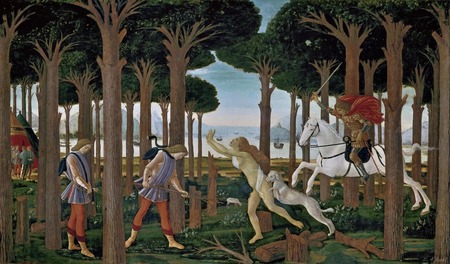
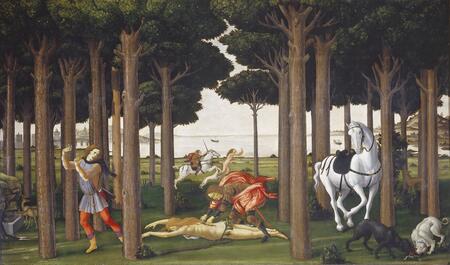
Sandro Botticelli and the Workshop. «The History of Past Judgment, ” first and second panels
In the episode featuring Nastadjo, the uniform helps reveal the character’s gestures. Here, however, the gestures expose the protagonist’s reaction to a single event across different moments. In the first panel, the young man sees a girl being pursued by a rider and dogs, and he snatches a branch, intending to protect her. In the next scene, he retreats in horror. Comparing the images, it becomes noticeable that Nastadjo changes direction: initially, he rushes toward the girl, and then moves away from her. The costume allows us to immediately recognize the young man in both instances. But how can we determine that these are the same characters if their clothing changes throughout the story?