Concept
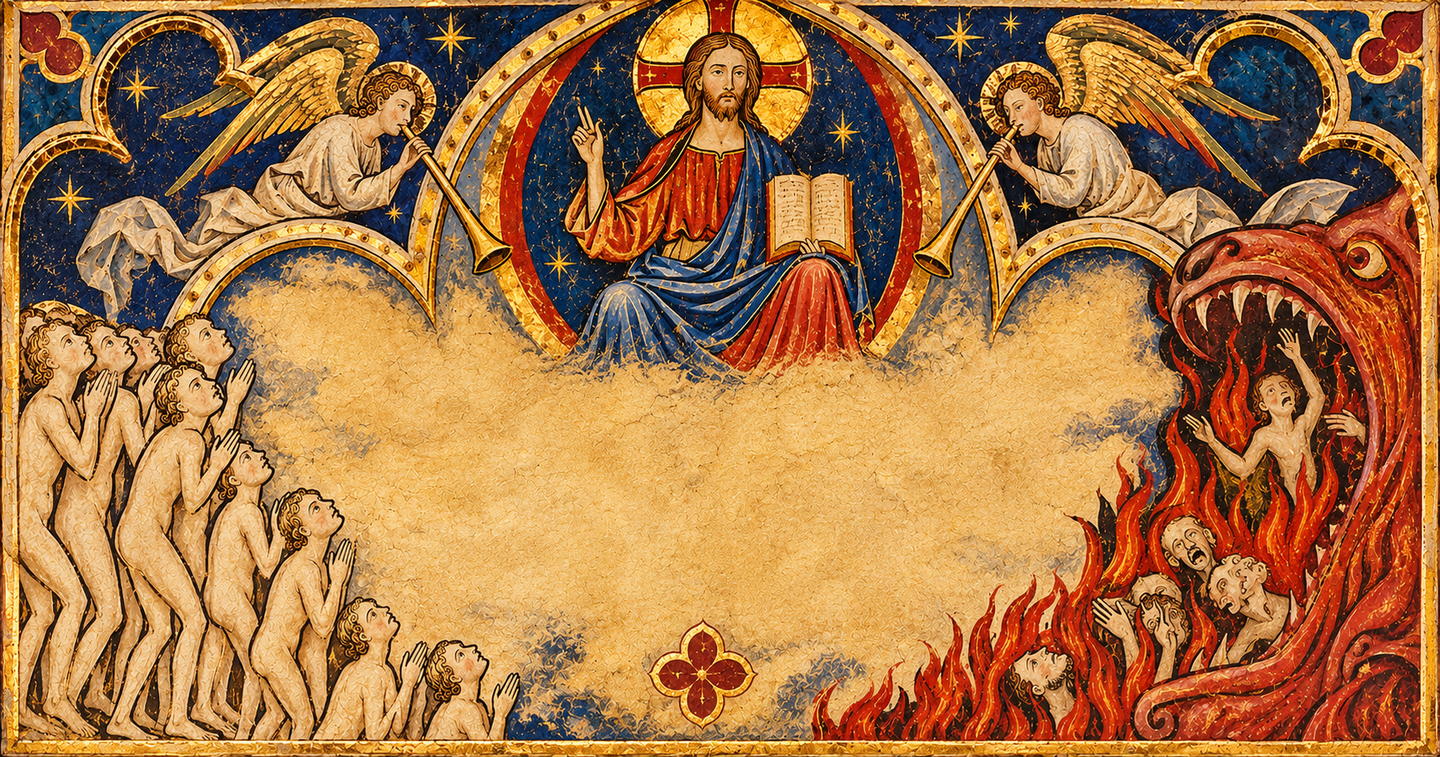
Medieval depictions of the Last Judgment and Hell explained to the viewer what posthumous judgment entailed. The fear in these images was created by the structure of the artwork itself. In the art of the 11th–14th centuries, the Last Judgment was portrayed as an event that determined the fate of every individual. Christ appeared as the judge, the deceased were resurrected, the righteous achieved salvation, and the sinners ended up in Hell. They were placed on church portals, in manuscripts, and on personal prayer items. Artists were required to convey a complex religious meaning in such a way that it could be understood through the arrangement of figures, gestures, and recognizable symbols.
The main research question
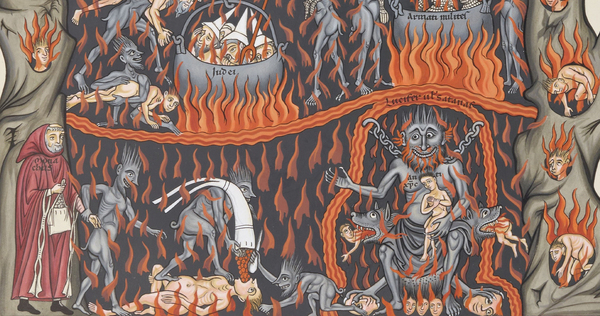
What visual means did artists use to make the fear of punishment tangible? It is assumed that two different principles operate in scenes of judgment and hell. The court is structured around a clear order: the central figure of Christ, symmetry, sequential rows of people, and the division between the saved and the condemned. Hell, on the other hand, is depicted through confinement, monstrous jaws, abrupt movements, and bodies stripped of freedom. This juxtaposition illustrates the finality of the verdict and the torment of the condemned. To facilitate comparison, ten works from the 11th–14th centuries were selected from the collections of the Vatican Museums, the Victoria and Albert Museum, the Metropolitan Museum of Art, the Fitzwilliam Museum, and the Walters Art Museum. The study incorporates ivory carving, wood painting, and illuminated manuscripts. Scale alters perception: a large composition is viewed holistically, while a miniature is examined up close. This distinction leads to differences in scene density, figure size, and methods of depicting action.
Research Method
Attention is drawn to the compositional axis, the distribution of figures, scale, gestures, the forms of the demons, and the depiction of the human body. The variations depended on the region, the commission, and the object’s purpose. The goal of the work is to demonstrate how medieval art linked moral choice with visible images of order and its loss, without imposing feelings onto the historical viewer for which we have no direct evidence.
The court of judgment intimidates with the clarity of its verdict. Hell—the destruction of the familiar order.
The material is organized into five chapters. First, the strict judicial scheme in works from the 11th–12th centuries is examined. Next, it is traced how the Arch in the 13th century gains recognizable contours, and punishment is conveyed through movement and gesture. Then, different artistic traditions are compared: some monuments feature clear tiers, while others present tense interactions between figures. The final chapter is dedicated to the 14th century, when small images allow for an especially detailed study of the fate of an individual.
Order as a Threat
Unknown author. «Doomsday» of the 11th century.
Narrative and core symbols.
In the small ivory relief, the Last Judgment is depicted as a sequence of interconnected events. At the top, Christ, surrounded by the apostles, stands as the supreme Judge, while the Virgin Mary and John the Baptist pray to him for humanity. This motif is that of the Deisis—intercession before Christ. Below, the resurrection of the dead, the saved, and the condemned are shown. In the center is the prepared throne, bearing a book and the signs of Christ’s Passion—the Theophany. It serves as a reminder of the judgment even before the viewer examines the individual punishments.
Composition and Visual Language.
The relief is divided into small registers, resembling lines of a complex narrative. The upper figures are placed with solemnity and symmetry; their stable poses convey the immutability of Divine order. In the lower scenes, however, gestures and directions of movement become more varied. The composition is structured so that the viewer’s eye moves from the static center of power toward the fates of individual people. The small scale requires focused observation—each gesture acquires meaning, and the density of the figures heightens the tension.
How the feeling of horror is created.
There is almost no need to depict the torture in detail. The fear arises from the structure of the trial itself: the world is divided into two incompatible spheres, and after the verdict is delivered, the path cannot be changed. Christ’s position above the other characters underscores the contrast between the absolute authority of the Judge and human vulnerability. Simultaneously, the presence of intercessors softens the image: the work connects the anxiety preceding punishment with the hope for mercy. For the viewer of the 11th–12th centuries, this was a visual explanation of moral choice and its consequences.
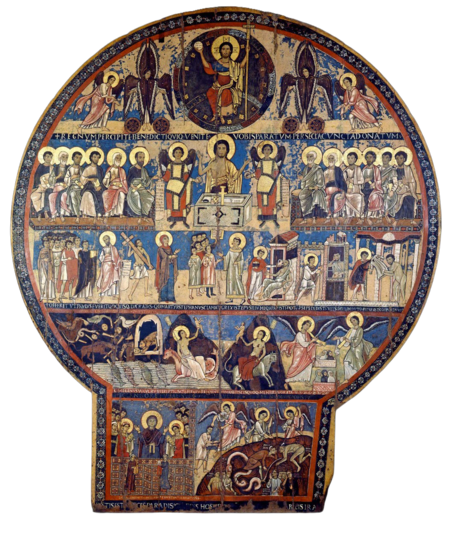
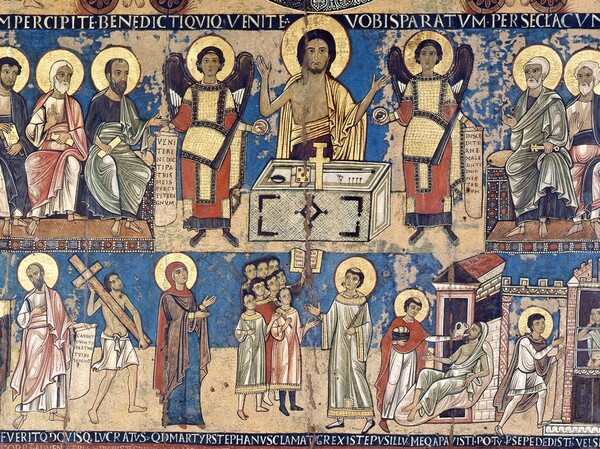
Nicholas and John, «The Last Judgment,» second half of the 12th century.
Narrative and Concept.
The icon of Nicholas and John in the Vatican Museums has an unusual shape: a circular top joined to a rectangular base. The scene is divided into five horizontal bands with Latin inscriptions. At the top, Christ is depicted among angels; below, Christ is shown with the apostles. The middle tier includes the righteous, the intercession of saints, and acts of mercy: aiding the needy is linked to the hope of salvation. Further down, angelic trumpets awaken the dead, and fish and beasts return the parts of the bodies they have consumed. The base contrasts Hell and the Heavenly Jerusalem.
How the image is organized.
Artists do not depict a single scene in one space. Instead, they assemble it from individual episodes, each of which can be viewed as a step in a larger narrative. The viewer’s gaze moves from top to bottom—from the source of the law to human actions, and then to resurrection and final judgment. The Latin inscriptions help interpret the composition as a religious text. The combination of repeating figures, clear stratification of levels, and contrasting lower sections creates a sense of immutable order.
Fear and Moral Significance.
The episode depicting animals and fish returning the remains of the deceased is particularly poignant. It illustrates that neither death nor the destruction of the body absolves a person of responsibility for their lived life. The terror here stems from the universality of judgment—everyone must face it. Simultaneously, the imagery of mercy provides the viewer with a clear ethical guide. Hell does not exist separate from earthly life; rather, it is shown as a potential outcome of specific human actions. For this reason, the icon serves both as a warning and as a moral lesson.
Symmetry renders the verdict final: every person already has their place.
Ad receives the form
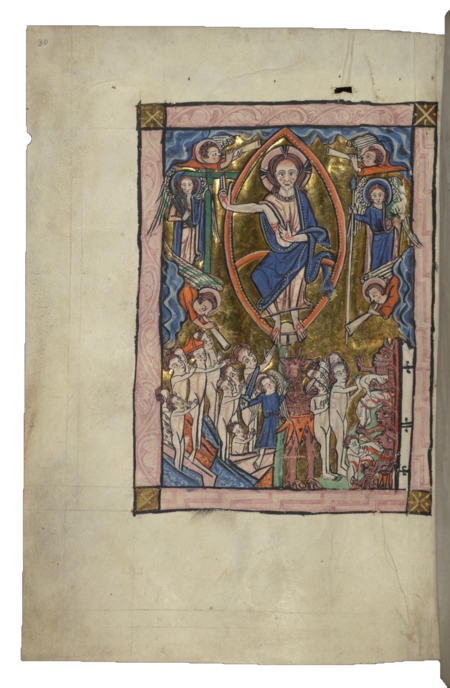
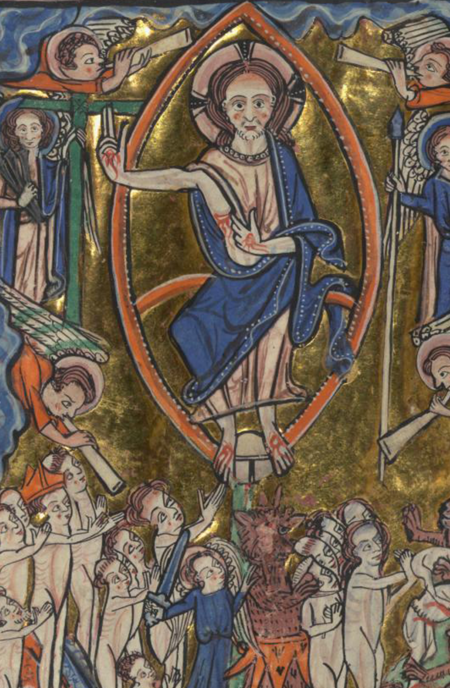
Unknown author. Carroque Psalter, c. 1250.
Plot and key figures.
A miniature from the Carroux Psalter, created in England around 1250, combines two sequential scenes. In the upper section, Christ appears in glory as the Judge of the world. Below, the deceased rise from their graves, while the devil guides the condemned to Hell. This combination does not depict a single moment, but rather the development of events: the appearance of the Judge, the resurrection of people, and the beginning of divine retribution. The miniature emphasizes the distinction between those who possess the authority to determine fates and those who are forced to accept the verdict.
Rhythm, movement, and scale.