Concept
I chose the topic of medieval stained glass because I am interested in examining it not only as decorative ornamentation in cathedrals but also as a means of conveying religious ideas and worldviews. Through their stained glass, medieval artists told biblical stories, depicted rulers, daily life, and symbolic imagery that reflected the mindset of their time.For this study, I selected stained glass windows from European cathedrals dating from the 12th–13th centuries, which fall within the stated period of the 11th–14th centuries. The primary examples were Bourges Cathedral, Chartres Cathedral, and Saint-Chapelle in Paris. When selecting the works, I focused on the variety of subjects, their historical significance, and the potential for detailed visual analysis.The research is structured thematically. First, the characteristics of medieval stained glass are examined, followed by biblical narratives, depictions of kings and rulers, scenes of everyday life, and symbolic compositions. In conclusion, the findings of the analysis are synthesized to identify the common principles of representing the world in medieval art.Scientific publications, museum catalogs, and materials from the official cathedral websites were used as textual sources. These resources help to establish the dating of the works, identify the depicted narratives, and understand the historical context. However, the main focus remains on the independent analysis of the imagery: composition, character gestures, sequence of scenes, and symbolic details.
How were religious ideas and conceptions of the world conveyed through the imagery and narratives of medieval stained glass windows from the 11th to the 14th centuries?
Medieval stained glass windows are not merely a collection of individual religious images, but an entire system of interconnected figures and narratives that reflects the Christian worldview of the medieval human regarding the structure of the world.
Chapter 1. Introduction to the World of Medieval Stained Glass.
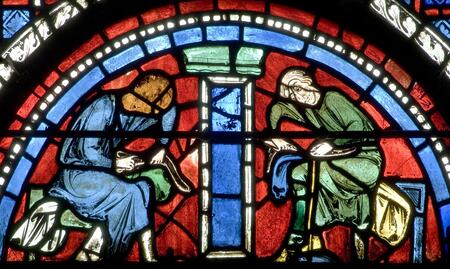
In medieval cathedrals, stained glass windows were far more than mere decoration. They told biblical stories, depicted saints, and conveyed crucial religious ideas. Furthermore, the significance was not limited to the imagery itself, but also to its placement within the church. Chartres Cathedral is a prime example, where its stained glass can be divided into three main groups. The lower windows are dedicated to events from the Holy Scriptures and stories from the lives of saints. They are composed of numerous small scenes that the viewer can observe sequentially.
Fragment of the «Good Samaritan» stained glass window (Window No. 44) from Chartres Cathedral. Photo: Peyton Cowan.
The upper windows often depict large figures of saints and biblical characters, clearly discernible even from a distance.
Stained glass in the lancet windows of the south transept of Notre Dame Cathedral in Chartres. Photo:
The large rose windows, which unite numerous images around important religious themes, hold a special place.
Fragment of the Western Rose («The Last Judgment») of Chartres Cathedral. Photo: Stefan Mao.
The stained glass windows of Chartres Cathedral formed a unified system, in which each image held its own distinct meaning and place. Biblical narratives, depictions of saints, and other symbolic imagery converged into a cohesive whole, creating a vast panorama of the Christian world.
Chapter 2. Stories from Sacred Scriptures.
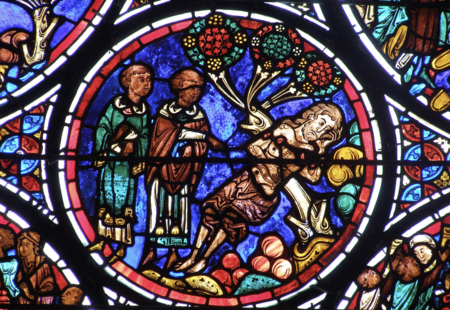
One of the central themes of medieval stained glass art was the stories from the Holy Scriptures. Cathedral windows depicted events from the Old and New Testaments, the life of Christ and his disciples, as well as Gospel parables. Through these narratives, the masters conveyed religious ideas that were vital to medieval society.The «Good Samaritan» stained glass window was created around 1205–1214. It is located in the northern part of the ambulatory gallery of Bourges Cathedral.Fragment of the «Good Samaritan Stained Glass Window» (Vitrail du Bon Samaritain), located in Saint Stephen’s Cathedral in Bourges. Photo: Gdessenne.
The work is based on a parable from the Gospel of Luke (10:30–37). It tells the story of a man who traveled from Jerusalem to Jericho, was attacked by robbers, and was left without help. A priest and a Levite passed by, but a Samaritan stopped, took care of the injured man, and helped him find shelter.A fragment of the «Window of the Good Samaritan» (Vitrail du Bon Samaritain), located in the Saint Stephen’s Cathedral in Bourges. Photo: Gdessenne.
The defining feature of this stained glass window is that the story of the Samarian is not depicted in isolation. The central medallions containing the parable’s events are framed by other biblical narratives that illuminate its religious significance.
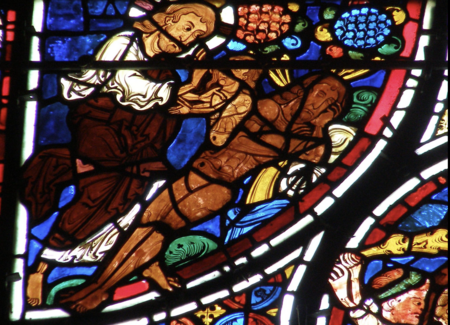
The upper section of the composition features scenes of creation and the lives of the first people in paradise. This is followed by the Fall of Adam and Eve, their expulsion, and events from the Old Testament. The lower portion of the stained glass panel depicts scenes related to Christ’s suffering and crucifixion.
Fragment of «The Stained Glass of the Good Samaritan» (Vitrail du Bon Samaritain) in Saint Stephen’s Cathedral in Bourges.
At first glance, these stories appear to relate to different events and eras. However, within medieval Christian interpretations, they were unified by the common theme of humanity’s salvation. The suffering traveler was perceived as an archetype of a person needing help and rescue. The Good Samaritan, in turn, symbolized Christ. Thus, the story of mercy gained additional religious significance. It is interesting that this idea is conveyed through the arrangement of the images in the stained glass.
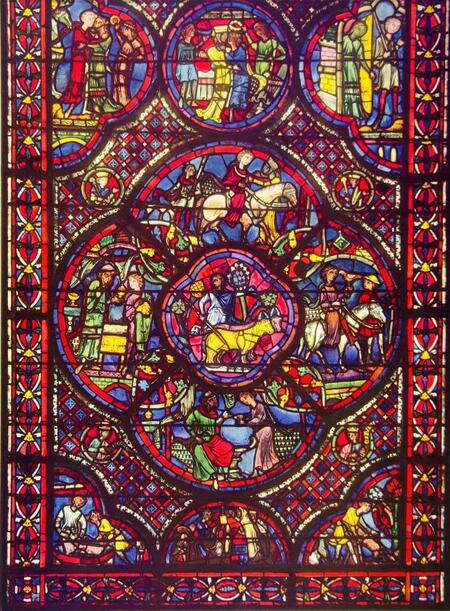
Another example is the stained glass window «The Prodigal Son, ” created around 1205–1214.
Its foundation is a parable from the Gospel of Luke (15:11–32). It tells the story of a younger son who asked his father for his share of the inheritance, left home, and squandered his fortune. When he found himself impoverished, he decided to return. The father forgave his son and threw a celebration to welcome him home, which caused resentment in the older brother.
Unlike the „Good Samaritan“ stained glass window, the primary focus here is the sequential development of a single narrative. The master depicts discrete events in the main character’s life, allowing the viewer to trace the changes in his circumstances.
Fragment of the „Parable of the Prodigal Son“ stained glass window from the Bourges Cathedral (Saint Stephen’s Cathedral in Bourges, France).
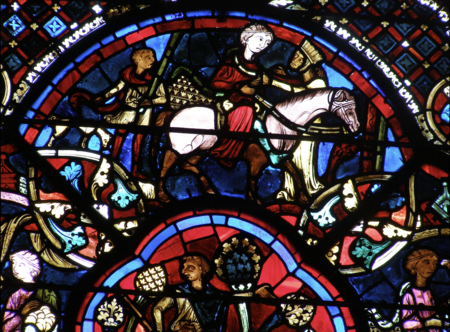
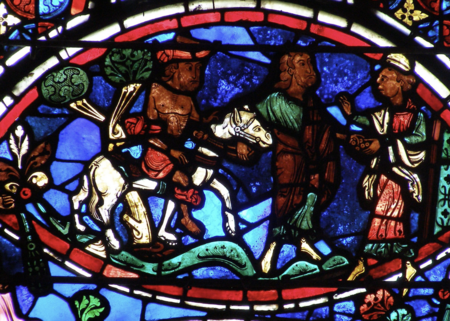
In one episode of the Prodigal Son, he is depicted riding a horse with a falcon on his arm. He is dressed in expensive attire reminiscent of a wealthy man’s suit from the 13th century.
This detail is particularly interesting because the artist transplants the biblical narrative into the familiar medieval reality of his time. The hero of the Gospel parable looks like a representative of the society in which the master himself lived.
Fragment of the stained glass window «The Parable of the Prodigal Son» (French: Vitrail de l’Enfant prodigue) from Saint Stephen’s Cathedral in Bourges. Photo: MOSSOT
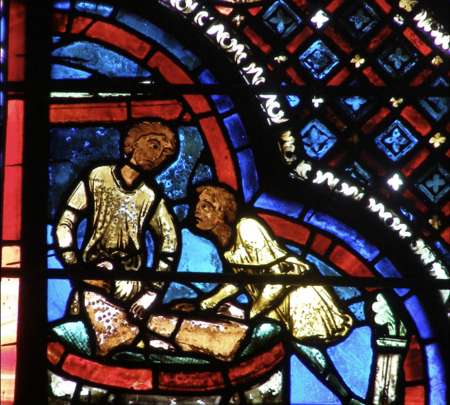
As the story progresses, the hero’s situation changes. His initial prosperity gives way to poverty, and then he returns to his father. This contrast helps convey the central theme of the parable—the possibility of repentance and forgiveness.A fragment of the stained-glass window «The Parable of the Prodigal Son» from Bourges Cathedral. Photo: MOSSOT
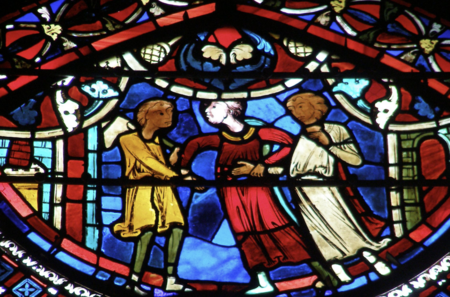
The final scene of the stained glass demands particular attention. The Gospel narrative concludes with a conversation between the father and his eldest son, who refuses to participate in the celebration. However, the master adds an extra episode: the father stands between the two sons, attempting to join their right hands.
It appears that the artist is not simply illustrating the biblical text, but is supplementing it with an image of reconciliation.
Fragment of the stained glass «Parable of the Prodigal Son» (French: Vitrail de l’Enfant Prodigue) from Bourges Cathedral.
The sequence of images plays a crucial role here as well. If the meaning in the Good Samaritan stained glass window is revealed through the juxtaposition of different biblical stories, then in «The Prodigal Son, ” it gradually forms through the changing posture of the main character.
Chapter 3. Kings and Rulers.
In addition to narratives from the Holy Scriptures, images of saints and miracles associated with their lives occupied an important place in medieval stained glass art. Unlike biblical subjects, many of these stories recounted events that occurred relatively recently and were tied to specific people and places. Saints were depicted not only as significant religious figures but also as intercessors whom people sought help from. Therefore, stained glass windows featured both solemn depictions of saints and entire narratives about pilgrims and miraculous healings. The Sainte-Chapelle in Paris is a particularly interesting example—a royal chapel constructed by order of Louis IX between 1241 and 1248.
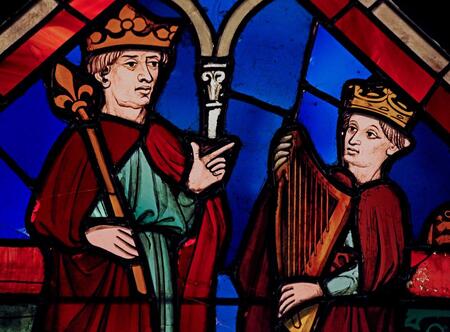
One of the significant narratives in Sainte-Chapelle is the story of the Old Testament kings. A dedicated window on the south side of the upper chapel is devoted to this theme.It depicts events related to the history of the rulers of Israel. The figures of David and Solomon hold particular significance, as they were viewed in Christian tradition as important examples of royal authority.Visually, these characters stand out due to their crowns, formal attire, and prominent placement among the other figures. Such details immediately signal their high status to the viewer.Fragment of the medieval stained glass window «David and Saul» from Sainte-Chapelle.
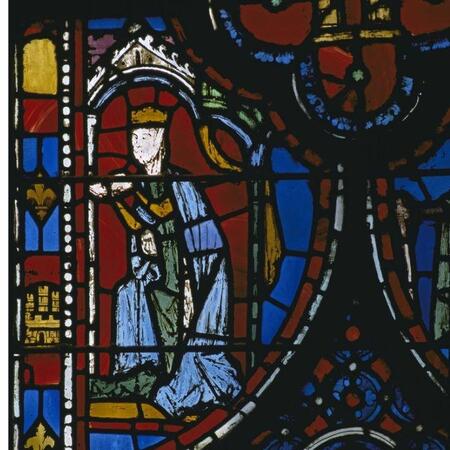
Another important theme in Saint-Chapelle is the story of Esther, which is dedicated to a separate window.Esther was the wife of the Persian King Artaxerxes, who is referred to as Ahasuerus in the biblical text. According to the Book of Esther, she succeeded in having a decree that threatened her people overturned.The window depicts the story through a sequence of scenes. Esther appears before the king, makes a plea to him, and participates in events that determine her people’s fate.The placement of this window is particularly interesting. It is situated above a location associated with Queen Blanche of Castile—mother of Louis IX, who played a crucial role in governing France.A fragment of the 13th-century stained glass «The Story of Esther» from the Chapel of Saint-Chapelle, photo: Bernard Acloc
«Saint Louis and Robert d’Artois carrying relics of the Passion of Christ, ” stained glass, Sainte-Chapelle in Paris, photographer: Bernard Acloc
The stained-glass window dedicated to the history of the Holy Relics of Christ’s Passion holds a special place. Unlike the other windows of Saint-Chapelle, this one depicts not only distant biblical events but also the history of the sacred relics' transfer to France. In one of the medallions, Louis IX is shown alongside his brother Robert d’Artois. They are barefoot, carrying a bier draped in fabric that holds the relic. This image notably differs from the typical solemn portrayal of a monarch. The King is not shown seated on a throne but participating in a religious procession. The bare feet and involvement in transporting the sacred object underscore his piety and humility. Furthermore, Louis IX’s placement within the larger cycle of stained glass connects him to the biblical rulers.
Through the example of the stained glass windows at Saint-Chapelle, we can see that the figures of rulers in medieval art served not only a narrative but also a political function. By depicting biblical kings, Esther, and Louis IX, artists conveyed concepts of just governance, piety, and the ruler’s responsibility to God.