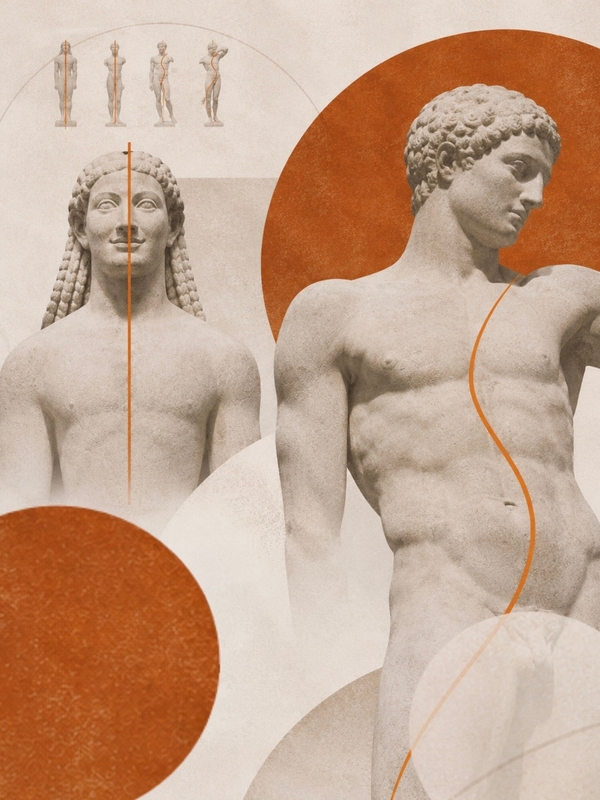
The evolving depiction of the human figure in Ancient Greek sculpture of the 6th–5th centuries BCE.
Table of Contents:
— Introduction
— Concept
— New York Kurus
— Critia Boy
— Doriphor
— Diadumen
— Comparative Analysis
— Conclusion
— Bibliography
— Image Sources
Introduction. Can a static sculpture convey movement?
Undeniably, the human body holds a significant place in ancient Greek sculpture; however, I became interested in how its depiction, and perception in general, varied substantially even over a short period of time. Comparing several rather similar sculptures, it became apparent that some appear static, while others are more lifelike—movement is palpable within the stillness. This led me to question: have sculptors become better at rendering anatomy, or has the fundamental principle of constructing the human form changed?
Concept: comparison criteria, sculpture selection, hypothesis
In my research, I want to explore how the depiction of the male body evolved in ancient Greek sculpture from the 6th to the 5th centuries BCE. To do this, I will examine several works from different periods and compare them based on consistent criteria: leg positioning, inclination of the shoulders and pelvis, symmetry, and weight distribution. It is not enough for me to simply show that sculptures looked different over time; I want to understand which specific changes in body posture led to the emergence of contrapposto—a pose in which the supporting and relaxed parts of the body are contrasted against each other [3].
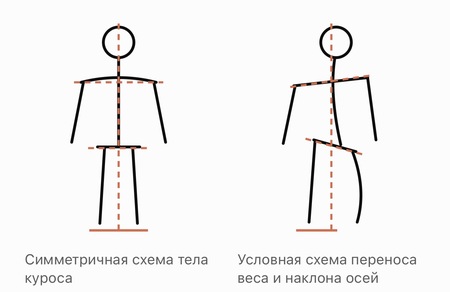
I am less interested in the detailed rendering of musculature or the exact anatomical proportions, and more concerned with the way the human figure is organized in space. Sculpture might possess meticulously developed musculature yet remain visually static; conversely, a subtle shift in the pelvis or knee can make a pose feel more natural, dynamic, and realistic.
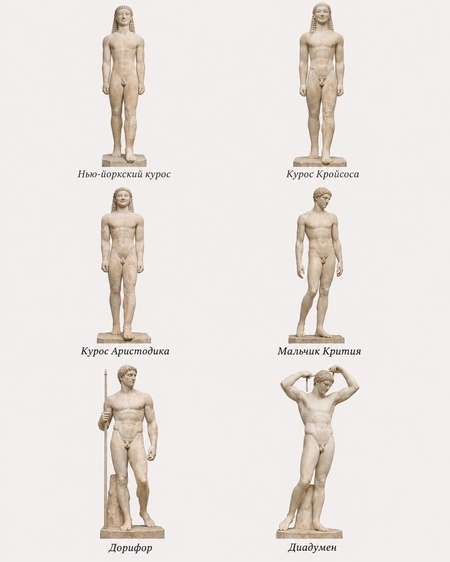
I selected four sculptures as my primary material:
— The New York Kouros — «Boy of Kritia» — Polykleitos’s «Doryphoros» — «Diadumenos»*Image generated by AI
Гипотеза
I hypothesize that the primary change was not just in the more accurate depiction of musculature and proportions, but also in how sculptors began to convey the distribution of body weight.
While archaic statues maintain a predominantly symmetrical pose, even when one leg is advanced [1], classical works incorporate a shift of weight onto a single leg, which necessitates changes in the position of the pelvis, shoulders, and the entire torso [2; 3].
In my view, it is this interconnection of body parts that helps create the sensation of a natural pose and the feeling of motion in a static form.
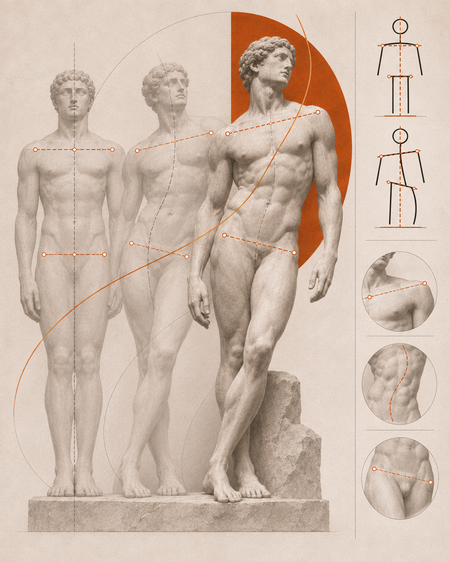
To test this hypothesis, I will systematically compare each sculpture using the same criteria. Rather than simply describing each statue in isolation, I will compare it to previous examples, as I believe this comparison will clearly reveal which features were preserved and which gradually changed.
Research Goal Based on visual comparison, I aim to determine the specific postural changes that distinguish archaic sculpture from classical contrapposto.
*Photo generated by AI
New York Culture. Circa 590–580 BCE.
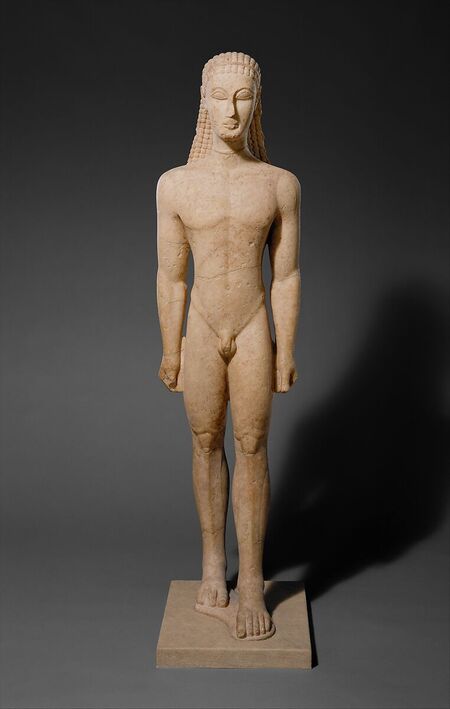
Artwork Record: — Title: «New York Kouros» — Artist: Unknown. — Date: c. 590–580 BCE. — Origin: Attic, Ancient Greece. — Material: Naxos marble. — Height: 194.6 cm without pedestal. — Location: Metropolitan Museum of Art, New York, Inv. No. 32.11.1. *All this information and photographs are taken from the official museum catalog [1].Photo 1. Front view
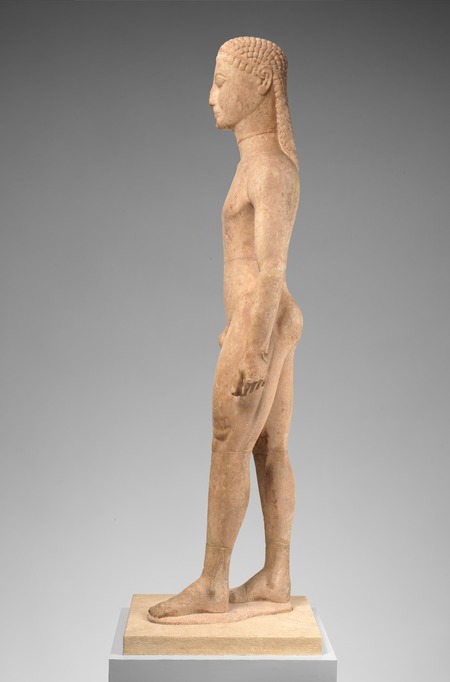
The first sculpture I decided to examine was the New York Kouros, as it is one of the early marble statues of the human figure executed in the Attic [1].
First Impression Upon seeing this sculpture for the first time, I felt a contradiction. On one hand, the pose clearly conveys movement—the youth has extended his left leg forward, as if about to take a step—but on the other hand, that movement doesn’t feel palpable; to me, the statue appears maximally static.
Photo 2. Side View * Photograph from The Metropolitan Museum of Art’s digital collection
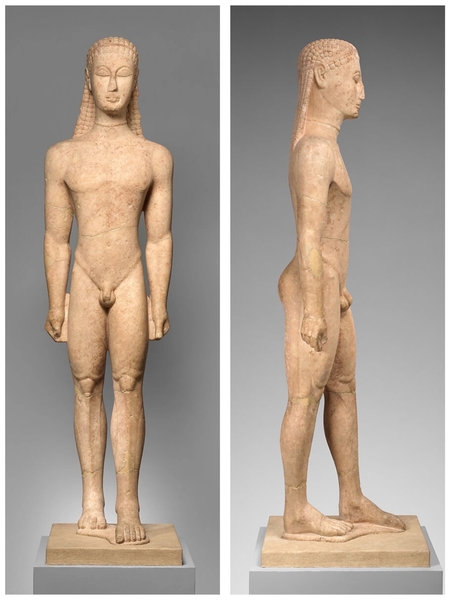
Foot Posture If you view the statue from the side, the difference in the placement of the feet becomes more noticeable, and we see that the left leg of the torso is slightly extended forward. However, when viewed from the front, the body retains almost complete symmetry. In Monica Balger’s art historical analysis, she also notes that this pose does not create a full sense of a natural stride. Despite the extended leg, the figure remains rigid and symmetrical [5].Here, it is important to note that the pelvis does not have a distinct tilt, and the torso does not move in sync with the leg. This is precisely why it is difficult to identify the weight-bearing leg in the sculpture. It appears the sculptor suggested a stride through the position of the leg but did not depict the changes in the other parts of the body that occur when walking in real life.Therefore, a small conclusion can be drawn: the leg extended forward, by itself, does not yet convey a feeling of natural motion.
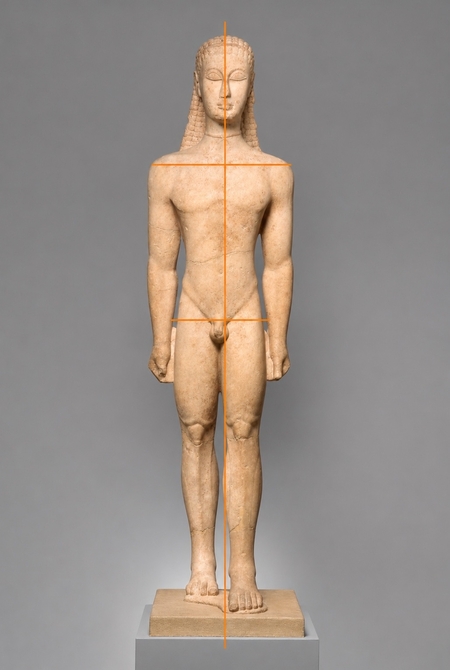
Symmetry. Shoulder and Hip Placement To check how symmetrical the figure is constructed, I drew a vertical line through the center of the head and horizontal lines through the shoulders and hips. Even with the naked eye, it is evident that the head is facing forward, the shoulders are roughly level, the pelvis is straight, the arms are hanging along the torso, and asymmetry is only present in the legs. However, for my study, what is particularly important is that the position of one leg barely affects the overall composition, and it is this body symmetry that creates a sense of stability and blocks the reading of motion.Photo 1. Front view (Line added by AI)
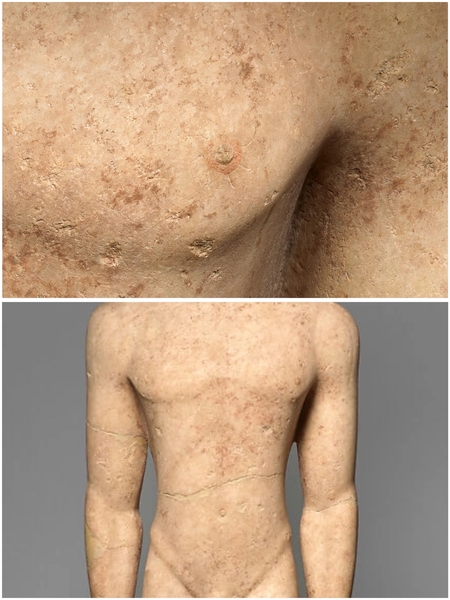
Anatomy In the figure, one can distinguish the pectoral muscles, abdomen, elbows, knees, and other anatomical elements, but almost all appear quite conventional. The Metropolitan Museum characterizes the forms of this sculpture as predominantly geometric. Monika Ballger also draws attention to the conventionality of the proportions and the ornamental nature of the depiction of anatomy [1; 5].Photo 1. Front view (bottom) Photo 3. Ribcage (top)
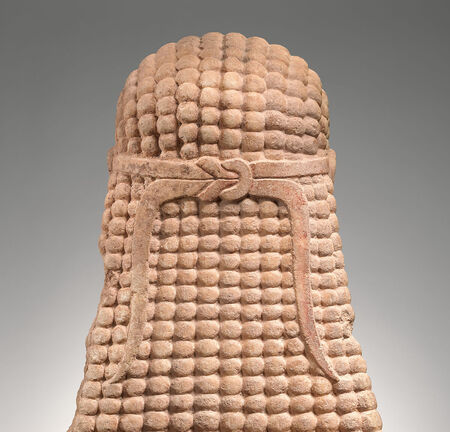
«The sculptor’s focus on symmetry and pattern is particularly noticeable on the face and hair of the figure. The cheeks are flat, while the eyebrows are delineated with single, curved lines. The ears are twisted like volutes. The hair has a rigid texture, composed of a series of square locks that fall heavily down the figure’s back. Although none of these characteristics might resemble a real person, they are easily recognizable as parts of the human body. They were rendered decoratively to create a more idealized image of an elite man» [5].Photo 4. Detail of the hairstyle
New York Kouros, c. 600–580 BCE, marble, 6 feet 4 inches high (The Metropolitan Museum of Art, New York; Photo: Steven Zucker, CC BY-NC-SA 2.0)
Analysis of the New York course showed that its composition is based on frontality and symmetry: the left leg stepped forward, but this did not affect the positioning of the pelvis, shoulders, or torso; anatomical details are present, yet many forms remain geometrically simplified.
We conclude that in this sculpture, movement is indicated by the leg’s position rather than expressed through the interconnected change in the entire body’s posture.
The Boy of Kritia. 480 BCE
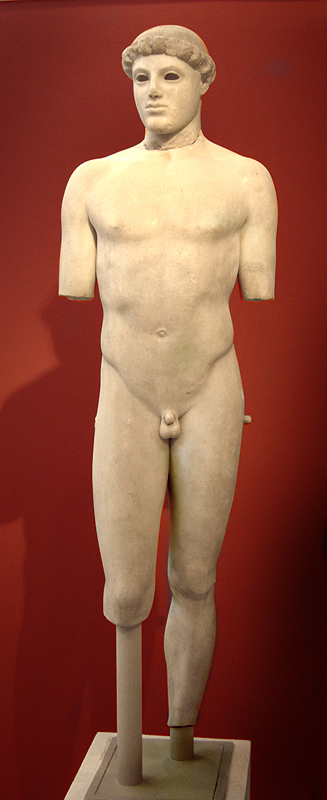
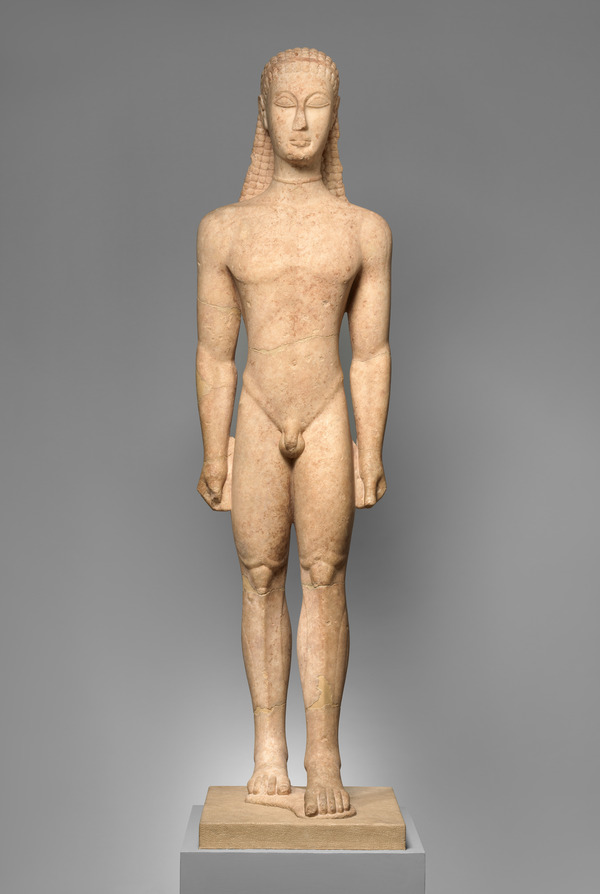
Photo 5. Critias’s Boy. Front view (left) Photo 1. New York Kouros. Front view (right)
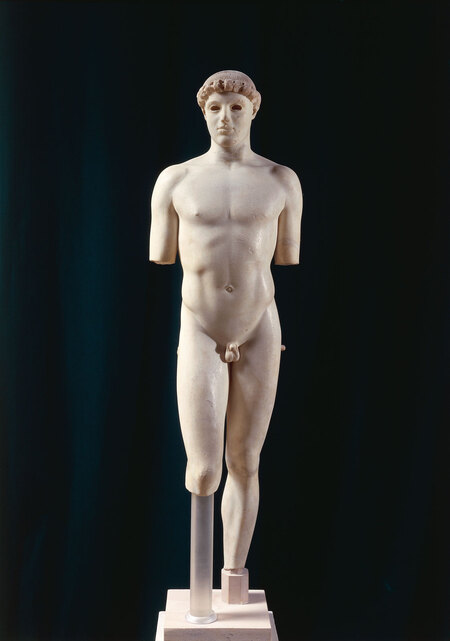
If you place the «Kritian Boy» next to the New York Kouros, the difference becomes apparent almost immediately. Both statues depict nude youths in a standing pose, but their bodies appear entirely different:
— The New York Kouros stands very upright; its shoulders and hips are aligned horizontally, parallel to each other, and its arms hang straight by its sides. Even though the left leg is stepped forward, the figure remains symmetrical and static.
— The Kritian Boy immediately presents a different torso posture. Here, the body does not appear identical on both sides; it is clearly evident that one leg bears the main weight and acts as the support, while the other is relaxed, thus conveying a tilt of the pelvis [6].
Photo 6. Overall view
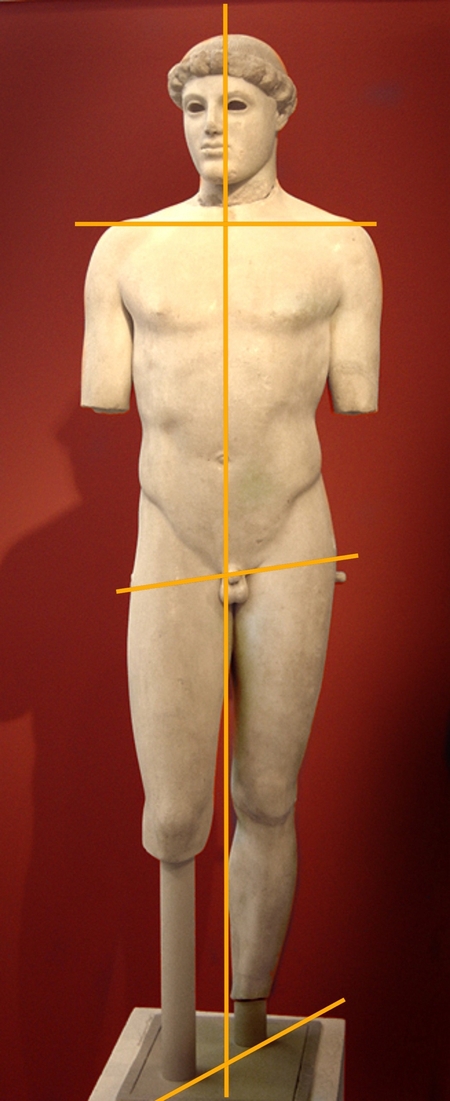
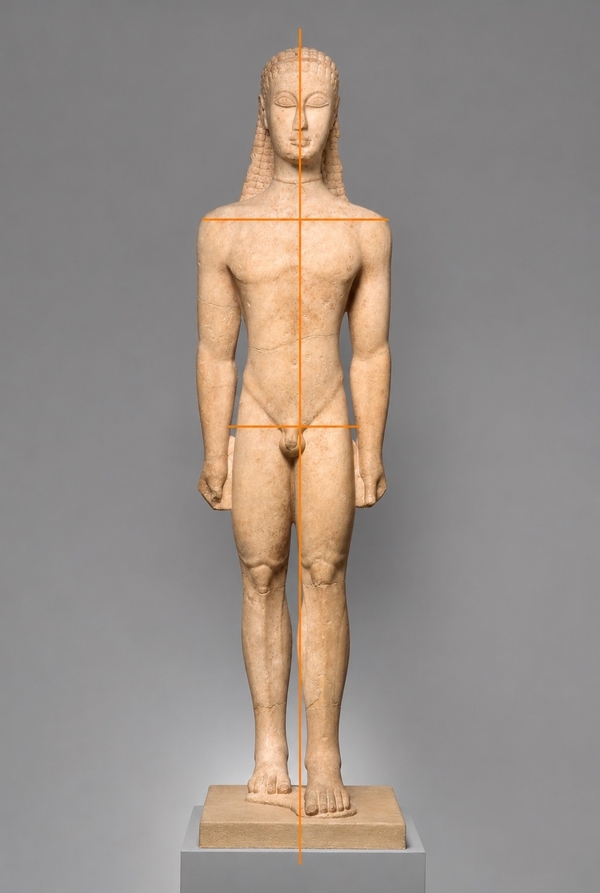
Photo 5. Cretan Boy. Front view (left) Photo 1. New York Kouros. Front view (right)
- Lines added by AI
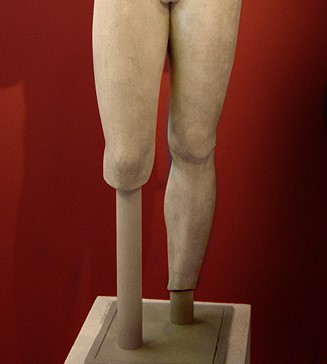
Foot Position Previously, I concluded that the left leg of the New York Kouros was extended forward, but this had no effect on the position of the other body parts—this is changing in the case of the «Kritios Boy.»According to the Acropolis Museum’s description, the main weight of the body rests on the left leg, while the right leg remains relaxed and bent at the knee [2].This is the main difference from the archaic stance of the Kouros, where the weight is distributed between both legs—an observation noted by researchers at the Cambridge Museum of Classical Archaeology [6].When comparing the two sculptures, the legs of the «Kritios Boy» are no longer perceived as two equal supports; we can clearly see which leg is the weight-bearing one.It turns out that the main change is not about which leg is extended forward, but how the body weight is distributed between the legs. Photo 5. Front view
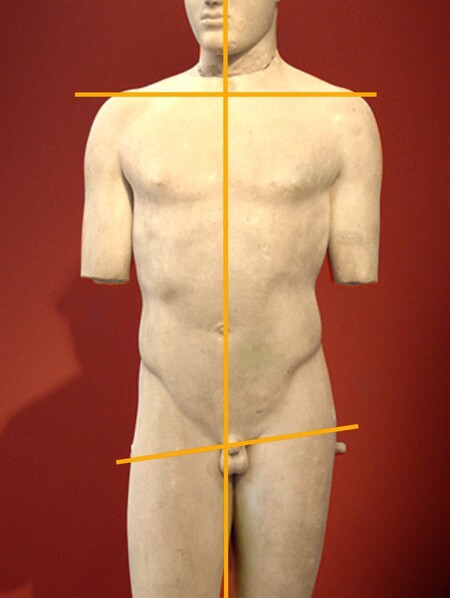
Symmetry. The Pelvic Line While analyzing the New York course, I drew a horizontal line across the pelvis and noted that it was level. I drew an identical line on the image of the «Kritian Boy.» Here, we see that the pelvic line is no longer horizontal; it is slightly tilted because the body weight has clearly been shifted onto the left leg. This difference demonstrates that the position of the legs also affects other parts of the body.It turns out that it wasn’t until 100 years later that sculptors realized the necessity of showing not just the position of individual body parts, but the connection between them.Photo 5. Kritian Boy. Front view
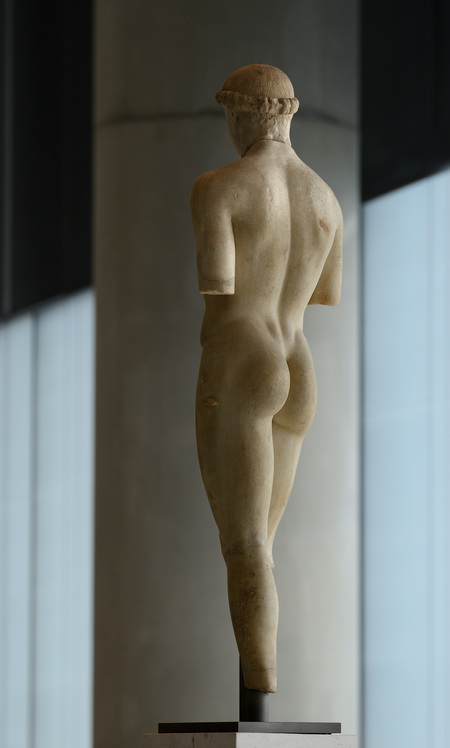
Asymmetry in Structure: Shoulders and Torso In the «Boy of Kritios, ” the torso’s posture becomes visibly more complex. Researchers at the British Museum note that the transfer of weight is accompanied by a pelvic tilt and a slight lateral curvature of the spine [6].In other words, if one draws a central line through the body, it is no longer as straight as it was in the early corpus.A study by the National Gallery of Art in Washington observes that the shift in weight distribution is reflected in the positioning of the pelvis, shoulders, and spine [7].Where the right and left sides of the figure were once nearly symmetrical, they now begin to differ. However, the body does not lose stability; consequently, it suggests that balance can be achieved not only through symmetry but also through the interconnected positioning of various body parts.Figure 7. Rear View
Doriform. 450–440 BCE
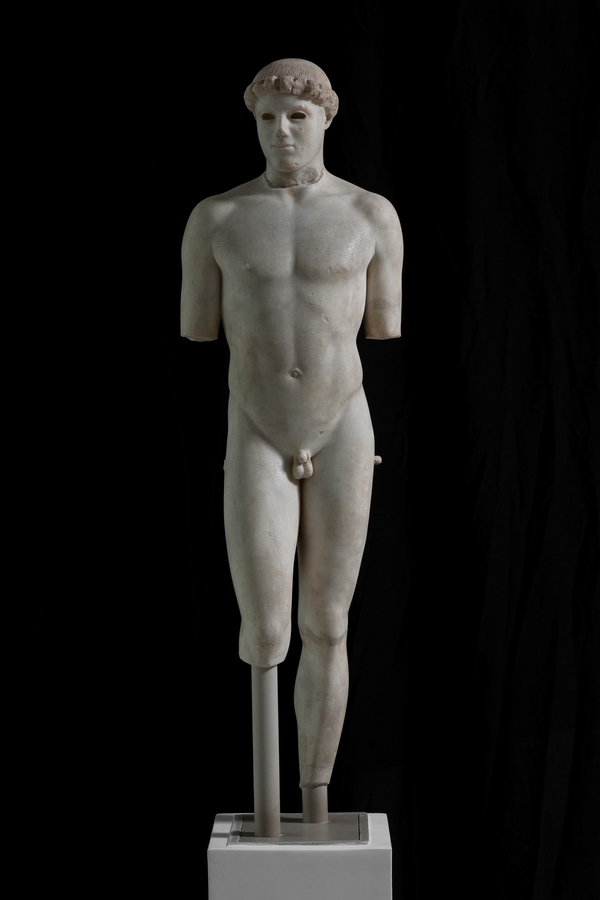
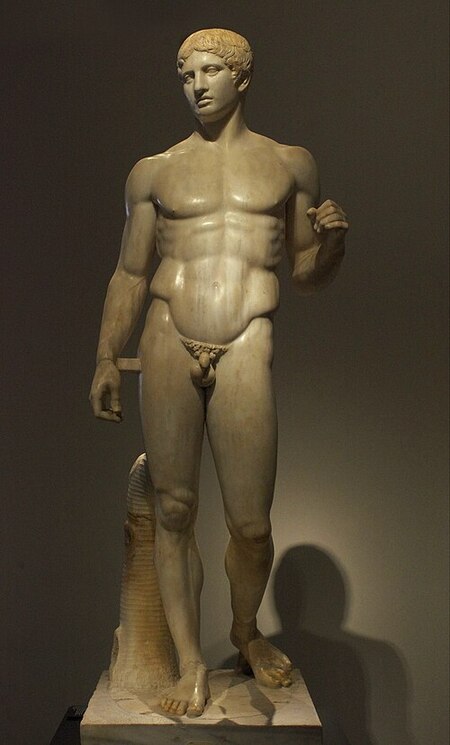
Photo 6. Kritia Boy. Overall view (left) Photo 8. Dorifor. Front view (right)
The original bronze statue of «Doryphoros» by the ancient Greek sculptor Polykleitos has not survived to the present day; therefore, for my research, I will be using a marble copy housed in the National Archaeological Museum of Naples [8].
Previously, I discovered that the body weight in «Kritios Boy» is shifted onto the left leg because the position of the pelvis and torso changes [2].
When I placed photographs of «Kritios Boy» and «Doryphoros» side by side, I noticed a similar principle in both figures, but the differences between the two sides of the body are more pronounced in «Doryphoros.»
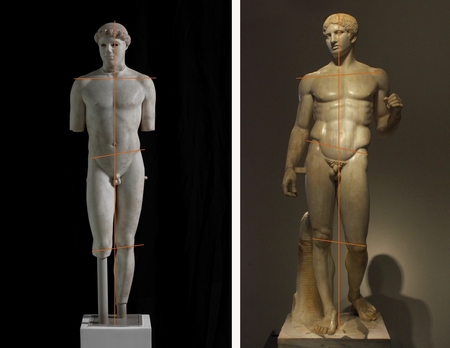
Leg Posture In the «Kritios Boy» the left leg serves as the primary support, while the right leg is slightly bent and relaxed [2]. In the «Doryphoros» the right leg becomes the support, with the left leg bent, slightly drawn back, and touching the base with the forefoot [8].This difference is clearly visible in the photographs; it is apparent that the «Doryphoros'» right leg forms a stable base, while the left appears freer—it even seems as if the youth could shift it forward and take a step. This sculpture conveys a strong sense of movement without any internal conflict, unlike the statue of the New York Kouros.Photo 6. Kritios Boy. Overall view (left) Photo 8. Doryphoros. Front view (right) *Lines added by AI