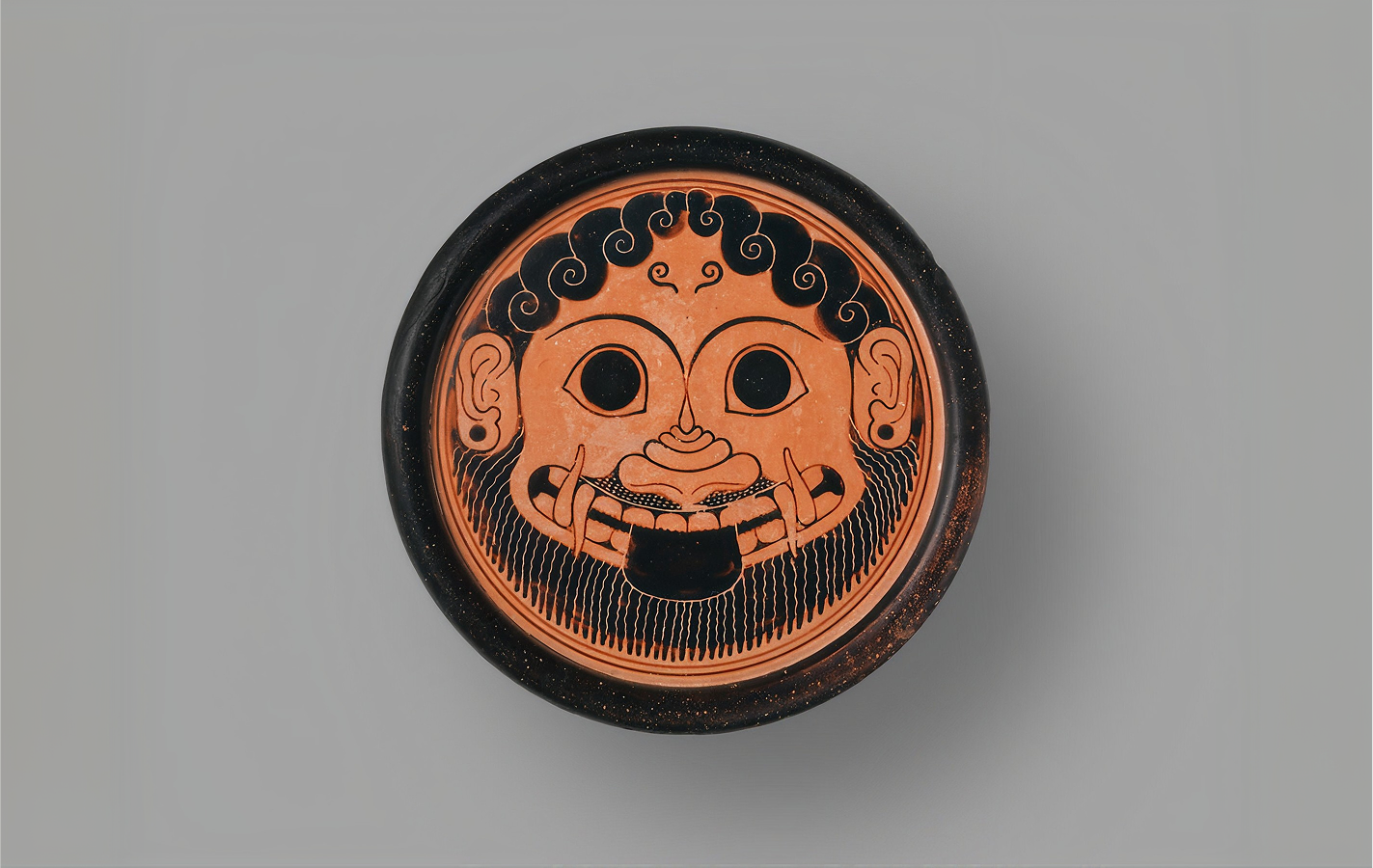
Как художники изображали Медузу опасной?
Внешность, взгляды и взаимодействие персонажей в греческом искусстве V–IV веков до н. э.
Concept
Medusa Gorgon can be recognized by her fangs, protruding tongue, snakes, and wings. However, in Greek art, there are also depictions where her face approaches a human likeness, and her grotesque features are softened. Yet, the heroine does not lose her powers; her gaze remains deadly. This contradiction makes depictions of Medusa interesting to study: must a threat always be present in a character’s appearance, or can it be conveyed through the relationships between figures?
Research Question: Through what means did artists convey the danger of Medusa in Greek art of the 5th–4th centuries BCE?
The hypothesis is that Medusa’s danger can be conveyed not only through menacing physical features but also through the reactions of other characters and the ways they interact with her. Averted gazes, defensive gestures, and the observation of her reflection can also signal a threat—which is precisely why softening monstrous features does not necessarily eliminate the image’s dangerous nature. Furthermore, caution does not inherently mean fear, just as a turned head does not always signify an attempt to defend oneself. The meaning of every gesture is interpreted within the context of the scene and refined through comparison with other depictions.
The material is limited to works from the V–IV centuries BCE from Attica and Greek centers in Southern Italy.
The basis of the study is the pictorial narrative, which allows for relating Medusa’s appearance to the actions of other characters. Images depicting the Gorgon’s encounter with Perseus, the transport and display of her head, the reactions of the satyrs, and the contemplation of the reflection are presented.
Images are selected to allow for a comparison of different ways danger is conveyed: similar subjects rendered through different facial expressions; various media presenting the same motif; figures in a state of sleep versus the moment of capture; and scenes depicting a severed head. Particular attention is given to scenes where Medusa’s head position, the direction of gazes, and the gestures of other characters are clearly discernible. While overall views of the works are included, individual gestures are always considered within the context of the entire scene.
The study’s structure follows a progression from appearance to action. The first section isolates the characteristics of a terrifying visage; the second compares the physical proximity to Medusa with Perseus’s gaze direction; the third section is dedicated to the severed head; the fourth explores its danger through the protective reactions of those around it; and the fifth examines reflections. The methodology employed is comparative visual analysis of similar subjects and varied solutions to a single compositional problem. Information about the artworks is verified using museum catalogs and publications. Interpretations are cross-referenced with the research of Catherine Topper, Françoise Frontizi-Ducrue, Oliver Taplin, and the catalog «Dangerous Beauty» [1–4]. Museum catalogs are used to confirm dating, authorship, and the titles of the works. Scholarly publications assist in clarifying the narrative and correlating personal observations with established interpretations.
1. Threat in Appearance
In the mythological narrative, Medusa’s gaze turns anyone who sees her to stone, and her severed head retains its power after the body dies [4, pp. 5–6]. In visual representation, this power does not necessarily take on a literal form. One way to denote threat is to render a face that sharply diverges from the human form. We begin with two works from the early 5th century, where such a distinction is expressed with particular clarity.
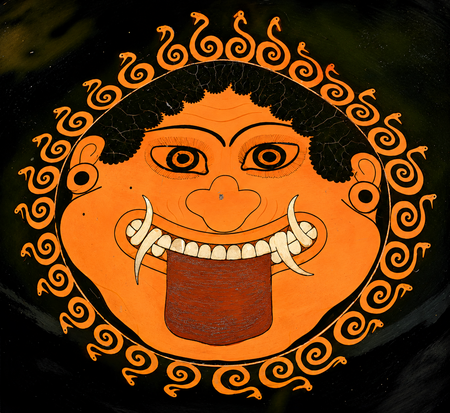
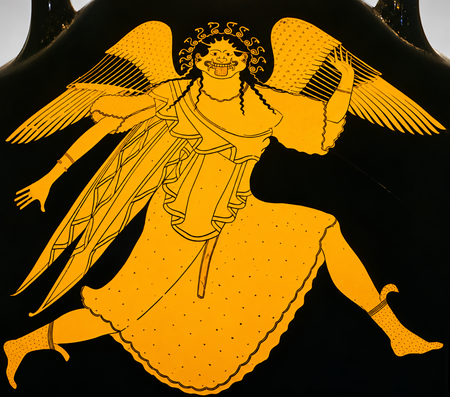
Hydria with Gorgoneion. Group London E445. c. 490 BCE // Amphora by the Berlin Vase Painter: Gorgon. c. 490 BCE.
On the amphora by the Berlin vase painter, a winged figure moves, but its face is turned outward. The body’s direction and the face’s orientation diverge: the movement belongs to the scene, whereas the eyes and grimace are directed toward the viewer. On the hydria from the British Museum, the body is absent, and all attention is focused on the head. Large eyes, protruding fangs, and tongue form a distinctly grotesque visage. In both cases, the threat takes on a concrete form through the emphasis on the face—its unusual features are presented so that they can be examined directly. This is the original method of constructing an image; next, we will compare it with situations where danger is indicated through action.
2. Approaching without meeting eyes
To slay Medusa, Perseus must approach her while simultaneously avoiding her gaze. This contradiction is reflected in his posture: his arms and weapon are directed toward the Gorgon, while his face may be turned in another direction. Let’s examine how artists convey danger through the hero’s movements and his interaction with Medusa.
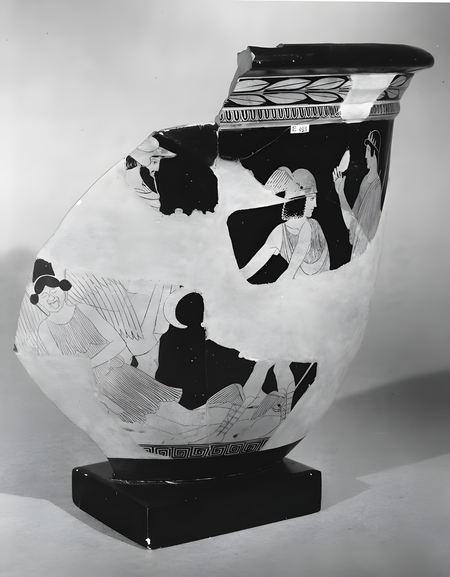
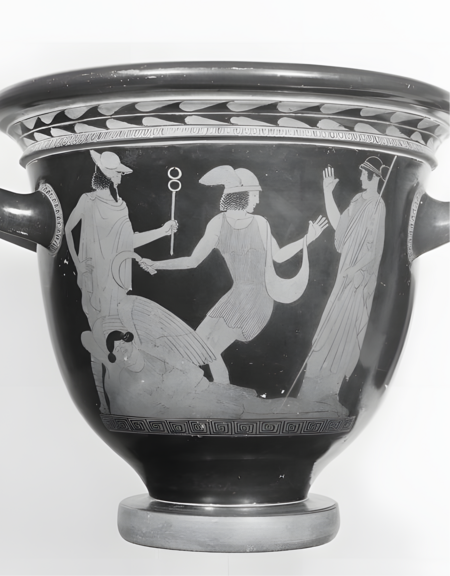
Fragmentary Krater of the Villa Giulia Painter: Approaching Perseus. c. 460–450 BCE // Krater of the Villa Giulia Painter: Perseus Before Medusa. c. 460–450 BCE
In the craters by master Villa Giulia Pesce, Perseus approaches the sleeping Medusa, turning his face toward Athena. The Madrid vase shows bent legs and a hand reaching out to Medusa; the London fragment retains a similar head turn. Catherine Topper notes the hero’s cautious approach and the variation in the Gorgon’s appearance: fangs are present only on the London crater [1, pp. 76–79, figs. 4–5]. Thus, despite the differences in Medusa’s appearance, Perseus’s behavior remains consistent: in both scenes, he approaches her but keeps his face averted. Consequently, the danger is conveyed not only through the Gorgon’s terrifying features but also through the hero’s caution, as he avoids making direct eye contact with her.
Gydria’s Masterwork: Perseus Before the Killing of Medusa. Circa 450–425 BCE.
In the depiction of the master Perseus and Narcissus, Perseus cautiously steps forward and extends his armed hand toward Medusa. His face is directed not at the Gorgon, but toward Athena, who stands on the other side of her. Sertfontain connects the hero’s caution with his posture and foot placement, while interpreting the goddess’s gesture more as a warning than as encouragement [7, pp. 45–46]. Thus, Medusa’s danger is conveyed not only through Perseus’s careful movements but also through his interaction with Athena: her gaze toward the hero can be interpreted as a warning about the threat emanating from the Gorgon.
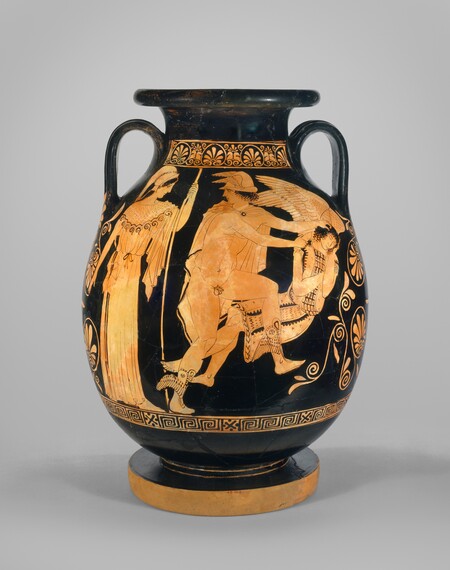
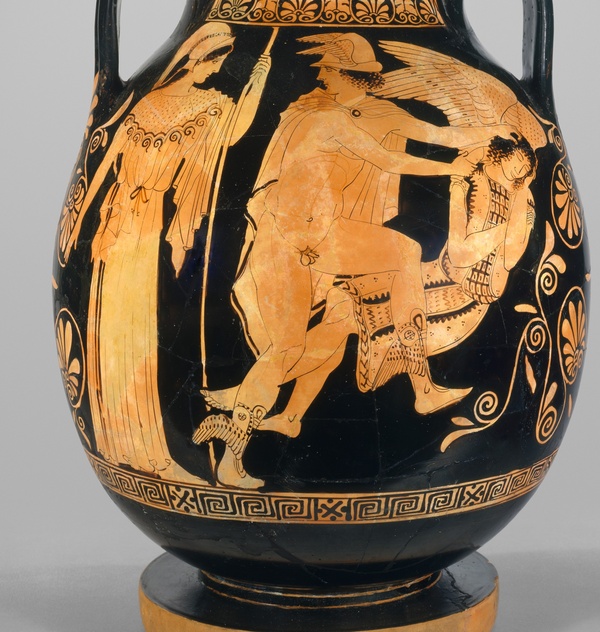
Pelika Polyglot: Perseus and Sleeping Medusa. Circa 450–440 BCE
On the Pelike of Polychronos, Perseus holds Medusa’s hair and brings a weapon to her neck, turning his face toward Athena. The museum card notes his gaze upon the goddess and the unusually beautiful face of the sleeping Medusa, which was rare in early depictions [5]. The softening of the Gorgon’s menacing features is particularly evident here. However, Perseus’s behavior remains consistent: even at the moment of direct contact, he avoids looking at her. A contradiction arises between her serene human appearance and the hero’s caution. It is this tension that allows the danger of Medusa to be conveyed, even though it is no longer expressed directly in her appearance.
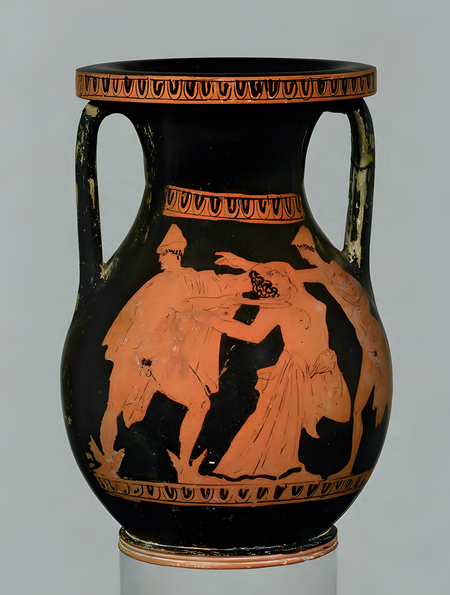
In a 4th-century Pelican from the Hermitage, Perseus holds Medusa, sharply averting his face from her. Unlike previous depictions of the sleeping Gorgon, here Medusa is awake and expresses fear herself. Caroglou draws attention to the harsh nature of the scene: Medusa is exposed from the waist up and gestures, imploring mercy [4, p. 11, Fig. 9]. Although Perseus physically surpasses the Gorgon and restrains her, he still avoids meeting her gaze. A contrast emerges: Medusa is portrayed as frightened and vulnerable, yet the hero’s behavior indicates that she still poses a danger to him.
Pelican: Perseus beheads Medusa. c. 360–350 BCE.
Even when Medusa is depicted sleeping, beautiful, or fearful, Perseus avoids her gaze. The Gorgon’s danger is conveyed not only through her appearance but also through the hero’s caution.
3. The Head as a Weapon
After decapitating her, Perseus’s situation changes: he can now carry Medusa’s head and use it against other characters. However, the Gorgon’s head does not become ordinary prey—even when separated from the body, it retains its dangerous power. Where the hero previously avoided Medusa’s gaze, he is now capable of directing that threat onto his opponents. This shift can be traced by observing how artists depict Perseus’s interaction with the Gorgon’s head and its effect on those around him.
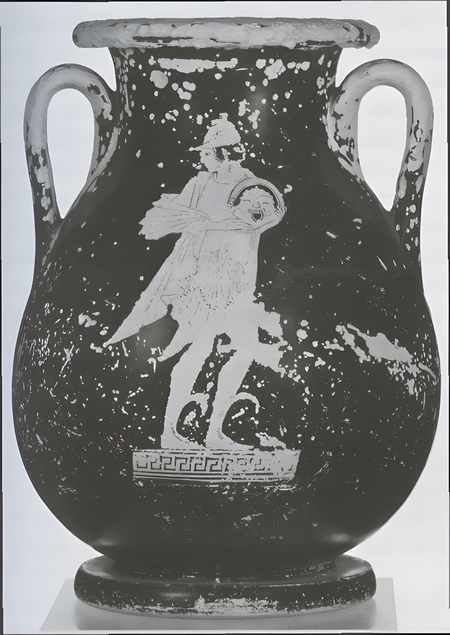
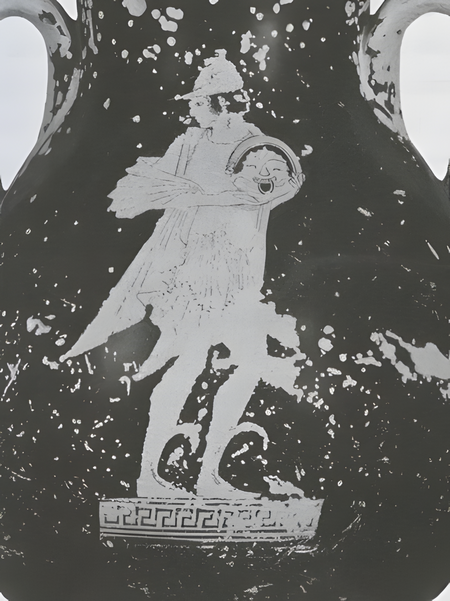
Pelican Master Pan: Perseus with Medusa’s Head. 480–460 BCE
On the panel, Pan’s master from Munich, Perseus, holds Medusa’s head against his chest, directing her face toward the viewer while looking to the side. The Gorgon has been defeated, yet the hero continues to avoid her gaze. His caution suggests that the severed head has not lost its danger. Now in Perseus’s hands, the way he handles it becomes a crucial means of depicting the threat.
Pan’s Gyadry: Perseus’s Escape After Decapitation. Circa 460 BCE.
In the hydria by the same master, Perseus looks at the beheaded body of Medusa, with her head emerging from the bag the hero carries before him. Frontizi-Ducrou observes the difference between the Gorgon’s body and her detached head, whose face is only partially visible to the viewer [2, § 19, Fig. 10]. In the Munich pelican, Perseus holds the head openly before him, whereas here it is almost hidden in the bag.
Comparing these scenes shows that Perseus treats Medusa’s head differently: in the pelican, he holds it openly, while in the hydria, it is partially concealed in a bag. In both cases, the head remains a distinct object—a specific motif whose handling is emphasized by the artist.
Scythos: Perseus showing Medusa’s head to Polydectes. 460–450 BCE
On the Louvre’s Scyphus, Perseus raises the head of Medusa before the seated Polydectus, directing its face toward the king. The identification of the characters is confirmed by the museum card [6]. The hero himself turns away, avoiding the Gorgon’s gaze. Medusa’s head here is no longer merely an object that Perseus acquired—he deliberately presents it to another person. The gesture of the arm and the tilt of the head allow us to see a threat aimed at Polydectus.
Polydekt’s Crater: Perseus turns his head against the king. Circa 450–440 BCE