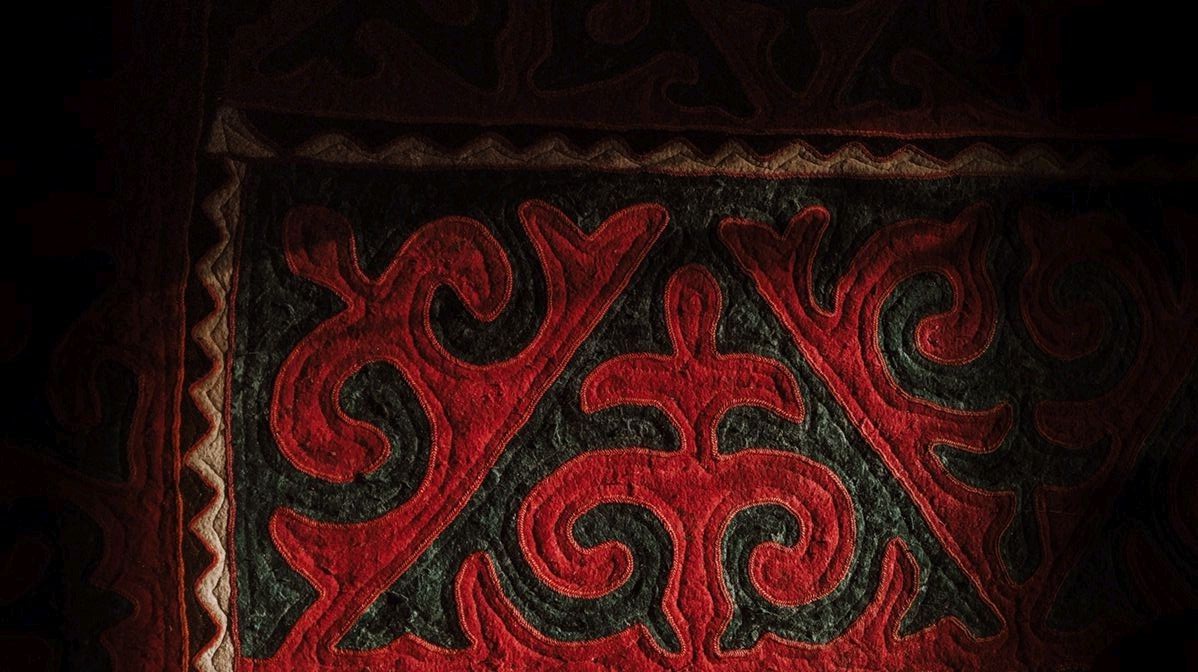
От архара к знаку: эволюция мотива «кошкар-муйиз» в искусстве кочевников. Применение принципа pars pro toto
Деконструкция образа барана и рождение орнаментального модуля
«The Kazakh pattern is a book written in the language of lines. He who knows how to read carpets and textiles reads the history of a people.» (Qadyr Myrza Ali, People’s Writer of Kazakhstan)
Navigation Menu
- Concept2. The depiction of the arhar in Scythian animal style — Animal figure and object form — The horn as part of the composition — Rhythm and repetition in the depiction of horns3. Horn-like motifs in Hunno-Sarmatian art — Animal representation on objects — Flattening and stylization of form — The horn as an independent motif4. Horn-like motifs in Turkic-era art — Motifs on metal and bone objects — Symmetry and repetition of spirals — Comparison with the «kochar-muyiz» ornament5. Conclusion
Concept
Kazakh ornament is traditionally viewed as a stable system; however, behind its graphics lies a long evolution of nomadic visual thinking. The focus of this study is the process of visual comparison and the evolution of the image of the mountain ram (argali) and its horn motifs. The chronological window—8th century BCE to 8th century CE—was chosen to analyze the indigenous art of the Saka, Sarmatian, and Turkic peoples before the formation of the late medieval canon.
How did the three-dimensional image of the Arhar in nomad plastic transform into flat, horn-like motifs? How stable were the formal characteristics of the horn arch across changes in eras, materials, and media, from the Early Iron Age to the Middle Ages?
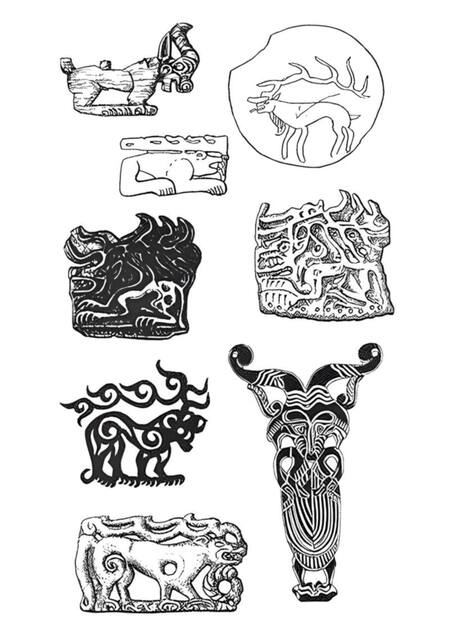
The evolution of motifs associated with the Khazar image is a sequential process of plastic compression. The Saxon animal style subordinated the animal figure to the geometry of objects [2]; the Hunno-Sarmatian art flattened volume [2]; and the Turkic era established symmetrical rapport modules [5], demonstrating the continuity of forms in material culture. The empirical basis consists of artifacts from Kazakh and Altai kurgans (Issyk, Beryl, Taldy-2, Shilikty), Turkic balbals, and belt sets [1, 4, 6]. The primary method is formal-visual analysis (comparing contours, rhythmic steps, symmetry, and relief depth).
Beldersaiskie (Kumbelskie) Petroglyphs. 4th–2nd millennia BCE.
Bronze plaque — mountain goat. Tamdy, kurgan, 6th century BCE.
The image of the Arkhara in the Saka animal style
In Saka-Scythian art of the 8th–3rd centuries BCE, the figure of the mountain ram is subordinated to a rigid geometric contour of plaques [1, 4]. The muscular volume of the torso combines with the hypertrophy of the horn spiral, which gradually transforms into the dominant graphic element [2]. The extraction of the horn from its anatomical context lays the foundation for future rhythmic compositions [7].
Golden plaque, 12th–3rd century BCE
In Early Saxon art, the beast’s body still retains volume. However, it is noticeable how the master subordinates the head to the shape of the gold plate.
Golden rhytons from a Sarmatian hoard, 6th–4th century BCE
The relief incisions on the horn create a rhythmic pattern. This transforms a biological detail into a decorative structure. These artifacts were particularly interesting to me because they were found during excavations of a burial mound in the Orenburg region, where I am from.
An Archar figure patch. Gold, die-casting, repoussé, casting, soldering.
Plastic Compression of VolumeIn these Early Sack artifacts made of gold, the body of the bharal still retains a three-dimensional density and anatomical relief (the texture of the wool on the flanks and the musculature of the thighs are detailed). However, the composition is already governed by rigid rules: the limbs are bent underneath the torso, forming a flat base, and the body is arranged within a closed contour. The horns are particularly striking: the artisan unrolls them within the plane, transforming them into closed loops. The anatomical detail here begins to dominate the entire form, serving as the main graphic accent and foreshadowing the future autonomy of the ornamental module [1, 2, 4].
Horn motifs in Hunno-Sarmatian art
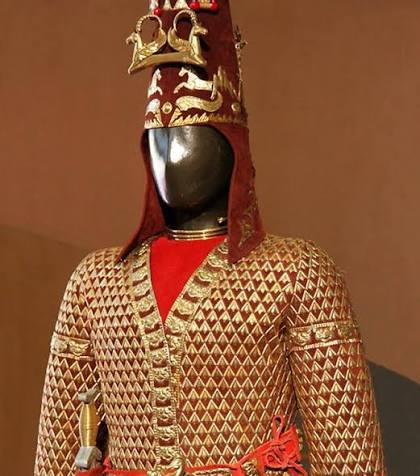
From Mass to Silhouette: Issyk ParallelsComparing the golden figural ornaments on the headwear of the «Golden Man» from the Issyk kurgan with early Saka finds from Taldy-2, noticeable stylistic differences emerge: in the Issyk plastic canon, the detailing of wool texture and muscular relief on the sides completely disappears. The animal’s body becomes smoother, more generalized, and schematic. A distinct silhouette takes precedence, where the massive, ribbed curl of the horn visually dominates the entire body, transforming the figurine into a concise heraldic sign [1, 2].
Golden rams with headgear of the Golden Man (Issyk), 4th–3rd centuries BCE.
Protome Isolation and Form Hybridization
On these Issyk tablets, we document the following stage of deformation: the animal’s body has been completely eliminated (the principle of pars pro toto—part representing the whole—is employed). The master leaves only the «protome”—a head featuring a massive, ribbed, arc-shaped horn fused with a decorative wing. The horn here stretches into a pure graphic arc that later forms the basis for symmetrical curls in classical ornamentation [1, 2, 4].
On the «Golden Man’s» headwear, zoomorphic motifs serve a sacred-heraldic function. The depiction of the argali is raised on a rigid horizontal base, transforming it into a heraldic emblem. While maintaining three-dimensional volume (the body and legs are modeled), the visual center of gravity is the massive spiral of horns, which forms a circular silhouette above the animal’s head. Here, the horn functions not merely as an anatomical part but as the main spatial accent of the composition [1, 2].
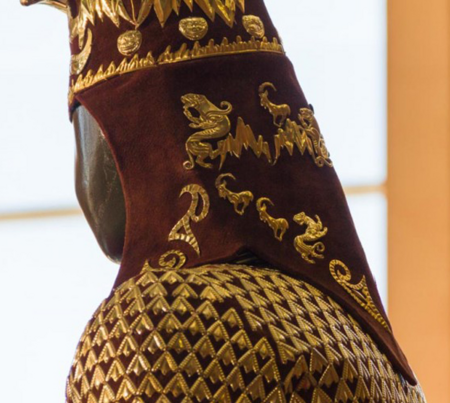
Rhythmic Sequence and Motif Reproduction
On the back of the Issyk velens, small golden figurines of archaic animals are arranged in a diagonal, repetitive row. The use of a stamp allowed the artisan to reproduce absolutely identical silhouettes. In this row, the animal figure completely loses its individuality; it is perceived by the viewer as a single ornamental module, where the curve of the horns sets the rhythmic step for the entire composition on the fabric [1, 2].
The Horn as an Independent Motif
Carved wooden appliqués for a bridle set featuring the motif of wild bull horns. 4th–3rd centuries BCE.
Change of Material and Plastic Shift
The transition from pliable metal embossing to carving in hard wood in monuments of the Beryl type [6] radically changes the nature of the graphic line. The smooth, rounded transitions of Saka gold here give way to sharper, more elastic facets. The carver is compelled to work with cut planes, which reinforces the geometric rigidity of the form. It is in the wooden horse tack appliqués that we observe a crucial structural shift: the ram’s horn begins to be carved for the first time as an independent graphic element, separated from the animal’s skull and body—a development that directly reflects the application of the pars pro toto principle.