Concept
How did a wine glass transform drinking into a sequential encounter with an image?
This research focuses on the kylix—an ancient Greek cup whose decoration was perceived by the viewer during its use. The exterior image was visible when the vessel was in front of the person, while the design on the bottom was revealed as the cup emptied. I was interested in how the kylix’s form and the sequence of images influenced the perception of the object. In this work, I analyze the structure of the cup, its exterior painting, and the images on the bottom to understand how the kylix captured the viewer’s attention.
Two sides of the same coin
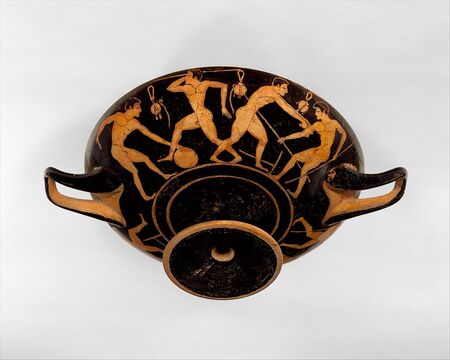
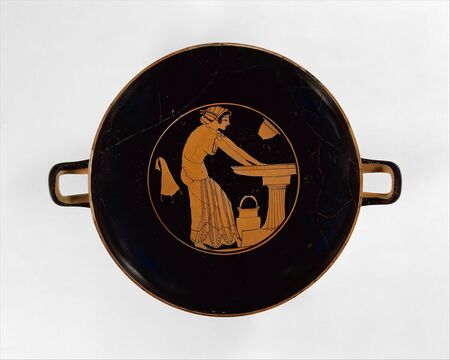
Kylix, attributed to Doris, circa 500 BCE. Attic red-figure pottery. Metropolitan Museum of Art.
The images on the kylix were placed in various locations: on the exterior—on the walls of the bowl, and on the circular base inside. To view them, a person would turn and tilt the vessel. For instance, on the Kylix of Dirus, the image in the tondo was visible when the cup was empty—before filling it or after drinking from it. Thus, the use of the object determined the order in which the viewer encountered the decoration.
Researcher Guy Hedreen also notes that the decoration on some archaic cups engaged the viewer in the mythical world depicted. This idea helps us consider the kylix not as a static picture, but as an object with which the viewer interacted.
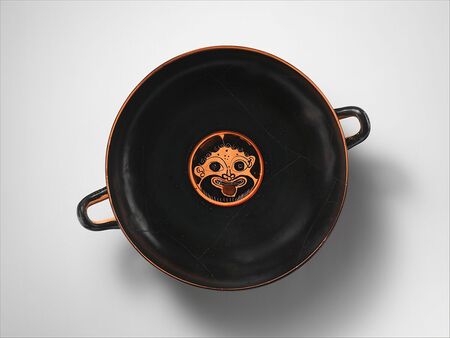
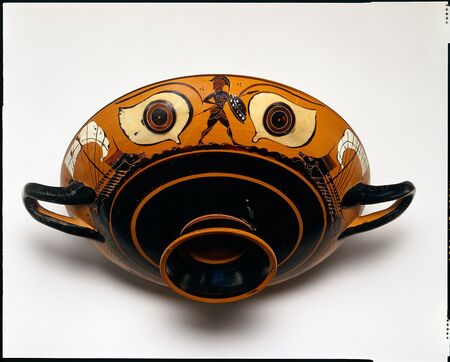
Kilik with eyes, master unknown, c. 520 BCE. Attic black-figure pottery. On the outside—an eye and a warrior; on the bottom—the Gorgon. Metropolitan Museum of Art.
Inside, at the bottom of this kylix, a Gorgon is depicted. On the exterior, there are large eyes and a warrior. These are two distinct images on a single vessel: one is visible from the interior, and the other from the exterior.
Brush shape and decoration technique
Kilik, master unknown, late 6th century BCE, Metropolitan Museum of Art.
Kilich is easily recognizable by its wide, shallow bowl, two horizontal handles, and tall leg. This shape allowed the vessel to be held by the handles and brought close to the lips. But for the artist, the bowl was also a surface—a place where images could be placed both inside and out.
Lip-cup type Kylix signed by potter Taleson, c. 540 BCE, Metropolitan Museum of Art.
The Kiliki differed not only in their decoration but also in their outlines. The rim of this bowl is particularly well-defined: this type is called a lip-cup, or a cup with a pronounced rolled rim. The rim became a separate band for images and inscriptions. The vessel is signed by the potter Tleson; the decoration is attributed to Master Tleson.
The bowl’s rim is not merely a structural part. It defines the boundary between the inner and outer imagery and helps the viewer understand where one decorative zone ends and another begins.
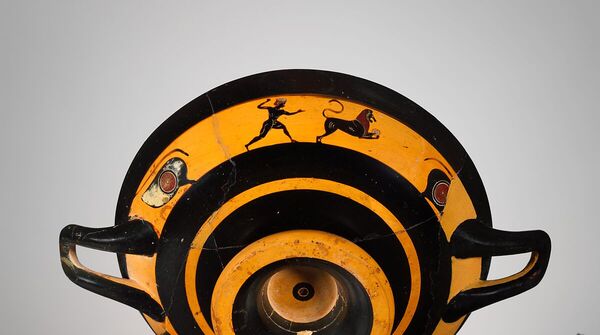
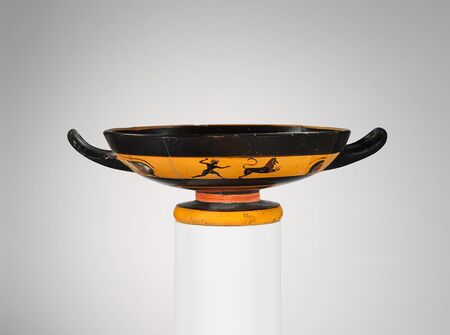
Kilik, master unknown, c. 535–500 BCE, The Metropolitan Museum of Art.
The handles divided the outer surface of the pitcher into individual sections. On this vessel, the handle area depicts a nude youth pursuing a lion. Because the figures are placed in the narrow space beneath the handles, their composition takes into account the shape of the bowl.
Tondo — an image at the base of a bowl
Inside the kylix is a circular area—a tondo. A sphinx is depicted at its center, while the surrounding circles and ornamentation emphasize the field’s shape. The circular composition mirrors the silhouette of the cup and directs the viewer’s gaze toward the center.
The image on the bottom of the cup seems to be waiting for its moment to reveal itself to the viewer. While the kylix is filled with wine, the tondo remains hidden; as the cup empties, the sphinx gradually comes into view. Thus, the image becomes part of the drinking experience itself—like a small revelation that happens in the viewer’s hands.
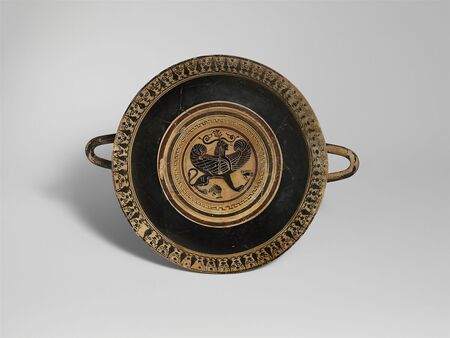
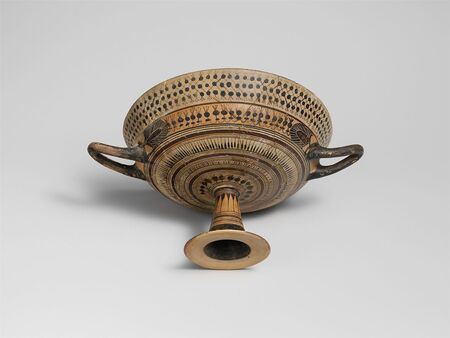
Laconic kylix with a sphinx, attributed to the Rider Painter, circa 550–540 BCE, Metropolitan Museum of Art.
A kylix featuring episodes from the Myth of Theseus, attributed to the Briseis Painter, circa 480 BCE. Metropolitan Museum of Art.
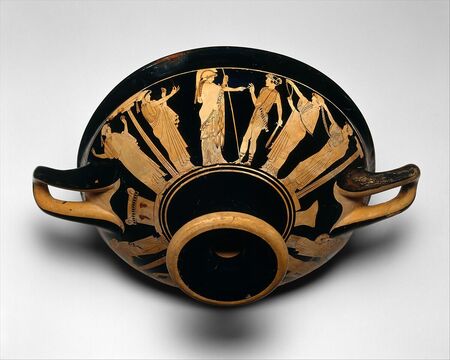
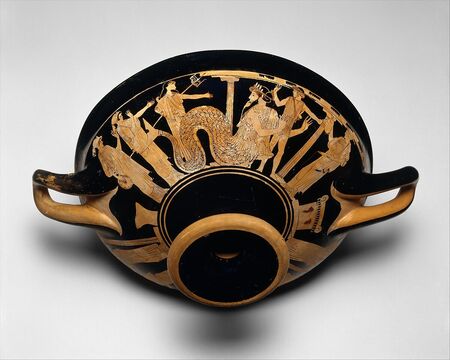
A kylix featuring episodes from the Myth of Theseus is attributed to the Briseis Painter, c. 480 BCE, Metropolitan Museum of Art.
Inside this kylix is depicted a scene featuring Theseus, while the story unfolds on two sides of the cup. To see the entire composition, the viewer had to turn the vessel. Thus, the form dictated the sequence of engagement with the image. The viewer does not see the entire narrative at once; they assemble it piece by piece. The kylix sets the viewing path.
Ornament as Indicator
The repeating pattern creates rhythm and binds together individual sections of the bowl. It does not tell a story, but it guides the eye across the surface, drawing attention to the transitions between ornament and figural elements.
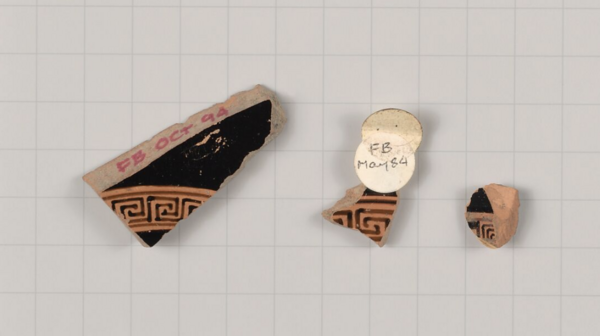
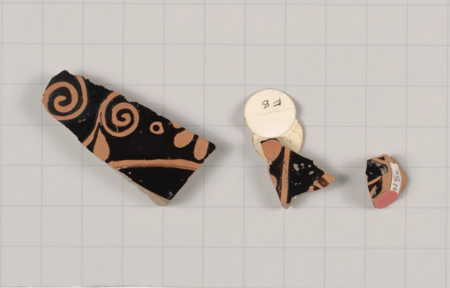
Fragments of kylixes with meanders and palmettes, 510–490 BCE, master unknown, The Metropolitan Museum of Art.
These fragments show a meander inside and palmettes and vegetal scrolls on the outside. The ornamentation emphasizes the borders of the image and helps the viewer perceive the cup’s surface as a deliberate composition.
Kilik in Action: Symposium and Drinks
Symposium—a ritualized feast in Ancient Greece held by men following a shared meal.
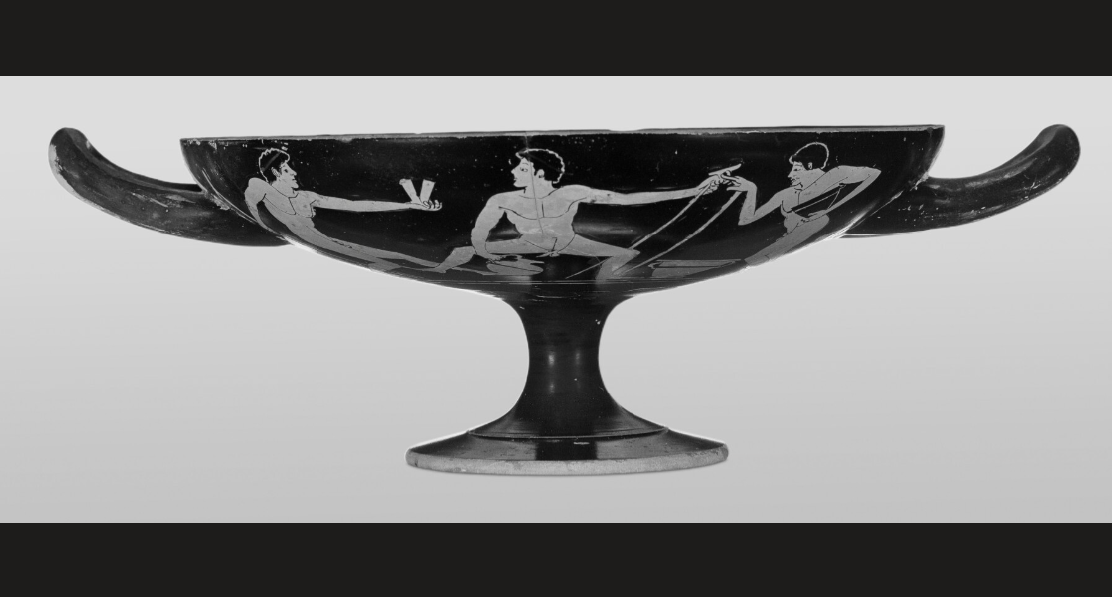
The kylix was not merely a wine vessel; during the symposium, it could become part of the game. The interior of this cup depicts a symposium participant playing kottabos: he attempts to throw the remaining wine from the kylix at a target. The painting illustrates how the vessel was used after the wine had been consumed.
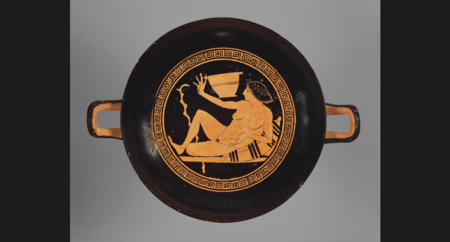
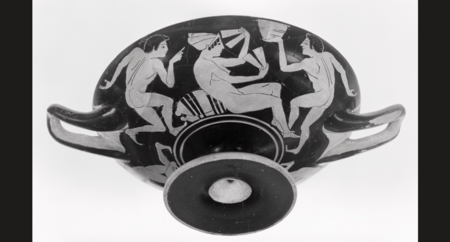
Red-figure kylix, attributed to Onesimos, circa 490 BCE, The Getty Museum.
Here, the image relates to a real action: the participant at the feast holds the same vessel that the viewer holds. The boundary between the scene on the platter and what is happening at the table becomes almost imperceptible.