The project examines the specifics of ancient Egyptian visual art as a phenomenon entirely subservient to religious and ritual function. Ancient Egypt stands at the very beginning of the human journey—it was one of the first great civilizations whose art became systematic, conscious, and canonical. Understanding how religion governed Egyptian art clarifies the mechanism that would later be replicated in various formats throughout the ancient culture, from Mesopotamia to Byzantium.
RESEARCH CONCEPT
Topics: HISTORICAL PERIOD. KEY TERMS. INTRODUCTION. CHAPTER 1. How the Egyptians perceived imagery. CHAPTER 2. Rituals and myths that influenced art. CHAPTER 3. The canon of visual art during that era. CHAPTER 4. The temple as a space for interaction with the gods. CONCLUSION.
Historical Period
Late Period (26th–27th Dynasties, circa 664–525 BCE) The era of the «Egyptian Renaissance» coincided with increasing external pressures. Art became more canonical and refined, featuring high-quality stone carving. Texts incorporating elements of historical and moralistic prose also began to appear. Furthermore, religion—the strengthening of the cults of Osiris and Isis, as well as local deities; the flourishing of temple construction and the priesthood—became paramount. Animal necropolises (the Serapeum at Sakkara, cats at Bubastis, etc.) gained significant importance.
Overall, the Late Period represents a final major period of Egyptian self-assertion before the Persian conquest, characterized by political instability on the frontiers, cultural archaism, and active foreign relations.
Key terms used in the study
Ka—one of the souls in Egyptian religion; the «doppelgänger» that requires a name, food, and an image to continue its existence. It was for Ka that statues and paintings were created: if the mummy deteriorated, the soul would inhabit the image. The «funerary cult» is a complex of beliefs and rituals aimed at ensuring the deceased’s prosperous life in the afterlife. This formed the basis for creating tomb reliefs and paintings. Relief is a raised image on a stone surface; in Egypt, it was the primary form of temple and funerary decoration. Painting is a pictorial image created with pigments on the walls of tombs and temples; it was often accompanied by hieroglyphic texts. The «Book of the Dead» is a collection of funerary texts (spells, hymns, instructions) placed in tombs; it was often illustrated with scenes from Osiris’s judgment and maps of the afterlife. The artistic canon is a strictly regulated system of iconographic rules (proportions, poses, angles) considered sacred. Ritual is a sequence of actions with sacred meaning; it determined which scenes were appropriate for a tomb or temple, where they should be placed, and in what order.
INTRODUCTION
Why, in Ancient Egypt, did artists not create based on personal taste but rather functioned as executors of divine laws—and what purpose did religious reliefs and murals serve?
Because in the Egyptian worldview, an image is not art for art’s sake; it is a tool for eternal life. The Egyptians believed that what was painted or carved existed and functioned in the afterlife.
I posed this question because it immediately challenges our conventional understanding of art. When we look at Ancient Egyptian murals, it seems to us that they are simply beautiful pictures, but the Egyptians thought otherwise.
In Ancient Egypt, art was not an independent discipline—it served religion. Religion dictated the subjects, the rules, and even the «magic» of the imagery. The Egyptians believed that everything painted or carved possessed power and could genuinely assist in the afterlife. Therefore, the reliefs and murals in tombs and temples were not mere decoration, but a practical tool for ensuring eternal life.
Relief from the Double Temple in Kom Ombo (c. 3rd–2nd century BCE)
In the relief, we observe a pharaoh appearing before the gods, making an offering, and receiving their protection. The hieroglyphs around it are not decoration, but text containing names and formulas that ensure the ritual’s «eternal» efficacy.
CHAPTER 1
The Egyptians believed that an image was not merely a picture, but the very real «doppelgänger» of a person or object. To answer this fundamental question, we must first clarify something: how did the Egyptians perceive imagery in general?
The key concept is the Ka, one of a person’s souls—their double that continued to live after death. For the Ka, the horror was not death itself, but starvation and oblivion: without sustenance, a name, and an «image,» the soul perished utterly. This led to two great innovations of Egyptian culture: mummification and, perhaps more relevant to us now, the depiction itself. The Ka could inhabit a statue or a drawing.
This insight drove something profoundly significant: to depict something meant to ensure its eternal existence. It was not about «representing,» but «recreating.» Therefore, the scenes of hunting, feasting, and harvesting in a tomb are not memories of a past life, but provisions for the afterlife—as long as the image exists, the deceased will eternally have bread, wine, servants, and beloved ducks.
Relief carving featuring images of Osiris and dedication texts (c. 664–610 BCE)
Reliefs from the small chamber of the tomb of Bakenrenef.
Bakenrenef is depicted worshipping various aspects of Osiris. The walls also contained lists of offerings and magical texts. Connection to religion: The depiction of worship was tied to a real ritual act—appealing to the deity and providing the deceased with the necessary provisions.
CHAPTER 2
What myths and rituals directly influenced art?
Myths were not plots, but rather an «instruction manual» for survival. We are accustomed to thinking that a myth is a story that is told. In Egypt, the myth often functioned as a ritual script: if you repeated the gods’ actions, the world would continue to exist, and the soul would pass the trials. The plots of myths became the basis for compositions.
Myths that Influenced Art
The Myth of Osiris: Death and Rebirth. Osiris was killed by his brother Set. Isis gathered his body parts and brought him back to life. Osiris became the ruler of the underworld, and his son Horus avenged his father.
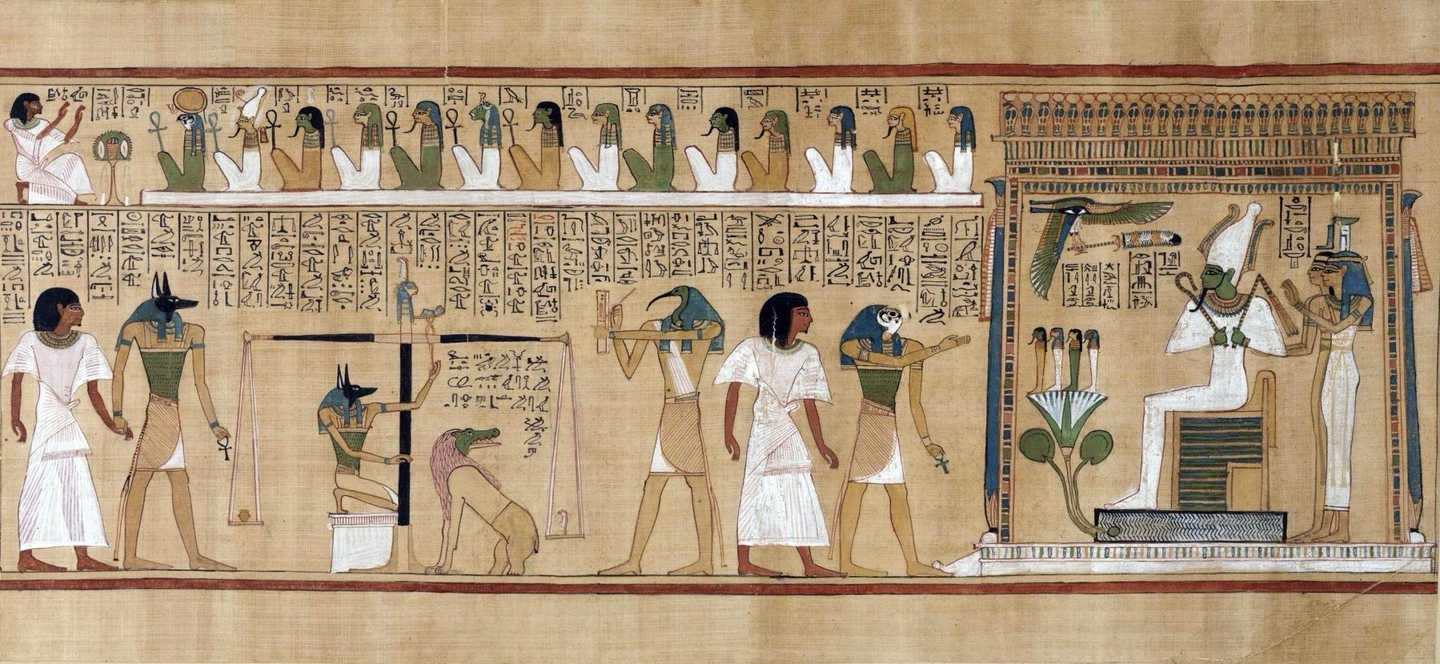
The Judgment of Osiris and the Weighing of the Heart. A scene from Chapter 125 of the Book of the Dead.
After death, a person faced the judgment of Osiris. Their heart was weighed on scales against the feather of the goddess Maat—a goddess who embodies truth, the symbol of justice, and cosmic order.
Ritual and its influence on art.The weighing scene became one of the most significant subjects in funerary papyri. Thus, the imagery served not only a magical function but also helped the deceased pass the ordeal.
The Sun Cult: Ra’s Journey. Myth: Ra traveled daily across the celestial world in a solar barge, and at night, he journeyed through the underworld, overcoming dangers.
The Sun God Ra in his solar barque (c. 13th century BCE)
Ritual: priests performed daily temple rites related to maintaining cosmic order. A crucial part of temple life was service to the deity.
Influence on Art.Depictions of the solar barge and the solar disk in frescoes and drawings. Also, the representation of the scarab as a symbol of the sun’s rebirth.
CHAPTER 3