Navigation
I. Concept II. The Female Body Under Drapery III. The «Wet Drapery» Effect IV. Partial Nudity of the Female Body V. Nude Female Body VI. Conclusion
I. Concept
In classical Greek sculpture, the female form was depicted in various ways—from fully draped figures to monumental nude statues. The drapery not only concealed the body but also emphasized its plasticity and movement. The direction, depth, and placement of the folds allowed for the depiction of body proportions, curves, and limb positioning.
Choosing a classical period is linked to the significant changes in the depiction of the female body during the 5th–4th centuries BCE. In the 5th century, techniques developed to show the body’s form through drapery; these are particularly striking in the second half of the century, for instance, in the relief «Nike Adjusting Her Sandal» (c. 410 BCE). A similar effect is also found in the Nereids from the monumental sculpture in Xanthos (c. 390–380 BCE). By the mid-4th century, Praxiteles created the «Aphrodite of Knidos, ” the first known monumental statue of a completely nude woman. This material allows for a comparison of the various solutions associated with representing the female form. The interest in this topic lies in tracing how the methods of portraying the female figure evolved and how fabric and body interacted.
Research Question and Visual Material Selection Principle
This work examines how the depiction of the female body changed in Greek sculpture during the 5th–4th centuries BCE. What means did sculptors use to convey anatomy and movement through drapery? How did the role of fabric evolve when depicting partial versus complete nudity? What was the effect of nudity on the representation of the female form?
To answer this, we compare the differences and similarities in the depiction of women from the 5th century BCE until the appearance of the Aphrodite of Knidos—the first known monumental statue of a completely nude woman. The selection includes Nike of Peonia, the Caryatids of the Erechtheion, the Tomb of Hegeso, and others. The selection is based not only on dating but also on how fabric and body interact. Some monuments are known only through Roman copies and plaster casts, in which cases the analysis relies on visual comparison.
Principle of Research Structuring
The work is structured on a typological principle and consists of four main sections, each concluded with a brief summary: the female body under drapery (II), «wet drapery» (III), partial exposure (IV), and the nude body (V). The conclusion compares the results and tests the hypothesis. This division demonstrates the diversity of solutions but does not imply that they arose in a strictly sequential manner.
Principle of Selecting Textual Sources
The theoretical foundation is built upon art historical studies of Greek sculpture and the depiction of the human form. For broad contextual background, the book «Gender, Identity and the Body in Greek and Roman Sculpture» by R. Barrow and «Greek Sculpture» by M. Fullerton are utilized. Data concerning the dating, authorship, provenance, and condition of the monuments were verified using materials from institutions such as the British Museum, the Acropolis Museum, the Metropolitan Museum of Art, and others.
Research Hypothesis
The role of drapery in V–IV century BCE sculpture is hypothesized to have depended on the degree of figural exposure. For fully clothed figures, the fabric shapes the body’s form; with partial exposure, it reveals the reason the body is uncovered; and in the case of complete nudity, drapery becomes a self-contained compositional element. The appearance of the nude statue did not signify an abandonment of drapery, but rather a shift in its function. Furthermore, this development was not linear—various solutions existed concurrently. This hypothesis is tested through a comparative analysis of selected artifacts.
II. The Female Body Under Drape
This section examines fully clothed female figures. The goal here is not to display the body, but to understand how fabric simultaneously conceals and reveals the form beneath the clothing. Two monuments offer two distinct approaches: the Caryatids of the Erechtheion, where the drapery is integrated with the architecture, and the tomb of Hegeso, where it constructs a narrative scene.
Caryatids of the Erechtheion
Alkamen and his circle. «Caryatids of the South Porch of the Erechtheion.» Circa 420–415 BCE. Modern replicas stand on the porch. The originals are housed in the Acropolis Museum and the British Museum.
Six female statues of the southern portico of the Erechtheion (late 5th century BCE, Acropolis Museum) replace columns, supporting the roof on their heads. The entire logic of their drapery is subservient to this function. Long vertical folds run along the supporting leg, emphasizing the stability and height of the figure and resembling the fluting of a column. Conversely, the fabric mirrors the contours of a bent, free leg, and the position of the body is discernible beneath the peplos. Above the girdle, the peplos forms a voluminous puff that contrasts with the austere lower section: the upper portion animates the figure, while the lower portion supports the structure. Because of this combination, the caryatid is perceived simultaneously as a structural support and as a living woman in a natural pose.
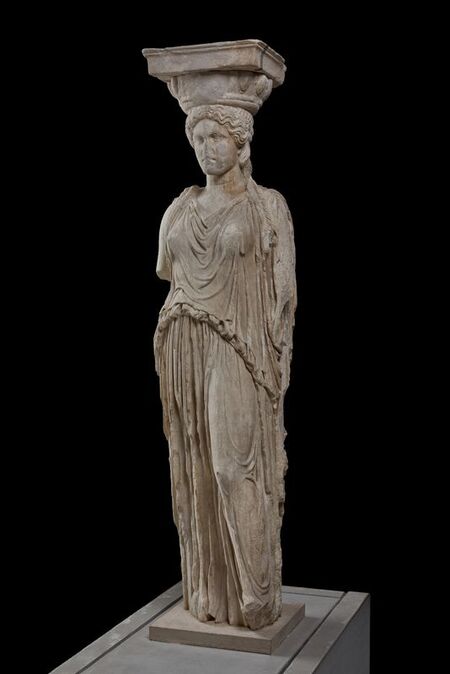
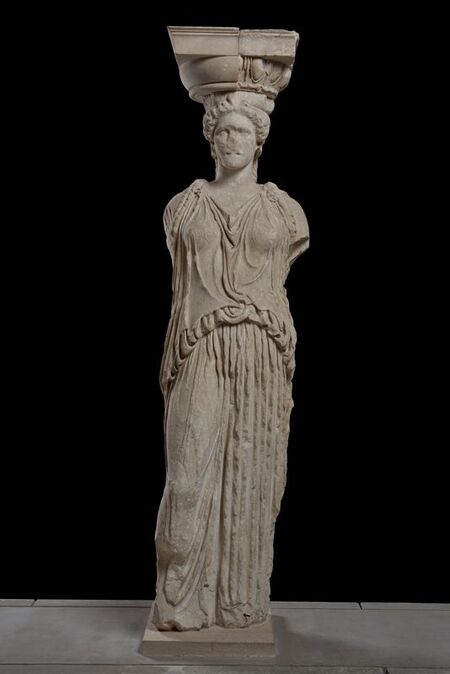
Corinthian A and Corinthian D. Alkamen and his circle. «Karyatid of the Erechtheion.» 420–415 BCE
The differences between the poses show that this is not mechanical repetition. Pose A is supported by the right leg and slightly extends the left, while Pose D is supported by the left, and the folds are reconfigured along with the posture—each figure has its own unique progression, so the six statues do not merge into a row of identical columns.
Hegeso’s Gravestone
Stela of Hegeso (c. 410–400 BCE; attributed to Callimachus, National Archaeological Museum, Athens) depicts a fully clothed female figure in a scene, rather than in an architectural setting. Hegeso sits on a chair examining a piece of jewelry presented to her by a standing maidservant; the jewelry itself was painted and no longer exists. Both figures are completely dressed, yet the fabric behaves differently on each.
Callimachus. Tomb of Hegeso, 410–400 BCE.
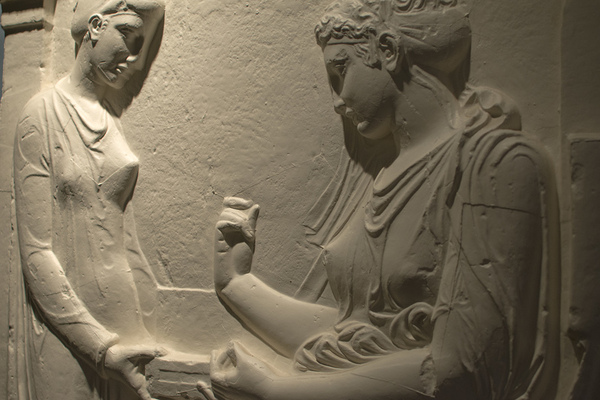
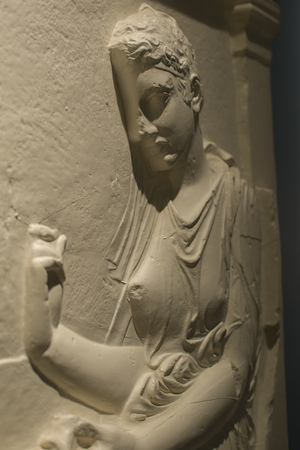
«Tomb Stele of Hegeso.» c. 410–400 BCE. Fragments of a plaster cast from the ancient original. Wilcox Collection, University of Kansas.
In the maid, the fabric forms elongated vertical folds corresponding to a standing posture, resulting in a straight and restrained silhouette. In Hegeso, the fabric gathers at the bust and waist, drapes over the bent knees, and falls down the edge of the seat. It is particularly noticeable that it does not end abruptly at the body’s boundary; rather, the hanging hem connects the figure to the chair and incorporates the furniture into the scene. The direction of the folds allows for the determination of the leg positions, even though they are completely covered. Hegeso’s attire is multi-layered, with a thin veil covering her head, while the maid is dressed more simply and wears long sleeves. The description of the stele from the Wilcox collection notes: «Hegeso’s significance is emphasized by the fact that she occupies two-thirds of the composition and wears an elaborate costume» [5, translation from English]. The difference in fabric indeed works alongside the size of the figures: the more complex the drapery, the higher the figure is positioned. While the relief is not deep, the folds lend volume to both figures, and their direction conveys the body’s position on and beneath the seat.
III. The «Wet Drape» Effect
In the latter half of the 5th century BCE, the technique of «wet drapery» develops in ancient Greek sculpture. The thin fabric is depicted as clinging so tightly to the body, as if it were wet, allowing the figure beneath the garment to be discernible.
Three Goddesses of the Eastern Pediment of the Parthenon
Phidias. «Three Goddesses of the East Pediment of the Parthenon.» 438–432 BCE.