Concept
Reptilian imagery is present in the art of many ancient civilizations. Snakes, dragons, turtles, and other reptiles frequently appear in the artistic culture and myths of various peoples. They could be depicted as fantastical beings—such as a magical serpent, dragon, hydra, basilisk, or god—or as real animals.The Mayan art is particularly interesting in this regard. Reptiles can be found everywhere there: in bas-reliefs, sculptures, and the decor of temples. Moreover, artists approached this task in diverse ways. In some instances, they strove to render the anatomy as accurately as possible, while in others, they transformed the creature into elegant ornamentation or deliberately simplified its forms.
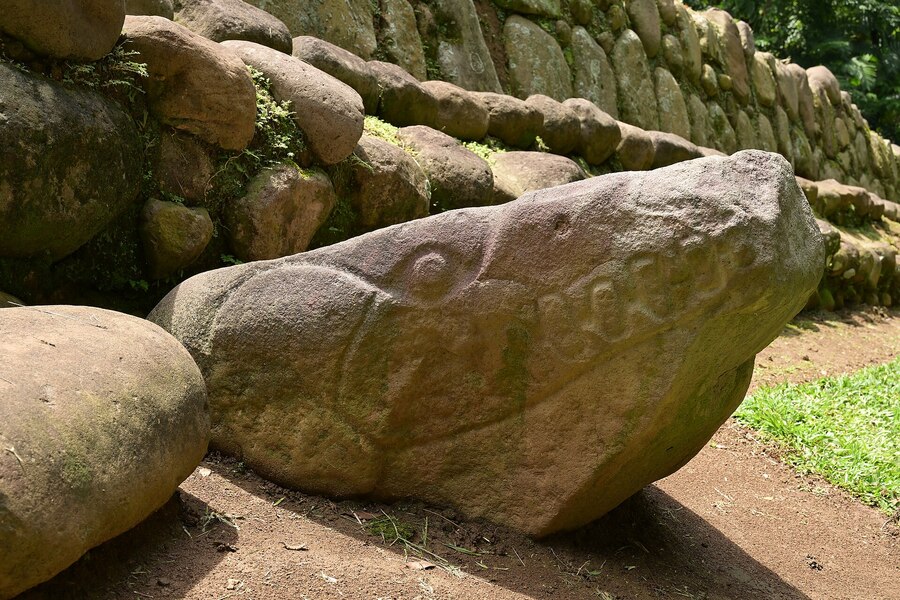
Monument 66 (Crocodile), 400 BCE — 150 CE, Takalik-Ambah National Archaeological Park
In this study, I want to explore exactly how Maya artisans worked with natural forms. How they transformed the winding body of a serpent, the massive head of a crocodile, or the carapace of a turtle into artistic imagery.
The objective of this work is to understand the techniques employed by Maya artists. I will analyze naturalism, stylization, the transformation of imagery into patterns, and the use of these motifs in architecture. What aspects did the artisans emphasize in their works?
Naturalism
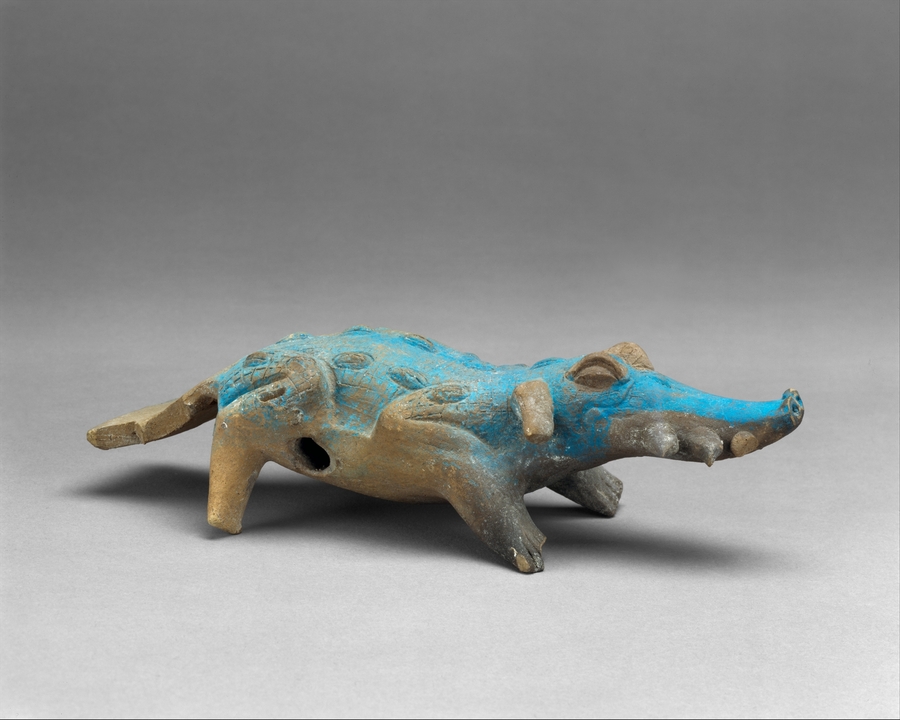
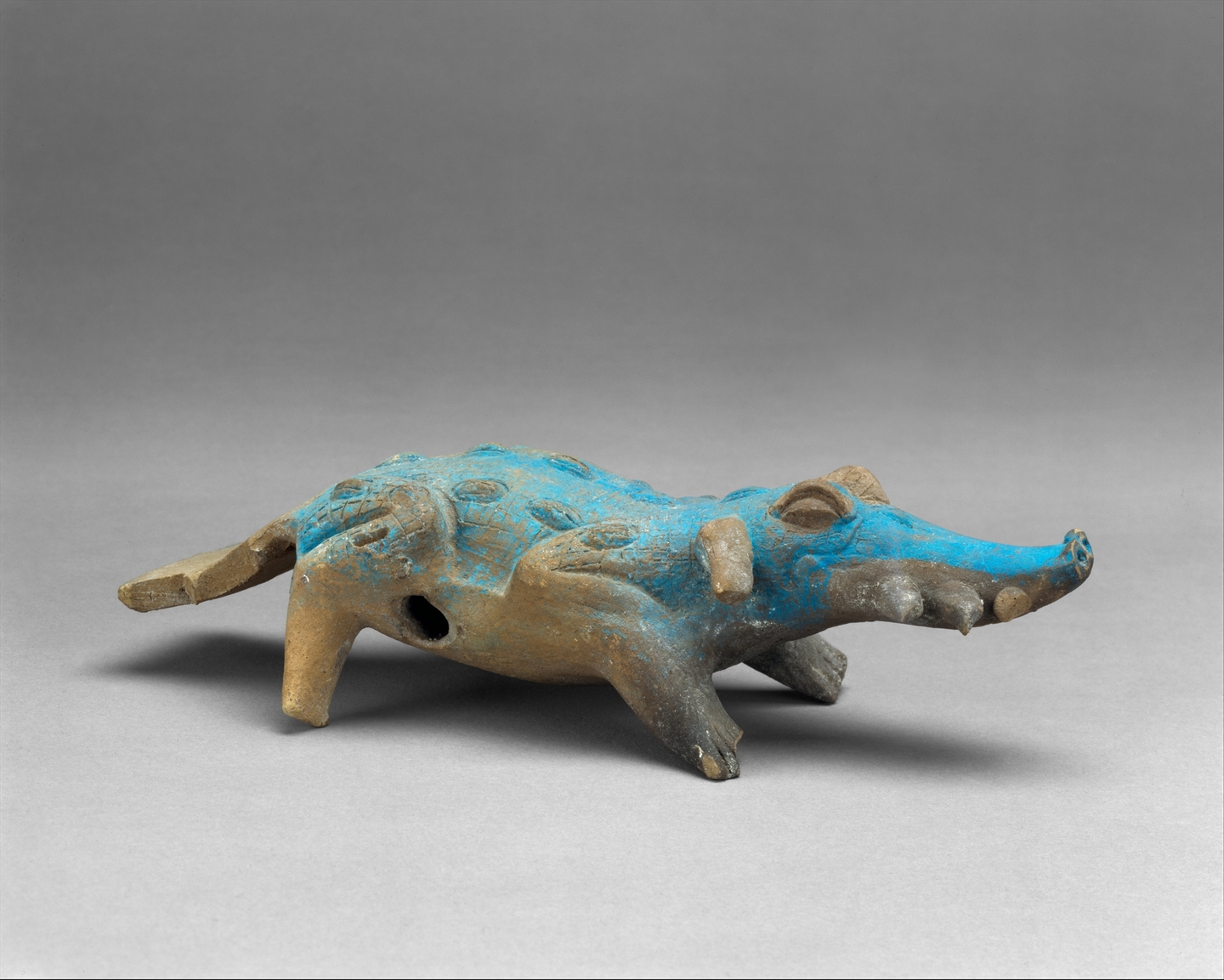
Crocodile whistle and rattle, 700–800 CE, Metropolitan Museum of Art
Maya artisans, when creating figurines, strived to convey the most characteristic features of their outward appearance. The naturalism in these depictions is evident in the recognizable anatomy of the animal: the elongated snout tapering to a point, prominent eyes, rounded nostrils, a powerful tail, and short limbs. Attention was also paid to the body surface—the characteristic bumps and the texture of the scales. Researcher Elizabeth Thurston notes that more naturalistic crocodile depictions are particularly found among three-dimensional figurines and pendants.
Crocodile-shaped vessel, 300–600 CE, Los Angeles County Museum of Art
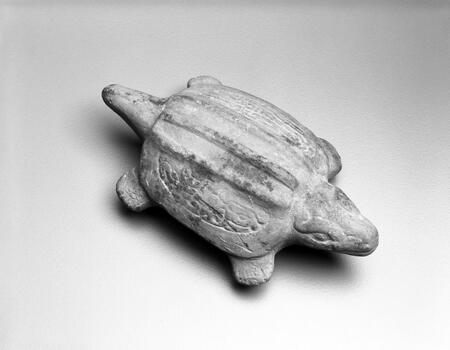
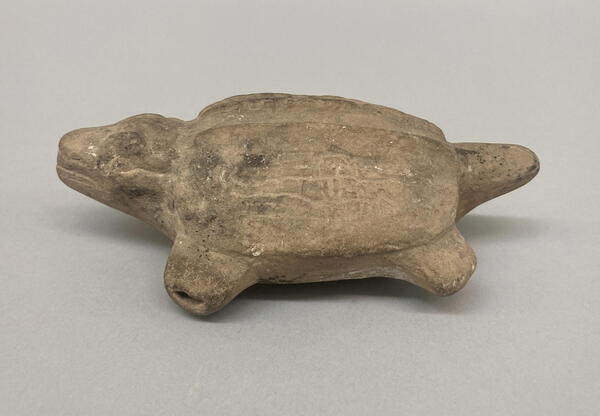
Whistle in the shape of a turtle, 500–850 CE, Brooklyn Museum
Much like the crocodile images, the artist paid close attention to the characteristic parts of the turtle figurine: the head, limbs, and small tail are well-detailed, making the animal look recognizable and natural. Furthermore, the whistle is skillfully camouflaged—the sound holes barely disrupt the image’s integrity and do not detract from its appearance. The shell’s shape is particularly interesting; it features three longitudinal ridges characteristic of the Mexican giant musk turtle (Staurotypus triporcatus). Researcher Karl Herbert Mayer notes that these features allow for a fairly confident identification of the animal’s species.
Snake Figurine, 250–950 CE, National Museum of the American Indian
In the serpent figurine from Chincultic, the artisan conveyed the animal’s characteristic elongated body and smooth curves, which create a sense of movement. Instead of intricately detailing the scales, he used red spots on the ceramic surface, resembling the natural pattern of snake skin. Furthermore, the figurine’s attribution to Mayan culture is considered tentative.
Stylization
Lancet/Bloodletting Instrument, 550–900 CE, National Museum of the American Indian
Some ritual objects were crafted in the image of zoomorphs and animals that played a significant role in Maya mythology. For example, this lancet resembles the Feathered Serpent. In this piece, the artisan unusually transforms the familiar image of a serpent. The winding body of the serpent is depicted in motion. The serrations along its curves symbolize feathers. The craftsman utilized the variegated structure of the stone to indicate the reptile’s eye. The master consciously generalized the recognizable form of the serpent.
Canoe shaped like a crocodile with passengers on its back, 600–900 AD. Dallas Museum of Art
In this image, the crocodile is distinguished by its exceptional detail and complex form. Its elongated body is curved in a smooth arc, creating a sensation of swift motion, as if the animal is rushing into an underground world. Individual parts of the body take on fantastical features: the limbs are represented as the heads of the god Cavil, and small human figures can be seen on its back.
Madrid Codex (Tro-Cortesian Codex) 15th Century, Museum of the Americas
Dresden Codex, 1200–1250 AD, Museum of the Book at the Saxon State and University Library in Dresden
In the Maya codices, reptilian depictions are characterized by a high degree of conventionality. Artists emphasized the most distinctive features of these animals—the elongated body shape, the silhouette of the head, skin patterns, and coloration—simplifying or exaggerating specific details. Furthermore, the reptiles were not depicted solely as real animals but also integrated into fantastic and mythological imagery. This is particularly evident in the Dresden Codex, where the Celestial Crocodile is presented as a fantastical creature combining traits of various reptiles, from whose jaws emerges the head of the deity Itzamna. In the Madrid Codex, depictions of deities and animals are incorporated into ritual and divination scenes.
Ornamentation
Elements in Architecture
Conclusion
Crocodiles and the Ancient Maya: An Examination of the Iconographic and Archaeological Evidence, URL: https://collectionscanada.gc.ca/obj/thesescanada/vol2/002/MR68216.PDF
An Ancient Maya Turtle Image Identified by Karl Herbert Mayer, URL: https://www.instituteofmayastudies.org/wp-content/uploads/simple-file-list/Newsletters/2021_issues/IMS_2021_04.pdf
Maya Art: Ritual Objects of Chert Slate and Obsidian, URL: https://a-gallery.ru/tpost/76jhx4n9o1-iskusstvo-maiya-ritualnie-predmeti-iz-kr
Crocodile Whistle and Rattle, 700–800 CE, Metropolitan Museum of Art, URL: https://www.metmuseum.org/art/collection/search/313335 (Accessed 11/15/26)
Crocodile-shaped Vessel, 300–600 CE, Los Angeles County Museum of Art, URL: https://collections.lacma.org/object/168630 (Accessed 11/15/26)
Snake Figurine, 250–950 CE, National Museum of the American Indian, URL: https://americanindian.si.edu/collections-search/object/ark%3A/65665/ws687b4ed2441d7419089492f35bac92526? (Accessed 11/15/26)
Turtle-Shaped Whistle, 500–850 CE, Brooklyn Museum, URL: https://www.brooklynmuseum.org/ru-RU/objects/118818
Lancet/Bloodletting Tool, 550–900 CE, National Museum of the American Indian, URL: https://americanindian.si.edu/collections-search/object/NMAI_145852