Concept
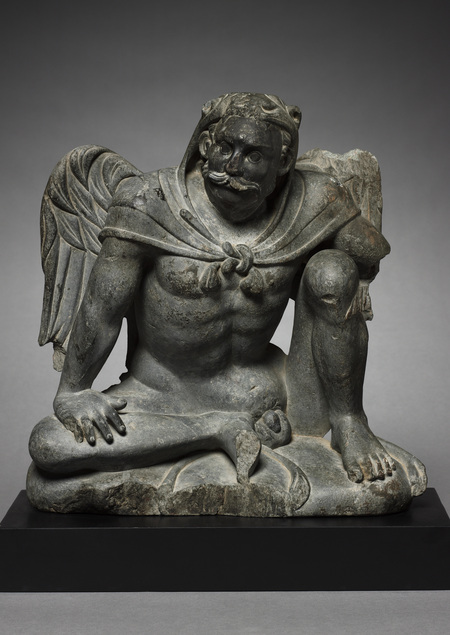
In the 2nd–4th centuries CE, a major school of Buddhist art developed in Gandhara. Buddhist sculptures and reliefs, which adorned local monasteries and stupas, were created here. Buddhist sculpture from Gandhara features imagery closely linked to Greco-Roman art. One can observe atlantes, garland bearers, and figures resembling ancient heroes. Researchers attribute the appearance of these motifs to the region’s Hellenistic heritage and later contacts with the Roman world. I chose this topic because I am interested in tracing how figures familiar from Greco-Roman art transformed when they became part of Buddhist monuments.
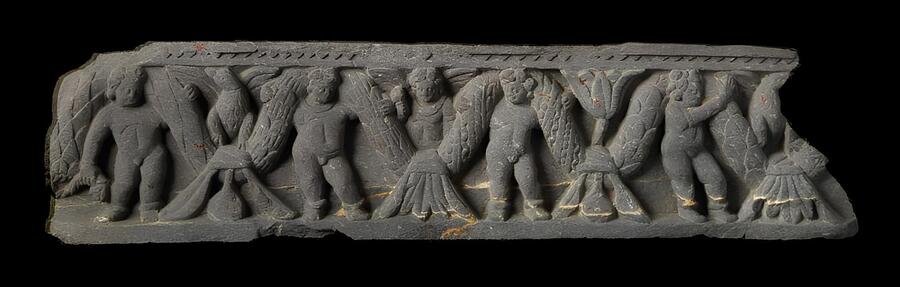
«Fragment of a frieze with putti supporting a garland, ” 12th–14th centuries.
The key question of my visual research: how did Gandharan masters utilize Greco-Roman imagery in Buddhist art?
In this study, I aim to determine what the Gandharan masters preserved from classical imagery, what they modified, and what role they assigned to these figures within Buddhist art. I hypothesize that the classical heritage was assimilated selectively. In some instances, the figure acquired a new religious role, while in others, it retained an architectural or decorative function but adopted new characteristics influenced by the local artistic tradition.
The primary material will consist of Gandharan sculptures and reliefs from the 2nd to 4th centuries. I selected works where the features of Greco-Roman art are most clearly discernible.In my comparison, I will focus on the poses and proportions of the figures, their drapery, gestures, and attributes. For each motif, I will select Greco-Roman works with similar visual characteristics. I will also examine the figure’s placement within the composition—what it supports, with whom it interacts, and how it relates to the surrounding space.I chose my textual sources based on their authority, relevance to the research topic, and depth of analysis. I selected both scholarly articles on Gandharan art and museum publications and texts concerning antiquity. These sources helped me better understand the emergence of classical motifs in Gandharan art.
The study is divided into three chapters to allow for a comparison of the use of ancient forms in character design, architectural ornamentation, and decorative composition. In each section, I will briefly outline the history of the motif, draw comparisons between works, and formulate a conclusion. The first chapter is dedicated to Vajrapani—the protector of the Buddha—some depictions of whom bear the features of Hercules. The second chapter will address the Atlantes used in the design of Buddhist stupa bases. The third chapter focuses on garland bearers.
Chapter 1. Vajrapani: The Image of the Buddha’s Protector with Heroic Attributes
In some Gandharan depictions, researchers have noted features in Vajrapani related to the image of Hercules. This connection manifests in different ways. In some works, specific attributes of the ancient hero are preserved, while in others, the resemblance is visible in physique, posture, or individual gestures.Images of Hercules were known in the region’s artistic circles even before the appearance of Gandharan reliefs. Connections to the Greco-Roman world were maintained through trade. Consequently, Greek and Roman artistic forms could enter the region at various times and through different commodities. [1; 2]
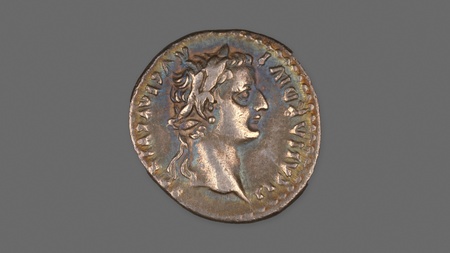
Tetradrachm of Demetrius I, c. 200–185 BCE
On the reverse of the coin, Hercules is depicted standing almost frontally. With one hand, he raises it toward his head, while in the other he holds a club and a lion skin. It is precisely the club and the skin of the Nemean Lion that allow us to identify Hercules among other characters.The coin indicates that the hero’s image was present in the Hellenistic culture of Central Asia long before the creation of the Gandharan monuments of the 2nd–3rd centuries.
«Hercules Landsdorn, ” circa 125 CE
In the Roman statue, Hercules' body is completely nude. Broad shoulders, chest, and abdominal muscles emphasize his physical strength. Despite this, the hero is depicted in a relaxed pose, resting on one leg. A club rests on his left shoulder, and a lion’s pelt hangs from his right arm, referencing Hercules' feat—the victory over the Nemean Lion.
In Gandharan scenes, Vajrapani accompanies the Buddha as a protector. His name means «holder of the vajra.» The vajra is a thunder-associated weapon depicted as a short scepter.
Fragment of a bas-relief featuring Vajrapani and other figures. 2nd–3rd centuries CE.
Vajrapani is located in the lower left portion of the preserved fragment. His torso is exposed, and a lion skin is draped over his head. Unlike Hercules Lansdown, who holds the skin in his hand, here it is used as part of his attire.
The connection to Heracles is particularly evident in this case through the lion skin. However, the other attributes belong to a different figure. Vajrapani holds a vajra in his right hand and a long sword in his left.
The sculptor utilizes one of Heracles’ most recognizable symbols while incorporating details that refer to Vajrapani. Thus, the ancient motif merges with the armament of the Buddhist protector.
Yet, the lion skin is not present in all depictions of Vajrapani. In the relief featuring the Buddha’s first sermon, the connection to Heracles manifests differently.
«Vajrapani at Buddha’s First Sermon, ” circa 2nd century CE
Vajrapani stands to the right of the Buddha. His bare chest distinguishes him from the clothed figures. There is no lion skin here, and his face appears young and clean-shaven.Vajrapani holds a vajra shaped like a short rod. It rests before his chest, helping to differentiate the protector from the other figures in the scene. However, the seated Buddha remains the central figure: his form occupies the center of the relief, his head is encircled by a halo, and his lowered hand points toward the wheel of doctrine.His proximity to the Buddha reveals Vajrapani’s role in the scene: the teacher delivers a sermon, and his armed companion symbolizes his protection.
«The Miracle of Buddha Before the Ascetics,» 2nd–3rd Centuries CE
Buddha is seated once again at the center, but Vajrapani is on the opposite side, to the teacher’s left. Here, the protector has a thick beard, an exposed torso, and defined abdominal muscles. The cloth is draped over the left shoulder and gathered around the lower body.
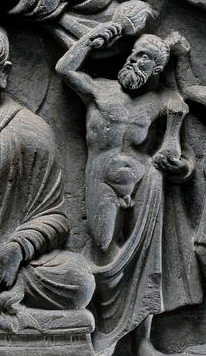
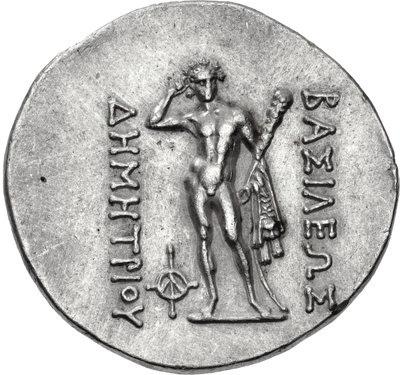
«The Buddha’s Wonder Before the Ascetics, ” 2nd–3rd centuries CE / Tetradrachm of Demetrius I, circa 200–185 BCE
In his left hand, Vajrapani holds a vajra, while in his right, he raises a whisk. The hand positions are reminiscent of Hercules on the Demeter I coin. This posture is linked to the ancient archetype of Hercules placing a wreath upon himself. [3]
The whisk reveals another aspect of Vajrapani’s role: he accompanies the Buddha and pays him homage. Simultaneously, the other hand retains the weapon of a protector.
The examined examples demonstrate that Vajrapani’s connection with Heracles manifests through various attributes. In all cases, Vajrapani is defined within a Buddhist context. Therefore, the ancient traits are not transferred wholesale; rather, they are selectively utilized and acquire a new function.
Chapter 2. Atlantes in the Decoration of Buddhist Stupas
In the decoration of Gandharan stupas, there are male figures that seem to support the parts of the structure located above them. Due to their resemblance to ancient images, they are commonly called Atlantes.
During the war of the gods and titans, the mighty titan Atlas sided with the vanquished, rising up against Zeus and Olympus. After the victory, Zeus severely punished Atlas, commanding him to stand eternally at the edge of the earth and bear the colossal celestial vault upon his shoulders.
Atlas Farnese, 2nd century CE
Atlas kneels on one knee, holding the celestial sphere on his shoulders. His body is bent under the weight, his head is lowered, and his arms are pressed against the globe.
Telamons in the Therm Forum Tepidarium, 80 BCE, Pompeii