Navigation
[1] Concept [2] Minoan Crete [3] Ancient Egypt [4] Assyria [5] Conclusion
Concept
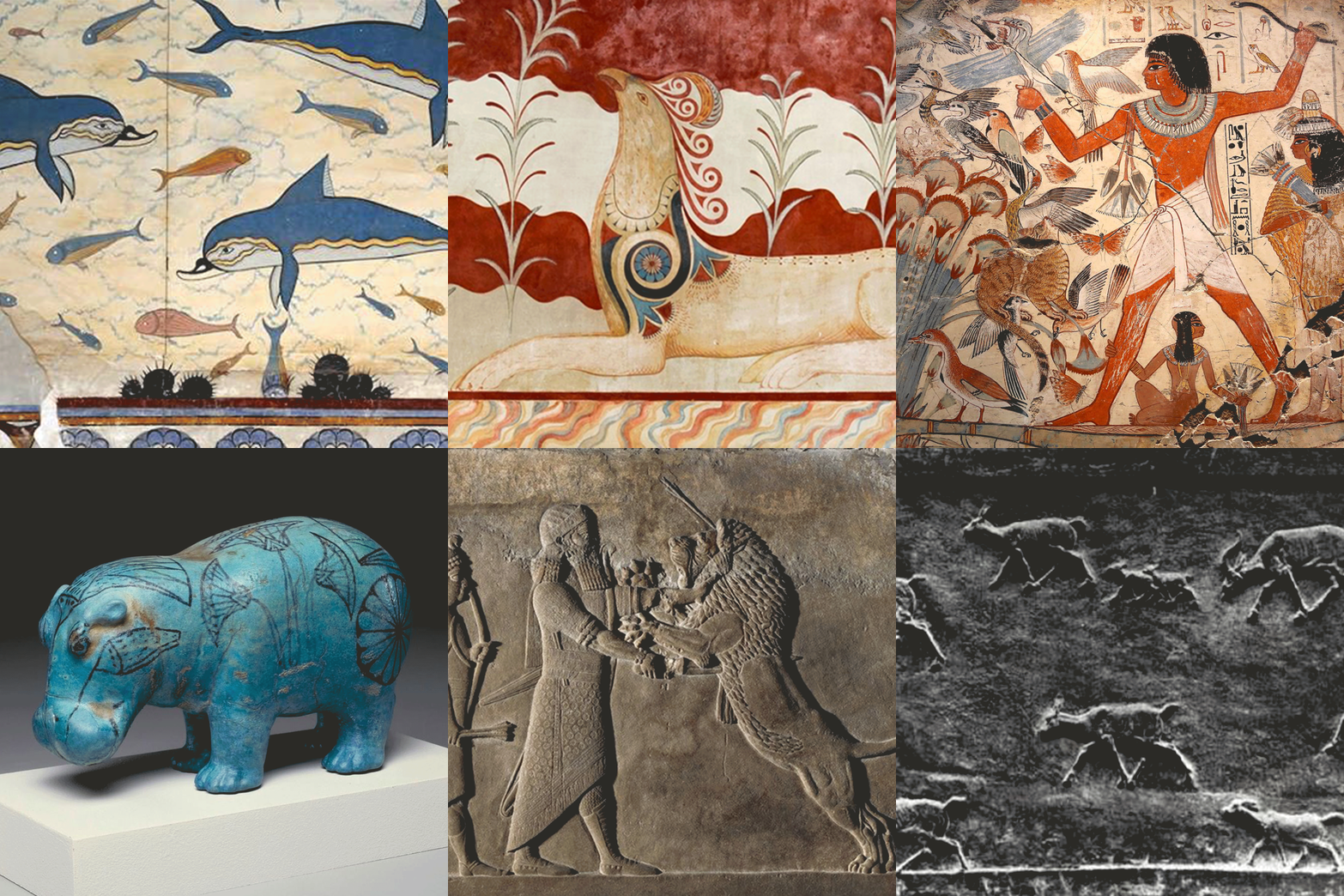
In the cultures and mythologies of ancient civilizations, animal imagery holds a special place. This is because ancient people built their lives and worldview based on what they observed—that is, the surrounding world. Humans were surrounded by dominant predators that posed a threat to their very existence, animals that formed the basis of their sustenance, or powerful, physically strong beasts. The passage of time and the development of civilization also prompted people to contemplate the cosmos and higher powers, and it was these very animals—whose strength and grace humans observed—that became their symbols. People began to perceive animals not as equals or lesser beings, but as embodiments of gods whose favor determined their own well-being.
Indeed, in the culture of many ancient civilizations, the image of the bull held a special place—a powerful and sometimes dangerous animal.
For example, in Minoan Crete culture, there was a deity associated with fertility and moisture, granting life to the earth, depicted in the form of the Bull of the Underworld, later identified with the Greek Poseidon. Thus, the symbol of the earth deity became a physically powerful and dangerous animal to humans, to which favorable treatment and offerings, according to the Cretans, would ensure societal well-being.
Similarly, the bull held significance in Ancient Egypt. Here, it became Apis—a sacred being that later symbolized the god Osiris, who was responsible for fertility among other things. This again connects the image of the bull to the earth, illustrating the dependency of soil fertility on reverence for higher powers, which could be expressed by performing specific rituals and depicting the animal associated with the god in their constructions.
As for Assyria, the bull evolved, becoming a symbol of the divine origin of royal power. A new creature, the Lamassu, emerged—a being physically even more powerful than the bull. Its imagery was augmented with the wings of an eagle, symbolizing freedom and the ability to resist evil, and the head of a human, representing wisdom and divine reason.
In my research, I aim to examine in detail why this image became so significant in the worldview of ancient civilizations, what role the bull occupied in their conceptual map of the world, and how this perspective differed among representatives of various cultures. To do this, I will study works of art from ancient civilizations where this image is particularly prominent—specifically, the sculptures, frescoes, and wall paintings of Minoan Crete, Assyria, and Ancient Egypt.
Lead: first image of bulls.
The earliest depictions of bulls date back to the Paleolithic era.
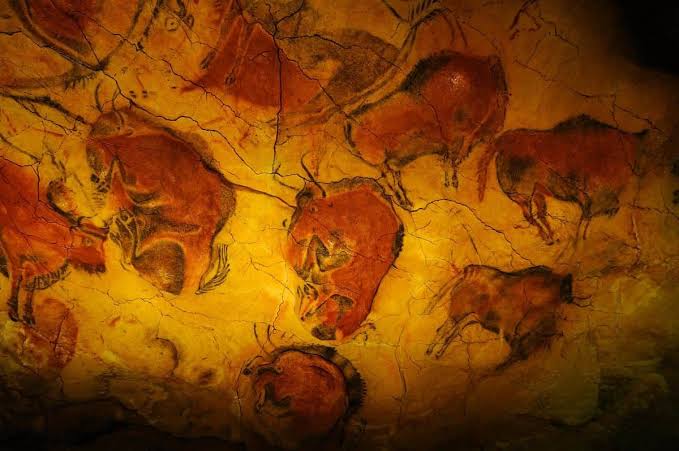
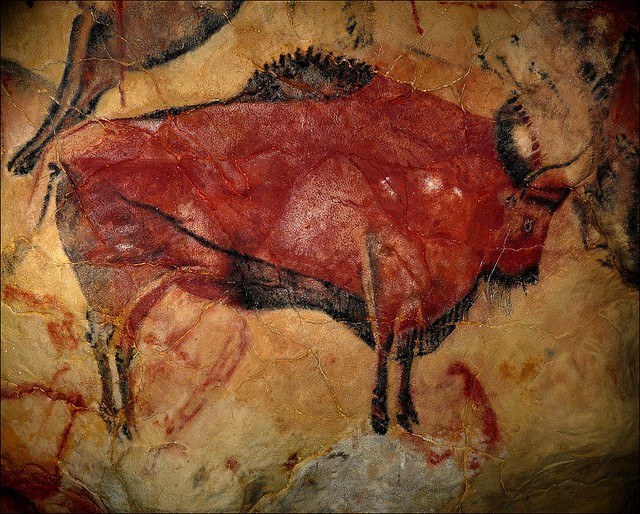
Altamira Cave. Spain. Approximately 35,000–11,000 BCE.
Minoan Crete
A significant number of Mycenaean artifacts have been discovered on the site of the Knossos Palace, so I will begin my research with it.
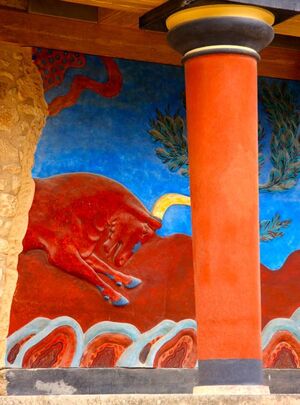
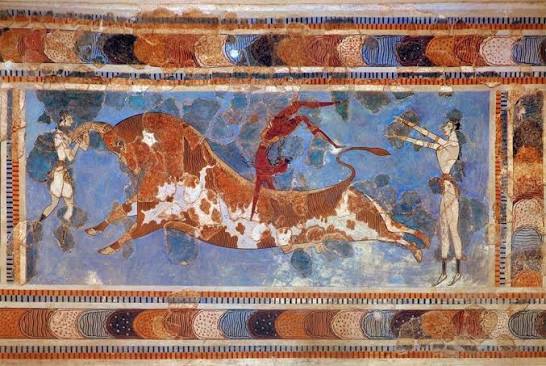
Relief fresco «Running Bull» at the northern entrance of the Knossos Palace, circa 1450 BCE / Fresco «Taurokathapsia» Eastern Wing of the Knossos Palace, circa 1500 BCE
The bulls depicted in these frescoes are shown in motion and share similar poses: their heads are thrust forward with horns, and their bodies are in mid-air, not touching the ground. The animal figures appear physically powerful and invulnerable. In the fresco «Taurokatapsia,» the figures of the athletes are also important, adding dynamism to the ritual act taking place.
The inherent symbolism of the bull within Minoan Cretan culture is profoundly important. There exists a cult of a Chthonic Bull—a representation of Poseidon—who serves as a god of fertility. Under his sway are the fluctuations of the earth’s surface, leading people to consider him the embodiment of nature’s destructive forces—the Father of Bulls—which directly substantiates the significance of this animal to the island’s inhabitants.
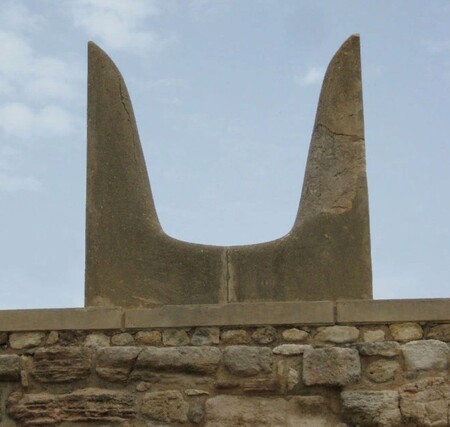
The ritual horns (c. 1600 BCE, Knossos Palace) are a cult symbol of Minoan religion, appearing not only on the central area of the Knossos Palace but also on other structures and their elements. This demonstrates the paramount role of the Bull in Cretan culture, serving as a form of amulet in their traditions.
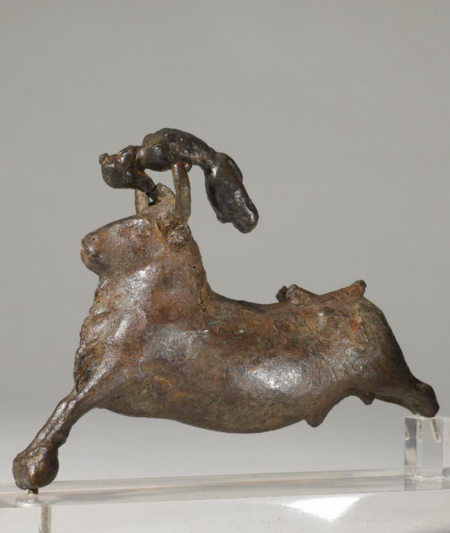
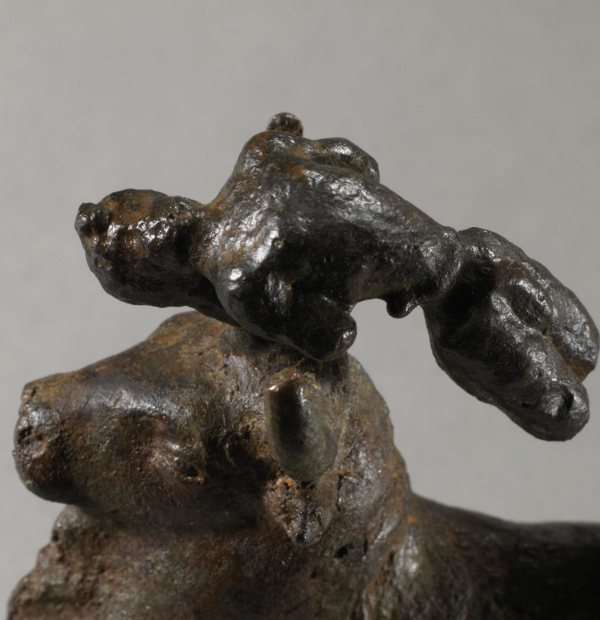
Bronze sculptural group «Bull and Acrobat, ” circa 1600–1450 BCE.
Here, the clarity and dynamism in depicting the ritual itself are also interesting.
This is how it is described in the article «The Knossos Palace — The Cult Center of Poseidon, the Earth Shaker»: «A human sacrificed was initially thrown into a pit toward the bull so that it would kill him. But sometimes a sufficiently clever captive emerged. He would evade for a period, which greatly amused the ceremony participants. Then the pit was made larger. Not one, but several victims were lowered into it at once to prolong the hunt. When the bull killed someone, the others were pulled out of the pit and released for the next round. But the longer the victims lived, the more skillful and agile they became. There were times when the bull grew tired quickly and no longer wanted to chase the doomed people. Then it was considered that the god was satisfied this time and did not want a sacrifice. In this situation, the most agile and quick „victims“ lived longer and managed to teach their art to the others. Each generation added something new to the „bull dance.“ After all, every person seeks glory—even a victim doomed to death. Simply dodging the horns was no longer satisfying to anyone. One had to transform the terrifying ritual into a graceful dance, conquer one’s fear, and interact with the bull as if one loved it. This was the golden age of tauromachy. The „bull jumpers“ were so famous that the most noble and brave youth from Crete came to the arena, out of love for the art, with the goal of honoring the god and earning renown.»
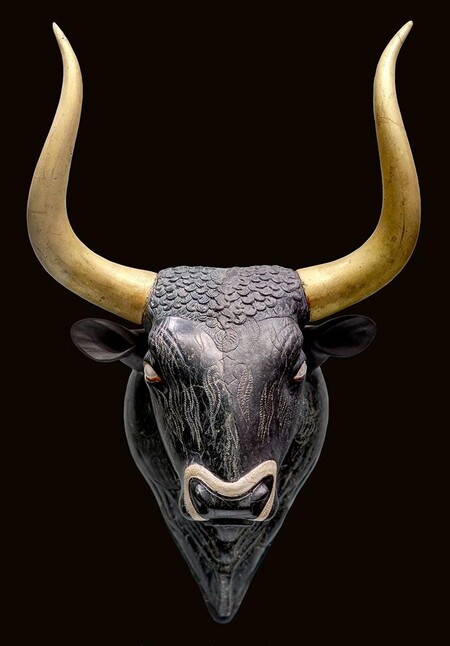
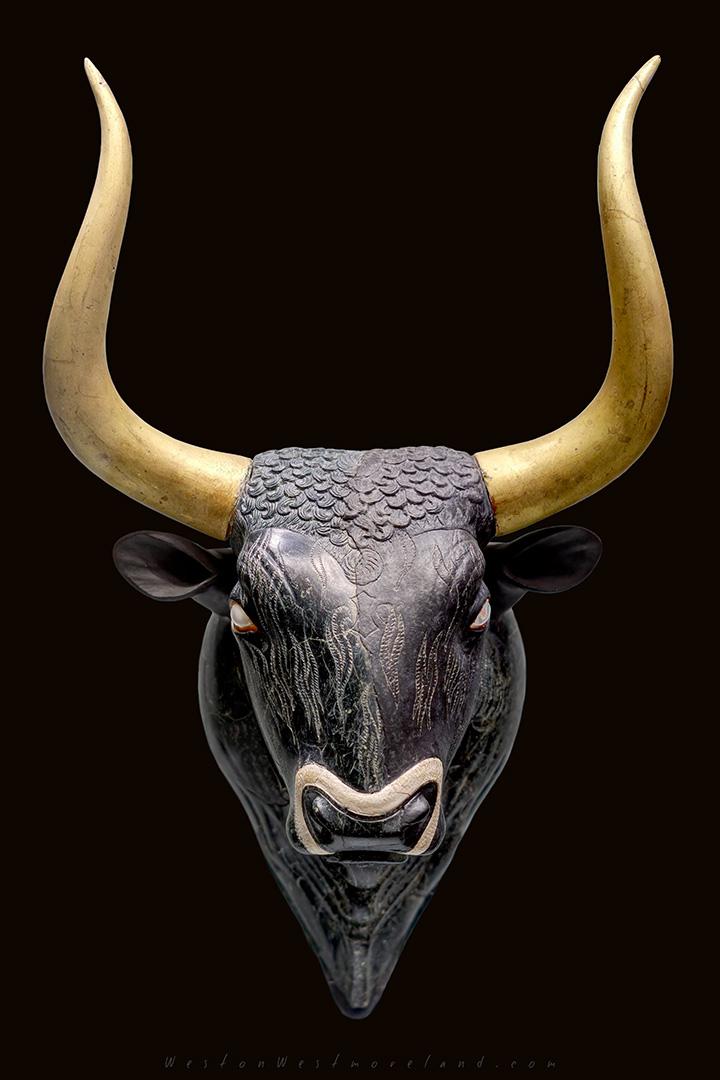
Rhyton in the form of a bull’s head. Knossos Palace (2nd half of the 16th century BCE)Here, the bull is depicted statically; the image clearly documents the animal’s physiological features, such as the folds of skin on its neck, the curls of hair between its horns, the fur on its muzzle, and the structure of the head itself.
Thus, the bull on Minoan Crete becomes a direct «participant» in many rituals, which influences its representation in art: it most often serves as the main or even sole protagonist in the composition, and the artist imbues it with the highest level of detail, always emphasizing its power and even its grace.
Egypt
In Egyptian mythology, the bull itself became a deity known as Apis. It was considered the living embodiment of the god Ptah and symbolized fertility.
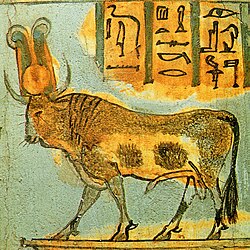
The selection of that sacred bull, which was destined to live at the Ptah temple, was conducted in a specific manner. The animal had to possess a white triangle on its forehead and black spots on its body, resembling an eagle or a scarab. There were also other unusual rules, for example, the calf was fed for forty days before being brought to the temple.
Sarcophagus for the mummified bull Apis. The Serapeum in Saqqara was built around the 7th century BCE.
After the death of the Apis bulls, they were mummified and buried. The burial site was the Serapeum in Saqqara—an imposing subterranean complex featuring gigantic sarcophagi. This location stands as a monumental testament to the bull cult in Egypt, as it directly illustrates the significance of the Apis within the culture, given that its burial paralleled that of the pharaohs.
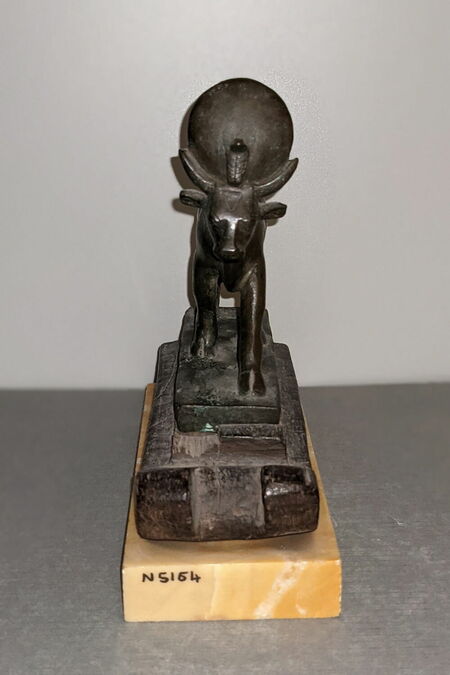
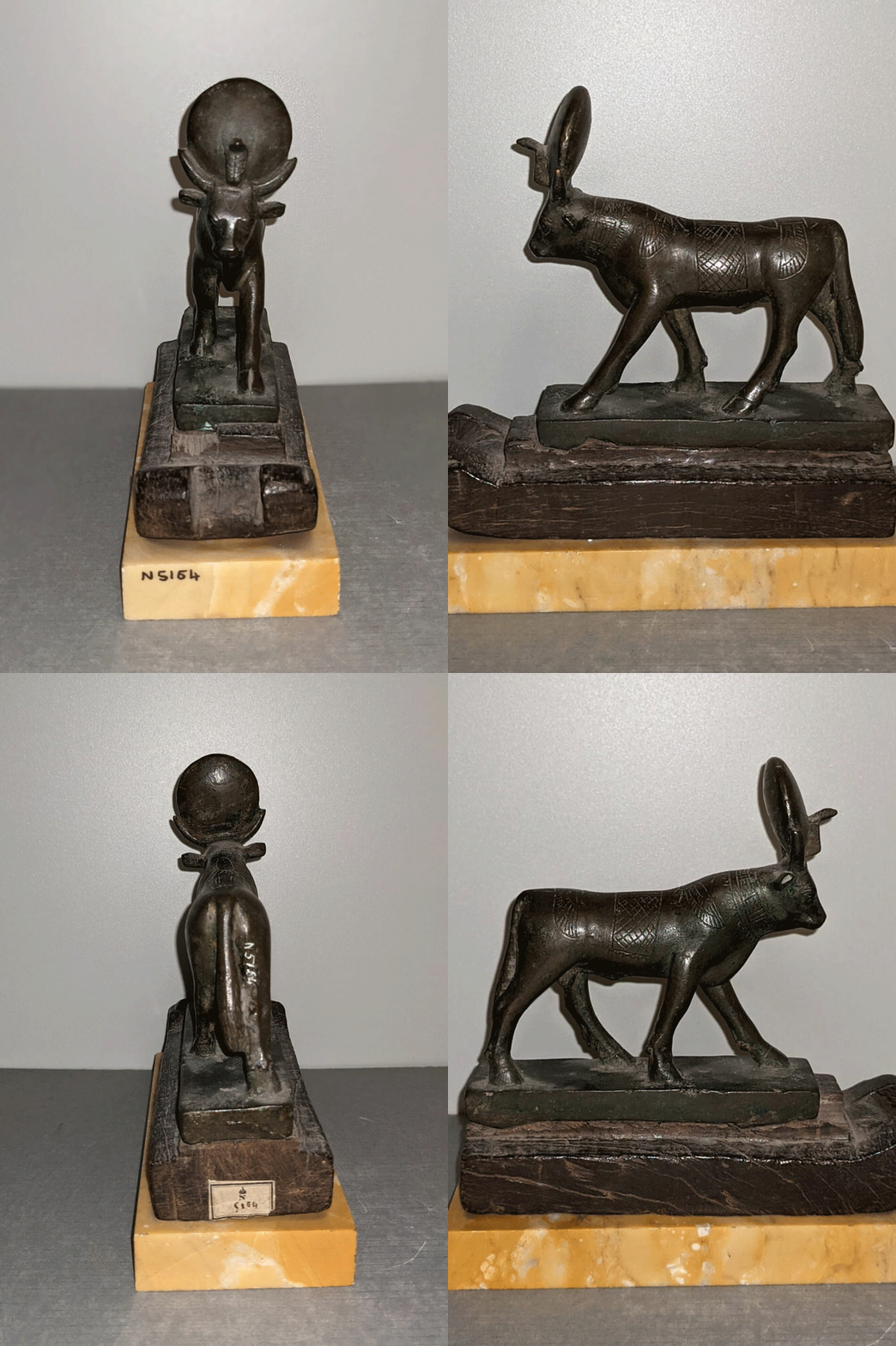
«Statue of the sacred bull Apis.» Louvre, 664–332 BCE.