Navigation
— Concept and Topic Selection
— Traditional Depictions of Gods
— From Zenith to Transition
— Aten: Discs, Rays, and Arms
— Divinity and the Royal Family
— Conclusion
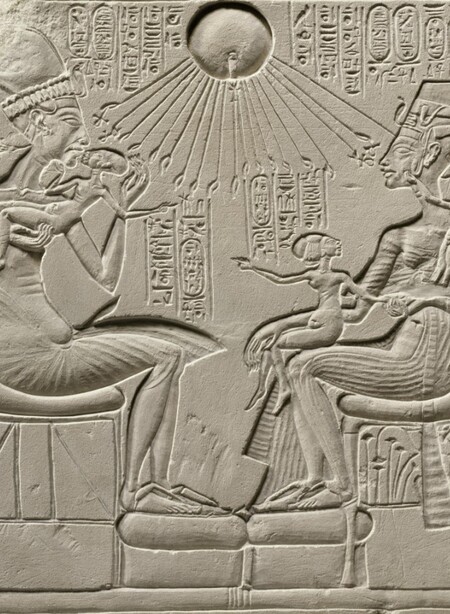
Akhenaten’s religious reforms ushered in a period of profound change in the art of Ancient Egypt. The familiar depictions of deities in human, animal, or composite forms yielded central ground to the image of Aten—the solar disk with rays terminating in hands. This transition affected not only the deity’s appearance but also the manner in which its presence and interaction with humanity were represented.
Hypothesis: The transformations affected not only the deity’s appearance but also the entire structure of the religious scene. The god’s position relative to the pharaoh, the direction of gestures, the distribution of space, and the methods of conveying signs of life could have changed as the cult of Aten was established.
This topic was chosen out of interest in how religious ideas take visible form and how the alteration of those ideas transforms artistic language.
The visual material primarily consisted of reliefs and stelae depicting deities and scenes of their interaction with the pharaoh. Selection was based on the dating, origin, preservation of the monuments, and the feasibility of examining significant details. Preference was given to works with museum attribution or scientific publication. The monuments from the reign of Amenhotep III will form the basis for examining the preceding tradition, while the works from the reign of Akhenaten will serve as material for studying its transformations.
The foundation of the research text comprised ancient Egyptian sources found in published translations, museum descriptions, and scholarly works on the art and religion of that period. A special emphasis is placed on the «Great Hymn to Aten, ” which is directly related to the Amarna religious tradition. Its fragments were used to compare verbal depictions of the solar deity with visual methods of illustrating its actions.
The goal of the study was to confirm the hypothesis that the Amarna transformations affected not only the deity’s appearance but also the entire structure of the religious scene.
Amenhotep III and the Art of His Era
Amenhotep III—a Pharaoh of the 18th Dynasty who reigned approximately from 1388 to 1353 BCE. His long and prosperous reign was a period of active construction and the flourishing of courtly art. Artisans strived for a more vibrant representation of movement, volume, and pictorial quality. While traditional canons for depicting pharaohs and gods were maintained in sculpture and relief, individual works displayed a distinct sophistication and a softer, more expressive modeling of figures. Therefore, the art of this period can be viewed as an important context for studying divine imagery within the selected theme.
Traditional depictions of the deity
Anthropomorphic divine figure
In the art of Ancient Egypt, deities were often depicted in human form. This mode of representation is called anthropomorphism. It allowed the god to be presented as a participant in the scene—for instance, seated on a throne or receiving an offering from the Pharaoh.
Fragment of the Senus stela, worshipping Osiris. New Kingdom, 18th Dynasty, reign of Amenhotep III, c. 1386–1347 BCE. Limestone.
On the Osiris stele, the figure is anthropomorphic: it has a human face and body, but the body is wrapped in funerary shrouds. The god is seated on a throne, wears the Atef crown, and holds royal regalia—a staff and a flail. Thus, the human appearance is combined with specific attributes that signify Osiris as a god and ruler of the underworld. Senu stands before him, turned toward him with hands raised in adoration. Senu is dressed in the traditional attire of an ancient Egyptian man—a loincloth, along with a wig and a broad collar.
The composition adheres to Egyptian artistic canons: the figures are shown in profile, their poses and gestures are conventional yet easily legible, and hieroglyphic inscriptions are included in the image. The relief dates to the 18th Dynasty, the time of Amenhotep III, and illustrates the endurance of traditional Osiris iconography. In this stela, the anthropomorphic image is particularly striking: the deity possesses a human body, but its divine essence is expressed through a specific pose, attire, and attributes.
Zoomorphic divine figure
Stele with Taweret and Mut from Isheru. New Kingdom, 18th Dynasty, the time of Amenhotep III, c. 1386–1347 BCE. Limestone, painted.
In ancient Egyptian art, deities could be depicted not only in human form but also in the guise of animals or creatures combining human and animal features. The animal served to visually signify the deity’s specific characteristics and powers.
On the panel from Isheru, on the left, is depicted the goddess Taweret, recognizable by her hippopotamus-like appearance. More precisely, her image is not entirely zoomorphic: Taweret was typically portrayed as a composite being—with the body of a pregnant hippopotamus, lion paws, and a crocodile tail. Therefore, it is more accurate to speak of the goddess’s zoomorphic, composite form here. The animal form is not merely a decorative feature; Taweret was associated with the protection of mothers and children, and her powerful image expressed protective strength. On the right is Mut. Unlike Taweret, she is depicted in human form—as a female deity in traditional attire and headwear.
The stela shows that during the reign of Amenhotep III, traditional methods of depicting gods—human and composite, based on animal features—were still in use.
A blended, or hybrid, depiction of a deity
In Egyptian art, deities could be depicted in a composite form—for example, with a human body and the head of an animal. This image merged the recognizable human figure with characteristics associated with a specific animal and deity. The hybrid differs from the anthropomorphic form by featuring distinct animal traits; it differs from the zoomorphic form in that the body is fundamentally human, not animal. This combination of elements helped portray the deity simultaneously as a participant in the human world while emphasizing its unique nature and power.
During the reign of Amenhotep III, not only relief carving on the stelae and temple walls but also round sculpture occupied an important place. Statues of gods were created, intended for temple spaces and cultic practices. Their artistic beauty combined with religious function: the statue served as a visible representation of the deity and could participate in its veneration.
The statue of Sekhmet, «Mistress of the Hill above Amun.» New Kingdom, 18th Dynasty, during the reign of Amenhotep III, circa 1386–1347 BCE. Granodiorite.
The goddess Sekhmet is depicted in a hybrid form: she possesses the head of a lioness and the body of a woman. This hybrid image combines the human figure with an animal head. The lion features emphasize Sekhmet’s power and formidable nature, while the human body allows her to be represented in the familiar seated posture characteristic of Egyptian sculpture. It is important to note that Sekhmet is not simply a person with an animal head; the combination of body parts creates a cohesive image of a deity that unites the human form with the strength of the lioness. Characteristic of Egyptian art are her frontality, symmetry, stable posture, and idealized, reserved appearance.
During the reign of Amenhotep III, deities were depicted according to the traditions of Egyptian art—in human, animal, or composite human-animal forms. Each type helped convey the distinct nature of the deity. Their identity was revealed through characteristic facial features, posture, headdress, attributes, and inscriptions.
From Bloom to Change: Akhenaten and the Art of His Era
Akhenaten (Amenhotep IV)—a pharaoh of the 18th Dynasty who reigned approximately from 1353 to 1336 BCE. His reign marked a period of sweeping religious transformation: the pharaoh elevated the cult of Aten—the sun disk—to a central position and curtailed the worship of traditional gods. These changes were accompanied by the development of a new artistic style, known as the Amarna style, characterized by figures depicted with unusual proportions, greater expressiveness, and in more fluid scenes.
P.V.A.P.