The Image of Struggle in Ancient Sculpture: The Southern Metopes of the Parthenon
Introduction
How are movement and tension conveyed in still marble through visual means?
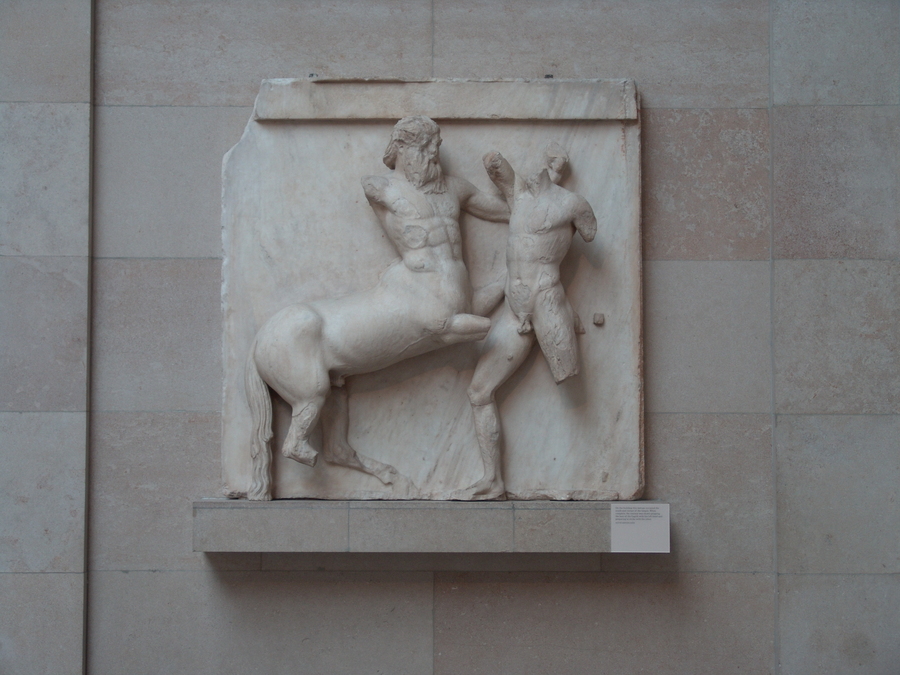
The Battle of Lapith and the Centaur. South Metope of the Parthenon XXXII. Parian marble, c. 447–440 BCE. British Museum, London.
Categories
Research Concept 1.1. Rationale for Topic Selection 1.2. Key Research Question and Hypothesis 1.3. Material Selection Principle 1.4. Visual Analysis Methodology Context: The Parthenon and its Sculptural Decoration 2.1. Pediments 2.2. Metopes and Triglyphs 2.3. Continuous Frieze 2.4. South Metopes — The Main Research Topic Analysis of Visual Elements 3.1. Centauromachy — The Battle Between Lapiths and Centaurs 3.2. Composition of South Metope XXVIII 3.3. Movement and Resistance: South Metope I 3.4. Unequal Confrontation (Metopes II and IV) 3.5. Resistance and Counterattack: South Metope XI 3.6. The Diagonal as a Direction of Movement 3.7. Movement Without Direct Conflict: Metope XXIX 3.8. More Than Conflict: Movement in a Calm Scene 4. Relief Between Plane and Space 5. Movement Read Through Contour 6. Hypothesis Testing 7. Conclusion: Motion Encased in Stone 8. Bibliography 9. Image Sources
Concept
Rationale for Theme Selection
This visual study focuses on the southern metopes of the Parthenon—square relief panels a significant portion of which depicts the mythological subject of the centauromachy. The selection of this theme stems from the unique artistic challenge ancient Greek sculptors faced: they needed to convey active movement, conflict, and physical tension within a static and strictly constrained material—marble. Unlike painting, relief is confined to the surface of the stone and the strict boundaries of the square, yet the figures on the metopes suggest continuous action.
Key research question and hypothesis
The central research question of this work is as follows: through what visual means does the sculptor create the illusion of movement and tension in static stone? The hypothesis posits that the sensation of struggle arises not only from the narrative subject matter but also from the system of formal plastic techniques. Key among these are compositional diagonals, unstable postures (a loss of balance), the opposing directionality of the characters' movements, and the characteristic outline and contrast of light and shadow.
Material Selection Principle
The principle of material selection is based on comparing several motifs that present different types of compositional solutions. This allows us to trace how the degree of expressiveness and drama changes depending on the placement of the figures. The work examines both scenes with the clear dominance of one character (where the centaur overcomes the lapifus, or vice versa) and compositions with a relative balance of forces, as well as tranquil scenes where movement is conveyed through a stride or body rotation.
Visual Analysis Methodology
In the visual analysis, particular attention is paid to the interaction between human and animal forms, the direction of gestures, head tilts, and the role of drapery. Clothing folds are examined not as a decorative element, but as an active means of enhancing dynamics—they accentuate jerks, falls, and resistance. The confined space of the metope functions as a kind of «vice»: the sculptor is compelled to construct the composition within a defined form, meaning the characters' bodies often intersect, forming complex plastic knots and diagonal crossings. The goal of the study is to demonstrate that motionless stone is capable of becoming an expressive artistic image of struggle.
The Parthenon. View from the south side. Acropolis, Athens. 447–432 BCE.
The Parthenon and its sculptural decoration
The Parthenon is an ancient Greek temple dedicated to Athena Parthenos, the patron goddess of Athens. It was erected on the Acropolis of Athens in the 5th century BCE, during the height of Athenian culture. Construction began in 447 BCE and was completed in 432 BCE. The temple was designed by architects Ictinus and Callicrates, and the artistic ornamentation of the sculptures is attributed to the workshop of Phidias. However, for our visual study, the Parthenon matters not only as an architectural monument. Its form is built upon strict proportions and the mathematical rhythm of its columns. Against this backdrop—in contrast to the cool, ordered architecture—the chaos and untamed dynamism of the sculptural scenes, which we will examine further, unfold.
The Parthenon. View from the south. Acropolis, Athens. 447–432 BCE.
The Parthenon was distinguished by exceptionally rich sculptural ornamentation. Its architectural form was complemented by three primary types of sculpture: pediment compositions, metopes, and the continuous relief frieze.
Pediments
The pediments of the Parthenon were adorned with groups of sculptures, which were placed in the triangular spaces beneath the temple’s roof. The eastern pediment depicted the scene of Athena’s birth, while the western pediment showed her dispute with Poseidon over patronage of Attica. The sculptures were executed in the round and were almost entirely detached from the background, creating a complex interplay of light and shadow.
Reconstruction of the eastern pediment of the Parthenon (Birth of Athena). 5th century BCE.
Metopes and triglyphs
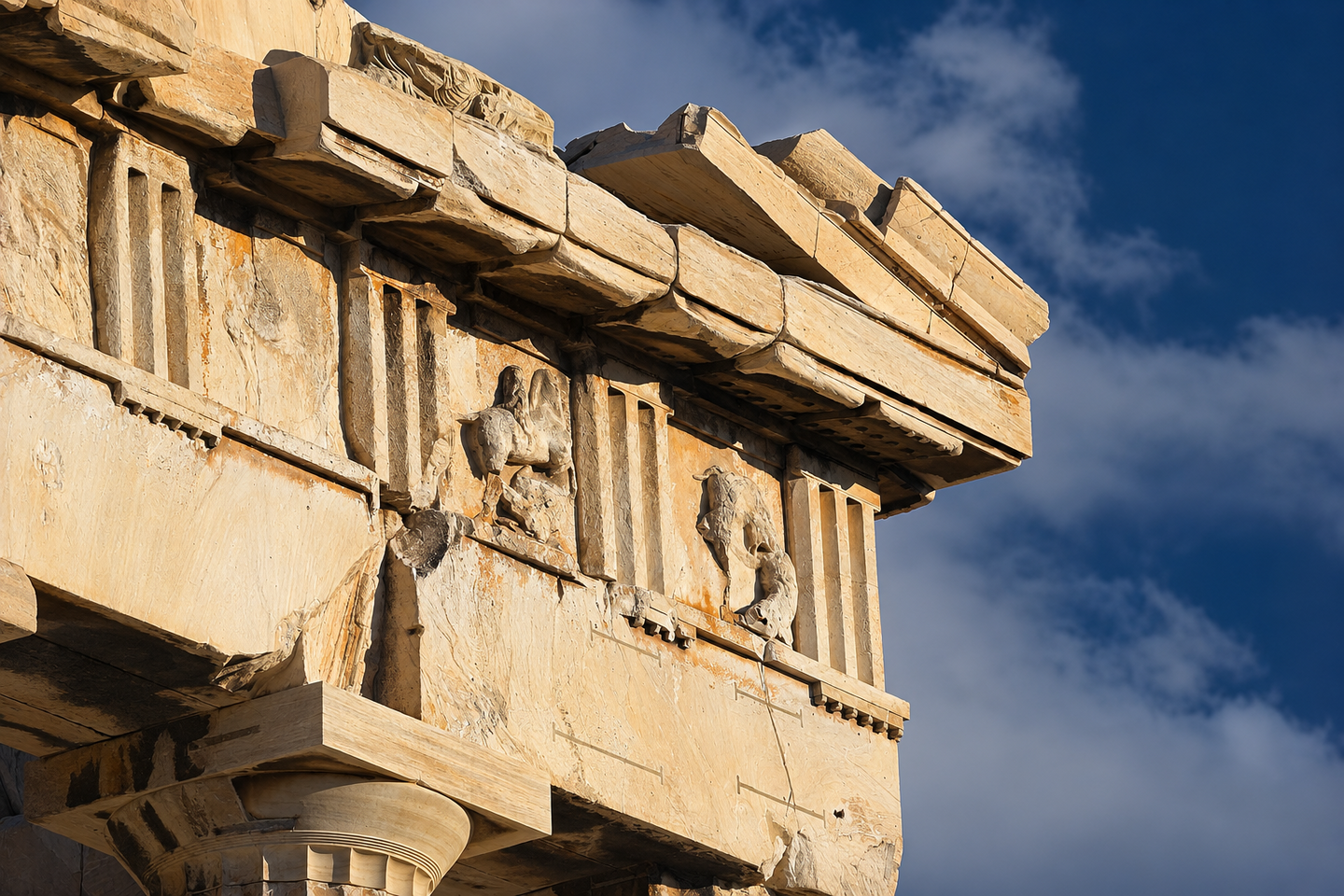
Metopes were individual rectangular bas-relief panels placed above columns, alternating with vertical elements called triglyphs. It was this rigid square frame that compelled sculptors to seek unique techniques to convey movement.
Fragment of the Doric frieze of the Parthenon. Alternation of metopes with reliefs of the Centauromachy and triglyphs. Acropolis, Athens. 5th century BCE.
Continuous frieze
The frieze, unlike individual metopes, constituted a continuous sculptural band that encircled the interior of the temple.
Panathenaic frieze of the Parthenon (fragment). Riders. 5th century BCE. British Museum.