Navigator
I. Concept II. Pre-Reception Fabric: Ornament and Initial Experiments in Transparency III. The Parthenon: Systematizing the Reception IV. The «Rich Style» V. 4th Century: Sea and the Nude Body VI. Hellenistic Reinterpretation: Nike of Samothrace VII. Conclusion VIII. Bibliography IV. Image Source List
I. Concept
Rationale for Theme Selection
The technique known as «wet drapery» refers to an ancient plastic method where clothing, appearing as if soaked or whipped by the wind, clings tightly to the body, revealing its structure while still maintaining the qualities of fabric—including weight, rhythm, and texture. This technique is usually presented as a finished concept, demonstrated through one or two examples. However, it possesses a rich biography: it undergoes various artistic reinterpretations across different workshops, shifts its function, and over more than two centuries, transforms into something fundamentally different. This topic was chosen because «wet drapery» allows us to examine a larger problem through a narrow medium: how the ancient sculptor resolved the tension between the body and the garment, between volume and surface, and between artistic intention and the viewer’s perception. Comparing the Parthenon and the Venus of Samothrace—two of the most renowned ensembles of Greek art—allows us to investigate the evolution of the folds' expressive role.
Material Selection Principle
The study includes circular sculpture and architectural reliefs from the Late Archaic to Early Hellenistic periods (circa 520 — circa 175 BCE)—works that, firstly, are documented, secondly, represent nodal points of change in reception function, and thirdly, allow for direct visual comparison. Two monuments are included as counterexamples: an Archaic Kore, in which the fold remains an ornament and the fabric conceals the body, and the Caryatids of the Erechtheion—contemporaries of the «rich style”—which are built on the opposite principle, where the drapery is likened to an architectural element. They demonstrate that „wet drapery“ is a conscious stylistic decision.
Research Categorization Principle
The organization is chronological, aligning with the hypothesis’s logic: five sections lead from archaic sculpture to Hellenistic synthesis, meaning the longread reads as the story of a single artistic development rather than a collection of masterpieces. Within the sections, works are paired up (Iris and «Three Goddesses»; Nike from the Parapet and Nike of Peonia; Nereids and Aphrodite of Cnidus) so that the comparisons function as evidence. Each section concludes with a brief summary that connects it to the next, maintaining a continuous line of argument.
Principles of Selecting and Analyzing Textual Sources
Attributions, dating, and the history of the finds have been verified against the catalogs of custodial museums (the British Museum, the Louvre, the Acropolis Museum, the Archaeological Museum of Olympia) and against scholarly literature—including the works of J. Bordman, B. Ridgeway, R. R. R. Smith, K. Havlock, R. Carpenter, as well as the Louvre’s collective monograph on the Samothrace Nike and the article by K. Clinton, L. Loge, E. Stewart, and B. D. Wescoat (2020). Controversial issues—such as the dating of the Samothrace Nike, its attribution to Pythocles of Rhodes, and the authenticity of the Ludovisi Throne—are presented in the text as open questions, with the positions of various parties indicated. Every significant fact was cross-referenced with at least two independent sources.
Research Question and Hypothesis.
Key Question: How did the artistic functions of the «wet drapery» technique evolve in ancient Greek sculpture from the Classical period through Hellenism? The hypothesis posits that as ancient Greek sculpture developed, the «wet drapery» technique gradually expanded its expressive functions—from accentuating the body’s plasticity during the Classical period to conveying movement and environmental interaction in Hellenistic art.
II. Pre-Reception Fabric: Ornament and Initial Experiments in Transparency
To determine the specific characteristics of this approach, it is necessary to compare it with earlier solutions. In archaic sculpture, clothing and body exist separately: the fold on the bark from the late 6th century is primarily a pattern, a rhythmic surface embellishment, rather than an accurate representation of fabric draped over a living body. The rhythm of parallel and diagonal folds here is more closely tied to the ornamentation of the surface than to conveying the anatomy or movement of the figure. The purpose of this technique is decorative: the clothing signifies status and festivity, while the body beneath is structurally concealed. This counterexample is important for the entire subsequent history: «wet drapery» is not the only possible continuation of the archaic method of representing fabric, but rather an alternative plastic solution.
Antenor, son of Evmar (according to the inscription on the base; dedicated to the potter Nearch). Cornucopia («Antenor’s Cornucopia»). c. 520 BCE. Paros marble, height 2.01 m. Acropolis Museum, Athens
Antenoros — circa 520 BCE This statue, larger than life-size and discovered in the «Persian refuse» at the Acropolis, is linked to an inscription on its base: the potter Nearchus dedicated it, and the sculptor Antenor, son of Eumarchus [1]. Antenor is clad in a chiton with a himation draped diagonally; its folds are traversed across the chest by severe parallel grooves, as if etched rather than naturally falling. The face and hands are modeled softly, but the drapery is isolated from this modeling—it behaves like a flat graphic layer. Inlaid eyes of mountain crystal, the painting on the diadem, and the lost bronze ornaments suggest that the archaic statue was a bright, nearly jeweled object, and the folds served to accentuate the surface sheen rather than the volume [1]. The folds primarily organize the statue’s surface. It is difficult to determine the exact posture of the body based on them.
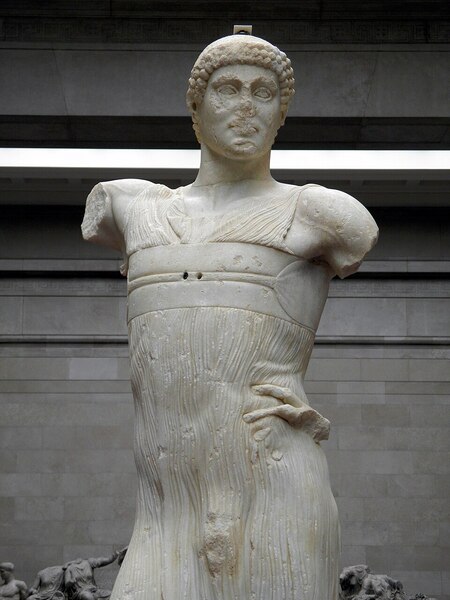
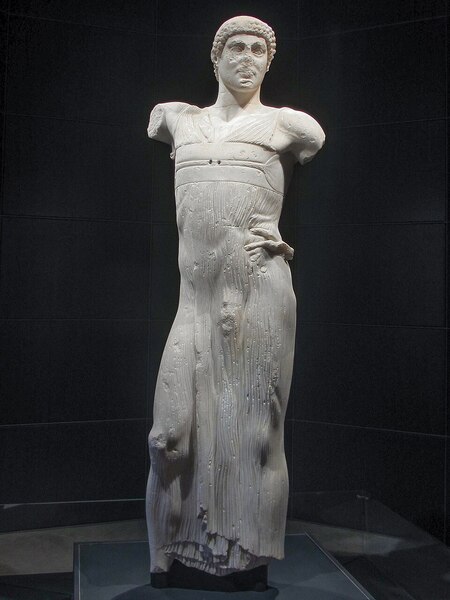
Unknown Master. Charioteer from Motia («Youth from Motia»). c. 470–450 BCE. Marble, height 1.81 m. John Whitaker Museum, Motia, Sicily.
Charioteer from Motia — c. 470–450 BCE The statue, discovered in 1979 in Phoenician-Greek Motia off the coast of Sicily, is one of the early monumental examples of an alternative approach [11]. The youth is draped in a long, thin chiton of a charioteer (kystis), tightly cinched at the waist, and the fabric behaves quite daringly: it clings to the torso, conveying the tension in the abdominal muscles, the line of the hips, and even the navel, while below the waist it settles in dense, fine folds through which the structure of the legs is discernible. Whether the depicted figure is a victorious charioteer, a team owner, or a hero is still debated [11]; for the history of the technique, something else is important. Here, the fabric no longer merely conceals the body: the treatment of the folds allows the viewer to intuit the figure’s plasticity. This technique emerges where the sculptor needs to demonstrate athletic tension without undressing the figure—the drapery remains in place, but it ceases to conceal.
Unknown Master (likely a Southern Italian workshop; authenticity was disputed). «Throne of Ludovisi»: Aphrodite’s ascent (?) from the sea. c. 460 BCE. Marble. National Roman Museum, Palazzo Altemps, Rome.
«The Throne of Ludovisi» — circa 460 BCE The central panel of the altar–“throne» from the Ludovisi collection likely depicts Aphrodite being raised from the sea by two attendants; the delicate fabric across the goddess’s chest and abdomen is so sheer that her body is almost nude. This is the most famous early example of «transparent» drapery. Note: The monument’s origin, interpretation, and authenticity have been debated by scholars. Therefore, it is presented as a comparative example, not as a confirmed link in the direct history of the motif [11].
By the mid-5th century BCE, various methods existed for depicting fabric—ranging from decorative folds to fine garments that suggested the human form. The second approach reached a particularly expressive development on the Parthenon.
III. The Parthenon: Systematization of Technique
On the pediments of the Parthenon (438–432 BCE), the techniques for conveying fine drapery were applied with exceptional consistency. This does not prove that they were invented there. The figures stood high above the viewer, within the deep triangular pediment, beneath the sloping Attic sun; they had to be viewed from the ground, from distances of tens of meters. The chiaroscuro treatment of the relief folds may have enhanced the legibility of the figures from a low vantage point: deep creases create dark lines, while the ridges catch the light, causing the fabric at a distance to transform into a system of modeling lines that build volume and suggest movement [6, 7].
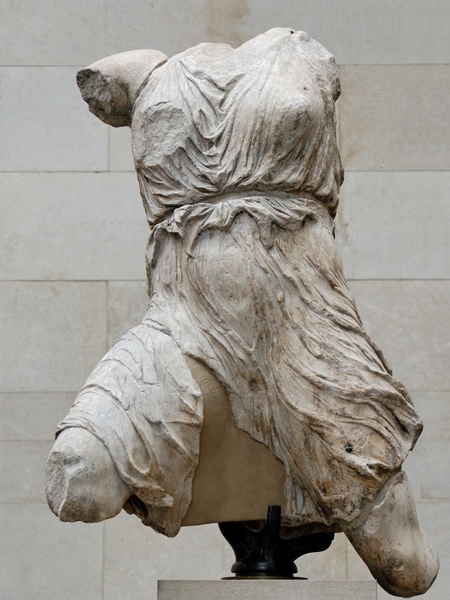
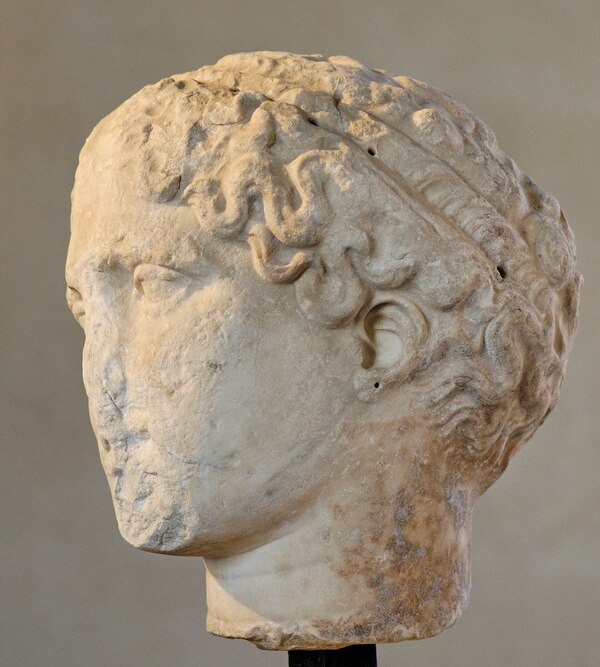
Phidias Circle. Iris, a figure from the western pediment of the Parthenon. 438–432 BCE. 1. Torso, marble, height approx. 1.35 m. British Museum, London; 2. Head, known as the «Labourd head.» Louvre, Paris.
Hera — c. 438–432 BCE The running messenger of the gods was positioned near Amphitrite’s chariot, alongside the central conflict between Athena and Poseidon. The treatment on the torso is displayed with extreme clarity: the sleeveless chiton is stretched across the chest so that the entire plasticity of the body is visible beneath the fabric—the line of the breasts, the indentation between them, the abdominal muscles; simultaneously, between the thighs, the fabric drapes in deep, parallel folds that suggest movement. The himation is wrapped around the left arm in a tight roll—a treatment destined for longevity; we will encounter its enhanced version in the Nike of Samothrace. Herida’s movement is swift, but not frantic: the folds organize the run into a clear rhythm, and the fabric, which clings in the front, remains heavy and disciplined along the contour.
Circle of Phidias. «The Three Goddesses» (Hestia, Dione, and Aphrodite?), figures K, L, M from the eastern pediment of the Parthenon. 438–432 BCE. Marble. British Museum, London.
«Three Goddesses”—c. 438–432 BCE The group on the right side of the eastern pediment—witnesses to the birth of Athena (their names are conventional; they are most often referred to as Hestia, Dione, and Aphrodite, who is kneeling on the mother’s lap)—perfects the Parthenon’s system. Here, the „wet drapery“ technique serves not to convey movement but repose: the fabric of the thin chitons flows around the shoulders, chest, and knees in three distinct ways, corresponding to three different poses, and within each figure, a living body is perceived—with weight, warmth, and breath. The folds of the himations are carved so deeply that, in the side light, they provided an almost engraved contrast; researchers have noted that the ridges and depressions of these folds catch the light and shadow, thereby revealing the body forms rather than concealing them under clothing [6].
The Parthenon plastic establishes a classical formula of reception: the fabric reveals the body and organizes movement, yet remains subordinate to ideal order. The next generation of masters will attempt to free the fabric from this discipline—to push transparency to its limits and allow the fold to live its own, almost random life.