Between Order and Chaos:
Architectural Images of Dystopia in American and British Cinema of the 1970s–1990s.
Navigation
[1] Concept [2] Order. The Architecture of the Ideal System [2.1] «THX 1138» (1971) [2.2] «Gattaca» (1997) [3] Scale. The Architecture of Suppression [3.1] «A Clockwork Orange» (1971) [3.2] «1984» (1984) [4] Chaos. The Architecture of Overload [4.1] «Blade Runner» (1982) [4.2] «Brazil» (1985) [5] Conclusion [6] Bibliography [7] Image Sources
Concept
Architecture in dystopian cinema functions not merely as a backdrop for events but also as a medium for depicting the social structure. Through the scale of buildings, geometry, and spatial organization, it conveys notions of power, control, and the individual’s place in society. Furthermore, the architectural imagery of dystopia can be starkly contrasting—ranging from sterile spaces with perfect geometry to monumental structures and chaotic, overloaded cities.
The paradox lies in the fact that opposing architectural principles—absolute order and chaos—can become means of depicting the same state: constraint.
The object of this study is the architectural imagery of dystopia in American and British cinema from the 1970s to the 1990s. Six films were selected for analysis: THX 1138 (1971), Gattaca (1997), A Clockwork Orange (1971), Nineteen Eighty-Four (1984), Blade Runner (1982), and Brazil (1985). This selection is driven by the opportunity to compare three contrasting principles of architectural space organization within the chosen historical and cultural context.
How can such disparate architectural spaces create a similar image of unfreedom? What architectural characteristics allow a space to become a tool for visually expressing control and oppression?
Research Hypothesis posits that the dystopian nature of architecture is not determined by adherence to a specific style, but rather by the characteristics of spatial organization and the nature of its interaction with the human subject. It is hypothesized that rigid order, monumentality, and visual saturation can express a lack of freedom through various mechanisms: depersonalization, massive suppression, and spatial disorientation.
The study is divided into three analytical parts. The first, «Order, ” is dedicated to geometric regularity, repetition, and visual uniformity using the films THX 1138 and Gattaca as examples. The second, „Scale, ” examines monumentality and the relationship between humans and architecture in the films A Clockwork Orange and 1984. The third, „Chaos, ” investigates density, multilayered complexity, and spatial overload in the films Blade Runner and Brazil. The comparisons are drawn using unified visual criteria: geometry, scale, rhythm, density, the presence of spatial landmarks, and the depiction of the human figure.
The theoretical foundation for this visual study is Juha Pallasmaa’s The Architecture of Image: Existential Space in Cinema (2001), which explores the connection between architecture, cinema, and spatial experience. For the analysis of specific examples, historical and architectural materials on modernist architecture, as depicted in A Clockwork Orange, are utilized, alongside Jonathan Stabb’s and Marco Kissel’s Futures Past and Present: History, Architecture and Dystopia in Brazil (2024), which focuses on the role of architectural forms in creating a dystopian world. These works allow us to examine architecture simultaneously as a physical space and as a medium of cinematic expression.
ORDER. Architecture of the Ideal System
Architectural order is typically associated with harmony, rationality, and predictability. However, in dystopian cinema, these qualities can take on an opposite meaning. Geometric regularity, repetition, and visual uniformity become tools for depicting a society in which individuality is subjugated to established rules.
«THX 1138» (1971)
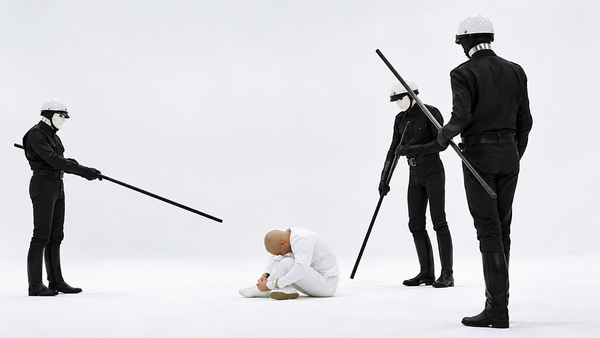
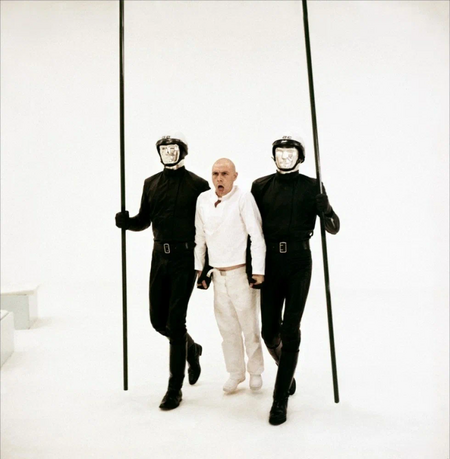
Stills from the film «THX 1138,» directed by George Lucas, 1971. Detention space.
In the film «THX 1138,» the architecture of the future lacks customary variety. White surfaces, uniform clothing, and a minimal number of details create an environment in which the individual virtually merges with the surroundings.
This principle is most vividly expressed in the confinement scene. There are no visible walls, corners, or boundaries in the space. The floor and background form a single white surface, and the human figures become the only spatial anchors.
Instead of the usual feeling of confinement, a paradoxical situation arises: the space seems infinite, yet the person remains enclosed.
In the prison sequence, George wanted the faces—and practically nothing else—to appear against a stark white void—an extreme liminal effect.
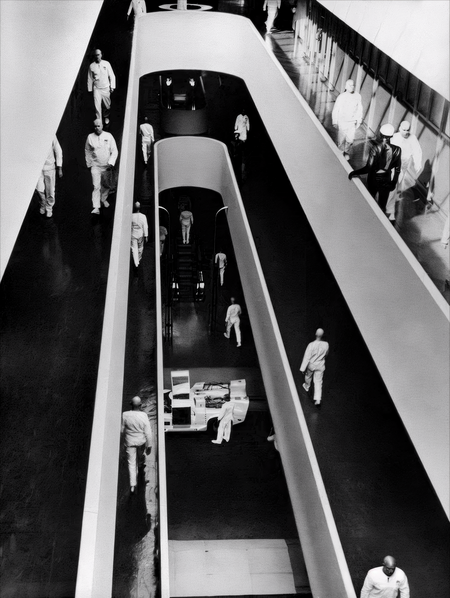
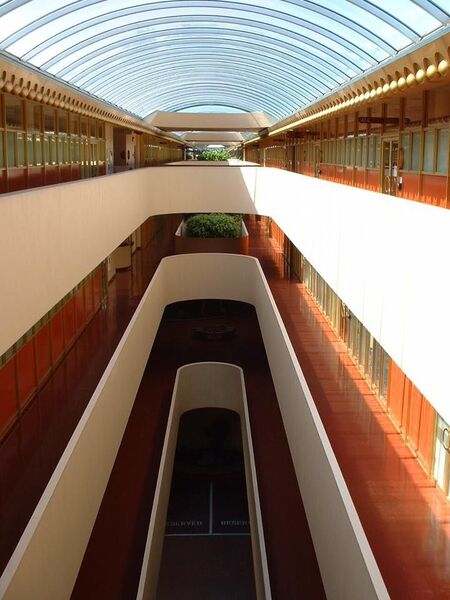
1. Stills from the film «THX 1138, ” directed by George Lucas, 1971. 2. Marin County Civic Center, Frank Lloyd Wright, San Rafael—California, USA, 1962.
To construct his dystopian world, George Lucas utilizes existing modernist architecture. In the Marin County Civic Center, the extensive galleries, repeating arches, and unified rhythm of the structures form a rigorously organized space. The continuity of the architectural elements creates a sense of infinite repetition, and the long perspectives underscore the space’s submission to a singular geometric system.
In the context of the film, architecture—originally conceived as an open public space—acquires an antithetical meaning. Repetition and visual uniformity become hallmarks of a world where individuality gives way to established order.
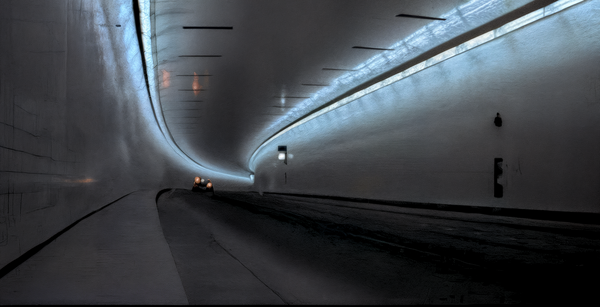
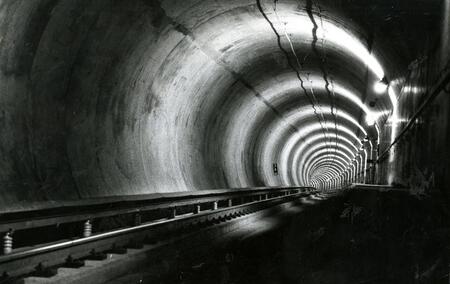
1. Stills from the film «THX 1138,» directed by George Lucas, 1971. 2. Transbay Tube (BART), Parsons–Brinckerhoff–Tudor–Bechtel, San Francisco–Oakland, USA, 1969.
In summary, the sense of anxiety and tension in the film «THX 1138» is created by sterile white spaces, the monotonous rhythm of recurring elements, and the absence of spatial orientation. The strict geometry and uniformity of the architectural environment transform order into a symbol of totalitarian control, forming the image of a dystopian society.
Gattaca (1997)
Although the films THX 1138 and Gattaca utilized the same building—the Marin County Civic Center—the distinct architectural elements shape different perceptions of order: in the former, it underscores dehumanization, whereas in the latter, it reflects societal idealism and rigid hierarchy.
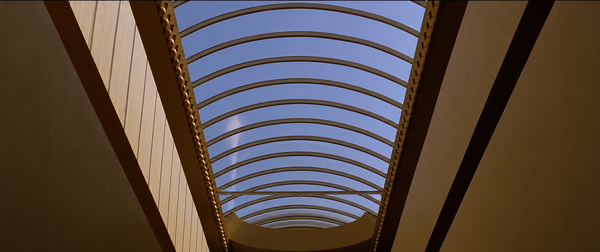
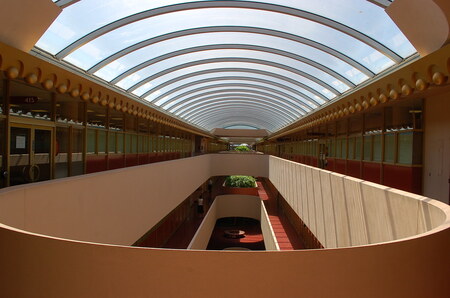
1. Stills from the film Gattaca, dir. Andrew Niccol, 1997. 2. Marin County Civic Center, Frank Lloyd Wright, San Rafael—California, USA, 1962.
Despite occupying the same building as in «THX 1138, ” the order here is perceived differently—not as dehumanizing monotony, but as an externally perfect yet overwhelming system.
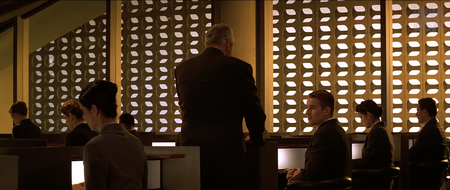
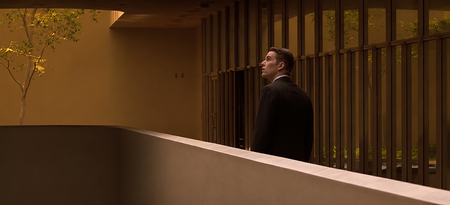
Stills from the film Gattaca, directed by Andrew Niccol, 1997.
In the film, symmetry becomes one of the primary compositional devices. Characters are often placed along the central axis of the frame, and the architecture forms a strictly ordered space around them.
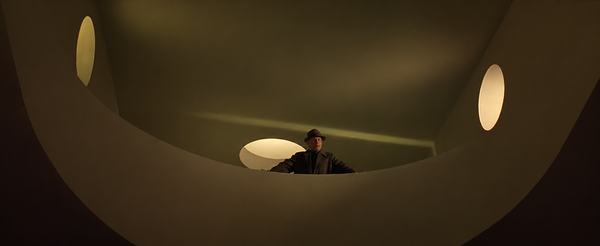
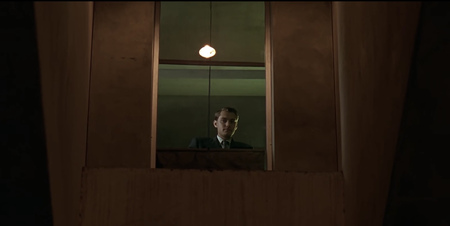
Stills from the film «Gattaca,» directed by Andrew Niccol, 1997.