Introduction
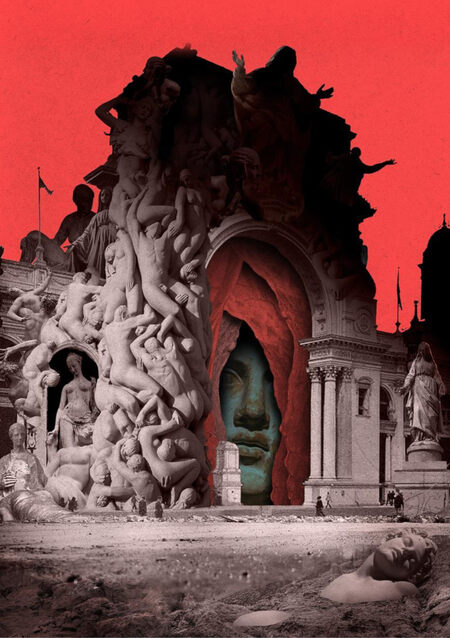
Cinematic imagery does not merely convey action; it organizes the space where the relationship between form and the viewer’s gaze is established. In some films, it adheres to a stable compositional logic. In others, it becomes multi-layered: a frame integrates several points of focus, perspective loses its singularity, and architecture assumes independent significance. These characteristics allow us to speak of a concept in contemporary cinema—neobaroque.
Image
Neo-Baroque does not imply a literal return to the art of the 17th–18th centuries. Rather, it involves a reinterpretation of Baroque principles within new historical contexts. Angela Ndalianis connects the neo-Baroque of contemporary media culture to cinematic spectacle, illusionism, and the virtuosic organization of space [1]. Omar Calabrese describes it through categories such as excess, fragment, instability, metamorphosis, and labyrinth [2]. Therefore, the neo-Baroque is considered not as a genre, but as an aesthetic model for analyzing imagery.
Neo-Baroque visuality is not confined to opulence or an abundance of detail. It manifests in complex composition, the interaction of spatial planes, the disruption of perspective, the illusoriness of the screen world, and the materiality of the image. Syd Walton draws attention to the sensual properties of the cinematic image—its texture and surface [3]. The core of this work lies in the methods of image organization and their artistic functions.
The research focuses on three directions of cinematic game:1) The post-classical Hollywood blockbuster, where visual virtuosity and spatial illusionism create a spectacle.2) Modern Gothic horror, where architecture, chiaroscuro, and spatial ambiguity generate tension.3) Baroque, Italianized art film. Alastair Fox’s term to describe the art film tradition linked to painterliness, theatricality, and the aestheticization of screen space [7].These directions are compared as different manifestations of related visual principles.
Image
This study analyzes the visual aesthetics of selected disciplines, the methods of organizing screen space—polycentrism, multilayering, illusionism, excess, and image materiality—as well as the forms and artistic functions of neo-Baroque aesthetics.
Neo-Baroque aesthetics do not coalesce into a single, universal style; rather, they emerge as a collection of principles that adapt to the demands of various disciplines. In blockbusters, they create a spectacle; in Gothic horror, they forge an atmosphere of unease; and in art cinema, they form an aestheticized composition and a sensually rich image. Similar visual principles can perform radically different artistic functions.
The following films were selected for this study: Jurassic Park (1993), The Matrix (1999), Inception (2010), Black Widow (2012), Crimson Peak (2015), I Love You (2009), Big Splash (2015), and Call Me by Your Name (2017). The comparative analysis focuses on frame composition, space, perspective, light, and camera movement.The work also defines the parameters of the concept: not every decorative or spectacular composition is automatically neo-Baroque.
Navigation
- The World as Spectacle: Neobarroque in the Post-Classical Blockbuster2. Architecture of Anxiety: The Neobarroque Aesthetic of Gothic Horror3. Image as Painting: Neobarroque in Baroque and Italianized Art Cinema4. Three Faces of Redundancy: What Unites Different Directions?5. Where Does Neobarroque End?6. Conclusion
The World as Spectacle: Neo-Baroque in the Post-Classical Blockbuster
Unlike the traditional narrative film model, where imagery primarily serves to advance the action, in postclassical cinema, the visual spectacle can gain relative autonomy. Individual sequences become grand compositional events where the organization of space, camera movement, and visual density take center stage.
Image
Barry Langford, in his book Post-Classical Hollywood: Film Industry, Style and Ideology since 1945 (2009), examines the discussion of the post-classical style through two main trends: the intensification of visual spectacle and the transformation of cinematic expression [4].One of the important characteristics of this process is the development of large-scale visual sequences capable of existing relatively autonomously from the main narrative.
Image
David Bordwell describes related changes using the term «intensified continuity.» This does not imply a complete abandonment of the classical narrative system, but rather an intensification of its expressive means: more vigorous editing, free camera movement, and increased image dynamism [5].At the intersection of these trends, a special form of cinematic spectacle emerges, which can be understood through the concept of Neo-Baroque.
Angela Ndalianis directly connects contemporary blockbuster cinema culture with Baroque aesthetics. Her research includes examples such as Jurassic Park and Alien [1]. Particularly illuminating is how these films orchestrate the viewer’s encounter with unknown spaces.
Image
In «Jurassic Park» (1993), the scale of the depicted world constantly conflicts with the limitations of human space. The appearance of dinosaurs is demonstrated through landscape shots, frame depth, and the juxtaposition of immense objects with their environment. The visual spectacle is not merely about portraying a fantastic creature; it is shaped by the gradual unfolding of space—its scale and inherent complexity.
Image
The frame becomes a kind of stage where several visual layers collide: the natural landscape, the park’s architecture, technical structures, and giant animal figures.This organization of the image allows the film to be viewed through the lens of Neo-Baroque Illusionism: the screen world strives to appear as an independent reality, transcending the limits of ordinary representation.
In «The Matrix» (1999), spatial organization takes on a different function. Here, reality itself becomes a visually constructed system where familiar architectural forms, urban spaces, and surfaces can conceal another structure of the world.
A particular interest is drawn to the repetition of architectural motifs and visual elements, as well as the use of reflections, geometric constructions, and artificially organized spaces.The image constantly reminds the viewer of its own constructed nature. The space appears simultaneously familiar and artificial, creating the impression of multiple levels of reality.
Image
In «The Beginning» (2010), spatial instability becomes almost a literal element of the visual language. One of the film’s most expressive sequences depicts the folding of urban space: streets and buildings change their orientation, and the familiar geometry of urban architecture ceases to obey the laws of physical reality.
Image
The films reviewed demonstrate different ways of creating neo-Baroque space. In «Jurassic Park,» visual excess is linked to the scale of the depicted world and the spectacular unveiling of the unknown. In «The Matrix,» it manifests through the artificiality and multilayered nature of screen reality. In «Inception,» it is conveyed through labyrinthine architecture and the disruption of conventional spatial relationships.
Thus, the neoclassical aesthetic of the post-classical blockbuster forms a space that does not merely accompany the narrative but becomes an independent event of image.