Concept
This project explores how the visual perception of the human body has changed—from an inviolable «vessel» veiled in gold to a dissected «mechanism”—and how this visual language became the foundation of modern 3D design.
Main Question
How has the visual language of the human body changed—from the «Sacred Vessel» in the Middle Ages and its aestheticization in the 17th-century anatomical theater to its digital «slice» in modern 3D visualization?Table of Contents
1. Introduction.2. From the sacred to the mechanical.3. Anatomy as art.4. The spectacle in the theater.5. Light instead of the knife.6. Pain and agony.7. From paintings to screens.
Selection Principle:
The material is arranged chronologically to trace the path from sacred inviolability to the aestheticization of dissection and digital anatomy.[Introduction]
In the 16th and 17th centuries, the attitude toward death in Europe underwent a profound transformation. Where in the Middle Ages the body was considered merely a sinful vessel to be buried quickly so that the soul could rise again, during the Renaissance it became an object of intense study. Artists and physicians began performing public dissections. How did it come to pass that a society that once feared decomposition to death suddenly began to aestheticize the dismembered body?
In Christianity, the body was considered the source of sin, while the soul was its «ruler.» Therefore, the remains of saints were kept in golden caskets—reliquaries. Gold reflected divine light and rendered the flesh inviolable.
«Shrine of the Three Magi» («Shrine of the Three Holy Kings»; German: Dreikönigsschrein). Cologne, c. 1181–1220. Master Nicholas of Verdun and his workshop. Wood, gilded copper and silver, enamel, gems, pearl. 220 × 110 × 153 cm. Cologne Cathedral.
Shrine of Charlemagne (Karlsschrein). Aachen Cathedral, 1182–1215. Oak, gilded and silver embossing, enamel. Commissioned by Emperor Frederick II; the emperor’s relics were moved on July 27, 1215.
Opening such a body was a true sacrilege, a violation of divine design.
[Anatomy as Art]
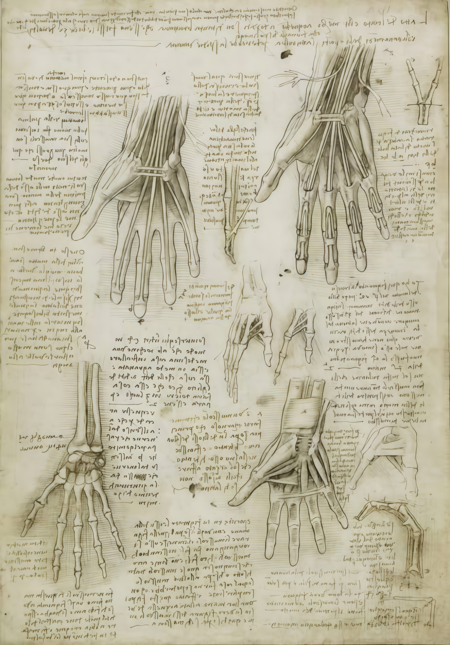
But during the Renaissance, fear began to give way to curiosity. Humanists declared that man was the «measure of all things» and that his body was perfect. Leonardo da Vinci was among the first to view muscles not as a divine wonder, but as a system of levers. He began secretly dissecting bodies to sketch them. His drawings began to resemble engineering blueprints. Leonardo transitioned the body from the category of miracle to mechanics. The gold of an old reliquary concealed matter, rendering it eternal, whereas Leonardo’s pencil exposed matter, making it comprehensible.Anatomical Study of the Hand: tendons, bones, and ligaments in the style of Leonardo da Vinci’s anatomical sheets. A contemporary graphic reconstruction (digital graphics, stylized as sanguine and pen circa 1510) based on anatomical studies of the hand from the Royal Collection, Windsor (c. 1510–1511, RL 919009, etc.). The annotations on the sheet are stylized to resemble the master’s mirrored script and are not authentic text.
[Theater Show]
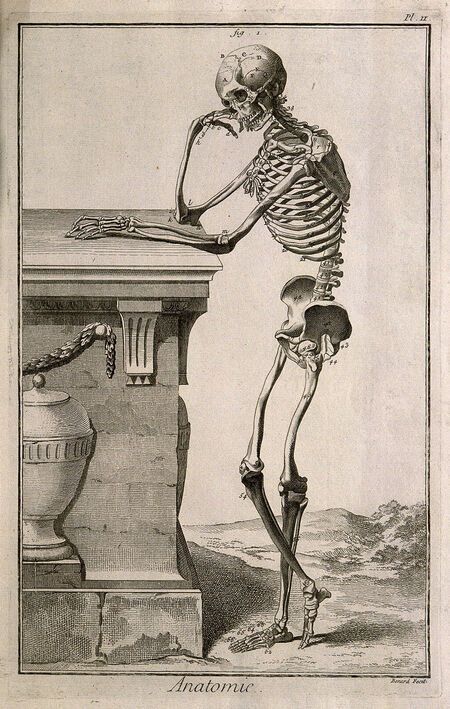
This revolt reached its peak in 1543 when Andreas Vesalius published his work, «De humani corporis fabrica.» Before this, physicians had blindly believed the ancient physician Galen for nearly 1,400 years, even though Galen had essentially only studied animals. Vesalius took a bold step: he challenged Galen’s errors, asserting that the truth could only be discovered by dissecting the body of a condemned criminal. Andreas Vesalius. Skeleton resting on a pedestal and contemplating a skull (side view). Engraving based on a woodcut from «Suorum de humani corporis fabrica librorum epitome» / «De humani corporis fabrica libri septem» (Basel, 1543). Later reproduction (late 18th — early 19th century).
But Vesalius was not just a physician; he was an exceptional art director. For the illustrations, he hired Jan van Kalcar, a student of Titian. Kalcar achieved the impossible: he transformed the rotting corpses of hanged men into classical heroes. Incised muscles were integrated into beautiful landscapes, and the poses of the deceased emulated classical statues. Vesalius and Kalcar created an entirely new visual language. Their primary goal was to strip the corpse of the stigma of «sin.» The skeleton in their engraving, leaning on a coffin, appears as serene as Michelangelo’s marble statue. The artist seemed to communicate to the viewer: yes, this body died, but its structure is flawless, much like the laws of geometry.Dissection at the time was not merely medicine; it was a genuine social spectacle. To facilitate this, special buildings—anatomical theaters (in Padua and Leiden)—were constructed. Essentially, these were circular halls, reminiscent of an ancient amphitheater. The body lay on a table in the center, and the audience sat in tiers. This immediately established a hierarchy: at the bottom, the professor-lecturer, the main actor; at the top, the students and the nobility. The professor stood in the center, like the sun, and the viewers looked down upon him. The body was the object around which everything revolved. Dissections were only performed in winter at that time—cold was the only way to preserve a body from decomposition even for a few days.
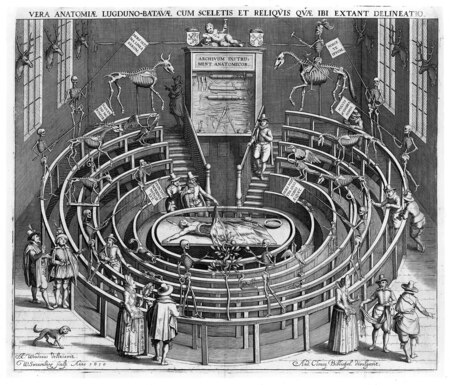
As researcher David Rosand notes, artists of that era frequently copied theatrical scenery. The circular hall of the theater created the effect of a «window into the world.» The audience felt not just like people in a room, but like participants in a major scientific discovery. In the engravings, the body was always at the center, and the gazes of all the viewers converged on the lecturer’s hands or the scalpel. Light fell from above, like a spotlight on a stage. This created an almost religious effect: the body of the criminal became the center of the universe. Scenography here functioned as a tool of power—it transformed physiology into an understandable scientific ritual.Anatomical theater of Leiden University. Engraving by V. van Swanenburgh after the drawing by J. K. Wudanus, 1610. Series of four views of the university (theater, library, fencing school, botanical garden); published by A. Klook, Leiden.
Light instead of a knife
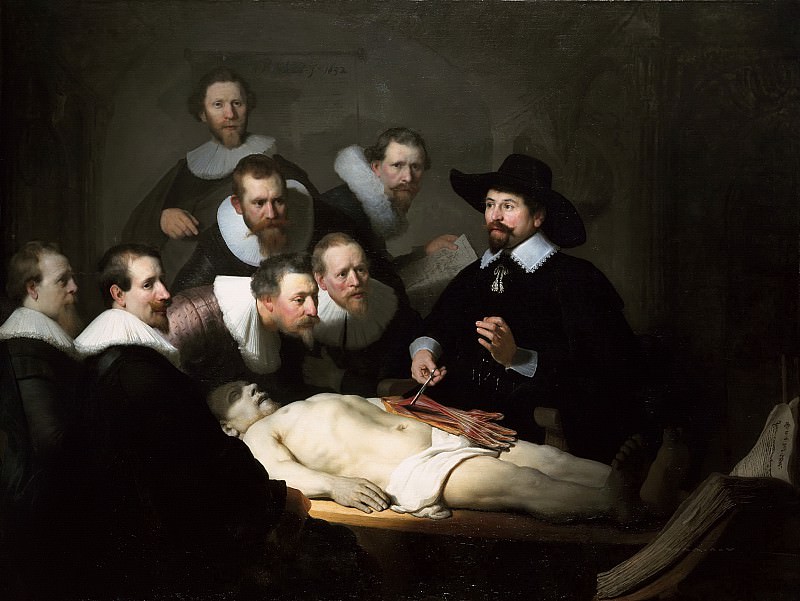
In 1632, 26-year-old Rembrandt receives a commission that would make him famous: «The Anatomy Lesson of Doctor Tulpe.» The painting depicts a dissection, but Rembrandt breaks convention. Instead of starting with the stomach, as was usual, Doctor Tulpe shows the muscles of the arm of the executed thief, Arys Kindt.
Rembrandt. Anatomy Lesson of Dr. Nicolaes Tulp. 1632. Canvas, oil, 169,5 × 216.5 cm. Mauritshuis, The Hague.
The most striking thing is that there is no blood or odor in the painting. Instead of horror, we see absolute silence and concentration. Why did Rembrandt remove all the grime? He transformed a brutal dissection into an act of knowing. This is not a surgical lesson, but rather a mystery. Seven listeners in dark robes lean in to hear the lecturer’s words. Their faces are illuminated differently—some are in shadow, others catch the light. This creates a sense of a living, breathing space.
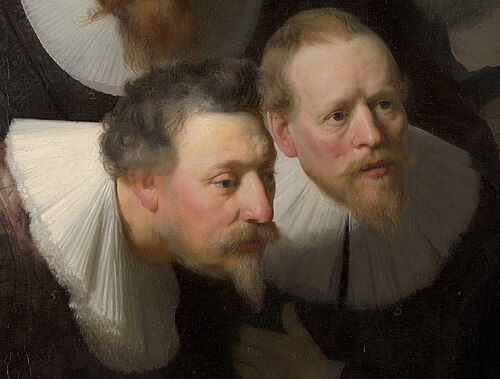
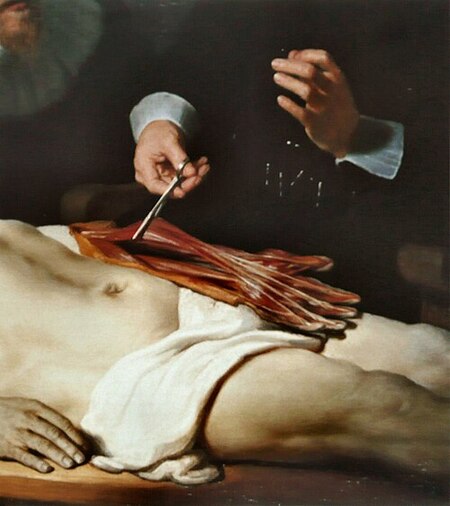
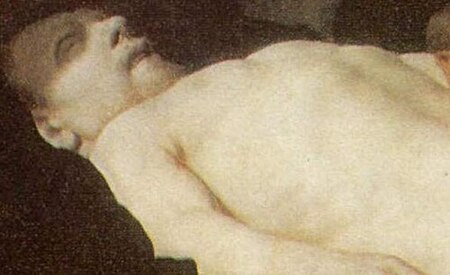
Rembrandt uses light as his primary tool. First, there is contrast. Aris Kindt’s corpse is the brightest spot in the painting. Against the black coats of the doctors, the dead flesh seems to glow. Rembrandt makes the cadaver more alive than the living people. Second, there are the gestures. Tulpe is not just pointing a finger. He is using forceps to lift a tendon. His own hand mimics this movement, explaining the mechanics. Anatomy becomes rhetoric. Third, the book. A massive folio lies in the corner. Previously, people thought it was Vesalius, but it is more likely a contemporary of Tulpe. This suggests that the Amsterdam physicians take pride in their living science rather than merely imitating the ancients. Fourth, the face of the corpse. Traditionally, the deceased were always covered with cloth. Rembrandt leaves the face exposed but immerses it in shadow. We see that this was a living person, but this «shadow of death» separates him from the living.
5. Pain and Agony.
If anatomy in the Netherlands was a matter of cold intellect, then in the south—Spain and Italy—it transformed into a narrative about suffering. The focus here shifts from mere observation to pure physiology. The central figure of this movement is Giuseppe de Ribera. His «Martyrdom of Saint Philip» is not about religion; it is about agony.
José de Ribera. The Martyrdom of Saint Philip. 1639. Canvas, oil, 236 × 234 cm. Museo del Prado, Madrid
Unlike Rembrandt’s serene doctors, Ribera’s painting features executioners. Their faces are often obscured—they are merely instruments of pain. The entire focus is on the victim’s body. Saint Philip is being hoisted onto the cross, yet he does not appear saintly.
His face is contorted, his muscles tense. This is the body of a living human being, currently being torn apart. Ribera is depicting not sanctity, but agony.
Riber employs light in such a way that the viewer physically feels the pain. First is the concept of «rupture.» In classical painting, the body is always whole. In Riber’s work, the body is literally torn apart by light and pain. The figure stands unsteadily, seeming on the verge of collapse. Second, there are harsh shadows (tenebrism).
The light pulls only the most frightening details from the darkness: bulging veins, knots of muscle. The shadow swallows everything superfluous. This light doesn’t caress the body; it strikes it like a spotlight, exposing every wound. Third, this is distorted flesh. Ribera is not afraid of the unattractive. He paints the aging, heavy body. The artist seems to «feel» the skin with the brush, conveying sweat and tremor.