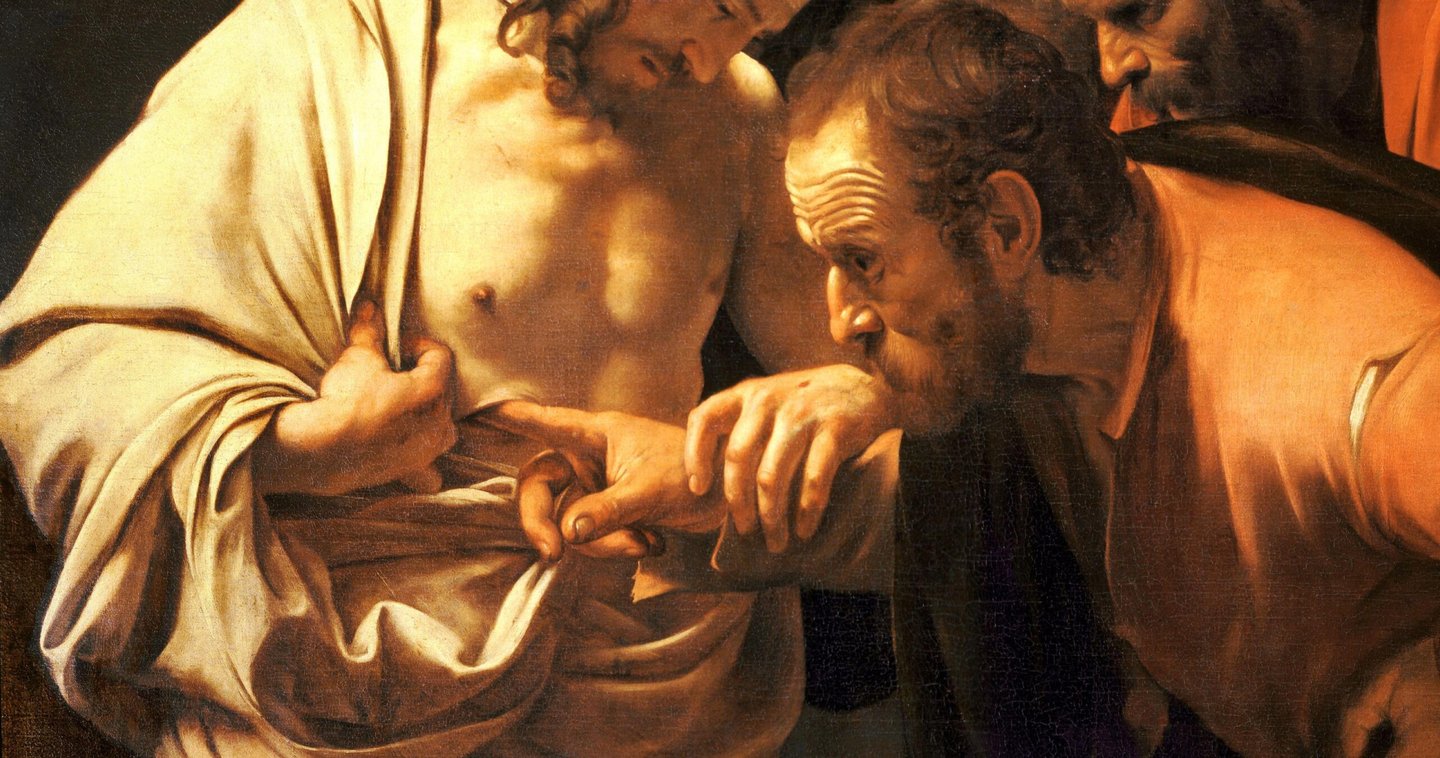
Why does it seem like we are standing next to each other?
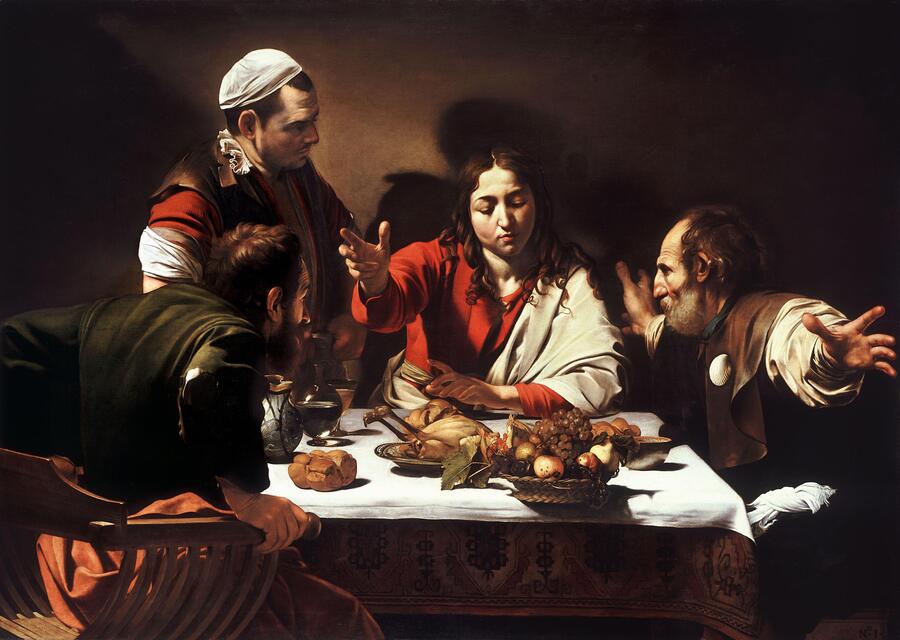
Caravaggio. The Supper at Emmaus. 1601. Canvas, oil. National Gallery, London.
The student’s hand is reaching toward us, and the basket extends beyond the edge of the table. These details seem to shrink the distance between the image and the viewer. How does Caravaggio manage to bring the gospel event closer to us and create a sense that it is unfolding right before our eyes?
Navigator
I. Concept and Topic Selection II. Betrayal: The Viewer Confronting Conflict III. Grief: The Viewer Beside Those in Mourning IV. Recognition: The Viewer at the Same Table as the Students V. Doubt: The Viewer Near Foma VI. Conclusion VII. Bibliography VIII. Image Sources
I arranged the paintings in the sequence of the Gospel events—from the arrest and burial of Christ to the meetings with him after the resurrection. The viewer’s perspective shifts from chapter to chapter. At the arrest, the viewer seems to stand right up against the guards; during the burial, they are positioned alongside those mourning Christ. In Emmaus, the viewer sits at the same table as the disciples, and in the final scene, they see Thomas touching Christ’s wound up close.
I. Concept and Topic Selection
Religious painting allows us to see how an artist understands and conveys events from the Holy Scriptures. By selecting a specific moment, arranging figures, and directing light, the artist offers the viewer their own interpretation of the narrative. I am interested in how the image helps foster a sense of proximity to the Gospel event—to imagine oneself as a witness to the meeting with the risen Christ, to share the disciples’ astonishment, or to empathize with the grieving. Therefore, the theme of my research became the effect of presence in Caravaggio’s religious painting.
I first contemplated the viewer’s place in Caravaggio’s paintings when I noticed the basket of fruit in «The Supper at Emmaus» (1601) jutting out over the edge of the table. It seems as if one could reach out and take it from our side. It feels as though the depicted event is unfolding directly in front of us; I call this the effect of presence in my work.
The closeness to the figures is felt differently in each scene. In «The Arrest of Christ,» the hand of the armored guard reaches toward Christ right in front of the viewer. From this distance, one can see that Judas is still embracing his teacher when the guard is ready to seize him. In «The Entombment,» the hands also draw attention. From the way Nicodemus is bent over, wrapping his arms around Christ’s legs just beneath the knees, one can feel how difficult it must be for him to support the body. I am interested in how Caravaggio allows the viewer to closely observe both the tension of the arrest and the care shown by those preparing Christ for burial.
For my research, I selected five works by Caravaggio from the early 17th century: «The Arrest of Christ, ” „Entombment, ” two versions of „The Supper at Emmaus, ” and „The Doubt of Saint Thomas.“ The latter three paintings share a thematic concern: how the disciples recognize the resurrected Christ. At Emmaus, they recognize their teacher when he breaks the bread. For Thomas, who heard about the resurrection from others, it is crucial that he see the marks of the crucifixion himself and touch the wound.For the chapter „Recognition, ” I chose both versions of „The Supper at Emmaus“ to compare how Caravaggio depicts the same moment twice. In the 1601 painting, the disciple spreads his arms so wide that one of his palms seems extremely close to the viewer. In the 1606 version, the surprise is expressed more subtly. The disciple on the right leans toward Christ and holds onto the edge of the table, while the maid standing behind him holds a dish and looks down. Through which gestures and gazes does the viewer notice that the disciples recognized their teacher at this exact moment?In each chapter, I briefly summarize the Gospel narrative, then examine the painting as a whole, and finally move on to magnified details. For instance, in the arrest scene, the crowded overall view first highlights how closely the people surround Christ. The close-up fragment allows the reader to pause on details easily missed at first glance. Judas looks directly at Christ, but Christ keeps his eyes lowered. Their faces are nearly touching, which is precisely why it is so noticeable that their gazes do not meet.The textual basis for this study consists of the Gospels and materials from the museums that hold the selected paintings. The Gospel narrative helps reveal what details the artist introduces into the familiar story. For example, John conveys Christ’s words inviting Thomas to touch the wound, while Caravaggio depicts the act of touching itself. I use museum descriptions to specify who is portrayed in the canvas, when it was created, and where it is currently located.
What Caravaggio techniques allow the viewer to feel like a witness to an evangelical event? How does this closeness reveal the meaning of each scene?

It is suggested that Caravaggio achieves a sense of presence in the selected paintings through the combination of several techniques. Large figures positioned near the foreground edge of the canvas and gestures directed toward the viewer create a feeling of immediacy. Chiaroscuro emphasizes the volume of the bodies, while the lighting on the faces and hands allows the viewer to clearly perceive expressions, movements, and touches. The characters' gazes direct attention toward the action they are observing. Together, these techniques help the viewer feel as if they are right next to the heroes—as if witnessing an epic event.
II. Betrayal: The Audience Facing Conflict
In Caravaggio’s painting, «The Arrest of Christ,» he depicts the moment of Judas’s betrayal and Christ’s arrest. Judas embraces and kisses his teacher while pointing out to the guards whom they should seize. To Christ’s right, an armored guard’s hand reaches out, while to his left, a disciple raises his hand and attempts to escape. Christ remains among the surrounding people, lowering his gaze and clasping his hands in front of him.
Caravaggio. The Arrest of Christ. 1602. Canvas, oil. National Gallery of Ireland, Dublin.
Get up, let’s go: behold, the traitor who betrayed me is approaching.
The figures fill almost the entire canvas, overlapping closely. Their bodies are cropped by the bottom and side edges of the painting, and the surrounding space barely shows through them. There is no clear patch of ground in front of the characters to separate them from the viewer. Consequently, the arrest is perceived as a collision happening very close at hand.Against the dark background, the faces of Christ and Judas stand out particularly vividly, as do Christ’s clasped hands and the guard’s gleaming armor. The light allows one to discern the expressions on their faces and the points of contact, while the surrounding environment remains obscured. The transitions from light to shadow emphasize the volume of the faces and hands—we can distinguish prominent cheekbones, the curve of the fingers, and the hollows between them.
Caravaggio. The Arrest of Christ. 1602. Fragment. Canvas, oil. National Gallery of Ireland, Dublin
Judas embraces Christ around the shoulders, drawing his face close to Christ’s cheek. Christ remains still, tilting his head slightly. Their faces are almost touching, but their gazes do not meet. Judas looks directly at his teacher, while Christ lowers his eyes. Light falls upon his forehead, allowing the viewer to see the furrowed brow and the lines above the bridge of his nose. Christ’s entire figure is almost motionless, which makes the tension in his face more apparent.This combination of stillness and tension can be interpreted as acceptance of the impending arrest. In the Gospel of Matthew, Christ tells his disciples that the one who will betray him is near, even before Judas appears. In the painting, he allows Judas to approach and does not try to pull his shoulder from the embrace. Caravaggio shows the significance of this restraint. Christ is ready to be taken into custody, yet his furrowed expression betrays the pain of becoming acquainted with the guards through the kiss of one of his disciples.
In the Gospel of Matthew, Christ commands the disciple to put his sword away (Mt. 26:51–54). In Caravaggio’s painting, the rejection of resistance can be read in Christ’s own gesture.
Caravaggio. The Capture of Christ. 1602. Fragment. Canvas, oil. National Gallery of Ireland, Dublin
Judas embraces Christ, holding him by the shoulder, while a guard’s metal-clad arm reaches toward him from the right. These actions are contrasted by Christ’s clasped hands in the lower part of the painting. He does not raise them for defense or push the onlookers away. The difference in materials intensifies the sensation of physical collision. On the smooth armor, the light creates sharp highlights, emphasizing the roundness and hardness of the metal. On his garments, it transitions into deep shadows within the folds, and on his hands, it allows the joints and curves of his fingers to be distinguished. This contrast underscores Christ’s vulnerability. The guard reaches toward him with an arm protected by metal plates, while Christ stands before him in simple attire, his fingers laced together in front of him. Through these details, the seizure is perceived as a tangible contact between bodies.
Christ’s hands are clasped, and on the left edge of the canvas, John’s open hand is visible as he recoils from the guards.
Caravaggio. The Arrest of Christ. 1602. Fragment. Canvas, oil. National Gallery of Ireland, Dublin
Ioann turns away from the scene, opens his mouth, and raises his hand with widely spread fingers. His gesture is directed toward the edge of the canvas, beyond which the figure is cut off. This gesture conveys fear and a desire to leave the crowded group. Christ’s restrained movements are particularly noticeable beside him: the characters respond differently to the same grasp.
The sense of presence here stems from the closeness of the figures and the ability to view the action in intricate detail. The viewer feels as though they are standing in front of a tight group, witnessing the betrayal up close. Judas is still embracing Christ, while the guard is already reaching for him—the embrace and the seizure nearly coincide in a single movement.
In the «Entombment, ” the meaning of touch shifts: the people leaning over Christ are taking on the weight of his body.
III. Grief: The Spectator Among the Mourners
In Caravaggio’s «Entombment, ” a moment before Christ’s burial is depicted. John and Nicodemus are lowering the body taken from the cross onto the anointing stone. Standing behind them are the Virgin Mary, Mary Magdalene, and Mary of Cleopas.
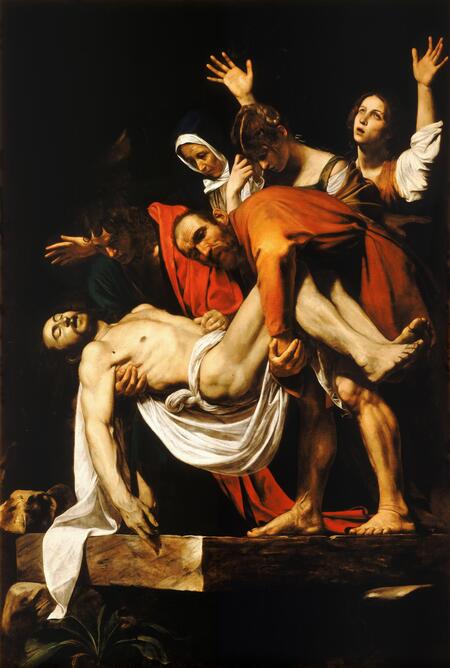
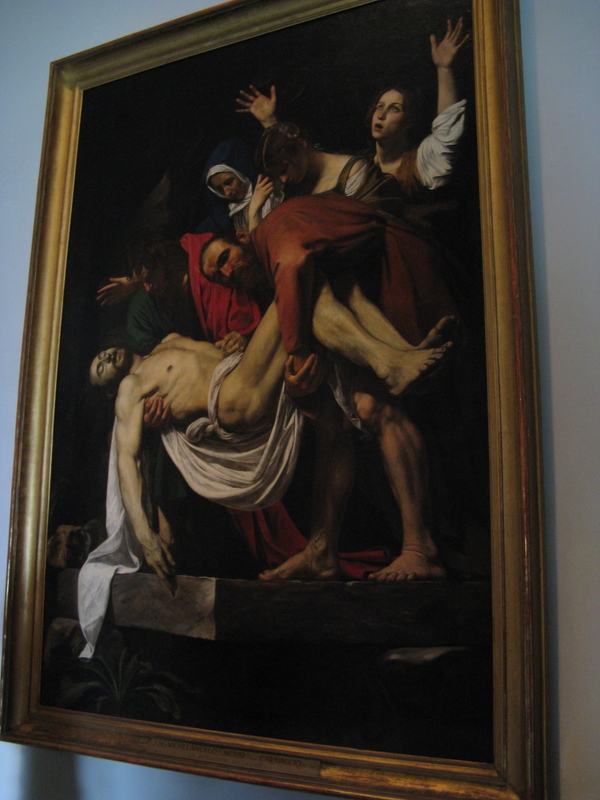
Caravaggio. Entombment. 1602–1604. Canvas, oil. Vatican Pinacoteca, Vatican. On the left is a reproduction; on the right is the painting in museum exhibition.
Also followed the women who came with Jesus from Galilee, who watched the tomb and how His body was laid to rest.