I. Concept and Topic Selection
France in the 17th and 18th centuries presents a unique interest for the study of fashion, as it was during this period that the French style gained significant influence in European culture. The female image became not only a reflection of personal preferences but also an indicator of social status, wealth, and belonging to a specific milieu. The royal court played a particularly noticeable role in shaping fashion trends, yet new conceptions of outward appearance gradually spread beyond its boundaries.
Navigation
I. Concept and Topic Selection II. The Ideal of Feminine Beauty in 17th–18th Century France III. Women’s Costume: Silhouette, Fabrics, and Decorative Elements IV. Hairstyles, Cosmetics, and Accessories V. The Evolution of French Fashion: From Baroque to the End of the Rococo Era VI. Conclusion and Bibliography
I decided to use this categorization to trace how perceptions of female beauty and fashion evolved in France during the 17th and 18th centuries. First, I examine the ideals of female appearance prevalent in society at that time, then I move on to the main elements of the look: clothing, hairstyles, cosmetics, and accessories. This division allows me to consider each component of the female image separately and understand how they combined to form the distinctive style of a particular era.
II. The Ideal of Feminine Beauty in 17th–18th Century France
To begin, I want to examine how the ideal of feminine beauty was perceived in 17th and 18th-century France. During this period, conceptions of attractive female appearance evolved alongside culture, societal tastes, and prevailing fashion trends.
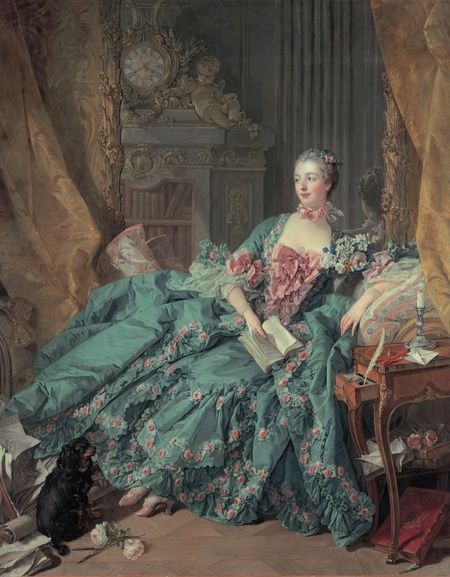
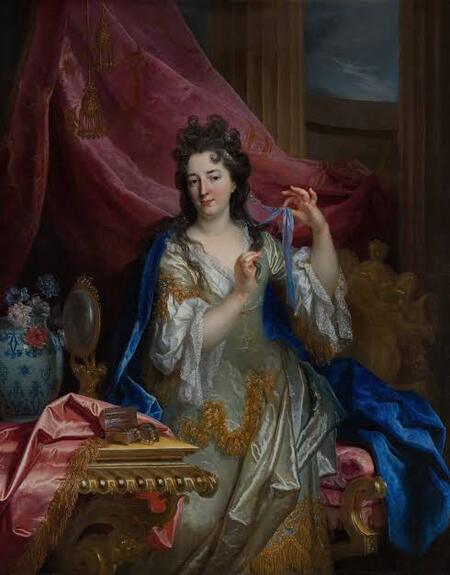
François Boucher — «Portrait of Madame de Pompadour, ” 1750 (1). Nicolas de Largilliere — „Portrait of a Woman, ” circa 1696 (2)
Fair, smooth skin was considered one of the important features of female beauty. It was associated with noble lineage and the absence of the need for manual labor outdoors. To achieve this look, women used light powder and specialized cosmetics. A subtle flush, defined lips, and neatly contoured features completed the image. Facial features held particular significance. Artistic portraits from this era often depict light skin, a delicate blush, expressive eyes, and small lips.

Жан-Франсуа де Труа — «Чтение Мольера», ок. 1728 г.
«Eighteenth-century French aristocrats traditionally wore thick layers of white makeup and broad streaks of rouge applied from the corner of the mouth to the tip of the ear. The face was adorned with decorative motes, and the look was completed by tall, powdered hairstyles.» [1]
III. Women’s Attire: Silhouette, Fabrics, and Decorative Elements
«Over several decades, the female figure has changed: from a shape resembling two triangles joined at their peaks to a natural, elongated, and slender silhouette.» [2]
In the 17th and 18th centuries, women’s fashion in France underwent significant transformations. Clothing reflected not only contemporary fashion preferences but also the woman’s social standing, wealth, and belonging to a specific social stratum. Particularly notable changes occurred in the silhouette of the dress, the width of the skirts, the design of the bodice, and the use of decorative elements.
In the 17th century, women’s attire was distinguished by intricate tailoring, layering, and the use of expensive fabrics. In the 18th century, «the silhouette was formed by the corset and wide skirts supported by panniers» [3]. Thanks to these understructures, the figure took on a characteristic shape—a distinctly narrow waist balanced by wide hips. The bodice was tightly fitted to the body, and the bustline was often adorned with embroidery, lace, and ribbons.
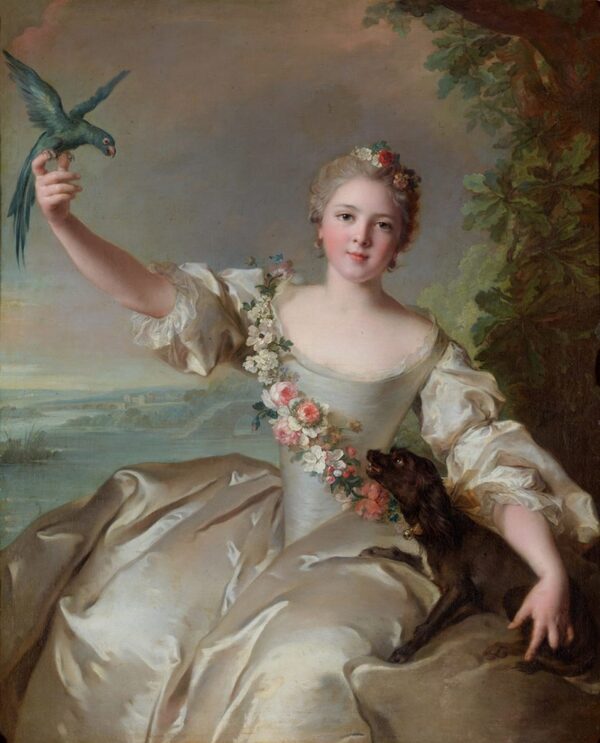
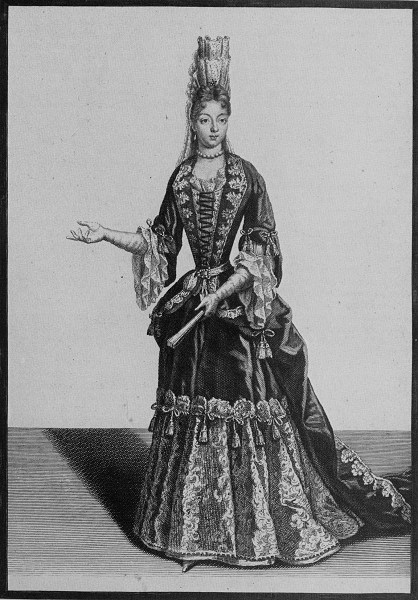
Jean-Marc Natteux — «Portrait of Mathilde de Canizy, Marquise d’Antin, ” 1738. (1) Unknown French engraver (circle of Nicolas Bonnar or Jean Dieu de Saint-Jean) — „French Lady“ (fashion engraving from the Recueil de modes series), 1693. (2)
The choice of fabric was highly significant. Silk, satin, brocade, and taffeta were used to create the garments. The fabrics could be embellished with floral patterns, embroidery, ornaments, and metallic threads. Intricate patterns and rich hues were especially valued, as they emphasized the opulence and formality of the attire.
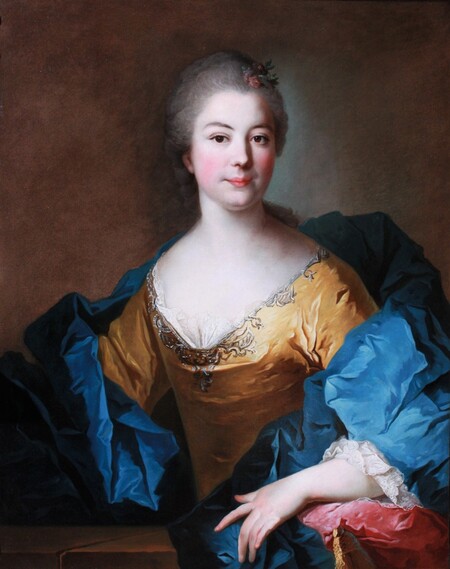
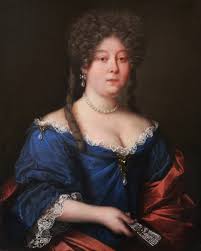
Jean-Marc Nattier Circle — «Portrait of a Young Noble Lady, ” 18th century (c. 1750s). (1) Unknown Artist (French School) — „Portrait of a Noble Lady with a Fan, ” late 17th — early 18th century. (2)
One characteristic of French fashion was the abundance of decorative details. Dresses were complemented with lace cuffs, bows, embroidered inserts, ruffles, and decorative elements on the bodice. However, by the last third of the 18th century, tastes were gradually changing: complex silhouettes and voluminous fabrics gave way to lighter shapes, simpler patterns, and natural lines.
IV. Hairstyles, Cosmetics, and Accessories
Hair played a vital role in creating the fashionable female look. In the 17th century, more natural and softer hairstyles were popular, adorned with ribbons, curls, and jewels. In the 18th century, hairstyles gradually became more complex and voluminous. A particularly notable trend in the latter half of the century was the high construction—the pouf. Creating these required special frameworks, added hairpieces, padding, and setting pomade. Hairstyles could be decorated with feathers, flowers, ribbons, and even small decorative arrangements. «Poufs were made using wire, padding, pomade, and hairpieces mixed with the woman’s own hair.» [4]
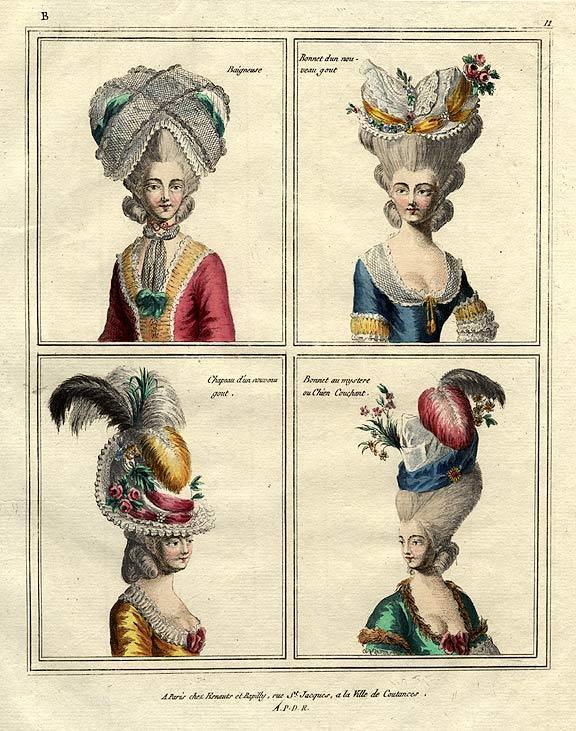
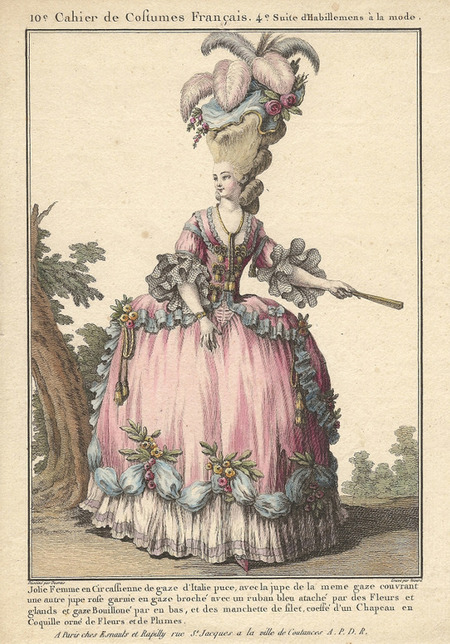
Pierre-Thomas Leclerc (or Claude-Louis Desre, publishers Jacques Enon and Michel Rapin) — Sheet B 11 («Bather, ” „New Style Cap, ” „Hat of New Taste, ” „The ‘Mystery’ Cap or ‘Lying Dog’“) from the series Galerie des Modes et Costumes Français, 1778. (1) Claude Louis Dère (artist) and Étienne Claude Vouazar (engraver) — „Beautiful Woman…“ 1778. (2)
A woman’s beauty was not limited to her face or hairstyle. Significant attention was paid to the condition of her skin, teeth, hair, and hands. Well-cared-for hands were considered an essential part of an attractive appearance. To maintain their beauty, women utilized special products, aromatic compositions, and home remedies. There were even entire manuals dedicated to grooming and appearance care.
Perceptions of female beauty were also reflected in views on the body. Posture, figure proportions, and silhouette played a crucial role. The corset helped create a narrow waist and support a specific shape for the upper body. In the 18th century, wide skirts supported by hoops visually broadened the hips, creating the characteristic silhouette of the Rococo era. It is also important to note that the idealized image in formal portraits did not always reflect a woman’s actual appearance. Artists might emphasize the model’s virtues, soften facial features, and create more harmonious proportions.
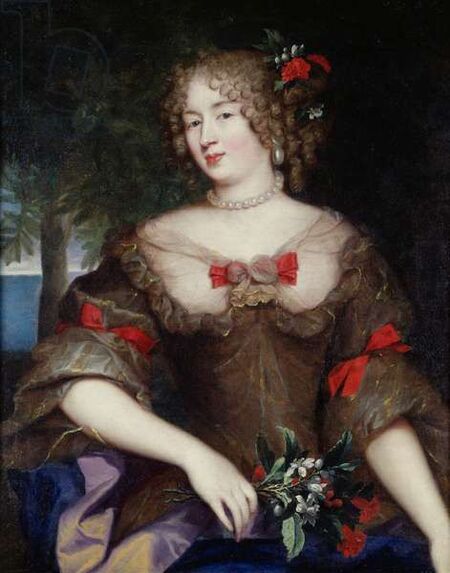
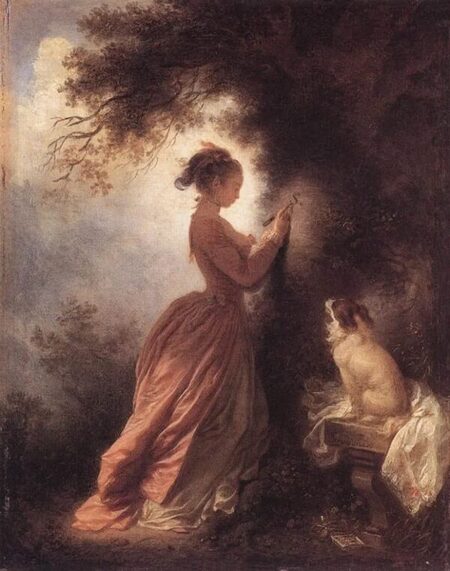
Pierre Minnier (attributed) — «Françoise-Marguerite de Sevigny, Countess de Grignan, ” circa 1669. (1) Jean-Honoré Fragonard — „Memoir“ (c. 1776–1778) (2)
In the seventeenth and eighteenth centuries, accessories were an essential part of women’s attire in France. They not only completed one’s appearance but also served to highlight a woman’s social standing and financial prosperity. For affluent ladies, these accessories were often crafted from luxurious materials: silk, lace, gold, silver, and precious stones.
One of the most recognizable accessories was the fan. It was constructed from paper, silk, lace, ivory, and wood, and was adorned with painting and decorative elements. Fans were used not just for fanning oneself; they became part of graceful gestures and manners, and also functioned as a striking adornment held in a woman’s hand.
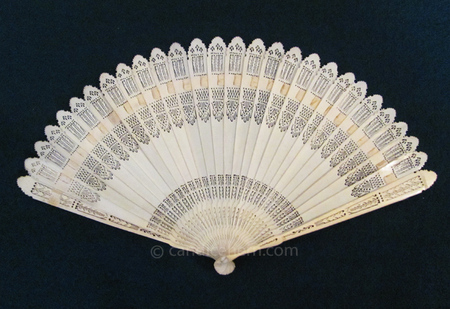
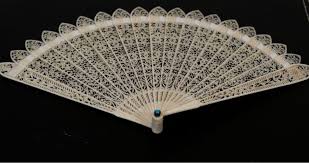
Carved Breeze Fans
The breeze fans did not have a fabric or paper screen; they consisted solely of delicate, openwork plates fastened at the top edge with a silk ribbon. In 18th-century France, they were most often cut from ivory or mother-of-pearl, designed to mimic the finest lace.
Gloves became widely popular. They were sewn from fine leather, silk, and other fabrics, and were adorned with embroidery and lace. They complemented an outfit and emphasized the neatness of the hands. During the cold season, women also used muffs—small fur or fabric items into which they could tuck their hands.