AHL, Episode 1, #18 2005, digital collage, edition pigment print on canvas, 150×450 cm; edition c-print on paper, 80×240 cm
Navigation
1. Concept 2. LAST RIOT 3. The Feast of Trimalchio 4. Sacred Allegory 5. INVERSO MUNDUS 6. Conclusion 7. Information Sources
Concept
AES+F is a group of Russian artists formed in 1987. Their collective includes Tatiana Arzamasova, Lev Evzovich, Evgeny Svyatsky, and Vladimir Fridkes, who joined the group in 1995. AES+F creates work using traditional photography, media, video, and digital technologies, defining their practice as «social psychoanalysis, ” through which they discover and examine the values, vices, and conflicts of the modern world. The collective creates worlds by reinterpreting allegories and motifs from classical art. They have found a unique style through which they demonstrate human potential and the values that comprise the norm. The works of AES+F hold deep meaning that each individual must contemplate independently. Furthermore, each piece is accompanied by a concept note detailing the framework upon which they based their creation. AES+F merges evolving artistic techniques with contemporary technologies, using them to portray reality in a novel way and point toward humanity’s potential.
One of the distinctive features of AES+F’s creative work is the experimentation with expressiveness, which lends originality to their pieces. Artists examine various aspects of modernity through the «prism» of established classical art imagery, creating aesthetically beautiful and provocative images in their works.
Why does AES+F take prototypes from its own works and from classical art objects? Why are they focused on the Renaissance era?
The Feast of Trimalchio, Arrival of the Golden Boat 2010, digital collage, c-print, Diasec®, 295×495 cm
The collective draws upon classical art forms to establish a dialogue with cultural heritage, adapting these elements to contemporary realities by creating new meanings. Through video installations, they «critique» modern society, examining its consumerism, violence, and the technologies that precipitate it. By employing established imagery from the past, AES+F develops multifaceted narratives that invite contemplation and interpretation. They weave the modern world together with objects and concepts drawn from classical art.
The Feast of Trimalchio, Still #2-1-41 2010, still from 1-channel video, pigment InkJet print on Fine Art Barite paper, 32×57 cm, limited edition of 10
In my visual research, I intend to draw parallels between Renaissance paintings and the works of AES+F, which reinterpret the artistic techniques and motifs of classical art. They bring these elements into the contemporary world, thereby exposing societal flaws through the imagery of classical art.
LAST RIOT
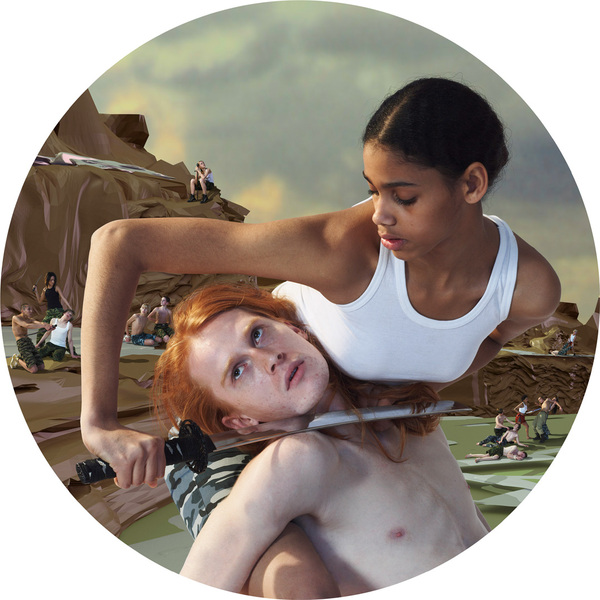
In the emotions of the protagonists of the first part of the trilogy, «The Liminal Space, ” several references to the paintings of Michelangelo Merisi da Caravaggio can be identified—paintings that depict death and violence. However, through the facial expressions of the characters, the work conveys different emotions that do not follow the canons of the narrative. For instance, in the painting „Judith and Holofernes, ” the heroine decapitating the man does not feel triumph or passion, but rather determination and disgust. Similarly, in one of the early variations of the painting „David with the Head of Goliath, ” Caravaggio’s David is not portrayed as a victor; instead, the young man’s face shows sorrow and regret. „The Sacrifice of Isaac“ illustrates the steadfastness of faith—a concept that is precisely what the characters in the AES+F world are fighting for. In the canvas „Narcissus, ” Caravaggio portrays the singular reality of a person consumed by themselves.
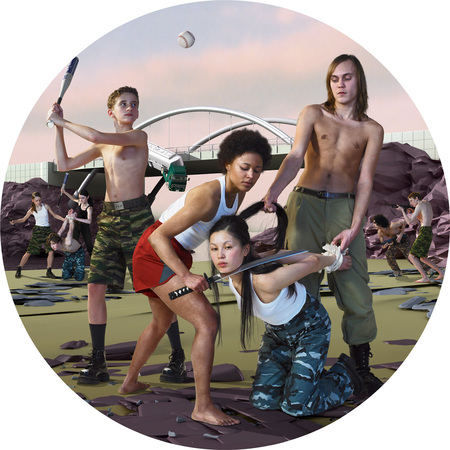

Last Riot 2, Tondo #6 2005, digital collage, edition pigment print on canvas, 150 cm; edition c-print on paper, 80×80 cm | «Judith and Holofernes» (1599) Michelangelo Merisi da Caravaggio
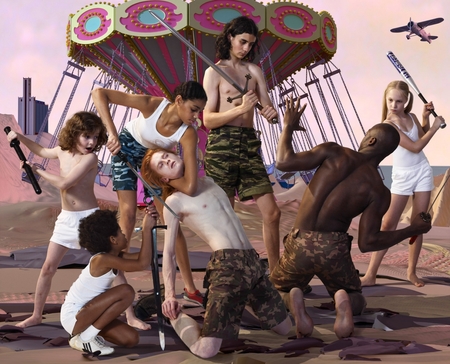

Last Riot 2, The Carrousel 2007, digital collage, edition pigment print on canvas, 170×210 cm; edition c-print on paper, 80×99 cm│ «The Sacrifice of Isaac» (1603) Michelangelo de Caravaggio
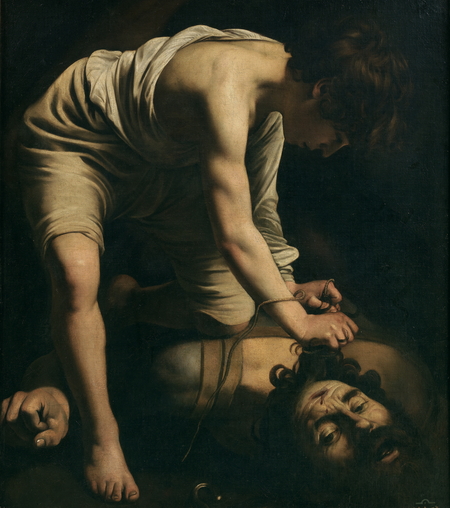
Last Riot 2, Tondo #23 2007, digital collage, edition pigment print on canvas, D150 cm; edition c-print on paper, 80×80 cm│ «David and Goliath» (1599) Michelangelo de Caravaggio
Last Riot, Still #1-3-07 2007, originally a 3-channel video, pigment print on Fine Art Baryta paper, 15×81 cm, limited edition of 10
«Narcissus» (1597–1599) Michelangelo de Caravaggio
AES+F, drawing on the motifs and emotions of classical art, evoke a feeling of hopelessness and hope intertwined in a single moment. The installation is part of a trilogy—heaven, purgatory, and hell—where it embodies the latter. At the mountain’s summit, teens and kids engage in an endless battle, their identities slowly dissolving. The world collapsing around the actions taking place suggests the self-destruction of people and their obsession with a fight they don’t understand will lead to anything.
«We wanted to create compositions reminiscent of Mannerist and Baroque painting, and Caravaggio in particular. We feel that contemporary visual culture is very similar to the Baroque era—everything is highly expressive, figurative, very striking, and image-based, but at the same time, very decadent.»
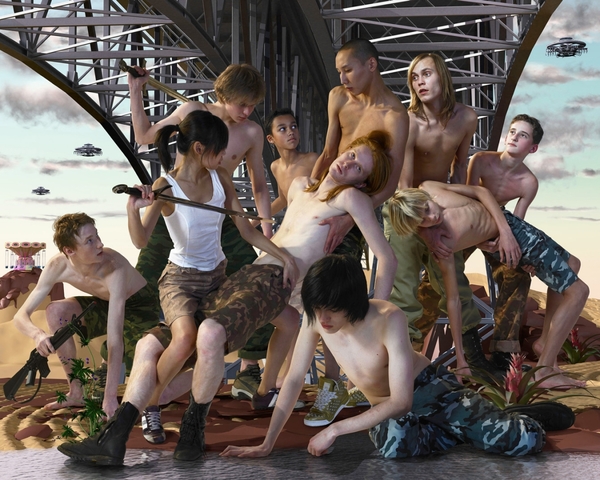
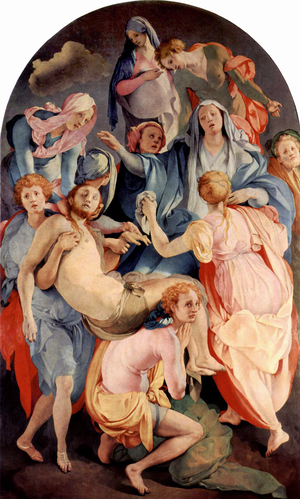
Last Riot 2, The Bridge 2006, digital collage, edition pigment print on canvas, 170×210 cm; edition c-print on paper, 80×99 cm│ «Descent from the Cross» (1525–1528) Jacopo Pontormo
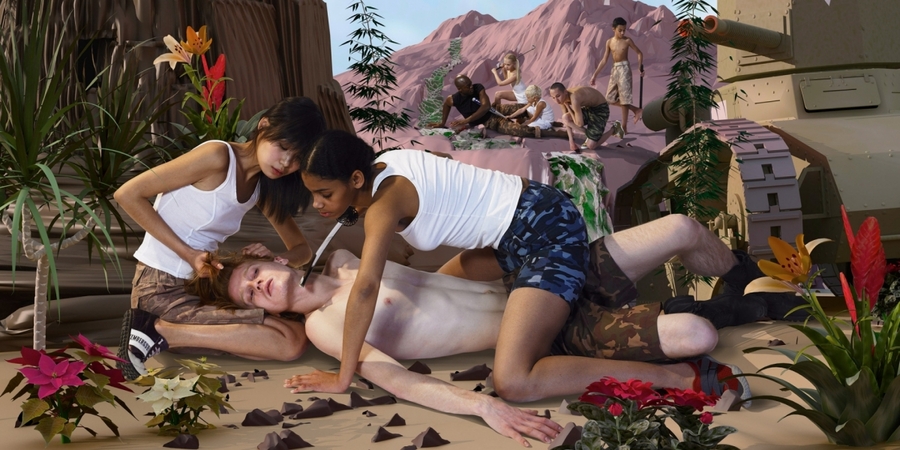

Last Riot 2, The Tank & Waterfall 2006, digital collage, edition pigment print on canvas, 100×200 cm; edition c-print on paper│ «Judith Slaying Holofernes» (1612–1613) Artemisia Gentileschi
The Feast of Trimalchio
In the second installation of the «The Liminal Space» trilogy by AES+F, one can identify references to Peter Paul Rubens’s «Garden of Eden» and Pieter Bruegel the Elder’s work, depicting the moment preceding the tasting of the forbidden fruit and the fall of man. Despite this, the painting portrays a paradise on Earth, which AES+F embodies in their installation. Furthermore, there are allusions to Rogier van der Weyden’s altarpiece, «The Descent from the Cross» (1435–1440), where the canons of Dutch painting are broken, the Virgin Mary faints, and assumes the same pose as Christ. The composition of this painting can also be examined, particularly how the hands of Jesus and the Virgin Mary are directed toward Adam’s skull, symbolizing the redemption of sins. Rafael Santi’s painting, «The Three Graces, ” is another work from which AES+F drew inspiration. The compositional motif features three nude female figures, through whom the artist conveys the idea of unity and perfection.

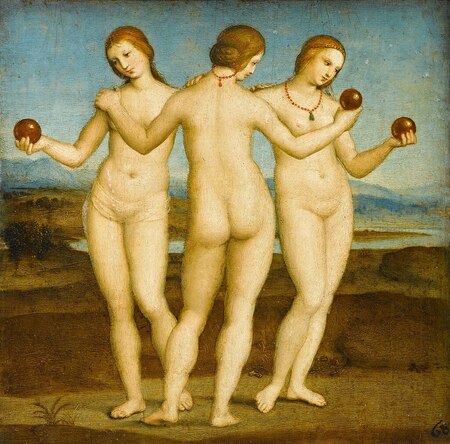
The Feast of Trimalchio, Still #2-1-14 2010, print from 1-channel video, pigment InkJet print on Fine Art Barite paper, 32×57 cm, limited edition of 10│ «The Three Graces» (1503–1505) Raphael
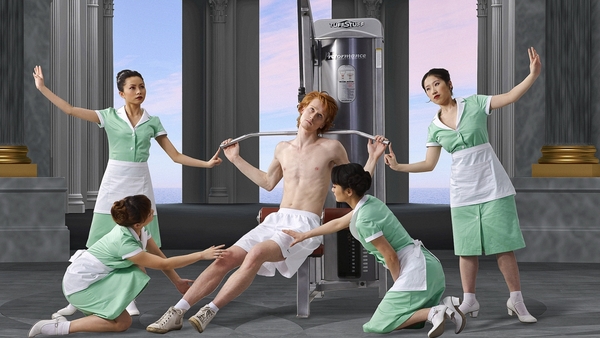

The Feast of Trimalchio, Still #2-1-08 2010, still from 1-channel video, pigment InkJet print on Fine Art Barite paper, 32×57 cm, limited edition | «The Deposition» (1435–1440) Rogier van der Weyden
The Feast of Trimalchio, Still #2-1-17 2010, still from 1-channel video, pigment InkJet print on Fine Art Barite paper, 32×57 cm, limited edition of 10
«The Garden of Eden with the Fall of Man» (1615) Peter Paul Rubens and Jan Brueghel the Elder
AES+F uses references to the Renaissance to depict a world on a private island, set within an expensive hotel where the «masters» occupy the place of the «servants.» This mirrors the socio-economic processes in the world, which are cyclical. The island fosters a unity among the installation’s characters; they forget their status and periodically switch roles. AES+F examines cultural, geopolitical, gender, and racial issues, weaving them into a singular narrative.
SACRED ALLEGORY