Concept
The concept of this visual study is to examine death as one of the most crucial motifs in art and culture. Through paintings, frescoes, and engravings, it explores how artists of different eras depicted death, conveyed its symbolism, and reflected the fears, beliefs, and worldview of society. Special attention is paid to medieval representations of death, where death becomes an inevitable force uniting all people, regardless of their status or standing. This study reveals how humanity has attempted to comprehend the finitude of life through visual imagery.
At the very center of the composition stands Jesus Christ in radiant robes. In his hands, he holds a small figure wrapped in white swaddling clothes—the animula (Mary’s soul)—which has just departed the body. This is a beautiful inverse symbolism: Mary once cradled the infant Christ, and now He, as a loving Son, gently receives her pure soul to carry it into heaven.
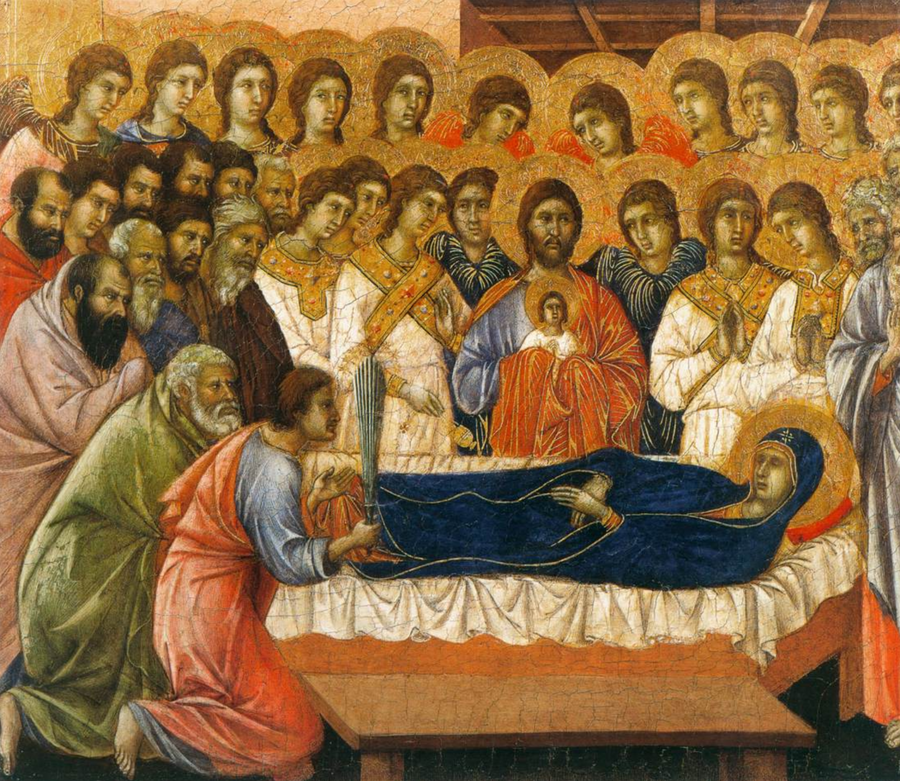
«The Death of Mary» (Dormition) by Duccio di Buoninsegna (1308–1311)
Artists of various eras have interpreted the theme of existential finitude in different ways. It is particularly fascinating to examine the symbolism of death in 15th-century art, a period marked by significant shifts in worldviews. The fifteenth century was an era of crisis and the transformation of canons. Influenced by wars and the plague epidemics, human mortality and the equality of social classes before eternity became the primary theme in art. Artists began employing new techniques, such as the Danse Macabre (Dance of Death) motif, representations of transi (decaying bodies), and multi-figure compositions. The forms of art also evolved—from frescoes to the first printed engravings. During this time, the theme of death began to be used as a tool for social satire and psychological defense, aiming to overcome collective fear of the unknown through the image of dance.
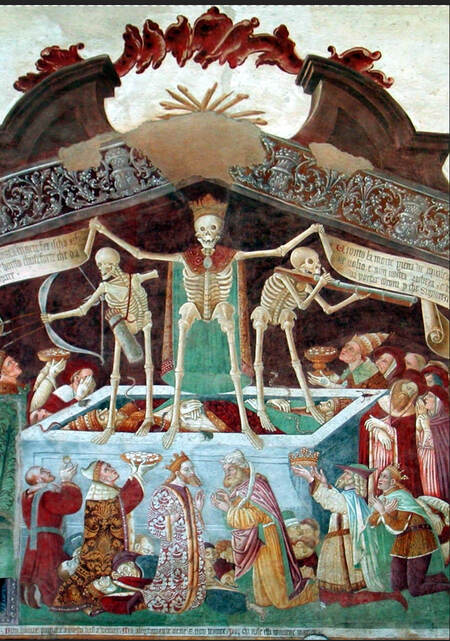
In the 15th century, a unique concept of eschatological egalitarianism emerged—the absolute equality of all people in the face of death. The composition was strictly structured hierarchically: Death sequentially drew into a dance the Pope, the Emperor, the Cardinal, the Merchant, the Monk, and the Peasant, visually demonstrating the illusory nature of earthly titles and wealth.
Fresco in Khrast-Provle (Ioann of Kast, 1490)
The Parisian Canon: Cemetery of Innocents (1424–1425)
Masterpiece on Canvas: Tallinn’s «Dance of Death» (Bernt Notke, late 15th century)
Kermaer-en-Iskoué (Brittany, France, c. 1450)
Fresco in La-Chaise-Dieu (Auvergne, France, c. 1460–1470)
«Be it the royal scepter, the mitre, or the porphyry,
The gold, and the brilliance of precious stones—
All this is but dust before the face of Him who extinguishes days.
Death reaps all, showing no mercy to rank…»
Francesco Petrarca
First Printed Book: Engraving «Imago Mortis» (Michael Wolgemut, 1493)
The Specificity of Death’s Representation in Fourteenth and Fifteenth Century Art
Within the iconography of the Danse Macabre during this period, the image of Death possessed unique visual and semantic characteristics:
• The iconographic type of «transi.»
In the fourteenth and fifteenth centuries, Death was not depicted as a purified skeleton with a scythe (this canon was established later), but rather as a decaying corpse—a transi. Artists meticulously detailed opened abdominal cavities, withered skin, maggots, and snakes. This naturalism served a didactic purpose, evoking physiological terror regarding the putrefaction of flesh.
In the 14th century, following the Black Death pandemic (1346–1353), the concept of death in the European consciousness underwent a radical transformation. Death ceased to be a distant biblical event. It became a personified, sudden, and terrifyingly palpable force. Artists began seeking new allegories to express this existential dread.
«Triumph of Death» Buonamico Buffalmacco
Graveuries by Guillaume Maréchal (1485): Text as an Inseparable Part of the Image
Wall frescoes were always accompanied by poetry, but it was the Parisian editions of Guillaume Maréchal that unified the image and text into a single, portable format.
In these texts, Death acts as a scathing critic. It does not merely take away the King or the Judge; it mocks their worldly vanity, greed, and foolishness. A picture without text in the 15th century was considered incomplete—it was the word that lent the macabre dance its legal and social force.
«Three Dead and the Hermit»
Ars Moriendi («The Art of Dying») and the Mental Mastery of Death
In the 15th century, the concept of death broadens: it is not enough merely to remember death; one must learn how to die properly. Following the invention of the printing press, illustrated handbooks—Ars Moriendi—were circulated in massive print runs.
• Concept essence: The mortal bed transforms into a spiritual battleground. While the person is weak and dying, angels and demons engage in a desperate dispute over their soul, tempting them with pride, despair, or unbelief.
• Artistic significance: These engravings conditioned individuals to perceive their personal end as a structured religious ritual, thereby diminishing the panic associated with the unknown.
Ars Moriendi («The Art of Dying»)
«Triumph of Death» in Pisa (Buonamico Buffalmacco, c. 1350): Campo Santo. A monumental fresco created immediately following the Black Death, depicting the winged Death flying with a scythe over the bodies of deceased rulers, ignoring the pleas of the poor and the crippled.
«Triumph of Death» (Buonamico Buffalmacco, circa 1350)
Mural painting in the Great Hall of Longthorpe Tower manor in Cambridgeshire. This is one of the earliest monumental examples of the theme of death in Europe, created even before the arrival of the Black Death (1348). On the wall of the residential house are depicted three young kings hunting with falcons, who suddenly encounter three gruesome, half-rotted corpses. The fresco proves that the nobility of the 14th century consciously surrounded their daily life with reminders of the body’s transience. «The Legend of the Three Living and the Three Dead.» The plot, where three noble youths on a hunt encounter three corpses. The dead do not dance; they merely utter the formula: «We were like you. You will become like us.» This laid the foundation for the future dialogue between humanity and Death.
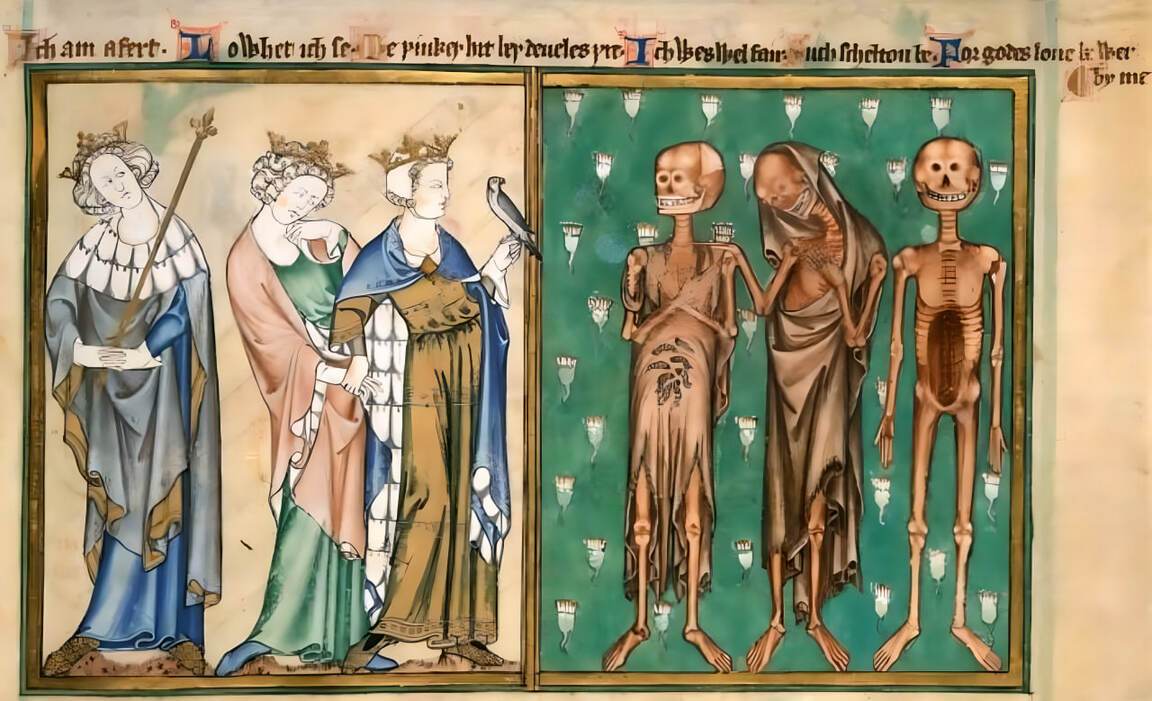
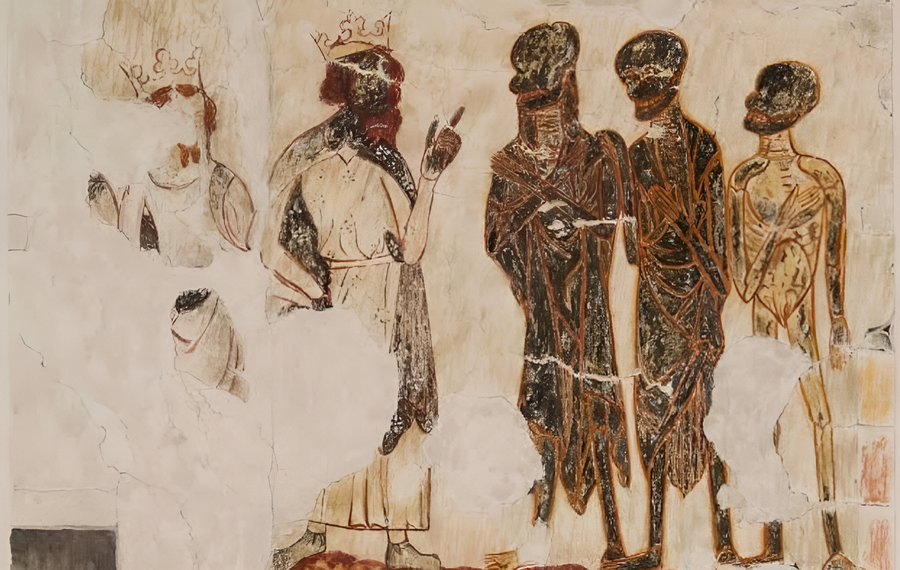
«The Legend of the Three Living and Three Dead»
Frescoes of the «Book of Hours of Bonn de Luxembourg» (Jean Le Noir, circa 1345–1349)
Unique miniatures from the personal prayer book of a French princess. The master, Jean Le Noir, executed a radical turn: instead of conventional skeletons, he depicted three corpses in wooden coffins with surgical, shocking naturalism at different stages of biological decay. The princess died of the plague in 1349, and these images served as her personal existential mirror.
«The Clock of Bonn de Luxembourg» (Jean Le Noir, c. 1345–1349)
«Whether he is a pope in a holy tiara, an emperor in a golden crown, or a simple artisan—Death takes them all by the hand. And when they pass under the earth, their grandeur vanishes like the wind over a field, leaving only bone and dust.» François Villon
The Horseman of the Apocalypse (Death on a Pale Steed):
The central figure is depicted as a reanimated desiccated corpse (a 'transi'), galloping on a gray (pale) horse. Note his attributes: a coffin is strapped to his back, and in his hand, he holds an arrow. In medieval art, the arrows of Death were directly associated with sudden calamities and epidemics—particularly the indiscriminately ravaging plague.
«The Legend of the Three Living and the Three Dead»