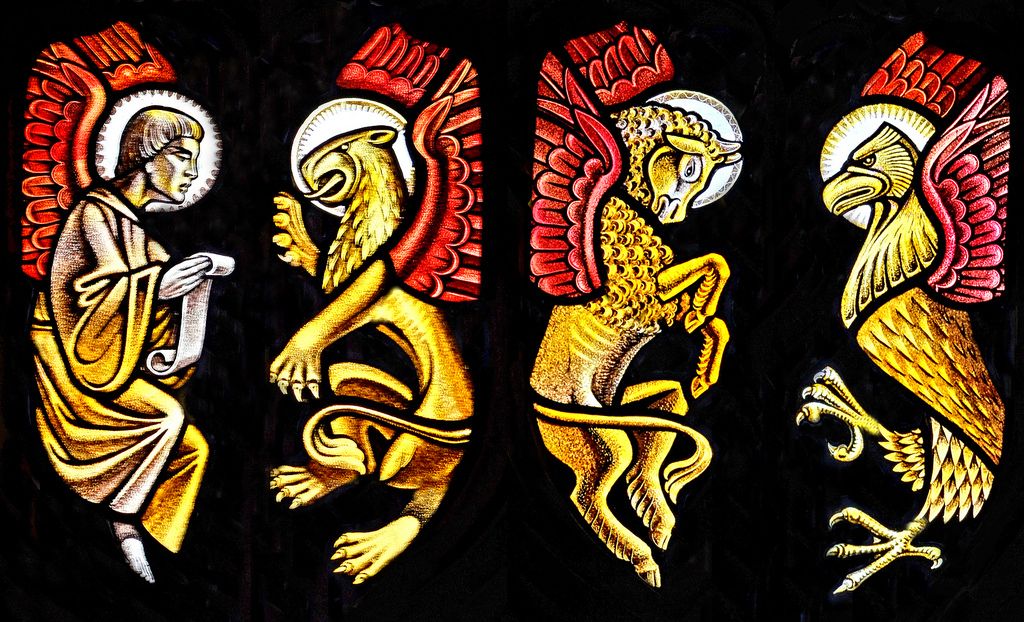
Тетраморф в средневековом христианском искусстве
Символика и визуальное воплощение четырёх евангелистов
Research Concept
Animals and fantastic creatures held a significant place in the artistic culture of the Middle Ages. They were depicted in religious sculpture, mosaics, book miniatures, and church furnishings. However, their presence in works was not always related solely to depicting the natural world. In Christian tradition, animals often became bearers of religious meaning, used to convey concepts of divine revelation, salvation, and the spiritual order of the world.Among these images, the tetramorph holds a special place—an iconographic system based on depicting four creatures: a human or angel, a lion, a calf, and an eagle. Its origins are connected to the biblical visions of the prophet Ezekiel and the Apostle John. The book of Ezekiel describes four living beings with human, lion, calf, and eagle faces (Ezek. 1:4–10). The Book of Revelation also features four creatures around the heavenly throne (Rev. 4:6–8). In early Christian tradition, these images gradually came to be associated with the four Evangelists.In medieval Western European iconography, the following correspondence became established: human or angel—a symbol of the Evangelist Matthew; lion—Mark; calf—Luke; eagle—John. However, this distribution was not the only one throughout the entire early Christian history. Early Christian authors also presented other variations in correlating these creatures with the Evangelists. Therefore, it is important to consider not only the established system of symbols but also the peculiarities of its formation.
The selection of this topic is motivated by the fact that the tetramorph is not merely a collection of four images, but a unified visual system. Each symbol possesses its own meaning and distinct visual characteristics, yet simultaneously functions as part of the overall composition. This allows for an examination of how religious content was conveyed through form, posture, attributes, and the interaction of the depicted creatures.Chronological Scope of the Study covers the period from early Christian art up to and including the 14th century. Early Christian artifacts are considered the historical prerequisites for the formation of the tetramorph iconography. Primary focus is placed on medieval works created before the end of the 14th century.
The research question is as follows: how did the symbolism of the four evangelists develop and manifest in medieval Christian art, and what artistic means were employed to create the unified composition of the tetramorph?
Research Hypothesis posits that the tetramorph in medieval art functioned not only as a means of signifying the four evangelists but also as an independent visual system in which each figure retained individual characteristics while simultaneously adhering to an overarching compositional structure. Its artistic manifestation depended on the medium, material, format of the work, and religious context.
Research Objective: To examine the symbolic meaning of the four tetramorph images and identify the characteristics of their visual representation in medieval Christian art.
The research employs the iconographic method, which allows for the determination of image meaning based on its attributes and narrative context; the formal-stylistic method, aimed at analyzing proportion, plasticity, composition, and degree of conventionality; the comparative method, which enables the comparison of images across different works; and the iconological method, which helps examine the artistic motif in relation to the religious and cultural representations of the era.The primary criteria for visual analysis include the external appearance of each figure, the character of its posture and movement, the presence of wings, halos, books, and other attributes, its compositional placement, its interaction with other symbols, and the image’s relationship to architectural or book space.The study draws upon scientific and art historical publications dedicated to Christian iconography, the symbolism of the evangelists, and medieval book art. Of particular importance are the works of N. V. Pokrovsky, who examines the origin and variations in correlating symbols with the evangelists, as well as materials from the «Orthodox Encyclopedia» and publications on Irish illuminated manuscripts.The illustrative materials selected are works of early Christian and medieval art created no later than the 14th century. Special attention is paid to the Lindisfarne Gospels and the Book of Kells, where the evangelist symbols are presented both as individual images and in unified compositions. Additionally, the study examines the miniature of the winged lion from the 13th-century MS M.138 Bible, as well as the 13th-century bronze eagle analog from Hildesheim Cathedral. Reference to book miniatures, decorative arts, and ecclesiastical objects allows us to trace how the same iconographic system adapted to various artistic forms.
To achieve this goal, the following objectives must be met:
- Examine the biblical origins of the Tetramorph and the history of the symbolism of the four evangelists.
- Study the symbolic meaning of the human, lion, ox, and eagle.
- Identify the characteristic visual features of each of the four figures.
- Analyze works across various art forms: illuminated manuscript, church sculpture, mosaics, and liturgical furnishings.
- Examine methods for unifying the four symbols into a single composition.
- Compare the works to determine the common patterns in the depiction of the Tetramorph within a chosen historical period.
Research Structure
Research ConceptChapter 1. The Formation and Symbolic Meaning of the Tetramorph 1.1. Biblical Origins of the Image 1.2. The Connection Between the Four Creatures and the Evangelists 1.3. The Tetramorph as a Unified System of SymbolsChapter 2. Symbolism and Visual Embodiment of the Four Evangelists 2.1. Man (Angel) — Symbol of Matthew 2.2. Lion — Symbol of Mark 2.3. Ox — Symbol of Luke 2.4. Eagle — Symbol of JohnChapter 3. Compositional Characteristics of the Tetramorph 3.1. Four Symbols in a Single Composition 3.2. Methods of Unifying Symbols in Medieval ArtChapter 4. Comparative Analysis 4.1. Peculiarities of Visual Symbol Representation 4.2. Realism vs. Conventionality in Imagery 4.3. Unity and Distinction of the Four FiguresConclusionList of SourcesList of Illustrative Materials
Chapter 1. Formation and Symbolic Significance of the Tetramorph
1.1. Biblical Origins of the Image
Italy, Padua. Bible: vision of the prophet Ezekiel, miniature from a manuscript. Circa 1287–1300.
The iconography of the Tetramorph originated from two biblical visions. The first is described in the book of the prophet Ezekiel, where the prophet sees celestial beings, each possessing four faces: human, lion, ox, and eagle. These creatures are associated with the manifestation of divine glory and accompany the heavenly throne (Ezekiel 1:4–10).
The second description is found in the Book of Revelation. Around God’s throne are four living creatures: one resembling a lion, another an ox, a third with a human-like face, and the fourth resembling a flying eagle. They praise God and constantly address Him (Revelation 4:6–8).
In Christian art, these descriptions became the foundation for creating a stable system of four symbols. It is important, however, to distinguish between the original biblical image and its subsequent iconographic interpretation. In Ezekiel’s book, the focus is on four-faced creatures, whereas in Revelation, they are presented as four distinct living beings. In the medieval artistic tradition, both descriptions influenced the depictions of the symbols of the evangelists.
1.2. The Connection of the Four Creatures with the Evangelists
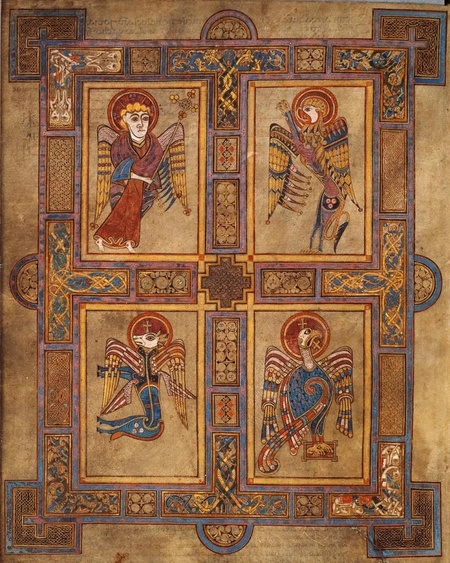
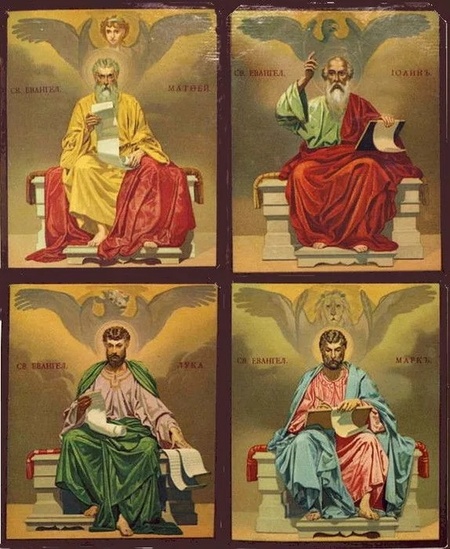
1. England. Portraits of the four evangelists with their symbols, Lindisfarne Gospel, sheets 25v, 93v, 137v, 209v. Circa 700–720. 2. Ireland. Symbols of the four evangelists, Book of Kells, sheet 27v. Circa 790–810.
The correspondence between the four creatures and the Gospel authors developed gradually. Early Christian authors proposed various arrangements of symbols. N. V. Pokrovsky notes that Irenaeus of Lyons, Augustine, and Jerome did not relate the creatures to the evangelists identically in every instance. Consequently, the modern customary schema did not exist in a fully established form from the very beginning.
In the medieval Western European tradition, the correspondence associated with Jerome’s exegesis became most widespread: Matthew — man or angel. The symbol relates to the fact that the Gospel of Matthew begins with the genealogy of Jesus Christ and emphasizes his earthly origins. Mark — the lion. The image is connected to the opening of the Gospel, where the voice of the wilderness cry is heard, as well as to concepts of strength and victory. Luke — the ox. The symbol relates to the sacrifice and the account of the priest Zechariah, from whom the Gospel of Luke’s narrative begins. John — the eagle. The image is linked to the elevated theological content of the Gospel, which begins with the words, «In the beginning was the Word.»
Thus, each symbol is connected not only to the external characteristics of the animal or creature but also to the content of the corresponding Gospel. The visual image becomes a means of conveying a specific aspect of Christian doctrine.
1.3. Tetramorph as a unified iconographic system
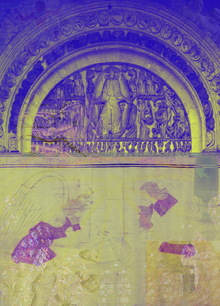
Muassek, France. Christ in Glory with the symbols of the four Evangelists, tympanum of the south portal of Saint Peter’s Church. Circa 1115–1130.
In medieval art, four symbols could be depicted alongside the corresponding evangelists, either individually or as part of a larger composition. In the latter case, they were typically positioned around the cross, Christ, or another central element.
The combination of the four creatures underscored the unity of the Gospels. Despite the differences between the figures, they were perceived as components of a single whole. The external diversity of the symbols did not disrupt the compositional unity: wings, halos, and books helped unify the man, the lion, the ox, and the eagle into a single sacred system.
Furthermore, the tetramorph was not always depicted identically. In some works, the symbols occupied separate panels, while in others, they were placed in the corners of the composition or accompanied the image of Christ.
Chapter 2. Iconography and Visual Representation of the Four Evangelists
2.1 Man and Angel—the Symbol of Evangelist Matthew
The first image of the tetramorph is represented by a human or an angel. In medieval iconography, it corresponds to the Evangelist Matthew. Visually, the symbol was typically depicted as a winged human figure, sometimes with a halo and a book.The connection to Matthew is explained by the content of his Gospel, which begins with the genealogy of Jesus Christ. Special attention is given to the Savior’s earthly origin and his human nature. Therefore, the human form becomes a suitable symbol for the first Gospel.However, various variations of the depiction are found in works of art—from a human figure with wings to an angel with a book. The terms «human» and «angel» do not always denote two distinct symbols. More often, it refers to a single image in which human features are combined with the attributes of a celestial being.
Lindisfarne, Northumberland. Lindisfarne Gospels. c. 700 AD.
In the Lindisfarne Gospel (circa 700 AD), the symbol of Matthew is represented as a winged human figure holding an open book. The inscription MAT, located near the figure’s head, allows for identification of the image. The figure is depicted in motion: the torso is slightly inclined, the legs are spread, and the large, outstretched wings occupy a significant portion of the composition. The book serves as the primary attribute connecting the image to the Gospel text. The combination of the human form and wings emphasizes the celestial nature of the symbol. The composition is enclosed within a circular frame. A bright red contour sets the figure apart against a golden background, while the folds of the clothing and the color transitions give the image dimension.
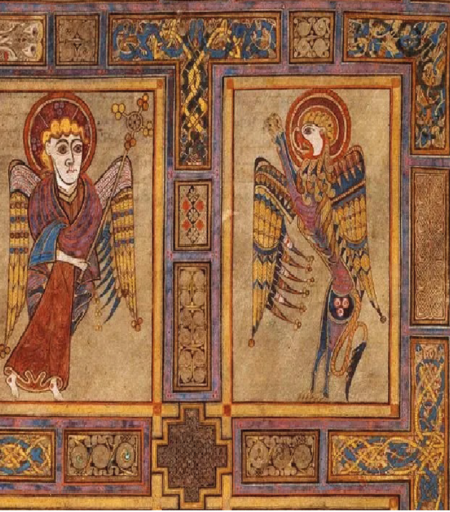
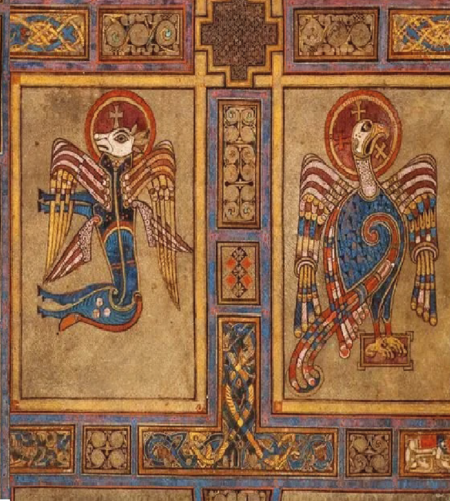
Ireland. Symbols of the four evangelists, Book of Kells, folio 27v. Circa 800 AD.
On folio 27v of the «Book of Kells» (Ireland, c. 800 AD), four symbols of the Evangelists are arranged around the central cross within individual decorative fields. The figure representing Matthew is depicted with wings and a nimbus.
Unlike the previous example, here the figure is not seen in isolation but as part of a unified composition. All four creatures are equal in status and subordinate to the central cross. At the same time, the similarity in their sacred attributes is combined with differences in their external appearance.