Визуальные последствия иконоборчества для Византийской и Русской иконы
Research Concept
Iconoclasm of the 8th–9th centuries is usually perceived as an episode of religiously-political struggle that culminated in the triumph of icon veneration in 843. However, for art history, this event holds a fundamentally different significance: it marked the birth of the visual order we today call the «Byzantine canon, ” which was subsequently inherited by Russian icon painting.
The iconoclasts were not „enemies of art“ in the modern sense. They created a new visual language, distinct from the early style—one presented through ornamentation and depictions of animals and plants—but they excluded the „corporeal images of Christ, ” the Mother of God, and other saints from the sacred space. It was this prohibition—and the ensuing struggle—that forced iconophiles to formulate a dogmatic justification for the image, which, after 843, was solidified into specific visual forms.
Russian iconography, which was adopted from Byzantium, inherited precisely the post-iconoclastic system formed during this crisis. This system ensured the continued development of the iconographic tradition after the fall of Byzantium, as well as its reinterpretation not only through religious art but also through the painting of the Russian avant-garde—a movement that, in its time, relied on the Orthodox iconographic tradition alongside Russian folk culture.
I am interested in the development of the iconographic tradition and the solidification of its canons. The influence of moments of crisis can tell much more than the tradition’s development during ordinary times. Art crises often eventually turn tradition in a different direction, which makes iconoclasm an interesting subject for examination. Through this, one can trace how Orthodox Christianity arrived at the iconographic canon that we can see in modern icons and that was reinterpreted by Russian masters in the 13th–19th centuries after the transfer of faith from Byzantium to Rus', as well as by Russian avant-garde artists of the 20th century, who were distant from faith.
The period before iconoclasm
To understand precisely what was rejected and reconstructed after 843, one must analyze the original state of the Christian image. The Roboti works of the 6th and 7th centuries, especially the Sinai icons, demonstrate a tradition in which the sacred image still retained classical tendencies, corporeality, and portrait individuality. These images possessed a sensuality and physicality that was later interpreted as a threat of idolatry. This tradition was fundamentally different; this path was closed after the crisis of the 8th and 9th centuries.
Encaustic. Sinai Icons
Icons painted with molten wax paints mixed with pigments on a wooden base. This method was inherited from ancient painting and Fayum funerary portraits. The images feature volumetric modeling of the faces and elements of Hellenistic portraiture (including some asymmetry in facial features). They were painted prior to the establishment of strict iconographic canons.
Christ Pantocrator. Icon of the 6th Century. Sinai Monastery of Saint Catherine
The icon of Christ Pantocrator is rendered with notable corporeality: chiaroscuro creates volume, and the face exhibits asymmetry and general imperfection. The hair is depicted with loose, quick brushstrokes. We are looking at a portrait, not the idealized image that we will see in the canon later on. The abandonment of the ancient tradition of portraiture has not yet occurred, but a new task—the creation of a religious image—has emerged, which will eventually demand a revision of visual solutions.
2. Ilya Prorok. Encaustic icon from the 7th century from St. Catherine’s Monastery on Sinai.
Prophet Elijah is depicted in a similar style: the folds of his clothing are formed by dynamic brushstrokes, and his face retains portrait individuality. The composition is frontal yet internally dynamic.
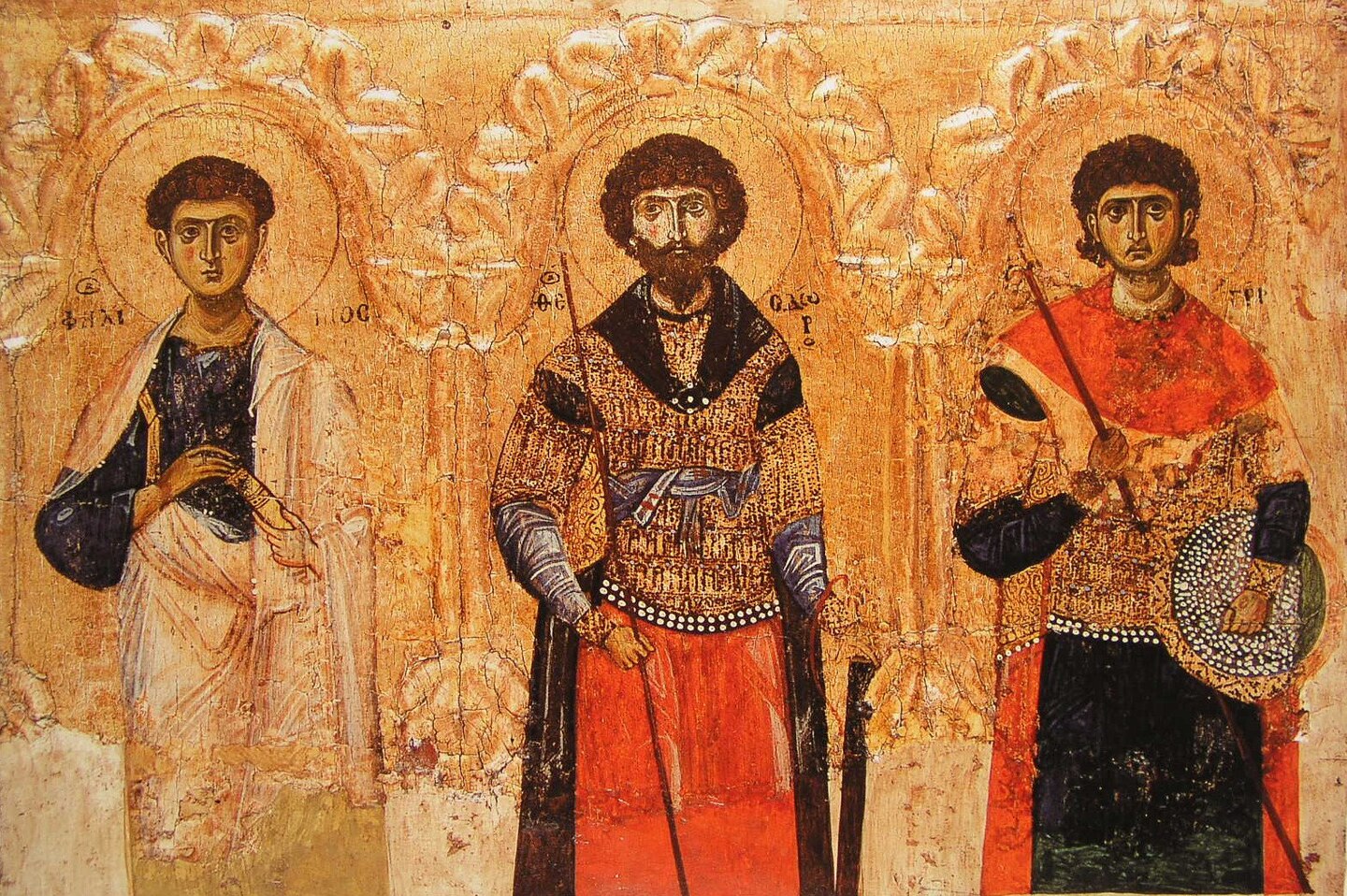
The Mother of God with the Child and the saints Theodore and George. Encaustic icon from the 6th century, from St. Catherine’s Monastery on Sinai.
A multi-figure composition featuring elements of frontality, yet utilizing volumetric modeling of faces and natural poses. The saints surround the Mother of God, creating a symmetry that would later become part of the iconographic canon.
These icons incorporate traits that iconoclasts perceived as a threat: an image possessing sensual conviction could provoke «idolatry.» Following this naturalism from the Iconoclasm period, there would be a shift toward a more conventional and symbolic representation.
Iconoclastic Period
Iconoclasm redirected religious art toward a decorative path: crosses, plant motifs, and animal imagery. It was during this period that the foundations for the strictness and hierarchy that would later become the canon were laid.The first prohibitions date back to the reign of Leo III: around 726–730, a decree was issued mandating the removal of icons from public spaces. The first action was the removal of the icon of Christ above the Halkian Gates of the Great Palace in Constantinople, which was replaced with an image of a cross. In 730, Patriarch German, who refused to acknowledge the doctrine, was deposed, and the destruction of icons in churches began.
Example of Christ of Halki. The original icon and the Halki gates themselves have not survived to this day. The Savior of Golden Floss, which is now in the Dormition Cathedral of the Moscow Kremlin. 13th century
Iconoclasts' Arguments
- The primary biblical argument is Exodus 20:4: «You shall not make for yourself a carved image, or any likeness.» Iconoclasts equated the veneration of icons with idolatry.
- The ineffability of the divine nature.
- Iconoclasts considered the very attempt to depict the celestial glory of saints using visual media to be insulting.
- Researchers link the intensification of Iconoclasm to the Byzantine military defeats by the Arabs in the 8th century: if God was punishing the empire, then sin needed to be eliminated, and idolatry seemed the most appropriate solution.
The most critical moment was the Iconoclasm Council of 754, convened by Constantine V. Its decree stipulated: «Any icon, made of any material, or even painted with the colors by the ungodly art of painters, must be removed from Christian churches.» For a cleric who venerated an icon, the penalty was the loss of his rank; for a monk—anathema. The only acceptable depictions of Christ were bread and wine, and the cross was also permitted as a symbol. In 768/769, all icons were removed from the treasuries of Hagia Sophia.
Mosaic cross in the apse, Church of St. Irene, Constantinople
After the Iconoclast Council of 754, the apse was decorated with a mosaic cross on a gold background. The cross was the only image that the Iconoclasts deemed permissible within the sanctuary space. The composition is strictly axial, symmetrical, and devoid of any figurative elements. The image is replaced by a symbol.
Fragment of a fresco with birds and crosses, Church of St. Kyriakos, Naxos, 8th–9th century
The best-preserved ensemble of aniconic painting on the Cyclades, dating from the Iconoclast period. The frescoes include: complex crosses, geometric and floral patterns, and bird imagery. Some motifs reveal Persian or Islamic influence, highlighting cultural intersections.
The Crucifixion of Christ. Two Iconoclasts, miniature, Khludovskaya Psalter, 9th century.
The miniature depicts a figure with a sponge or brush obscuring the face of Christ on an icon. This image was created after the victory of icon veneration: iconoclasts are presented as «destroyers» of the image. Here, iconoclasm becomes an object of depiction for the first time, rather than just a subject of prohibition.
The Byzantine Canon After Iconoclasm
Byzantine art enters a period of constructing a new canon. In the 9th–12th centuries, what we call the «Byzantine canon» takes shape: a hierarchical system of church decoration and the canonization of iconographic types. Russian iconography inherited precisely this system, rather than the pre-iconoclastic tradition.
The iconography of the Theotokos and Jesus Christ itself represents one of the most significant changes of this period.
Types of Theotokos Imagery:
- Hodegetria («She Who Shows the Way») — The Theotokos holds the Infant in her left arm, while her right hand points to Him as the path to salvation. The Infant is typically depicted frontally, making a gesture of blessing and holding a scroll.
- Eleousa («Tenderness») — An image that emphasizes the tenderness and intimacy between the Mother and the Child: the Infant leans his cheek against the Theotokos. Byzantine theologians interpreted this unity as the love between the Church and Christ.
- Oranta («The Praying One») — The Theotokos with her arms raised, often full-length, either without the Infant or with Him. This type is particularly characteristic of monumental apse frescoes.
1. Icon of the Mother of God «Hodegetria.» Early 15th century. Byzantium. 2. Vladimir Mother of God «The Tenderness.» 3. Mosaic of the Mother of God «Oranta» in the apse of the Cathedral in Cefalù (Sicily). 1148.