Святой Иаков как апостол и паломник в искусстве XII–XIV веков
Concept
In this study, I examine how Saint James the Elder (James the Zebedee, hereinafter referred to as James) was depicted as both an apostle and a pilgrim in 12th–14th century art. I am interested in understanding which details emphasized each of these roles, how they combined within a single figure, and how James’s iconography evolved throughout this period.
To achieve this, I compare works of sculpture, painting, and illuminated manuscript miniatures. I pay close attention to James’s attire, gestures, accoutrements, and placement among other characters. Comparing these details will help trace how his connection to pilgrimage to Santiago de Compostela—and beyond—was expressed in his image, as well as which apostolic attributes were maintained during this representation.
Key Question How do the apostolic and pilgrim attributes of Saint James differ and interrelate in 12th–14th century art?Hypothesis The pilgrim image evolved by augmenting the apostolic figure with travel accouterments. The book and nimbus maintained the saint’s status, while the staff, satchel, hat, and scallop shell connected him to pilgrimage.
1. As Jacob the Apostle is shown
Apostle and Spiritual Mentor
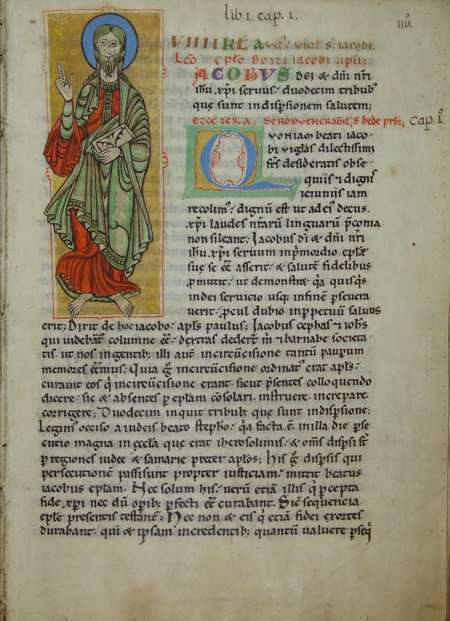
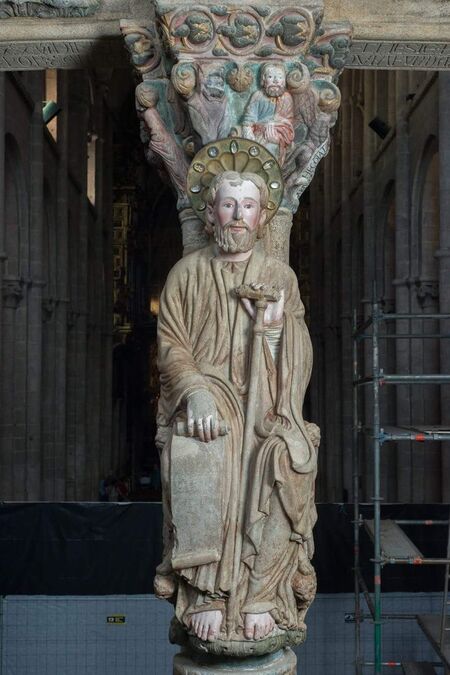
St. James Codex Calixtinus and James on the Portico of Glory. 12th century.
In the miniature, Jacob is highlighted with a halo and a colored background. His figure is elongated, and his long robes almost completely cover his body. His raised hand is directed toward the viewer, reminiscent of a gesture of blessing. In his other hand, a book is visible, though it is less emphasized. Jacob occupies a significant portion of the writing page, and this combination, next to the text, helps the viewer perceive Jacob as a spiritual mentor conveying sacred doctrine.
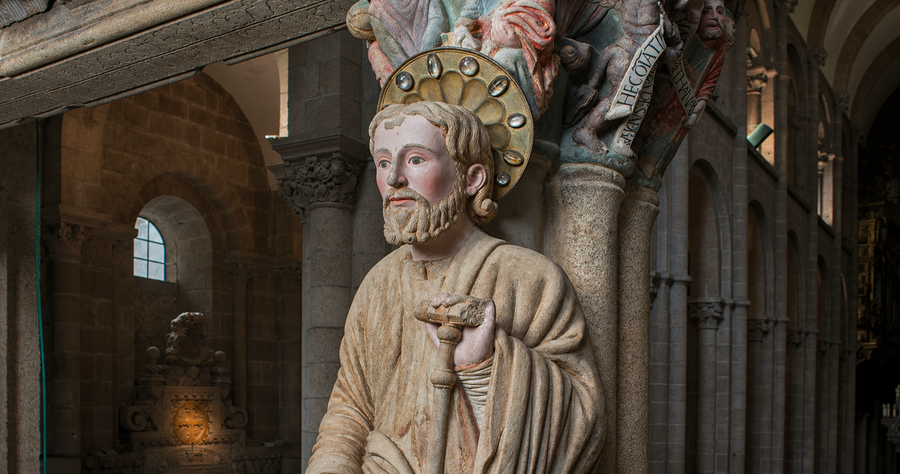
On the Portico of Glory, Jacob is depicted seated on the central column at the entrance of the cathedral. A halo encircles his head; one hand rests on a T-shaped staff, while the other holds a scroll.
In both works, Jacob is primarily presented as a saint and a spiritual guide. The described details link him to the transmission of sacred teaching, and his role as a pilgrim is not emphasized in these images.
James Among the Apostles
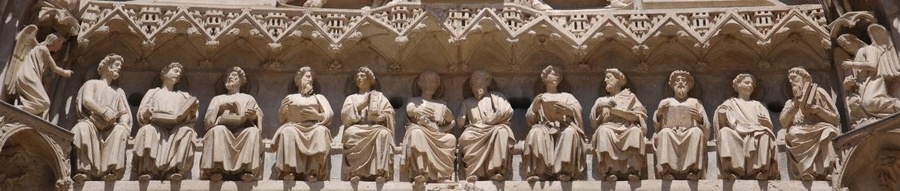
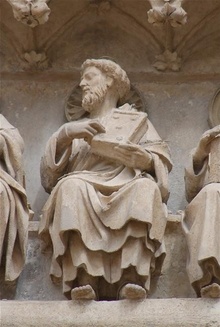
Apostles on the lintel of the Sarmenthal portal. Circa 1235–1240. Cathedral of Burgos, and Saint James separately.
In the general shot, James appears like the other apostles. They are seated in a row and are dressed in long robes. Here, James’s apostolic role is revealed through his surroundings. In the close-up, a book he holds against his chest is visible. The monument catalog notes the shells on its cover, although they are difficult to discern in this photograph. The connection to pilgrimage is signified by a detail within the broader apostolic image. This is one example of two roles appearing in the small detail of a shell on his book.
Iakov as Patron
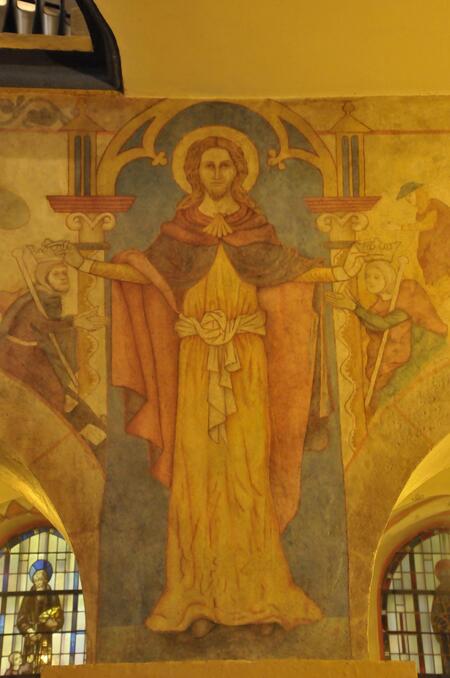
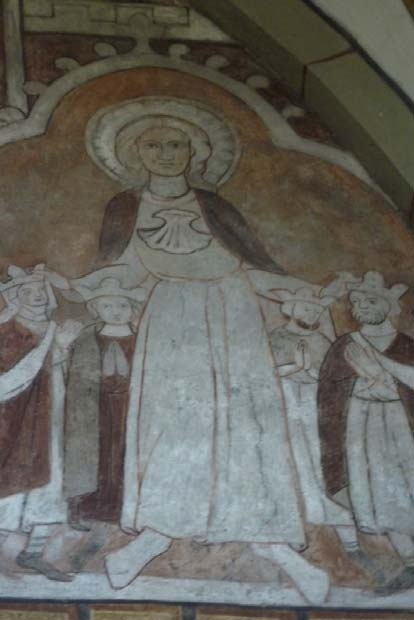
James crowning the pilgrims from St. Martin’s Church in Linz-on-Rhine, 13th century and James Fresco painting of St. Kyriac Church, Nidermendig, 13th century
In these murals, Jacob occupies a central position and noticeably dwarfs the surrounding figures. A halo encircles his head, and his arms are outstretched toward smaller human figures on the periphery.
Jacob places crowns upon the pilgrims. A distinct image of a scallop shell appears on his chest and collar, further connecting him to the pilgrimage. The description of the mural notes the travel gear of the people approaching him.
In both compositions, the role of the patron is revealed through Jacob’s actions and his relationship with the people around him. The pilgrims turn to the saint, and he receives and crowns them. The image of the patron unifies Jacob’s sacred status with his connection to those undertaking the journey.
2. The Pilgrim Jacob as Depicted
Bag and Sink
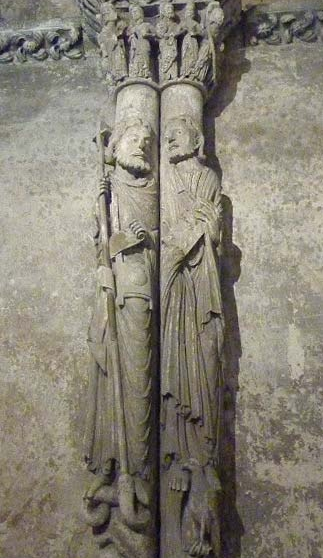
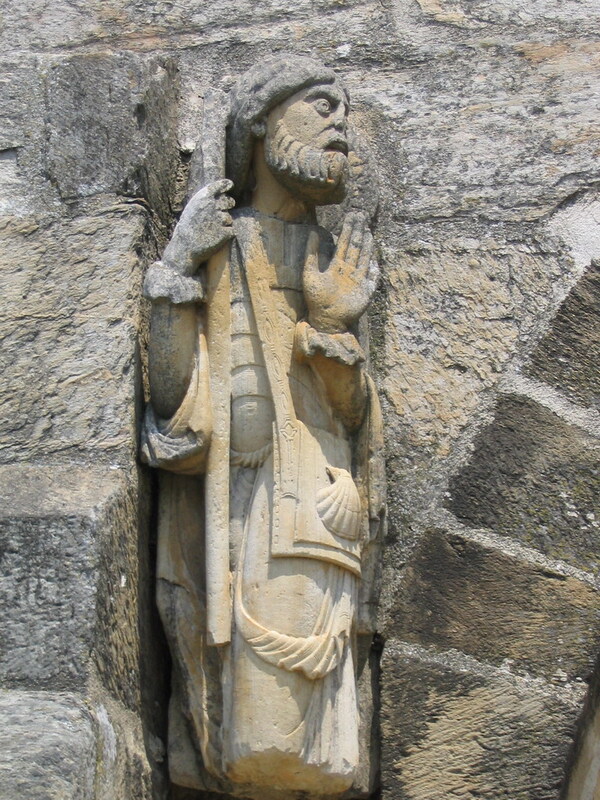
James and John. c. 1169–1175. Santa Chamber of Oviedo Cathedral and Saint James. Second third of the 12th century. Santa Marta de Tera Church
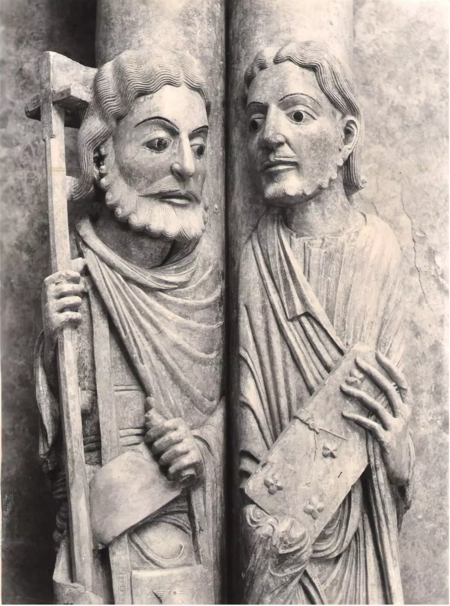
In Oviedo, James stands on the left next to John. Their figures share similarities in clothing and posture. However, the shell bag sets James apart from the other apostle. Here, James is more perceived as a patron than a pilgrim, suggested by his staff and unfurled scroll.
In Santa Marta de Tera, the large shell bag is clearly visible. Its strap crosses diagonally across his chest. He holds a staff—a walking stick often carried by pilgrims for ease of travel—and his other hand is raised with an open palm. Here, his belongings and overall depiction evoke the journey more strongly.
In these sculptures, travel accoutrements complement the saints’ figures. The bag establishes a traveling atmosphere, while the shell specifies the connection to the pilgrimage to Santiago.
Hat and Staff
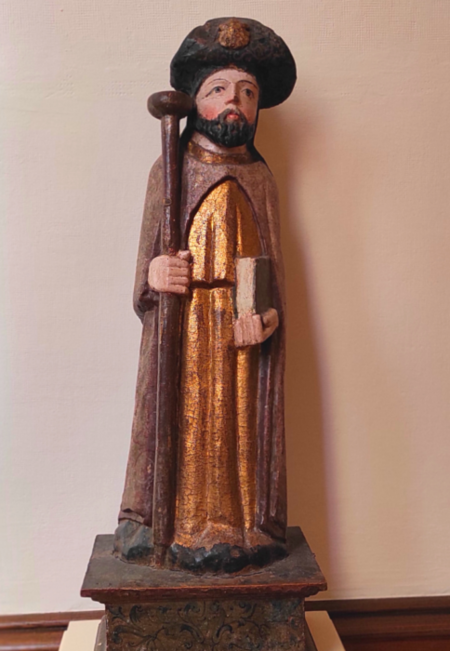
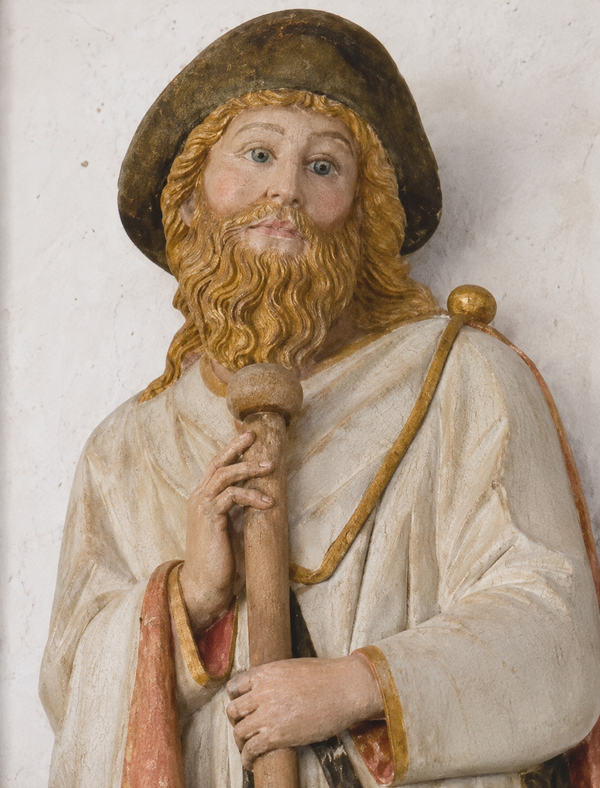
Jacob the Pilgrim from Quintana-de-Fon. 13th century, Astorga. and Jacob in the Cloister of Burgos. Detail of head and staff.
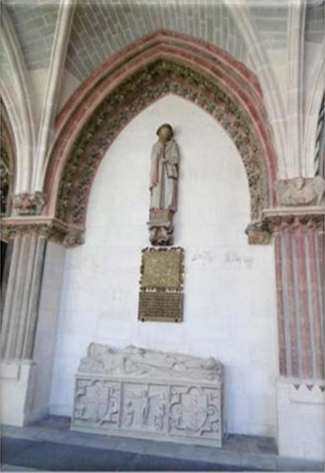
In the work by Jakob from Quintana-de-Fon, a wide-brimmed hat with a shell and a staff are noticeable. The hat brim frames the head, and the long staff runs alongside the body. In his other hand, the saint holds a book. Even here, travel accouterments merge with the apostle’s customary attributes.In the close-up view of the sculpture from Burgos, the hat, staff, and a travel bag with shells are clearly visible, but due to the poor photo quality taken from a distance, they are difficult to discern. Here, without the saintly attributes, James closely resembles an ordinary pilgrim.The hat, staff, and bag make the pilgrim’s role apparent in James’s overall appearance. Meanwhile, the book, if present, maintains a connection to his apostolic ministry.
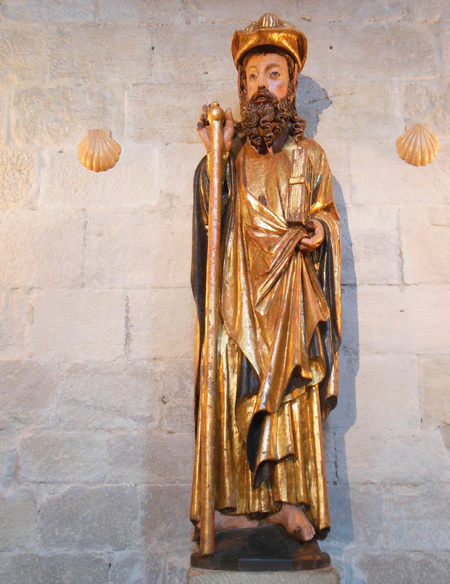
The Traveler’s Aspect of James
Photo: Santiago Beliz. 14th Century. Church of St. James, Puente la Reina.Here, a long staff is also noticeable, running almost the entire height of the figure. The hat, cloak, and bare feet complete the look of a traveler, as does the book pressed against the chest. Therefore, even in this pronounced traveler’s guise, the apostolic characteristic is retained. Two large scallop shells positioned on the sides of the wall relate to the statue’s modern setting; they should not be considered part of its medieval costume.In these images, the travel accoutrements define the first impression of the figure. Their combination makes the pilgrim figure recognizable, while the book allows us to simultaneously see James as an apostle.3. How the Wanderer and the Saint Intersect
Book and Basin
Simone Martini. Saint James the Greater. c. 1315–1320.
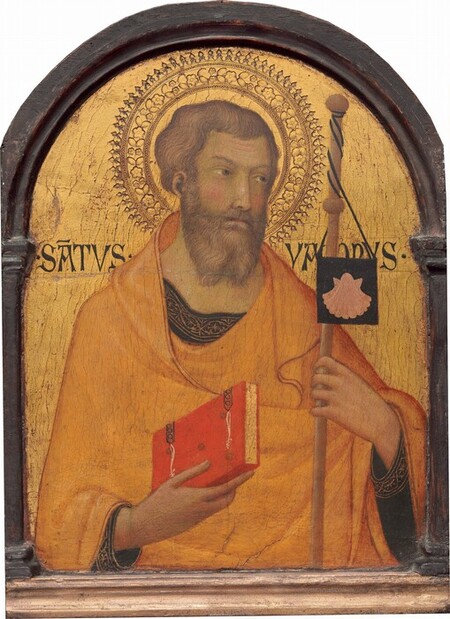
To Simone Martini’s left, from the viewer’s perspective, is a red book, and to his right is a staff bearing a scallop shell. The book stands out due to its color, and the light shell is clearly visible against the dark background. The halo and golden background emphasize James’s holiness.
Both roles are conveyed here simultaneously. The book connects James to apostolic teaching, while the staff and scallop shell relate to pilgrimage. There are no hats or bags in the frame, but the theme of travel is still discernible.
A few well-chosen objects are sufficient to merge these two roles. Their arrangement allows one to perceive James as both an apostle and a pilgrim in a single image.
Jacob with a Relic
Jacob the Pilgrim. Cocatrix Reliquary. c. 1321.
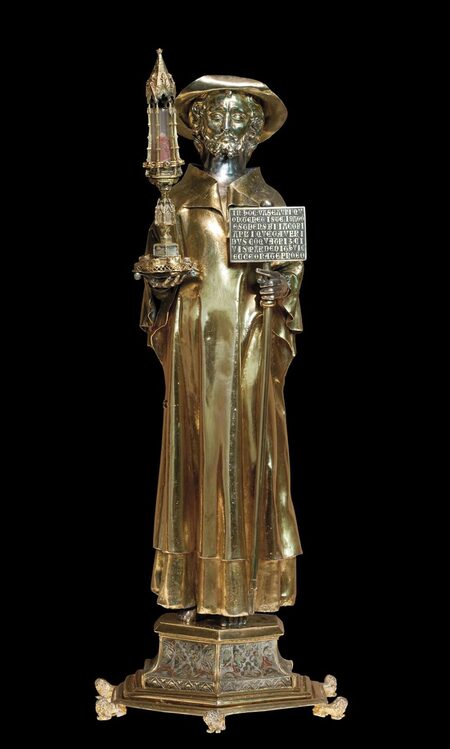
In the reliquary of Cocatrix Iakov, he is depicted full-length. The wide-brimmed hat and staff create a traveling appearance. In his other hand, he holds a small vessel for a relic. The connection to sanctity is expressed through the object incorporated into the very structure of the sculpture.In Martini’s work, a book and pilgrimage signs connect two roles. In the reliquary, the traveler’s garb is combined with the housing of the sacred object. The pieces are close in time, but they link pilgrimage to the veneration of the apostle in different ways.The traveling costume can be combined with the religious function of the piece. Iakov appears as a pilgrim while simultaneously remaining a saint to whom devotion is directed.
Overall Conclusion
In the works examined, Jacob retains his apostolic role while acquiring recognizable traits of a pilgrim. In some images, the book, the gesture of a mentor, or his place among the apostles are most noticeable. In others, the hat, bag, shell, and staff draw the primary focus.The hypothesis is supported in the aspect of connecting the two images. Travel accessories can supplement the book and other sacred attributes. This is particularly clear in Simone Martini’s work, the sculpture from Quintana de Fon, and Santiago Belice.However, the selected works do not allow us to prove the sequential appearance of all attributes. The bag and shell appear as early as the 12th century, while works from the 13th–14th centuries show varied combinations of objects. Their quantity also depends on the concept, the format, and the preservation state of the monument.In coronation scenes, Jacob is presented as a patron of those who have embarked on a journey. Thus, this research links the saint’s outward appearance to his role; the travel items bring him closer to pilgrims, while the gestures, objects, and composition preserve his sacred status.Carvajal González, Helena. Santiago peregrino // Revista Digital de Iconografía Medieval. 2015. Vol. VII, No. 14. P. 63–75.
Universidad Complutense de Madrid. Codex Calixtinus. Folio 4r.
Cathedral of Santiago. Pórtico de la Gloria.
Spain.info. Images of the Pórtico de la Gloria. Photo by Pixy Aronso. © Cathedral Program, Barrié Foundation and Cathedral Foundation.
Nebreda Labarga, José Luis. Jacobean Iconography in the City of Burgos. P. 7, 9.
Gaudí Palace. Pilgrim St. James from the 13th century, piece of the September of the Month.
National Gallery of Art. Simone Martini. Saint James Major, c. 1315/1320. Samuel H. Kress Collection. Inventory number 1952.5.25.
Ministère de la Culture, France. Statue: Saint James, Montebourg. POP Database, Palissy. Record number PM50000684.
Collectif Objets. Saint James, Montebourg. Archival photograph © Ministère de la Culture, Médiathèque du patrimoine et de la photographie.
Museo Catedral de Santiago. Santiago Coquatrix.
Eusko Ikaskuntza. Carving of Pilgrim St. James in the Church of Santiago el Mayor of Puente la Reina (Navarre).
Malabia, Vicente. Santiago el «Betza» // Peregrino. No. 213–214. Page 67 PDF. Color photograph — Magazine Archive; historical photograph — J. E. Uranga.
Stadt Linz am Rhein. Way of St. James.
Martinsweg am Mittelrhein. Catholic Church of St. Martin in Linz am Rhein.
https://www.martinsweg-am-mittelrhein.de/sehenswertes/linz-am-rhein/katholische-kirche-st.-martin/index.html1. https://www.ucm.es/data/cont/docs/621-2015-12-22-Santiago%20peregrino71.pdf