Concept
During the Medieval era in Europe, the depiction of dance underwent numerous transformations: in the early period, it appeared only as a rare symbolic sign in religious miniatures; by the 12th–13th centuries, it became an element of courtly and urban culture; and in the 14th century, it became a link between life and death. Despite relying on the same motif of movement, the imagery of dance constantly evolved—from simple, static poses to more lively and fluid movements. The drawn figures became more vibrant, their movements more natural. Medieval artists infused the depiction of dance not only with decorative meaning but also with deep symbolic significance: dance was used not just to convey movement, but also to express religious ideas, social norms, and human experience.
The research topic focuses on comparing depictions of dance in European Medieval paintings from the 11th to 14th centuries, identifying common and divergent conceptual approaches related to the evolving techniques of dance illustration in visual art. This period was examined through the lenses of symbolism, social context, and the visual techniques employed by artists of that era.
The Middle Ages mark the beginning of dance representation, and later, during the Renaissance, paintings dedicated to secular evenings, balls, folk gatherings, and celebrations became an inseparable part of culture.
Furthermore, the choice of this topic is driven by its ability to allow historians to see how people lived in that era, how medieval artists depicted the moving human form, and how their perception of choreography evolved. Dance remains a popular element in art today, such as in performances, so this study reveals how «movement on canvas» originated—how it developed from primitive miniatures into fully realized works imbued with profound and complex meaning. By understanding how medieval artists viewed and represented movement, one can learn to analyze the depiction of the body in the art of subsequent eras more deeply.
Research Objective — to compare visual evidence from the 10th–14th centuries, identifying the symbolism and social functions embedded in dance depictions across various stages.
The primary materials consist of articles dedicated to iconography, art historical websites focused on analyzing the human body, and Biblical narratives.
The text is structured chronologically, describing the plasticity of the figures by demonstrating changes in posture, arrangement, and number of people. It was important to present the visual material in a way that clearly illustrated the evolution of the dance image.
The basis for the visual research is a structured analysis of works from the 10th–14th centuries, each chapter of which describes a specific stage in the evolution of dance in painting.
Central research question:
How did the ways of depicting dance in Western Medieval painting change?
As the artistic means of conveying dance grew more complex, its meaning became increasingly multifaceted. The conventional silhouette gradually transformed into an independent element of visual art.
Chapter 1. The Sign of the Other (10th–11th Centuries)
During the X to XI centuries, dance appears rarely in visual arts. It is found predominantly in miniatures, sculptures, and frescoes, almost always within a religious context. Simultaneously, a duality in the meaning of dance begins to form in painting, marking the start of its further evolution.
There are very few reliable sources that document dance in European Middle Ages. Because of this scarcity, establishing a clear and truthful trajectory of drawing from that period is quite problematic. Nevertheless, researchers have managed to synthesize the ideas and meaning from the surviving works of Medieval artists, realizing that the painting of that era captured not so much the actual choreography as its symbolic potential.
In the early Middle Ages, the public attitude toward dance was quite contradictory. The Church opposed its depiction, viewing it as a «devilish invention» that led people toward sin and debauchery. The populace was urged to avoid any physical movement practices. Church officials advocated for a complete ban on dancing, especially during religious holidays, because such large gatherings often became uncontrollable. Nevertheless, dance continued to thrive in folk culture.
In the early Middle Ages, dance was depicted as a symbol of the Fall. Dancers were often shown with strongly negative characteristics. An example is the Dance of Salomé, which symbolized the heroine’s sinfulness and immorality.
Salome’s Dance. Detail of a miniature from the «Master of the Maastricht Hours.» First quarter of the 14th century. Liège, Netherlands. British Library.
The primary medium through which dance takes visual form is the miniature. In these works, there was no attempt to depict dance naturally or realistically; flatness predominated. The dancer’s figure often served as an element of the pattern, and its movement was communicated through line and silhouette.
The second characteristic is the absence of natural proportions. The body of the dancer is not built according to the rules of anatomy: limbs can be elongated or shortened, the torso is simplified, and the head is disproportionate. It was this very quality—the lack of movement logic, the unrealistic figure, and the unnaturalness—that gave the drawing its vitality while simultaneously constraining it.
By the end of the 11th century, dance begins to be depicted more frequently, and the attitude toward it becomes more favorable. If in the 10th century dance was merely a decorative element on the page, by the 11th century it gains its own form—a set of recognizable poses and gestures that would be repeated and varied in subsequent centuries.
However, this process is far from complete: there is no single visual schema, and each dance style employs its own kinetic means. The technique remains conventional, linear, and expressive.
Chapter 2. The Social Code (12th–13th Centuries)
During the 12th and 13th centuries, dance in painting ceased to be merely a symbolic sign embedded within religious narrative. It became a recognizable element of secular and courtly culture, and its depiction gained greater narrative accuracy. In this period, established dance canons were defined—canons that allow one to delineate successive eras.
Compared to the early Middle Ages, the technique of depicting dance becomes more complex. If previously the figure of the dancer often dissolved into the ornamental rhythm of the page, it now increasingly becomes the center of attention. Dancers are placed in various locations: city squares, large halls, gardens. They are dressed in luxurious clothing that defines their status.
The circular composition becomes an important motif. The Carole, the era’s principal dance, is most often depicted as a closed circle of dancers holding hands. However, researchers note that only in the most luxurious and artistically refined miniatures are the dancers rendered realistically, forming a complete circle. Typically, the Carole is shown partially, sometimes as a chain with alternating poses. In addition to it, artists begin to portray dances with torches, as well as solo and acrobatic dances.
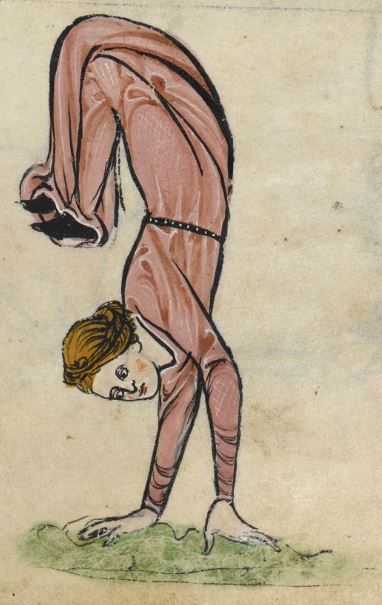
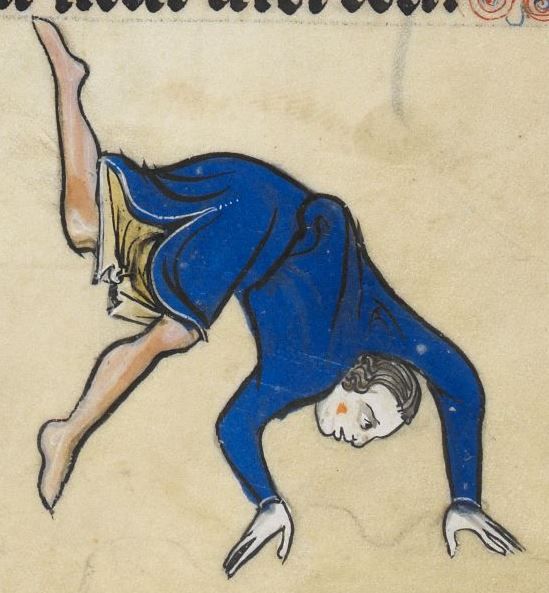
Fragment from the «Psalter of Rutland.» Medieval manuscript (circa 1260). British Library.
The plasticity of figures in court dances also changes. Movements become more fluid and controlled, reflecting the restraint of the dancers and emphasizing their status and grandeur. At the same time, the former expression remains in images of folk dances: the movements appear freer and more energetic. The bodies remain curved, and the heads are tilted back.
Attitudes toward dance in the 12th–13th centuries remained ambivalent. Church ideology continued to oppose any practices related to bodily movement that evoked the «joy of physical experience.» However, Carol managed to neutralize the threat. The circle symbolized the acceptance of a couple into the social environment and strengthened the connection between the dancers.