Categories
- Navigation
- Concept
- Death in the Medieval Mind
- The Black Death and Its Reflection in Art
- Triumph of Death
- Dance of Death
- Conclusion
Concept
Death is one of humanity’s most enigmatic and least understood subjects across the ages. The fear of the unknown—of what awaits the soul beyond the veil after leaving the earth—breeds terror. This very unknowability compels people to contemplate their ultimate destiny and whether they are worthy of a bright place among the clouds.
Death in the Medieval Mindset
In the Middle Ages, death was regarded as a transition to the afterlife. People who adhered to Christianity viewed death not as the end of life, but as a passage into another world for continued existence. This perspective influenced not only beliefs about a person’s ultimate destiny but also shaped ideas about the soul’s fate or eternal punishment. Some believed that earthly life was merely a temporary phase of a much longer journey. After this life, a Divine Judgment awaited humanity, scrutinizing their actions performed on Earth. People began to contemplate whether they were worthy of reaching a blessed place, because at the transition to another realm, all their sins and acts of repentance determined their fate. Based on these aspects, a soul could attain salvation or face punishment for its deeds. The most terrifying element, of course, was the Last Judgment itself. This event definitively determined one’s soul.
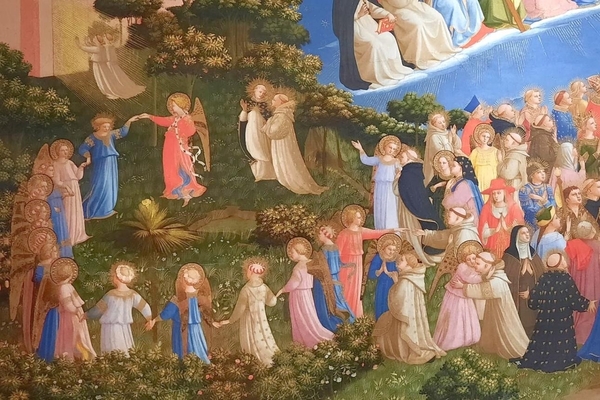
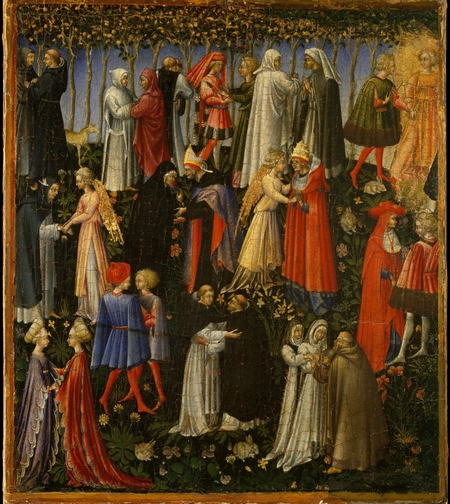
1. Not known. 2. Giovanni di Paolo — «Paradise»
The belief in heaven and hell played a crucial role in shaping conceptions of the afterlife. For people, there was a clear distinction between these realms. Heaven was a bright, serene, and noble place near God, whereas hell was its complete opposite—a place of torment and suffering for sinners. However, purgatory—an intermediate state for the soul—was also distinguished. In this state, the soul underwent purification from sins committed on earth. After this purification, a person became worthy of entering heaven. All these divisions inspired artists to create paintings and icons that reflected these perceptions of these realms.
Tadeo Di Bartolo — «Hell»
Eberhard von Graiffenklaue Missal — «Purgatory»
The Last Judgment had a profound influence on people, capturing the attention of creative individuals for developing their painting subjects. These works depicted Christ in the role of the supreme judge, determining humanity’s future.
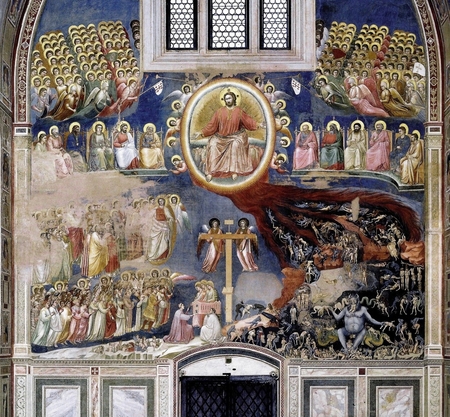
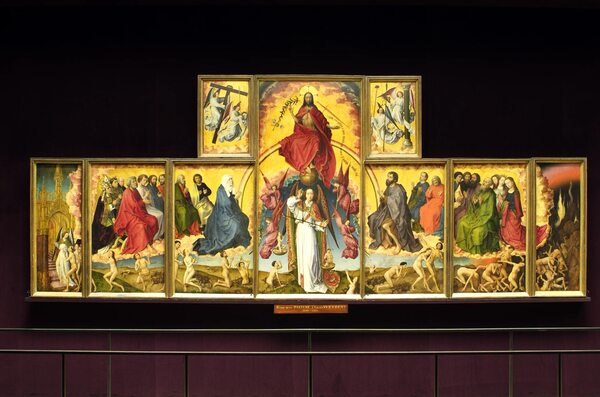
1. Giotto di Bondone — «The Last Judgment,» 14th Century. 2. Rogier van der Weyden — «The Last Judgment,» 15th Century.
Giotto di Bondone — «Last Judgment» XIV.At the center of the composition is Christ as Judge. Apostles stand on either side of him, with angels positioned slightly above them. At the very bottom are the dead, awaiting judgment to determine their placement in heaven or hell.
Rogier van der Weyden — «The Last Judgment» XV.
In the center is Christ, judging the fate of humanity. Before him, clad in white robes, stands Archangel Michael, weighing human souls. On one side are the righteous, heading toward heaven, and on the other, sinners, being dispatched to hell.
These paintings vividly illustrate the process of the Last Judgment for souls diverging in different directions.
The Black Death and its Reflection in Art
One of the most tragic events in Medieval Europe was the plague epidemic (14th century), also known as the «Black Death.» It swept across Europe between 1346 and 1352, resulting in a massive loss of life. Overall, the pandemic claimed approximately 30–50% of the population. It spread rapidly through the populace, moving not only from city to city but also crossing into neighboring countries.
Pieter Bruegel the Elder. «The Triumph of Death,» 1562.
Following the loss of a significant number of people, the population lived in constant fear of a renewed outbreak. Sudden deaths deeply affected the crowd. They began to realize that human life was fragile and that death did not discriminate based on age—it took everyone: the wealthy, the poor, the old, or the young.
The epidemic had a profound impact on people’s religious consciousness. The population lacked the necessary education to determine the cause of the disease’s spread; therefore, the only explanation available for such a tragedy was the perception of the plague as divine punishment. They believed it was a scourge for the sins of humanity. These conclusions intensified people’s fear of death, the Last Judgment, and the hell awaiting them with eternal torment.
This upheaval was reflected in art. It contributed to the proliferation of themes where death was no longer merely an inevitable event, but a triumphant force. Following such events, death was a jubilant victor, sweeping away half the population. She could not be bribed, deceived, or begged for mercy; she reigned and claimed lives indiscriminately, at any time.
The Triumph of Death
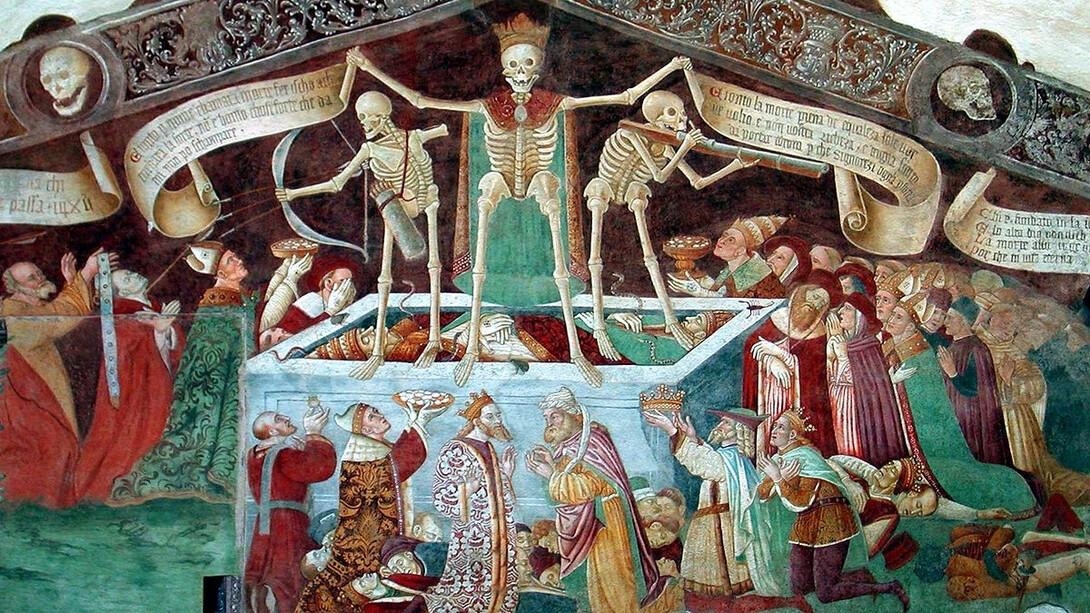
The theme of the «Triumph of Death» is prevalent in European art. In this subject matter, death is depicted as a powerful force capable of destroying all living people, regardless of their status or age. This theme became particularly popular against the backdrop of the Black Death pandemic, which claimed millions of lives.
Triumph of Death
At the center of the fresco is a skeleton—Death, seated astride an emaciated horse. In its hand, it holds a bow from which it shoots arrows at people, showing no distinction regarding which social strata they belong to. Under the animal’s feet lie the corpses of a king, a bishop, and others. This vividly illustrates that Death, compared to all mortals, is the only leader who triumphs in its power and demonstrates strength by inflicting it upon the people.
The most compelling element of this painting is the depiction of societal strata on either side. The wealthy are positioned on the right. They calmly enjoy their carefree and prosperous lives, seemingly unaware that death is racing toward them mere meters away. On the other side—to the left—are the poor, who appear to be drifting toward their demise simply to avoid the suffering of destitution.
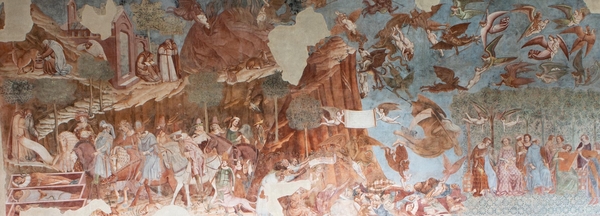
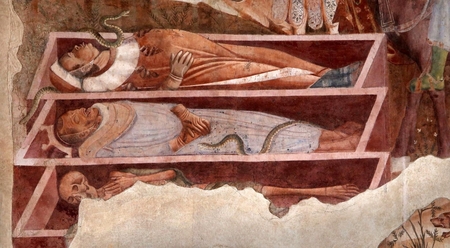
Triumph of Death
On the fresco, Death is depicted as a woman with massive demonic wings and scythe in her hands. She flies toward young ladies, already having raised her weapon. Below the painting, like a gorge, lies a crowd of bodies, while above them, angels and demons fly, claiming the souls of the deceased.