Профиль и анфас: почему египетский человек смотрит на нас одним глазом
Визуальное исследование о логике египетского канона
Contents
- This is not a mistake
- Head Profile: The most recognizable contour
- Frontal Eye: The complete eye symbol
- Frontal Shoulders: Width, strength, stability
- Leg Profile: Stride, direction, foot symbol
- Assembly: Grid and the «full body»
- Boundaries of the Canon: Amarna and Roman Egypt
Conclusion List of Sources Image Sources
Introduction
The head is in profile, the eye and shoulders are frontal, and the legs are again in profile. The Egyptian figure combines several viewpoints—and it is precisely this combination that keeps it instantly recognizable.
Why does an artist choose a specific viewpoint for each body part? This study examines the canon as a method for making an image clear, stable, and functional for its intended purpose.
The Key Question
Why does the canon connect precisely these perspectives—and how does this choice relate to the image’s function?
Hypothesis
The composite perspective helps showcase each body part from its most characteristic angle. In funerary art, this completeness can be linked to the concept of preserving the individual and their capacity to act after death.
Material and Scope of Study
The focus is on reliefs and paintings. Sculpture is included for comparison: it possesses different spatial possibilities, meaning a frontal statue cannot be literally equated to a composite figure on a plane. The analysis proceeds from individual body parts to the system of proportions and its variations.
01. This is not an error
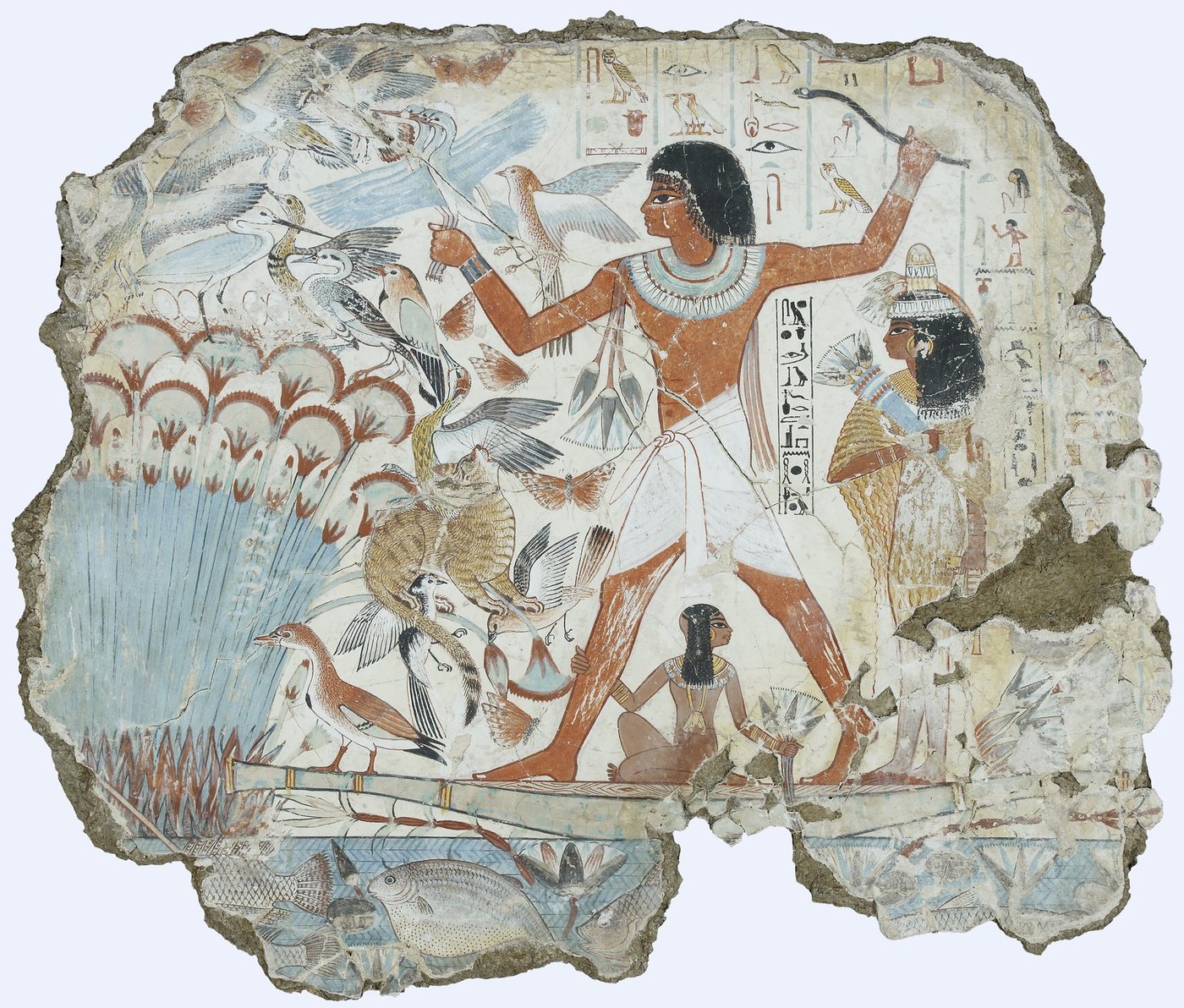
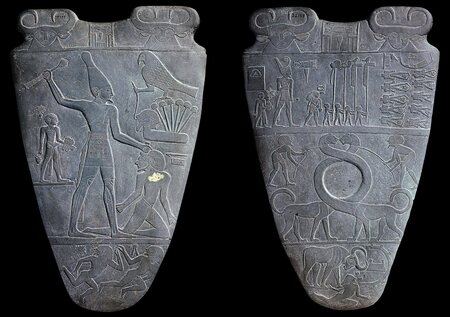
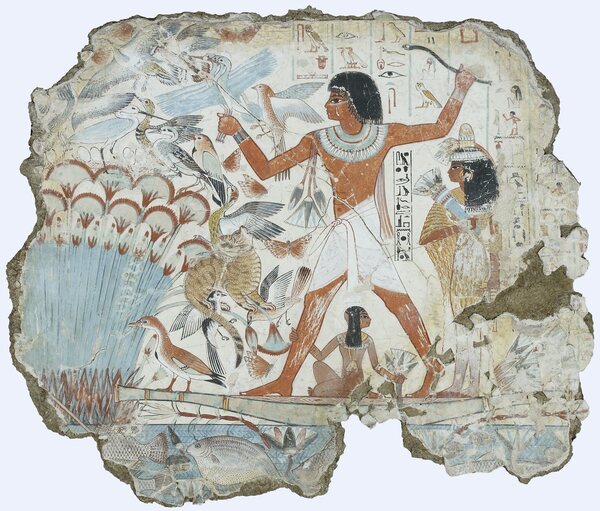
In Egyptian reliefs and paintings, figures often combine multiple viewpoints. This is visible on the Palette of Narmer, in scenes from the tomb of Nebamun, and on funerary papyri. This convention was maintained for centuries, although it varied depending on the era, genre, and the character’s role.
Observation and Convention
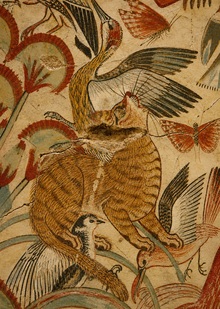
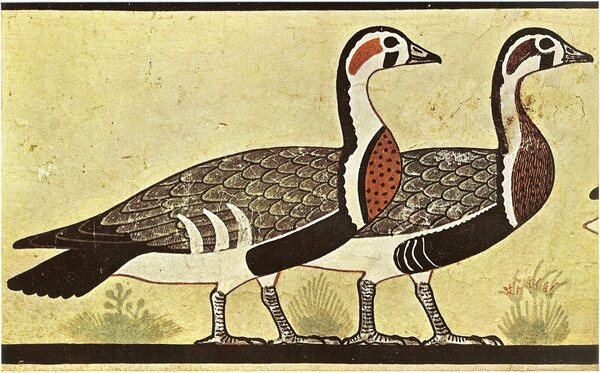
The «Geese from Medum» illustrate how attentively Egyptian artists observed nature. Therefore, the conventionality of the human figure cannot be explained by a single flaw in skill—each depiction served a different artistic purpose.
Heinrich Scheffer, in his book «On Egyptian Art» (1919), examined the depiction through knowledge of the subject’s characteristic properties. This approach is connected to the term «aspectiva, ” developed by Emma Brunner-Traut: the subject is constructed from its most expressive sides, rather than from a view taken from a single, fixed point.
Where Viewpoints Appear
The neck connects a profile head with a turned shoulder; the waist joins a frontal torso with the direction of the legs. These transitions make the composite structure of the figure noticeable. The artist aims to maintain the recognizability of the parts rather than aligning them with a single optical projection.
Canon selects the angle for each body part in which it is most clearly readable.
Two Depiction Methods
On the left is the Narmer Palette. The human figure connects the head and feet profile with a turned shoulder.
On the right is the «Geese of Medum.» The outlines of the birds are conveyed through observation of their natural form. These are monuments from different eras; the comparison illustrates a range of artistic objectives, not the work of the same masters.
Egyptian Museum, Cairo. Photo source: Wikimedia Commons.
02. Head Profile: The Most Recognizable Contour
The profile clarifies the facial contour: forehead, nose, lips, and chin are defined by a single line. For a two-dimensional image, this is an economical and expressive way to delineate the head.
A frontal face can also be represented schematically. Therefore, the choice of a profile should be understood as a preference for a specific convention, rather than a technical impossibility of depicting the face head-on.
Contour and Direction
The profile connects the head to the action: the character is turned toward a conversational partner, an offering, or the next scene. The direction can change with the composition. Both illustration and hieroglyphic writing utilize a similar logic of a clear silhouette, but not all facial features and their parts are depicted in profile.
Left — Jepu. Fragment of a mural, c. 1390–1352 BCE. Brooklyn Museum, New York.
Right — «Nebamun Hunting.» c. 1350 BCE. British Museum, London. Photo source: Wikimedia Commons.
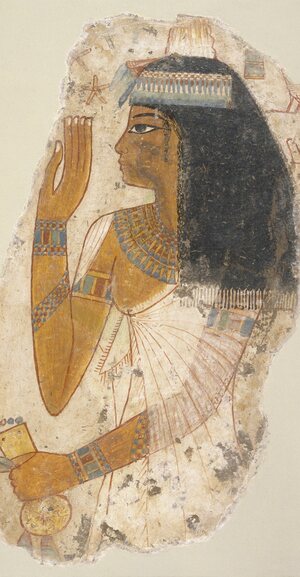
When the Face Faces the Viewer
Front-facing figures, such as the depictions of Hathor and Bes, are a prime example. Here, a direct address to the viewer becomes a powerful stylistic device. These examples demonstrate that while the profile is a persistent preference, it is not an absolute prohibition against other angles.
The following three photographs are presented in sequence:
- Capital with the face of Hathor. Cleveland Museum of Art.
- Figurine of Bes. Metropolitan Museum of Art, New York.
- «Spare Head.» Kunsthistorisches Museum, Vienna.
The sculptural head is included for comparison: this volumetric object allows viewing from multiple sides and is not a direct exception to the conventions of two-dimensional drawing.
03. Frontal Eye: The Complete Eye Symbol
In the profile head, the eye is often depicted as if turned toward the viewer. Its almond shape, pupil, brow, and eyeliner maintain a clarity that an anatomical side profile would make less apparent.
The Eye as a Recognizable Sign
This technique connects the contour of the head to the complete sign of the eye. It can be read without shading or the need to reconstruct facial volume. The artist selects an informative aspect of the detail while preserving the overall direction of the head.
Gaze and Presence
In Egyptian funerary art, the gaze is connected to the life and action of the image. The inlaid eyes of sculptures and amulets in the shape of the Eye of Horus help illustrate this connection. However, they belong to different categories of objects: the comparison shows the significance of the eye rather than proving the sole reason for the composite perspective.
The Eye of Horus is associated with restoration and wholeness. Within the research hypothesis, the frontal eye can be understood as a means to make the gaze clear and continuous.
The head sets the direction of action. An open eye maintains the clarity of the gaze. A single figure merges the movement within the scene and the sensation of presence.
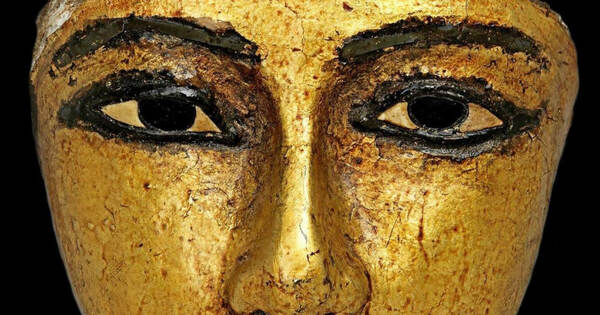
The first photograph above is a detail of the statue of Nefertiti. The outlines and the inlay of the eye are clearly visible. Egyptian Museum, Cairo.
The second photograph is an amulet shaped like the Eye of Horus. The eye has been transformed into a standalone symbol. The Metropolitan Museum of Art, New York. Photo source: Wikimedia Commons.
04. Shoulder-on View: Width, Strength, Stability
The turn of the shoulders allows for the depiction of torso width and makes both arms distinct. If the head establishes the contour, the torso defines the stable axis of the figure.
Width and Stability
A frontal torso preserves a clear silhouette of the upper body. Comparing this to round sculpture reveals a similar emphasis on axis and balance, but the methods of representation differ: the statue has real volume, while a relief or a painting has limited depth or a flat plane.
In one common grid variation, the male figure has about five squares across the shoulders and two and a half at the waist. These measurements help compare proportions; narrow shoulders by themselves do not prove a low character status. See Source 9.
Transition to the Legs
At the waist, the turn of the torso connects with the direction of the hips and legs. The composite angle allows for the retention of both body width and its movement within the scene.
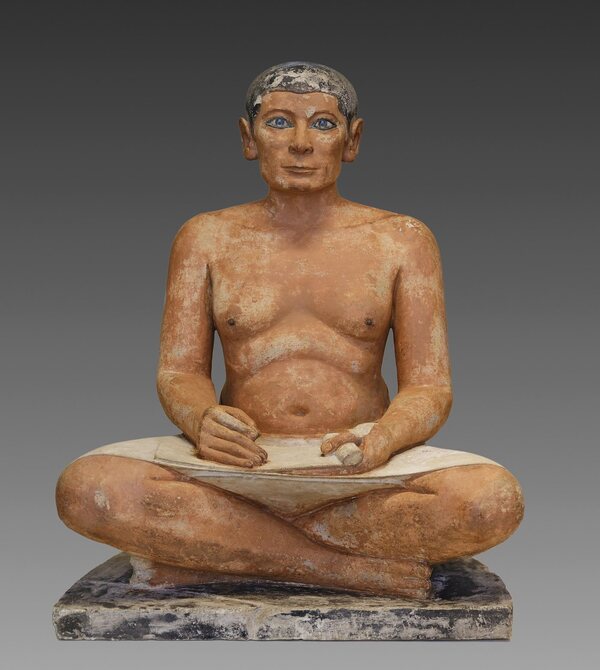
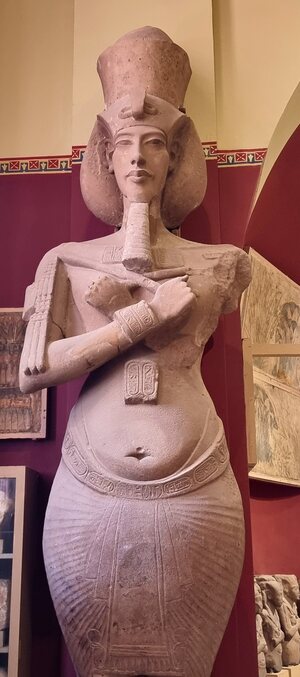
The detail above is the torso of the «Seated Scribe.» In the pair of photographs below: on the left is the complete statue; on the right is the statue of Amenhotep IV (Akhenaten). The different proportions show that frontality does not dictate a single body form. Louvre, Paris. Source: Wikimedia Commons.
05. Foot Profile: Step, Direction, Foot Sign
The profile emphasizes the knee, calf, heel, and arch of the foot. From this angle, the stride and direction of movement are especially clear.
How the Stride is Indicated
In frescoes and reliefs, the legs are often directed toward the same point as the head and the action of the scene. A forward-thrust leg makes the pose active, even when the figure maintains strict stability.
This conventionality is noticeable in the depiction of the feet: a characteristic contour may be repeated instead of sequentially showing the differences between the near and far leg. This is a choice of clear sign rather than a literal record of what is visible from one point.
Drawing and Sculpture
On a flat surface, the stride is denoted by silhouette. In sculpture, it exists in volume, and the frontal axis may be maintained. Therefore, the triptych and the fresco are compared as two ways to make the leg position expressive, not as identical compositions.
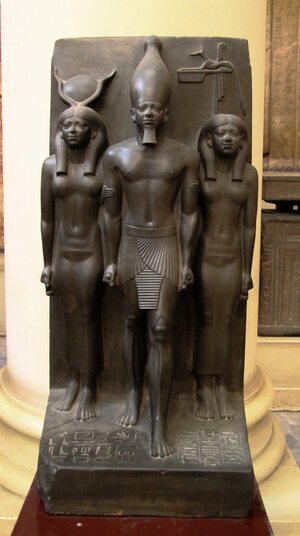
Left — Mikerin’s Triptych. Egyptian Museum, Cairo.
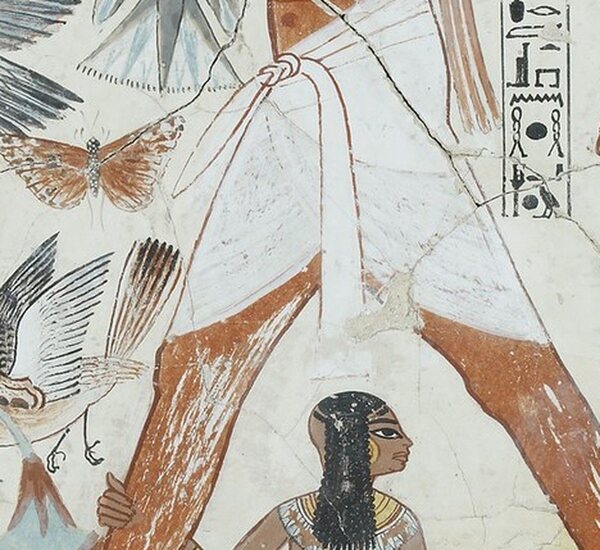
Right — Fragment of «Nebamun Hunting.» Profile of the legs and the direction of the stride. British Museum, London. Photo source: Wikimedia Commons.