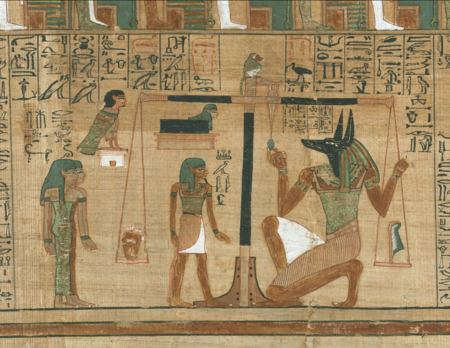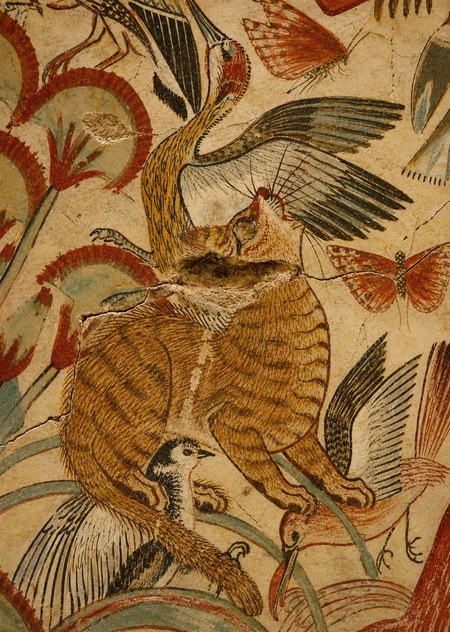
«I ascended to primordial time, became Hepri, grew like a plant, and assumed the form of a turtle.»
«Книга мёртвых» Заклинание 83. Перевод с английского.[1]
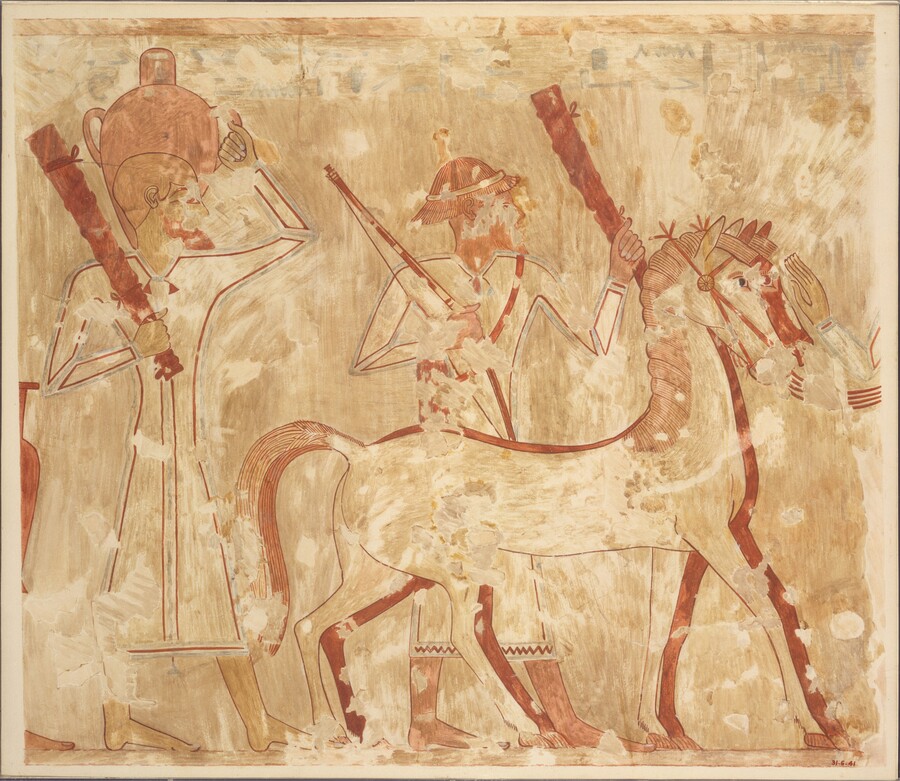
Nina de Garis Davis. «Syrians with Horses, ” Rehmir Tomb. Facsimile; original—c. 1504–1425 BCE.
Why do animals have a place in the tomb?
I have long been interested in the theme of death and how people conceptualized life after it. Because of this, I focused my attention on the paintings in ancient Egyptian tombs. The animals within them struck me as particularly fascinating: they could be part of scenes depicting hunts and nature, appear alongside the deceased, or be connected to divine imagery. I wanted to understand why animals held such a prominent place in funerary art and how their meaning shifted from one tomb to another.
Animals are depicted in ancient Egyptian tombs in a wide array of scenarios: hunting, farming, domestic scenes, and processions of offerings. Their role shifts depending on the narrative. Therefore, it is insufficient to assign a single, predetermined meaning to each creature; it is crucial to observe what the animal is doing, how it is integrated into the composition, and who is nearby.This study focuses on the funerary depictions of animals in Ancient Egypt. Its time frame spans the 26th–13th centuries BCE—from the tombs of Nefermaat and Itet in Medum to the New Kingdom monuments in Thebes. This collection does not encompass all of Egyptian culture. Instead, it includes scenes from various tombs and eras where the animal actively participates in the action and where the context can be verified through museum descriptions. Comparing these monuments allows us to observe differences and similarities without reducing the work to a single painted frieze.The visual material features not only images of animals but also scenes with people, landscapes, and objects. The surrounding context helps determine whether the episode relates to hunting, husbandry, offering, or ritual. Thus, the focus is not on the presumed symbolism of an individual species, but rather on the animal’s function within the entire composition of the tomb.
The material is structured thematically. It first examines the hunt and encounters with the wild, followed by birds, husbandry, and offerings. Subsequently, animals appear in processions from other countries, becoming part of a narrative about gifts and power. The final section is dedicated to the cat striking the snake and the defensive meaning of the scene. Thus, the narrative moves from everyday human interaction with nature to funerary concepts of the world after death.
Information regarding the monuments, dating, and subject matter is cross-referenced with the catalogs of the Metropolitan Museum of Art and the British Museum. These sources help establish what is depicted and what is known about the object; the conclusion about the animal’s role is formulated separately, based on the composition. Facsimiles—copies of ancient paintings made by artists—are also included in the visual sequence: the captions distinguish between the date of the original and the date of the copy. All originals were created before the 18th century; the 20th-century facsimiles serve as reproductions and do not alter the chronological boundaries of the theme.
Research Question: How did depictions of animals help portray the deceased’s life—from encounters with the wild to prosperity, offerings, and protection?
The main point is that animals in tombs do not carry a single, universal meaning. In hunting scenes, they relate to the wild; in domestic scenes, they signify food and offerings; in processions, they represent distant connections and power; and in Senegem’s tomb scene, the cat acts as the deceased’s protector. Their meaning unfolds through action, their placement within the composition, and their proximity to other figures.
Hunting: the encounter between human and beast.
From a hunting scene discovered in the Kheti tomb, a small detail remains: a dog biting the leg of a desert animal. The dog’s head is discernible to a reasonable degree, but the animals' bodies and the rest of the composition are lost. Therefore, while this fragment allows us to determine the action depicted, it is impossible to reconstruct the entire scene. The relief originally came from the decorated entrance passage of the tomb; the hunt was part of the space created for the deceased [2].
Why were scenes of animal capture depicted in the burial site? Hunting scenes reveal how closely the tomb’s decoration was connected to earthly life. The walls featured elements of nature and human pursuits, including interaction with animals. In such an environment, hunting could have been part of the image of a desired existence after death—a world where familiar activities persisted and the ability to acquire necessities remained. However, regarding the Kheti fragment, this is a general interpretation of the funerary context: the fragment itself does not provide evidence to assign a special protective role to the dog or to consider it an image of a deity.
At the beginning of the study, this example presents animals as participants in the hunt: the dog aids in capturing the prey, and the other beast becomes its target. Subsequently, the more complete compositions in the scenes from the Ramayana and the Menna allow us to examine how the hunt connects with the surrounding world and concepts of afterlife existence. From these scenes, we can move to the following question: how were the captured animals integrated into the household and the offerings intended to sustain the deceased?
Relief from the Khēti Tomb, TT 311. Middle Kingdom, circa 2051–2000 BCE. Metropolitan Museum of Art.
The hunting scene preserved in the Raemkay Chapel is significantly more complete than the one in the Kheti Tomb. On the south wall, an entire environment can be observed: horned animals stand among plants and uneven soil, while hunters and dogs operate nearby. In the lower hunting row on the right, a person restrains an animal with a rope. Furthermore, many animals appear calm—they are standing or lying down, and the entire composition does not turn into a frantic chase. The Metropolitan Museum notes that the favorable, abundant depiction of desert nature is particularly noticeable here [3].
This depiction is important for understanding the funerary meaning of the image. The desert outside the fertile Nile Valley was both a habitat for animals and a space for necropoleis. In the museum description, the calm nature of the scene is connected to its location inside the chapel: the world surrounding the deceased is presented as a favorable environment. Hunting is included in this world alongside plants, resting animals, and human activity [3].
«The South Wall of the Raemkai Chapel.» Old Kingdom, c. 2446–2389 BCE. Metropolitan Museum of Art
Below the hunting scenes in the photograph, boats with rowers and canopies are visible. The inscriptions connect their movement to the «Beautiful West”—a space associated with the world of the deceased. Therefore, the juxtaposition of the two subjects helps to read the entire wall: above the boats undertaking their journey to the afterlife, nature’s life continues. This provides a basis for considering the hunt in connection with the funerary purpose of the chapel, although no definitive symbolic meaning can be confidently ascribed to each depicted animal here [3].
Compared to the Kheti fragment, this wall allows for a further observation: how a specific interaction between humans and animals enters the broader composition of the tomb. Here, it is no longer just the capture of prey that is important, but also the surrounding space that connects natural abundance with the deceased’s passage to another world. In Menes’ hunting scene, this connection is expressed differently—through papyrus thickets filled with birds and fish.
Norman de Garis Davis. «Man Carrying a Hedgehog and a Hare,» Tomb of Khnumhotep, Beni Hasan. Facsimile of a Middle Kingdom painting, circa 1897–1878 BCE.
The frescos in the tomb of Khnumhotep at Beni Hasan depict a stage of human interaction with wild animals: a man is carrying a hedgehog and a rabbit. Here, the focus shifts from capturing the animals to transporting them. In the sequence of investigation, this scene becomes a transition from hunting to the theme of abundance: the animals are presented as provisions that the man can command. However, the fragment itself does not allow us to assert that they are carried specifically as a funerary offering [4].
In the tomb of Menna, the space is different. Instead of an open desert, there are papyrus thickets and water. His tomb facsimile depicts Menna twice: in one part of the scene, he hunts birds; in another, he catches fish with a spear. Members of his family are nearby. Surrounding them are birds, fish, a crocodile, and a small cat climbing a stalk, trying to catch a bird [5].
If we look only at the hunter himself, one might conclude that the scene is about recreation or prey. But the swamp occupies nearly all the space and prevents us from forgetting the life surrounding him. The same person appears twice because the composition connects different actions rather than freezing a single random moment. Consequently, the scene does not show an isolated episode, but rather a desired, complete world that must remain accessible to the tomb owner.
The composition helps us see this literally. Menna occupies a prominent place among the papyrus and animals, but he does not displace them: the thickets and water are filled with small figures. The gaze moves from the hunter to the birds, from the birds to the cat, and then to the fish underwater. Therefore, what is important is not only the status of the tomb owner, but also what surrounds him. The man is situated within a large natural space, not separate from it.
Nina de Gares Davis. «Menna and His Family Hunting in the Swamps.» Facsimile from 1924; original—Menna’s Tomb, TT 69, XVIII Dynasty.
The museum description invites the viewer to read this hunt not just as entertainment. The swamp was considered a special, liminal environment, and the wild creatures within it were associated with the forces of chaos.
«By defeating these enemies, Menna helped maintain the order of the Egyptian world» [5]
This idea explains why the hunting scene might have had a funerary meaning: it depicted not only a successful hunt but also the restoration of order. This is a museum interpretation, not a literal annotation by the ancient artist. Therefore, it is better to view it as one way to read the image, rather than as the only possible explanation.
Comparing Khety and Men shows two different representations of nature. For Khety, it is the immediate confrontation between the dog and the prey. For Men, it is a vast swamp where hunting is combined with fishing and the presence of family. In both cases, the animals bring the scene to life, but the composition suggests different emphases: struggle and harvest in one example, completeness and renewal in the other.
These scenes set the starting point for the entire study. Nature in the tomb is not separate from the deceased’s life; it is depicted as a space where movement, hunting, and human interaction with animals continue. This connection changes further—from the hunt to husbandry and provisions.
From Extraction to Reserves.
Another option depicts the net trap set for birds in the tomb of Khnumhotep. People are pulling the net containing waterfowl; the action is distributed across the entire composition rather than being focused on a single hunter. The birds are not mere background elements—it is their sheer number that creates the sensation of a successful catch and abundance. Unlike the hunting scene of Menes, this episode illustrates collective labor [6].
Nina de Garis Davis. «Catching Birds with a Net, ” Tomb of Khnumhotep, Beni Hasan. Facsimile of a Middle Kingdom painting, c. 1897–1878 BCE.
In the tomb of Nefermaat and Iset at Meidum, a series of geese is depicted. At first glance, this is an entirely different scene—there is no chase or struggle here. The birds stand side-by-side, and the artist has meticulously rendered the color and texture of their feathers. However, the fragment was part of a larger composition: above it was a scene where people capture birds with a net and bring them to the tomb owner [7].
Therefore, the geese are best viewed in conjunction with the surrounding narrative. They are connected to living nature, yet simultaneously integrated into human order: the birds are caught, accounted for, and presented. The image does not require a complex «hidden code.» Its meaning unfolds through the adjacent actions—the capture and the offering. The natural resource becomes part of the deceased’s provisioned life.
There is also a visual distinction between the geese and hunting animals. The geese are arranged in a neat line, and their coloring is repetitive, but the details of the plumage and posture are not identical. The painting preserves the artist’s keen observation while simultaneously submitting the birds to a clear order. Thus, individual living creatures are transformed into a component of the composition related to husbandry and offering. This is a strong example of how realistic detail and conventional pictorial organization can work in tandem.
Charles K. Wilkinson. Facsimile of the «Geese» paintings, the tombs of Nefermaat and Itet, Meidum. Original — 4th Dynasty, circa 2575–2551 BCE.
A similar connection between animals and labor is visible on the east wall of the Raemkai chapel. Nearby, figures depicting people harvesting crops, birds, and representations connected to the deceased’s estates are displayed. This is not just a single domestic scene, but an image of the farm as a system: the field yields grain, people work, and the products become part of what the deceased possessed. Animals are integrated into this order alongside plants and human activities [8].
«The East Wall of the Raemkai Chapel.» Old Kingdom, circa 2446–2389 BCE. Metropolitan Museum of Art.
The scene in Nakhth’s chapel illustrates the next step: not just the finished resource, but the labor that creates it. The field is divided into several registers. Below, people prepare the soil; above, other tasks related to sowing, harvesting, and processing crops take place. Nakhth himself observes the fields from under a canopy. The metro museum notes that the sequence of scenes progresses from soil preparation to grain processing.
The museum directly links these field scenes to funerary rites:
«These scenes are connected to the production of offerings necessary for Nakhtu’s existence in the afterlife» [9]
It is now clearer why ordinary labor is shown in such detail on the wall. The field doesn’t merely create a beautiful backdrop; it provides the seed, people process it, and the resulting products become gifts. The quote specifically refers to this sequence of work visible in the image.
In the scene of Naqt, the direction of reading is also important. The museum description notes four registers and a sequence of activities, from soil preparation to grain processing. Naqt sits under a canopy, observing the fields. This presence connects the depicted labor to the person for whom the funerary ritual is being created. We are not seeing abstract «abundance,» but rather an entire order of actions, with a distinct place for every stage.
Norman de Gires Davis and Lancelot Crane. Scenes from the Nacht Chapel, TT 52. Facsimile from 1908–1910; original—18th Dynasty.