This project is a student or research project from the HSE Art and Design School. This project is not commercial and serves educational purposes.
Navigation
- Research Concept
- Justification for Topic Selection
- Introduction of the Key Research Question and Hypothesis
- Principles for Selecting Visual Material
- Principles for Selecting Research Sources
- Reflection as an Illusion of Space
- Reflection as a Symbol
- Reflection as a Tool for Creating Illusion
- Conclusion
- Bibliography and Image Sources
Research Concept
Mirrors, during the 15th–17th centuries, cease to be mere decorative elements of an interior and transform into distinct tools in the artist’s hands. With them, supplementary spaces are created, the unseen is revealed, and the viewer’s attention is directed. During this era, artists developed a keen interest in experiments with perspective, the depiction of space, and the capabilities of human sight.
In the Renaissance, creators aimed to convey the surrounding reality with fidelity. The mirror allowed for the demonstration of virtuosity: depicting objects that could not be seen from the primary viewpoint. Furthermore, the reflection enabled the complication of composition—showing multiple perspectives, connecting different parts of space, and generating visual puzzles.The mirror was used not just to represent reality. Reflection played a vital role in symbolism. It could be associated with purity and truth, yet simultaneously imbued with meanings of vanity, pride, and sinful attachment to earthly beauty. This is precisely why the mirror played a crucial role in conveying philosophical concepts to the viewer.In the 17th century, artists became more drawn to how the viewer perceived the painting and where they were positioned relative to the depicted space. The reflection in a mirror offered the opportunity to include figures who existed outside the frame.
Rationale for Topic Selection
The choice of a visual research topic stems from my interest in Western European art and its artists. I was drawn to how artists from the 15th to 17th centuries reflected illusions and hidden meanings in their paintings. I became particularly interested in the symbolism of the mirror and wished to study this topic in greater depth.
In my opinion, studying the works from these eras helps one understand the motives and meanings embedded in the art of that time.
The objective of this study is to explore the artistic and symbolic significance of reflection in the works of the 15th–17th centuries.
How did artists use reflections to convey hidden meanings and create visual illusions?
Hypothesis
The mirror becomes more than just an interior design element; it carries religious, symbolic, and philosophical weight. Through it, the reliability of human perception of the world and its surroundings is questioned.
Principles of Visual Material Selection
The research material was selected based on chronological and thematic principles. The foundation consisted of Western European paintings from the 15th–17th centuries, where the mirror and its reflection play a role in composing the image and establishing supplementary meaning. The material for this study includes not only pieces featuring mirrors but also a specific function within each one: creating illusions, expanding space, or showcasing objects and figures located beyond the picture frame.
Source Selection Principle for Research
Sources were selected based on their level of reliability and relevance to the research topic. Priority was given to official museum websites, academic publications, and art critics’ articles. Key criteria included authority, the presence of confirmed information about the works, and a direct examination of the role of the mirror and reflection in 15th–17th-century art.
Reflection as Spatial Illusion
One of the most striking examples of depicting figures existing outside the frame is found in Jan van Eyck’s painting.
Jan van Eyck — «The Arnolfini Portrait» (1434)
The work features a woman and a man inside a wealthy home. «It is likely Giovanni di Nicolao d’Arnolfini, an Italian merchant who worked in Bruges, and his wife.» On the back wall between the figures is a small convex mirror. It reflects a space that the viewer cannot see from the main perspective. In the mirror, one can make out people standing in front of the depicted scene.The mirror allows the artist to show multiple viewpoints simultaneously within one space. The viewer sees the characters from the front, and in the reflection, their backs. This technique creates the sensation that the space continues beyond the confines of the painting.
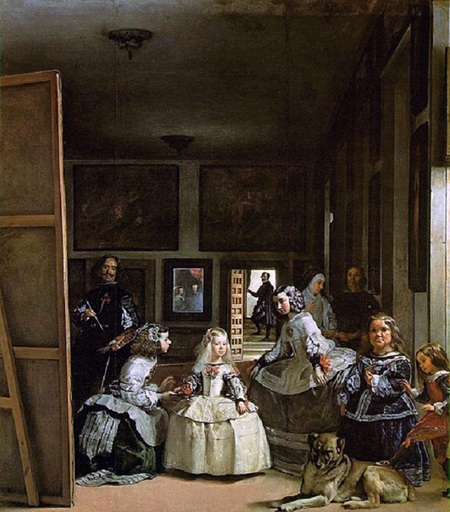
Another vivid example of spatial expansion is the painting «Menippov.»
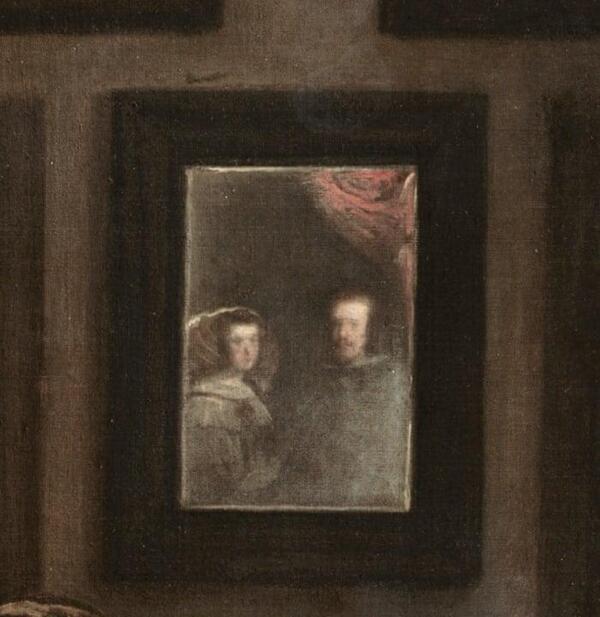
Diego Velázquez — «Las Meninas» (1656)
The most famous painting in the Prado depicts Infanta Margarita, daughter of Philip IV, surrounded by her ladies-in-waiting, Maria Agustina de Sarmiento and Isabela de Velasco; two court jesters, María Bárbola and Nicollito Pertusato, and a mastiff dog.The small mirror on the back wall is particularly significant for studying reflections. In it, the figures of King Philip IV and Queen Mariana of Austria can be seen. It should be noted that they are not explicitly part of the painting’s composition.The mirror creates an unusual spatial effect by showing people who were likely standing in front of the depicted scene. This suggests that the monarchs were in the same space as the viewers. However, this is only a theory.This reflective effect conveys a sense of space extending beyond the canvas.
Petrus Christus — «Saint Eligius in His Workshop» / «Goldsmith in His Shop» (1449)
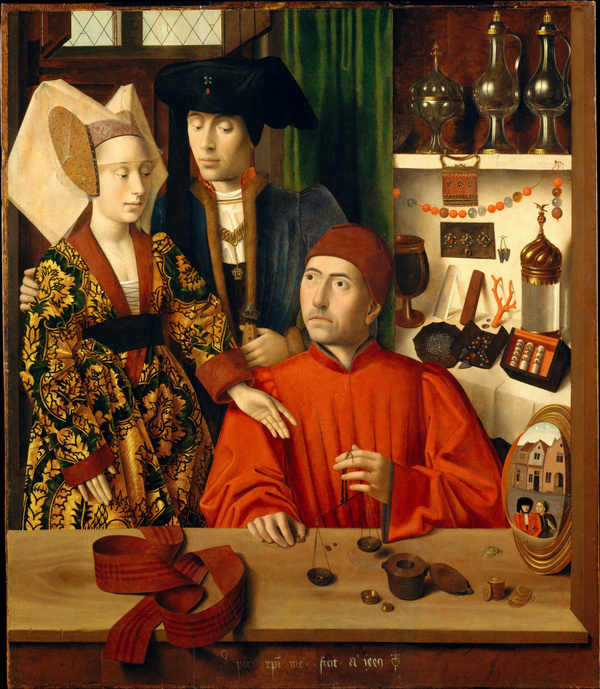
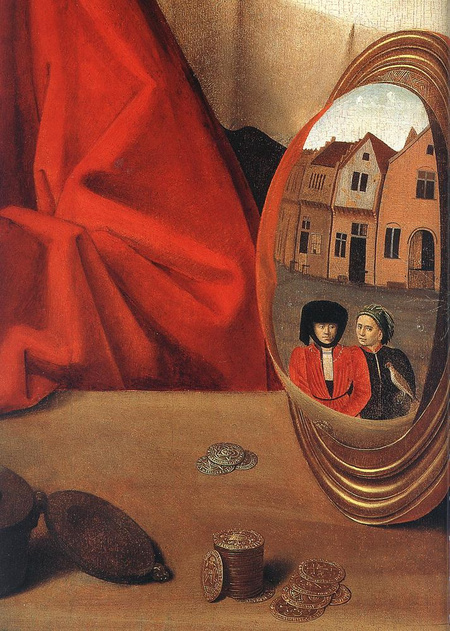
The painting by Petrus Christus was created in 1449. It depicts a jeweler working in his workshop. Standing before him is a richly dressed young couple, most likely selecting a ring. Surrounding them are jewelry pieces, gemstones, scales, and other tools of the trade.Attention is drawn to a small convex mirror located in the lower right section of the painting. It reflects the street space in front of the workshop and two young men, one of whom has a falcon. This reflection allows the viewer to see what lies outside the frame. In this way, the mirror connects the interior of the workshop with the exterior urban space.The reflection serves not only a spatial but also a symbolic function. According to one interpretation, the falcon is associated with pride and greed, and the reflected passersby stand in contrast to the couple choosing an engagement ring. The mirror itself can also be seen as a symbol of vanity. However, these interpretations are not the only ones.
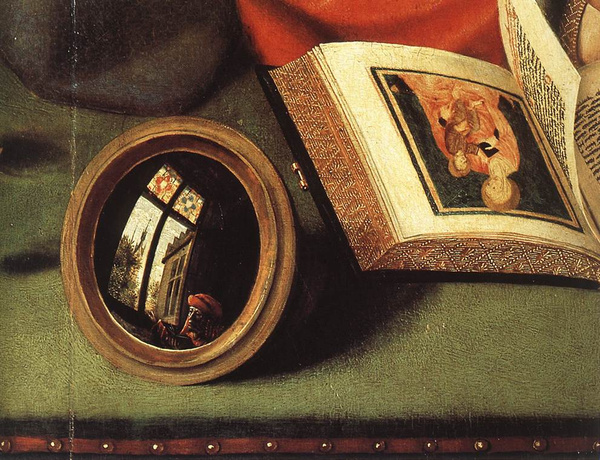
Quentin Massys — «I Changed with My Wife» (1514)
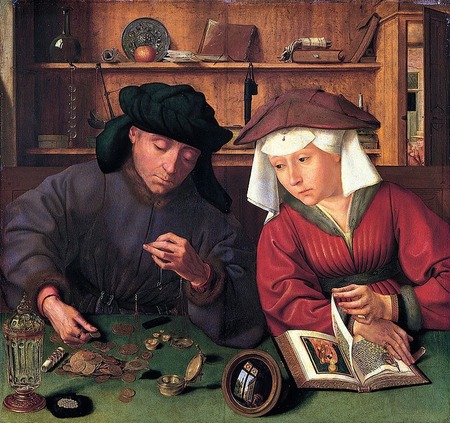
The painting, «My Wife and I,» was created in 1514. It depicts a man weighing coins, and likely his wife, who is looking at an open book. The scene takes place indoors, resembling a shop or workshop. On the table are scales, coins, jewelry, and other objects.A convex mirror located at the bottom reflects the space outside the main image, continuing the theme of spatial expansion.
Reflection as a Symbol