Navigation
I. Concept
II. Historical Reality and the Social Character of Chivalry
III. The Visual Image of Chivalry in 13th–14th Century Art
IV. The Apotheosis of Illusion: The Image of the Knight in 19th Century Victorian Painting
V. Deconstruction
VI. The Cult of the Beautiful Lady and Chivalric Feats
VII. Miniatures as a Mirror of the Courtly Era
VIII. The Ideal That Never Was: Visualizing Courtly Love in the Victorian Era
IX. The Collapse of Aesthetics
X. Conclusion
I. Concept
This visual research explores the romanticization of chivalry in European art and its divergence from reality. The ideal, striving toward a vision of noble human perfection—is merely a mask behind which a morally bankrupt world of self-interest, cruelty, and violence conceals itself. As Johan Huizinga noted: «In its aesthetic function, chivalry repeatedly reveals its inadequacy, its inability to depart from its sinful origins.» (J. Huizinga, Autumn of the Middle Ages).
Timeline
The chronological scope of the main study covers the Medieval period (12th–15th centuries). However, to create a sharp contrast between historical reality and the romantic aesthetics of knighthood, the Victorian era is examined for comparative analysis. The visual research employs biblical miniatures, paintings, and illustrations, along with material from the 19th century. It is these works that help to analyze and juxtapose the events more thoroughly.
Relevance
The relevance and core idea of this work stem from contemporary popular culture’s enduring fascination with the Medieval era. The archetype of the noble knight, first shaped in art and literature, continues to appear in books and cinema, often forming a distorted perception of the past. Understanding how and why the myth of honest and virtuous knights was created allows for a comprehensive and unclouded critical examination of historical reality. To achieve this, the study investigates the socio-economic aspects of the time—such as the principle of entailment and the lack of inheritance. Furthermore, the mechanisms by which medieval society justified brutality under the guise of religious truth and the cult of valor are actively explored. In addition to these objectives, a comparative analysis of visual sources from different eras is employed: honest and grotesque miniatures alongside aesthetic canvases from 19th-century Victorian culture.
Research Structure
The visual study has the following structure. The initial chapters explore the historical reality: the social issues of knighthood (manorialism), the brutality of war, and miniatures are analyzed and later compared with Victorian-era paintings. The subsequent chapters are dedicated to the cult of chivalric deeds. Using examples from medieval illustrations and 19th-century paintings, I will demonstrate how art romanticized knighthood and what a real soldier of that time looked like.
II. The Historical Reality and Social Facets of Chivalry.
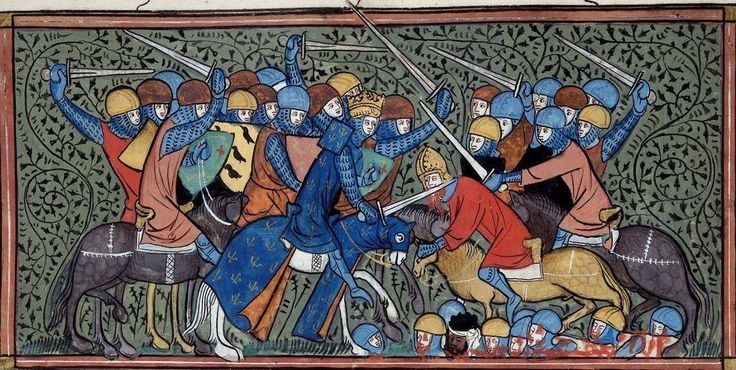
In the collective consciousness, the knight was an archetype of honor, virtue, and selfless service. However, reality was far harsher. The foundation of the knightly class was a military function that demanded the constant application of force. Furthermore, the socioeconomic standing of most knights was precarious. Due to the principle of primogeniture (transferring the entire inheritance to the eldest son), a vast number of younger sons from noble families were left without land or income. The only available pursuits for them became service, participation in wars, and Crusades. Knights joined the ranks of mercenaries, served wealthy lords, or, as often happened, committed pillaging and raids. It was these men, left only with weapons as an inheritance, who most frequently posed a threat to the civilian population. The Church approved participation in the Crusades, and killing enemies in the name of faith transformed cruelty into a pious act that granted absolution. Religion served as a propaganda tool that did not so much justify as encourage all atrocities. The blood, cold-blooded murder, and danger of war in medieval art and biblical illustrations were vividly depicted, yet presented as worthy of emulation.
III. The Visual Image of Chivalry in Art of the 13th–14th Centuries
Let us refer to the first illustration mentioned from Matsievsky’s bibliography:
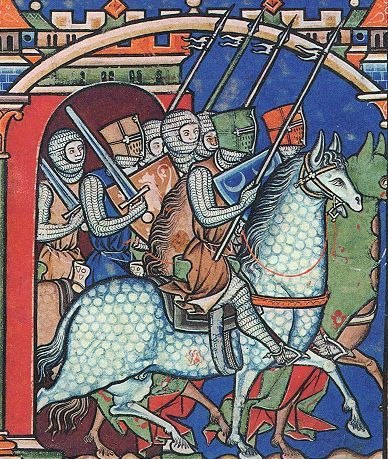
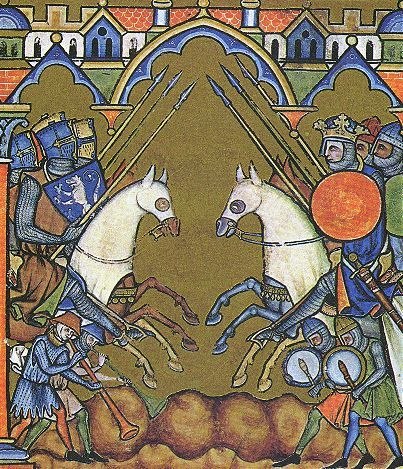
«The Bible of Cardinal Maciejski» (1240–1250)
The first miniature features a traditional military subject. The knights appear as an organized, formidable force, moving cohesively toward another army. Their faces express martial spirit, readiness, confidence, and the masculinity inherent in warriors, embodying an aesthetic ideal and canon. Coats of arms are visible on the shields. Heraldry is the visual language of nobility and high status. The artist aimed to elevate the image of the knights, showcasing their stature and dignity. The creator portrays the warriors as strong and brave. The second miniature serves as an example of a similar subject from the same biblical narrative.
This military motif and the idealization of knighthood are consistently developed by the artist throughout the entire manuscript.
Examples
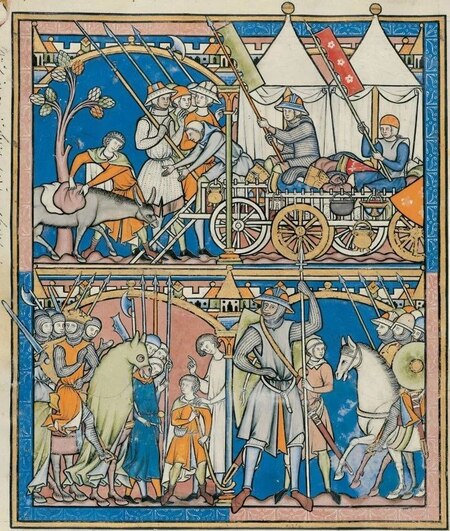
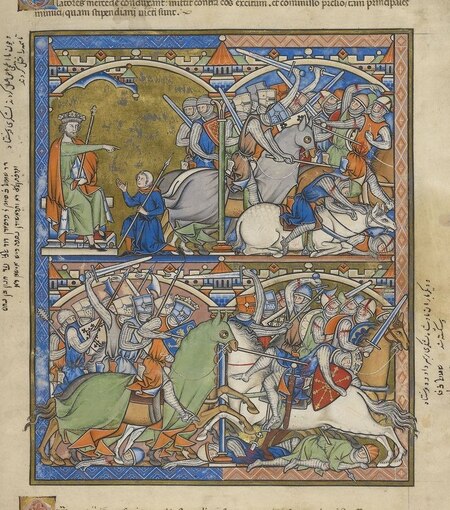
«The Bible of Cardinal Maciejewski» (1240–1250)
IV. The Apotheosis of Illusion: The Knight Figure in 19th-Century Victorian Painting
Over subsequent centuries, the harsh reality began to be forgotten and gradually faded into the past. Time slowly erased the true image of warriors and the deeds they performed from people’s memories. During the Renaissance (16th–18th centuries), knighthood, as a military institution, lost its significance, but the image of valor did not vanish. It transformed into a ceremonial symbol of honor. Nobles posed for portraits in armor without intending to fight in it, and tournaments finally became purely recreational events. The myth of nobility began to spread. In the Victorian era, European artists turned again to the image of the knight, who fulfilled his duty with dedication and high moral fervor, regaining the qualities of bravery and self-sacrifice.
A striking example is Edmund Blair Leighton’s painting, «The Accolade.» The canvas depicts a sacred, almost ritualistic moment of investiture: a beautiful, serene queen in pure white robes, a shining sword carefully resting on the shoulder of a humble youth, and a reverent silence. The ceremony wraps itself in mystery and the ephemerality of the event. The knight accepts his duty with courage and honor.