Мифы без формулы: редкие сюжеты на вазах VI века до н. э
Table of Contents
1. Concept 2. Formula for Success 3. Magic and Monsters 4. Eternal Punishment 5. Death Without a Duel 6. What’s Left Over 7. Bibliography 8. Image Sources
Concept
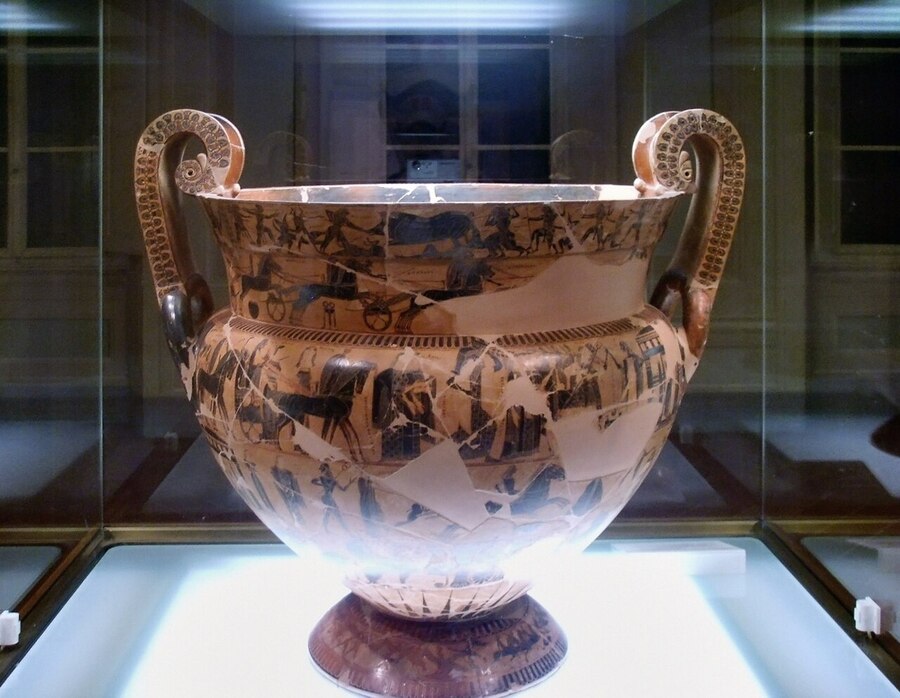
Klitios (vasopistos), Ergothymos (potter). Krater with volutes («Vase of Francois»). Circa 570 BCE. Florence, National Archaeological Museum, inv. 4209. Photo: Sailko / Wikimedia Commons.
Black-figure vase painting from the 6th century BCE preserved the earliest major collection of mythological imagery in Greek art. This collection is distributed highly unevenly. The deeds of Hercules, Dionysian processions, and several episodes from the Trojan cycle recur on hundreds of vessels, whereas many storylines well-known from Homer and Hesiod appear on solitary vases. Even the «François Vase,» which gathered several mythological cycles on a single krater, does not negate this disproportion. These rare scenes form the subject of study—they reveal the limits of the pictorial language, boundaries invisible within the material of popular motifs.
Key research question: Why did myths familiar to Greeks of the Archaic period through epic poetry rarely appear on vases, and how did the vase painter construct a scene for which there was no ready-made template?
The question pertains specifically to the imagery. The rarity of the subject matter cannot be explained by a lack of knowledge of the myths: Polyphemus’s blinding, Circe’s transformation, and Sisyphus’s stone are described in the «Odyssey,» while Prometheus’s punishment and Zeus’s battle with Typhon are detailed in the «Theogony.» These texts existed, but no established visual trope emerged.
The hypothesis is that a narrative remains obscure when it lacks a recognizable visual formula—that is, a discernible pattern of figure arrangement that can be repeated without further explanation.
The silhouette technique uses a dark silhouette against a light background and best conveys the collision of two bodies or a measured procession. Punishment, witchcraft, suicide, and sacrifice do not fit these schemas. Therefore, each such scene becomes a distinct experience: the artist combines several narrative moments, names the characters, or borrows composition from a popular motif.
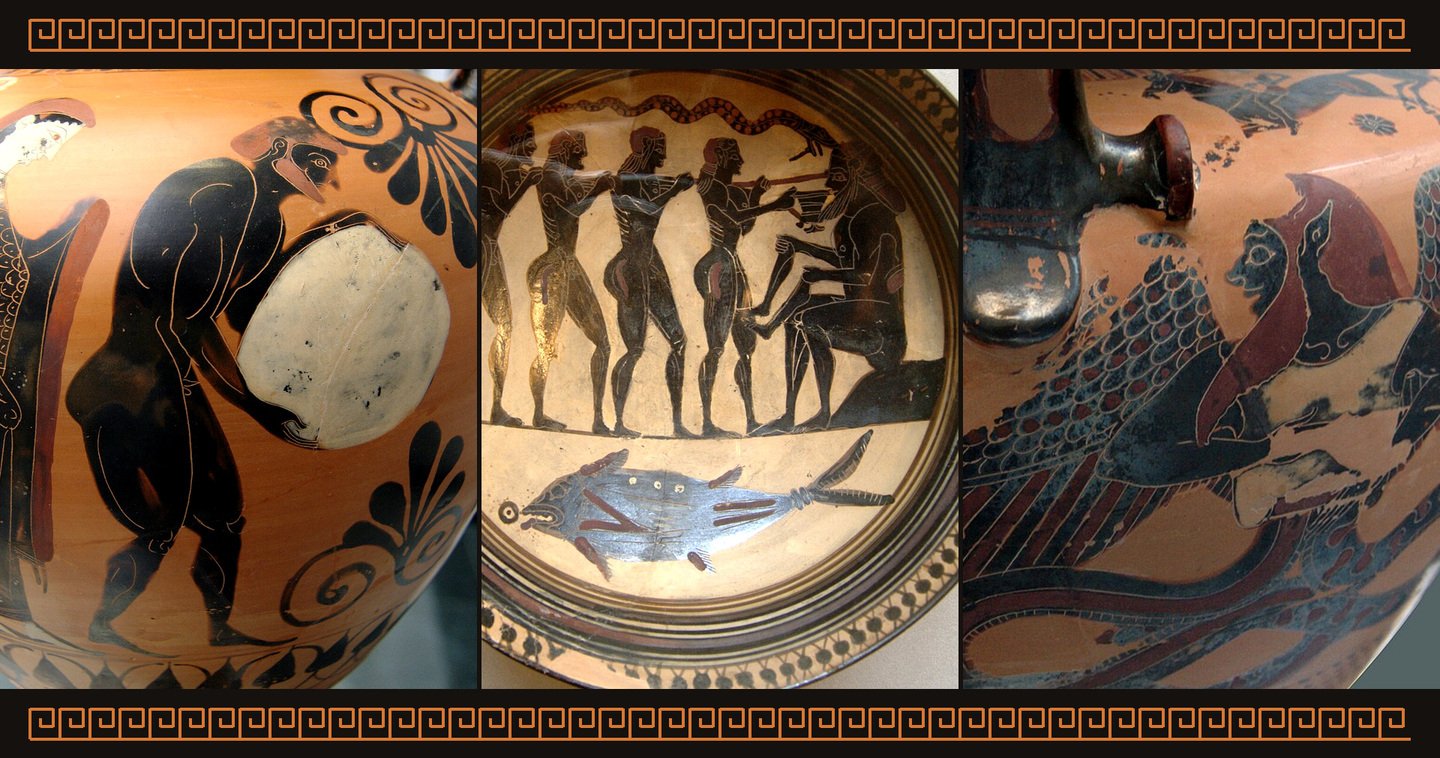
Exekias. Kylix with Dionysus on a ship, interior painting. Circa 540–530 BCE. Munich, State Antikensammlung, Inv. 8729 (2044). Photo: MatthiasKabel / Wikimedia Commons.
The material was selected based on three criteria. First, the subject matter is known from the literary tradition of the Archaic period. Second, it is represented in black-figure technique on single vases or in a short series, based on museum descriptions and the Bizley Archive database records. Third, at least one vase with reliable attribution and high-quality photography has survived. The corpus intentionally extends beyond Attic ware. It includes Laconia, Corinthian, Halkidian, and Cyretan vessels, because rare subjects are often preserved in regional workshops. The Kylix of Exekias presents an extreme case: its scene lacks repetitions, and its subject is still interpreted in various ways.
This study is built on comparison. The introductory section presents three popular schemes and identifies the characteristics of the pictorial formula. Three analytical sections are grouped by the type of action that resists the formula: sorcery and monsters from Odysseus’s journeys, eternal punishment, and death outside of combat. In each section, a rare scene is examined alongside a «doppelgänger» from the same mythological sphere, which easily translates into a silhouette. This juxtaposition reveals that what distinguishes them is not the obscurity of the myth, but the ease of its translation into a silhouette.
Textual sources are divided into three categories. Ancient texts (Homer, Hesiod, Apollodorus) provide the literary version of the myth. Museum catalogs and the Bizley Archive database offer attribution, dating, and descriptions of the vessels. Three key works establish the theoretical framework. E. Panofsky’s three-tiered analysis dictates the order of examining each vase: description, plot identification, and interpretation. L. Giuliani distinguishes between narrative and descriptive imagery. E. Snodgrass describes the «synoptic» mode of narration, where different moments of action are combined within a single scene.
The Formula for Success
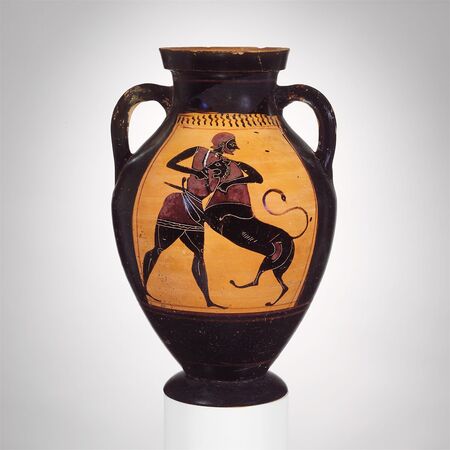
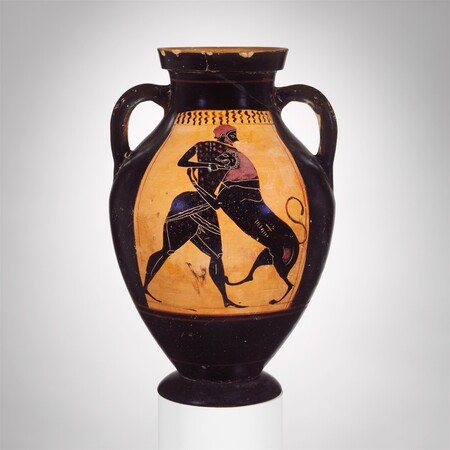
Brussels Group R 243. Amphora with Hercules and the Nemean Lion. c. 540 BCE. New York, The Metropolitan Museum of Art, Accession No. 40.11.20.
The battle between Heracles and the Nemean Lion, depicted on an amphora from the Metropolitan Museum, is repeated on both sides of the vessel. The narrative is reduced to the entanglement of two bodies—human and beast—with both combatants shown as equals in strength. The black silhouette is instantly legible, and the outcome is already known to the viewer. Heracles remains the most sought-after hero in Attic black-figure vase painting.
Excelsior. Amphora with Achilles and Ajax playing. Ok. 540–530 BCE. Vatican, Gregorian Etruscan Museum, inv. 16757. Photo: Jakob Badagard / Wikimedia Commons.
The Amphora of Exekias depicts Achilles and Ajax playing a board game. This scene is absent from any surviving text, yet museum descriptions account for over 150 depictions of it. The list compiled by S. Woodford initially included 115 Attic black-figure vases and was later augmented by twenty more. Two leaning figures, mirrored around a central axis, form a closed, symmetrical composition. The formula can be deduced even without text if the silhouette is found.
Master of Amasis. Amphora with Dionysus and Maenads. Circa 540 BCE. Paris, Cabinet des Médailles, Inv. 222. Photo: Jastrow / Wikimedia Commons.
On the amphora, Master Amasis Dionysus stands before two maenads, one of whom holds a hare. The god’s name is signed, and the potter’s signature stands nearby. There is almost no action here—it is a standing scene that can easily be expanded into a procession by adding figures. Dionysian scenes fill wine vessels and do not require the viewer to know a specific narrative.
Three examples illustrate three characteristics of the formula. The scene is built around a single action conveyed by the contour: a fight, a mirrored pair, or a procession. It is understandable without captions or knowledge of preceding events. It can be reduced to two figures or expanded with spectators without altering its meaning. Rare plots in the following sections violate at least one of these conditions.
Sorcery and Monsters
The Knight Master. Laconic Kylix with the Blinding of Polyphemus. Circa 565–550 BCE. Paris, Cabinet des Médailles, Inv. 190.
The Tondo of Lacoon’s Kikil unites in one frame the entire episode from the ninth song of the Odyssey. Polyphemus sits on a rock holding the legs of a devoured companion. Four men carry a long stake aimed at the giant’s eye, and the nearest of them simultaneously offers him a chalice. A snake is depicted above the scene, and a large fish is beneath it.
Three actions, separated by time within the text, are presented as a single whole. Snodgrass calls this narrative technique synoptic. The master does not select a climax because no single moment makes the plot recognizable: the body, without wine or remains, could signify any retribution. Recognizability is achieved through the accumulation of attributes, not a silhouette.
Unknown Attic Master. Krater with columns: Odysseus and the Ram. c. 525–500 BCE. Los Angeles, Getty Museum, Inv. 96.AE.303.
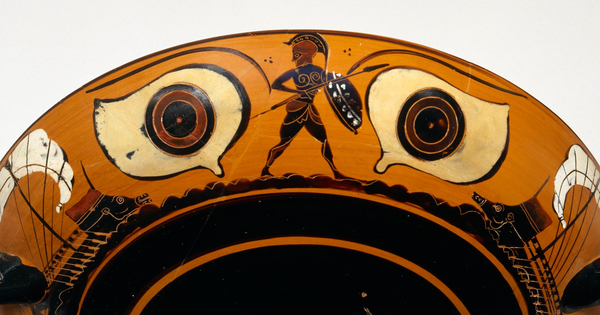
Depictions of blinding appear as early as the 7th century BCE, but they remain rare. The escape from the same cave is depicted differently. At the Getty Museum’s crater, Odysseus is shown tied beneath a ram, the scene positioned between two large eyes. The human and the animal merge into one compact silhouette that requires neither a cave nor a Cyclops. The same myth yields two distinct solutions: one requires accumulating attributes, while the other condenses into a contour.
Master of the Boston Polyphemus. Kilim with Kirk and Odysseus’s companions. Circa 550–525 BCE. Boston, Museum of Fine Arts, inv. 99.518. © Museum of Fine Arts, Boston.
On the Boston kilim, a nude Circe stands in the center, stirring a potion in a bowl. Before her is Odysseus’s companion, with a boar’s head and human hands, and a small dog sits at her feet. Other figures with animal heads and human legs stand around. On the left, Odysseus approaches with a bare sword; on the right, Euryloch flees. Between the figures are inscriptions that do not form words.