This project is a student academic assignment from the HSE Art and Design School or a research project from a faculty member at the HSE Art and Design School. This project is not commercial and serves purely educational purposes.
Concept
Still Image Event
How does a static image convey a change in human perception? The interest in expressive posture, linked to the practice of drawing and animation, translates here into a art-historical question. The core of this study is the moment when students recognize Christ during the supper in Emmaus. The Gospel associates recognition with blessing, breaking, and the sharing of bread [10, Luke 24:30–31]. However, listing these actions does not yet explain how an artist makes their significance visible. The same subject can be presented through outstretched arms, a dark silhouette, or a small scene in the depth of an interior.
I need the Russian text you want me to translate. Please provide it.
The subject of the work is the interaction of light, gesture, and the viewer’s position across nine works from 1601–1654. The main body consists of two Caravaggio paintings, two Rembrandt paintings, and two Rembrandt etchings. Three additional examples do not broaden the scope to a general Baroque overview; rather, each tests a specific hypothesis. Ter Borch allows for a comparison between a dramatic example and its restrained reinterpretation; Velázquez enables an examination of the necessity of a large, centralized depiction of the event; and Storm allows for distinguishing between domestic lighting and luminescence, as well as assessing the role of the servant as an external observer. In all cases, a single subject matter in 17th-century European painting and graphic art is analyzed.
Materials, Methods, and Sources
The selection is based on museum attribution, episode matching, and the availability of reproductions. First, Caravaggio and Rembrandt are considered; then, three control examples are reviewed; final comparisons examine the scale of the gesture, facial visibility, the position of the light source, and the function of secondary figures. The overall composition precedes the fragment: magnification of detail should not obscure its actual place within the composition. Each fragment is chosen for a specific observation; illegible sections are not used as primary evidence.
Museum catalogs serve as sources for dating, technique, and interpretation. Larry Kita’s technical study links the effect of Caravaggio’s light tablecloth to the material construction of the painting [8]. Nadine Orenstein’s essay helps consider etchings as independent solutions and takes into account variations in print tone [7]. Pierre Curie and Isabelle Legenhuck’s material on the restoration of the Louvre’s «Supper» limits conclusions about color: the condition of the varnish affects the visible contrasts [15, p. 66]. The accessible abstract and text from this page were used, rather than the full, unavailable article.
Caravaggio. «The Supper at Emmaus.» 1606. Pinacoteca di Brera, Milan.
Question and Working Hypothesis
Key question: Is recognition necessarily conveyed through a brightly lit face of Christ and a strong movement of the disciples? The working hypothesis is that neither of these features is sufficient on its own. The event becomes legible through the relationships between Christ’s action, the response of those around him, and the viewer’s access to the scene. «Access» refers to the observable composition of the image: figure scale, overlaps, the placement of the table, and the distance of the episode. This allows the hypothesis to be tested using specific details rather than describing impressions with words like «dramatic» or «spiritual.»
The comparison is organized based on the overall narrative and the function of the artistic device. Historical connection and formal similarity differ: the Toledo Museum links the painting by Ter Bruggen with Caravaggio’s «The Supper» in London [12], whereas Rembrandt’s direct encounter with both of Caravaggio’s paintings is not demonstrated here. The coincidence of a gesture or light contrast alone does not serve as proof of borrowing. The hypothesis requires clarification if a subtle action maintains narrative clarity or if the figure of the attendant is a watchful witness. Therefore, additional examples are included for verification, not as illustrations of a pre-established conclusion.
I. Caravaggio: Scope and Restraint
Recognition as a rupture of everyday action
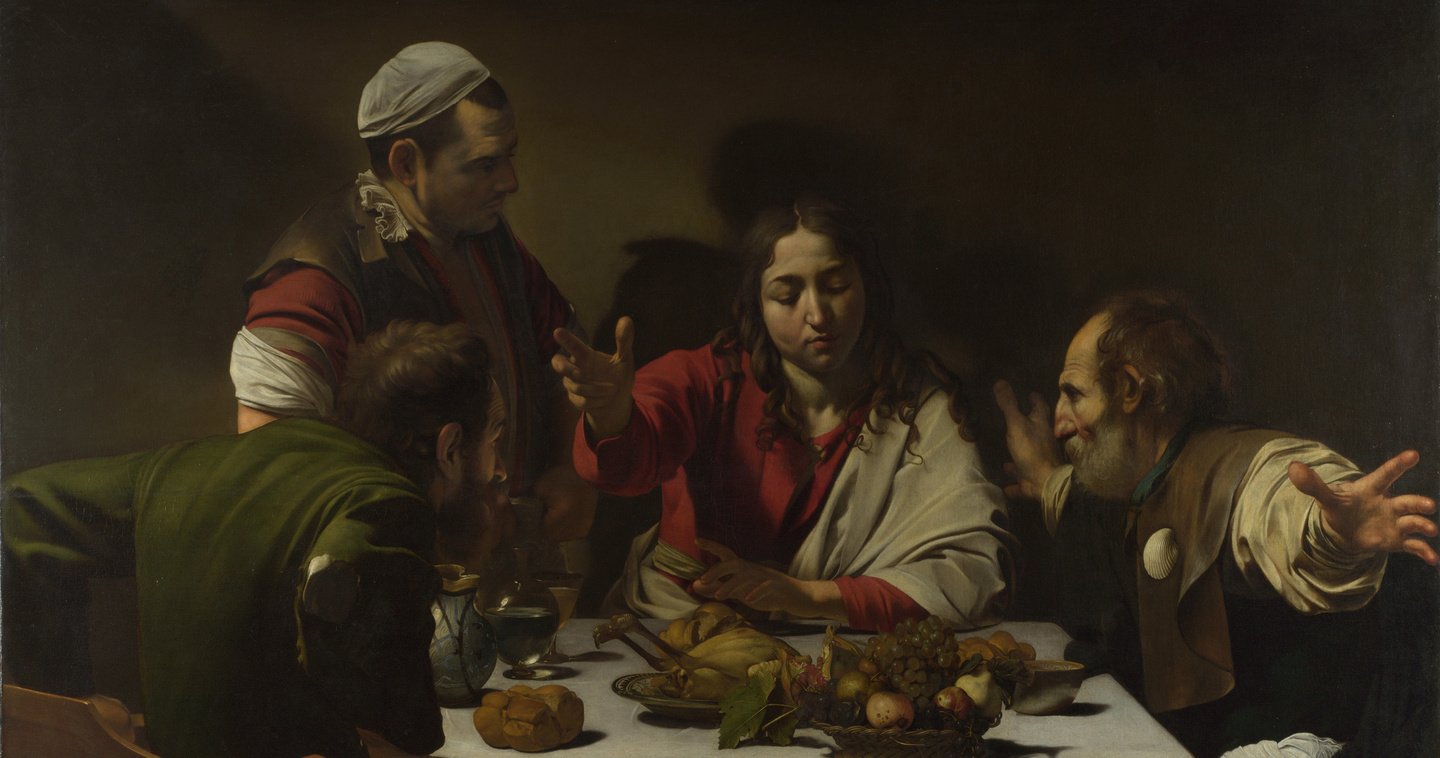
Caravaggio. «The Supper at Emmaus.» 1601. National Gallery, London.
The London version depicts a meal where participants' reactions have already diverged. Two seated students are engaged in sudden movement, while the standing host maintains a more contained posture. This inequality in reactions makes the event distinguishable: the same gesture from Christ elicits different responses. The museum connects the scene’s climax to a sudden realization [1]. Next, we will examine how this difference is organized through visual means.
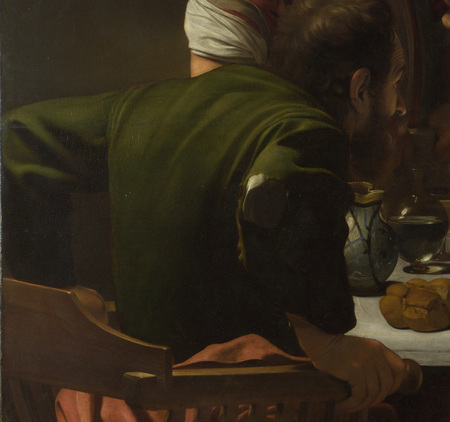
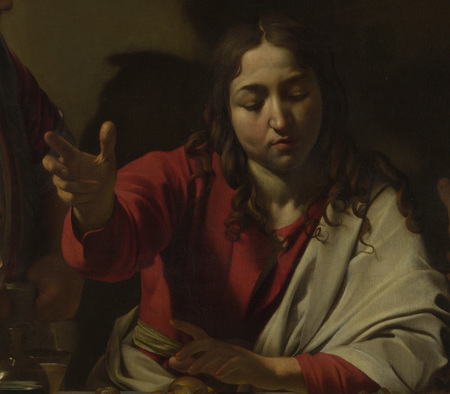
Караваджо. «Ужин в Эммаусе». 1601. Фрагменты. Национальная галерея, Лондон.
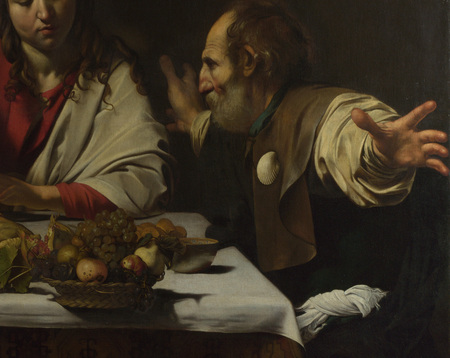
Calm Center
The face of Christ is cast downwards, and the raised hand does not mirror the broad gesture of the student on the right. The red garment sets the central figure apart from the muted tones of the surroundings. Within a single scene, two tempos arise: the restrained action in the center and the rapid reactions at the edges. Therefore, the center of the composition does not coincide with the area of the strongest physical tension.
Turning away from the viewer
The student on the left is shown from the back, and their face barely contributes to conveying the emotion. The meaning of the reaction must be interpreted through the torso, shoulder, and the support of the hand on the chair. The extended elbow connects the foreground with the central action. This example is important for the hypothesis: an emotional shift can be expressed through posture even when facial expression is unavailable.
Exposed Gesture
The student on the right spreads his arms wide. One palm reaches toward the edge of the frame, while the other is directed inward toward the scene. Thanks to the perspective, this gesture simultaneously connects him with Christ and expands the group outward. The spatial amplitude of the arms makes the reaction noticeable before the viewer has time to register his face; the movement becomes the primary carrier of suddenness.
Witness without a reciprocal movement
Caravaggio. «The Supper at Emmaus.» 1601. Fragment. National Gallery, London.
The owner stands next to Christ, but his vertical figure is not incorporated into the students' dynamic gestures. His hands remain at his waist. The crucial point is not the conclusion about his internal state in isolation, but the observable difference in postures: one character is simply present, while the others alter their body positions. It is on this contrast that the museum builds its interpretation of the owner’s non-recognition [1].
The edge of the table as a boundary
Caravaggio. «The Supper at Emmaus.» 1601. Fragment. National Gallery, London.